

Explore 12 ship fire investigations by MAIB and NTSB. Learn how fuel leaks, machinery failures, poor maintenance, delayed detection and weak emergency systems contributed to fires.
Ship fires can begin with a small leak, a failed component, an overlooked hot surface or an unsafe work practice. An investigation often shows that the initiating fault was only one part of the event. Detection, maintenance, fire boundaries, emergency power, fixed extinguishing systems, escape arrangements and shore response all influence how severe the consequences become.
This article reviews twelve instructive ship fire investigations published by the UK Marine Accident Investigation Branch (MAIB) and the US National Transportation Safety Board (NTSB). The cases are selected for the safety lessons they illustrate; they are not a ranking of the world’s worst ship fires. Some involve large commercial vessels, while others concern domestic passenger craft. Their regulations and operating contexts differ, so lessons should be applied with those differences in mind.

How official ship fire investigations are used
A marine safety investigation aims to prevent future casualties by gathering and analysing evidence, identifying causal factors and, where appropriate, making safety recommendations. The IMO Casualty Investigation Code describes this purpose and the expected content of an investigation report. IMO Casualty Investigation Code
The IMO’s Global Integrated Shipping Information System (GISIS) includes the Marine Casualties and Incidents (MCI) module. It provides casualty data and makes submitted marine safety investigation reports and IMO-approved casualty analyses available through its public access arrangements. Some information is restricted to IMO Member States. GISIS is useful for locating casualty records and reports; the investigating authority’s report remains the best source for the evidence, analysis and recommendations in a particular case. IMO: Marine Safety Investigation Reports and GISIS
MARPOL and SOLAS flag States have reporting responsibilities for marine casualties, including the submission of final investigation reports for very serious casualties as set out in the relevant instruments.
1. Conception: fire grows while passengers are asleep
In September 2019, a fire broke out aboard the small passenger vessel Conception off California. Thirty-three passengers and one crewmember died. The NTSB could not determine the fire’s ignition source. Its probable-cause finding focused on the operator’s failure to ensure an effective roving patrol, which allowed the fire near the aft salon to grow undetected. The report also identified the absence of smoke detection throughout accommodation spaces and inadequate escape arrangements from the bunkroom as factors in the loss of life. NTSB investigation report: Conception
Safety lesson: A fire that is not detected quickly can make escape routes unusable before an alarm is raised. Patrols, detection, alarm audibility, independent escape paths and realistic overnight emergency drills must work together.
2. Moritz Schulte: opening a pressurised fuel filter
In August 2020, a fire started in the engine room of the LPG and ethylene carrier Moritz Schulte after a third engineer opened a pressurised auxiliary-engine fuel filter. Marine gas oil sprayed onto a hot exhaust on an adjacent engine. The engineer was overcome by toxic smoke and later died. The MAIB investigated on behalf of the Isle of Man Ship Registry. MAIB investigation report: Moritz Schulte
Safety lesson: Before opening fuel equipment, identify all sources of pressure, isolate them, depressurise the system and verify its safe condition. Work planning and supervision must account for the possibility that fuel under pressure can reach hot surfaces.
3. Arco Avon: repair work beside a failed fuel pipe
A fire in the engine room of the suction dredger Arco Avon claimed the life of its third engineer. The engineer was attempting to repair a failed fuel pipe while fuel remained under pressure; the fuel ignited. MAIB investigation report: Arco Avon
Safety lesson: A leak should not be treated as a routine repair while the system remains energised or pressurised. Stop the relevant machinery, isolate the supply, relieve pressure, confirm isolation and only then assess the repair. Emergency response plans should also address the risks of working alone or in a machinery space during an evolving fire.
4. Pride of Canterbury: hydraulic oil ignites on hot exhaust uptakes
In September 2014, a hydraulic pipe joint in the controllable-pitch propeller system ruptured as Pride of Canterbury approached Calais. Pressurised oil sprayed onto the engine exhaust uptakes and caught fire. Investigators found that a worn back-pressure valve had jammed, allowing pressure in the return line to rise. The valve had not been function-tested during its 23 years of service, and the pipe joints lacked effective spray shields. The ferry berthed safely and the fire was extinguished. MAIB investigation report: Pride of Canterbury
Safety lesson: Pressure-control and relief devices need defined inspection and test intervals. Risk assessment should consider system-wide overpressure, and shielding can prevent a leak from spraying onto hot surfaces.
5. The Calypso: fuel-pipe failure and confusion over CO₂ controls
In May 2006, a fuel-pipe flange failed on a main engine of the passenger cruise ship The Calypso. Fuel sprayed onto the turbocharger or exhaust piping and ignited. The ship lost all but emergency electrical power and drifted in the Dover Strait until it was towed to port. The MAIB also found that an officer trying to operate the fixed CO₂ system mistook timer bottles for pilot cylinders; CO₂ was not released during the initial response. MAIB investigation report: The Calypso
Safety lesson: Fixed extinguishing systems must be clearly labelled, maintained and operated by people who understand their sequence. Training should cover the actual installed arrangement, including pre-use checks and the steps needed to leave the protected space safely.
6. Oscar Wilde: a fixed foam system that could not deliver
In February 2010, a fire broke out in the auxiliary engine room of the ro-ro passenger ferry Oscar Wilde shortly after it left dry dock. The fire began around the auxiliary engines’ fuel supply module and spread through the compartment, causing loss of electrical power. The MAIB found that a regulating-valve diaphragm was made from rubber unsuitable for oil exposure. The high-expansion foam system did not extinguish the fire because corrosion debris blocked its distribution nozzles; the performance of other fire systems was also affected by inadequate maintenance. MAIB investigation report: Oscar Wilde
Safety lesson: Fixed systems must be tested as complete systems, including pipes, nozzles, valves and the supply of extinguishing medium. A system shown on a plan may still fail if its components are blocked or poorly maintained.
7. Stena Europe: known weaknesses left without effective protection
In February 2023, pressurised fuel escaped from a loose main-engine pipe connection on the ro-ro passenger ferry Stena Europe and sprayed onto a hot exhaust pipe. The MAIB found that neither spray shielding nor exhaust insulation provided effective protection. The connection design had already been recognised as a weakness, but recommended modifications had not been completed. Crew inspection training and temperature-monitoring methods also had limitations. MAIB investigation report: Stena Europe
Safety lesson: A known defect or manufacturer recommendation must be tracked through to closure. Fire prevention depends on several barriers: sound connections, spray shields, insulation, effective inspection and a process that ensures modifications are installed.
8. Finnmaster: unapproved hose and failed emergency barriers
In September 2021, an auxiliary-engine failure on the ro-ro cargo ship Finnmaster allowed fuel to escape from a flexible hose and ignite on a hot surface. The hose had been fitted during an unapproved modification and did not meet the required standard. The MAIB also found that a fault in the emergency-generator circuit breaker prevented emergency systems from receiving power, and defects prevented the fixed CO₂ system from fully operating. MAIB investigation report: Finnmaster
Safety lesson: Uncontrolled substitutions and modifications can undermine equipment integrity. Emergency generators and fixed extinguishing systems need testing under realistic conditions, with defects corrected before they are needed in an emergency.
9. Kommandor Susan: overhaul quality becomes a fire-safety issue
In January 2025, a diesel-generator engine suffered catastrophic failure during sea trials aboard the site-investigation vessel Kommandor Susan. The failure caused an engine-room fire and total blackout. The fire was extinguished and the crew mustered safely, but the vessel lost propulsion and drifted. Attempts to deploy anchors failed because the anchor winches required electrical power. The MAIB identified non-genuine engine components installed during an overhaul, extended service intervals based on the assumption that genuine components were used, and insufficient owner oversight of the contractor. MAIB investigation report: Kommandor Susan
Safety lesson: Maintenance assurance includes parts traceability, contractor supervision, approval of substitutions and checking whether extended service intervals remain valid. The case also shows how a fire-induced blackout can disable equipment needed for the vessel’s safety.
10. Caribbean Fantasy: fuel leak during approach and emergency evacuation
In August 2016, a fire began in the main engine room of the ro-ro passenger vessel Caribbean Fantasy when fuel sprayed from a leaking flange and contacted a hot engine surface. The NTSB identified an improper gasket material and a non-standard blanking plate as factors in the leak. The fire could not be contained, and all 511 people aboard were evacuated, with several non-life-threatening injuries. The vessel later drifted aground outside the port. NTSB investigation report: Caribbean Fantasy
Safety lesson: Use specified materials and components in fuel systems, and investigate unexpected changes in leak severity. Emergency planning must include passenger accounting, communications, evacuation and coordination with shore responders.
11. Spirit of Norfolk: delayed detection in an unmanned space
In June 2022, a fire broke out in the engine room of the passenger vessel Spirit of Norfolk. The NTSB found that combustible materials stored near a generator exhaust pipe most likely ignited. The vessel was not required under the applicable exemptions to have engine-room fire detection or fixed gas extinguishing systems. The fire was discovered late, spread throughout the vessel and burned for several days. The crew evacuated 108 people without injury. NTSB investigation findings: Spirit of Norfolk
Safety lesson: Unmanned machinery spaces still need risk-based detection and protection. Safe evacuation is essential, but early detection and a suitable fixed system can limit fire growth and improve the chance of controlling the casualty.
12. Grande Costa D’Avorio: cargo-handling equipment and shore response
In July 2023, a pusher vehicle caught fire on an internal garage deck of the ro-ro/container vessel Grande Costa D’Avorio while used vehicles were being loaded. The NTSB found that the vehicle was not designed for the industrial role in which it was being used; its transmission fluid overheated and ignited on a hot surface. The report also identified a fire-boundary door that could not be safely controlled from outside the space, undermining the fixed gas system’s effectiveness. Two shore firefighters died and others were injured during the response. NTSB investigation report: Grande Costa D’Avorio
Safety lesson: Fire safety on a cargo ship includes the equipment and work practices of contractors and stevedores. Ship and shore teams need clear coordination, suitable cargo-handling equipment, working boundary controls and a shared plan for firefighting in enclosed spaces.
What these investigations have in common
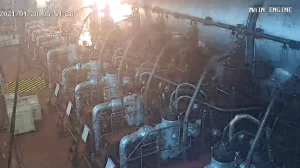
Across very different vessels, the reports reveal recurring conditions that allow a small fire to become a major casualty:
- Pressurised oil or fuel reaches hot surfaces. Loose joints, failed hoses, incorrect fittings and unsuitable materials repeatedly appear in engine-room fires.
- Known defects remain open. Earlier warnings, overdue inspections or manufacturer recommendations have little value unless corrective action is verified.
- Fire systems are not proven in service. Corroded pipework, blocked nozzles, failed circuit breakers, leaking ventilation closures or misunderstood controls can defeat equipment that is nominally installed.
- Detection and isolation determine how much time remains. Fires in unmanned spaces or accommodation areas may grow beyond effective response before anyone sees them.
- Training and procedures must match real equipment. Crew should know how to respond to high-temperature alarms, isolate fuel, operate fixed systems and account for people during evacuation.
- Ship and shore response are connected. Cargo fires may involve shore workers and responders unfamiliar with a vessel’s layout, access points, ventilation and fire boundaries.
These are also core themes in SOLAS chapter II-2, which addresses prevention, detection, containment, extinction, escape, maintenance, onboard training and fire safety in vehicle and ro-ro spaces. The precise requirements depend on vessel type, construction date, flag and applicable rules. IMO: SOLAS chapter II-2 fire-safety summary
Practical fire-prevention checks for ship operators and engineers
Investigation findings can be translated into routine controls:
- Inspect fuel and oil pipes, joints, flexible hoses, supports and spray shields for leaks, chafing, vibration damage and incorrect fit.
- Check hot-surface insulation and identify exposed surfaces near fuel or oil systems; use suitable methods to find local hot spots.
- Review alarms and operating instructions for abnormal temperatures, pressure changes, leaks and engine shutdown decisions.
- Control modifications and replacement parts through technical approval, traceability and verification against manufacturer requirements.
- Test emergency generators, fire pumps, alarms, ventilation closures, fixed systems and remote controls in accordance with approved procedures.
- Confirm that fixed extinguishing-system pipes and nozzles remain clear and that crews understand release, evacuation and post-release checks.
- Keep machinery spaces, galleys, accommodation spaces and vehicle decks clear of unnecessary combustibles.
- Conduct drills that include detection, alarm, communication, isolation, firefighting, passenger accounting and evacuation.
- Coordinate with contractors and shore teams before cargo work, hot work or maintenance begins.
- Record defects, assign responsibility and verify closure rather than relying only on a work order being raised.
Frequently asked questions
What is the most common cause of ship fires?
There is no single cause across all ship types. In the cases reviewed here, several engine-room fires began when leaking fuel or oil contacted hot machinery or exhaust surfaces. Other fires involved combustible materials, open-flame equipment or cargo-handling operations.
Why do engine-room fires spread quickly?
Machinery spaces contain fuel and lubricating oil systems, hot surfaces, electrical equipment and ventilation that can supply oxygen or move smoke. If detection is delayed or the space cannot be sealed effectively, fire and smoke can spread and may disable propulsion and electrical systems.
Does GISIS contain every marine accident investigation report?
No. GISIS contains casualty information and reports submitted to IMO, but IMO notes that some information is available only to Member States. Public users can access materials released for public access; availability depends on the submitted record and its release status. IMO GISIS report access information
Where should readers find the full findings?
Use the investigating authority’s complete final report linked in each case. The summaries here are intended for learning and do not replace the full report’s evidence, limitations, causal analysis or recommendations.
Conclusion
Ship fire investigations show that ignition is often only the beginning of the causal chain. Component condition, maintenance quality, early detection, fire containment, emergency power, crew competence and ship–shore coordination shape the outcome. Reviewing official reports through MAIB, NTSB and IMO GISIS helps turn individual casualties into practical lessons for safer ships.
Fire Hazards and Safety on Different Types of Ships: A Comprehensive Guide
References and official investigation reports
- IMO, Marine Safety Investigation Reports and GISIS
- IMO, Casualties and GISIS MCI module
- IMO, Casualty Investigation Code, resolution MSC.255(84)
- IMO, SOLAS chapter II-2 fire-safety summary
- MAIB, Moritz Schulte
- MAIB, Arco Avon
- MAIB, Pride of Canterbury
- MAIB, The Calypso
- MAIB, Oscar Wilde
- MAIB, Stena Europe
- MAIB, Finnmaster
- MAIB, Kommandor Susan
- NTSB, Conception
- NTSB, Caribbean Fantasy
- NTSB, Spirit of Norfolk
- NTSB, Grande Costa D’Avorio