
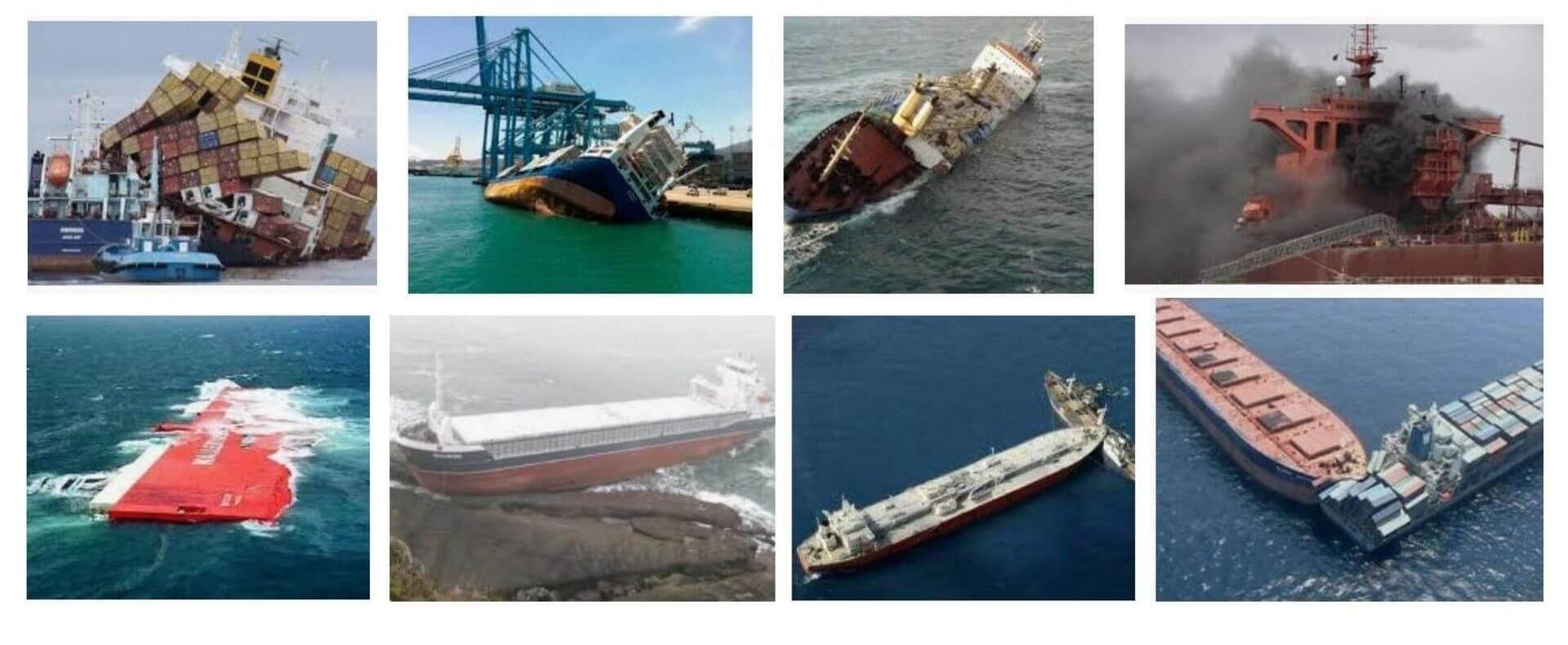
Explore 12 official abandon ship investigations. Learn how distress calls, muster, lifeboats, liferafts, passenger escape and crew training affect survival at sea.
An order to abandon ship is among the hardest decisions a master faces. A fire, flood, collision or grounding may leave little time, while wind, list, smoke or loss of power can make the planned embarkation station unusable. Survival depends on how early people are warned, whether everyone can reach safety equipment, and whether the crew can launch and board it.
This fifth article in the maritime casualty investigation series examines twelve published reports in which people had to leave a vessel, or attempted to do so. It focuses on evacuation and survival rather than repeating the full technical causes covered in the fire, collision and flooding articles. The cases are selected for their teaching value, rather than ranked by vessel size or fatalities.
What is the difference between an emergency and an abandon-ship order?
An emergency alarm brings people to their assigned duties or muster stations. It does not always mean that everyone must immediately enter survival craft. The master may still be directing firefighting, controlling flooding or arranging a transfer to another vessel. Preparation for abandonment should begin while safe options remain.
The IMO’s summary of SOLAS chapter III covers communications, lifesaving appliances, muster lists, survival craft, launching arrangements, training and maintenance for ships to which its provisions apply. Requirements vary by vessel and trade. imo.org
1. British Trent: a lifeboat route blocked by fire
After a collision with bulk carrier Western Winner near Belgium in June 1993, cargo escaping from tanker British Trent caught fire. Pilot launches took off seven crew members. Others expected to leave in the starboard lifeboat, but flames and smoke enveloped that side. They jumped into the sea among patches of burning cargo. Pilot launches rescued twenty people from the water; nine crew members died from smoke inhalation. Read the MAIB investigation. GOV.UK
Abandonment lesson: Fire can block the designated lifeboat or embarkation side. Muster plans and drills should account for inaccessible routes and the need to move people away from smoke, heat and burning cargo.
2. Argos Georgia: delayed distress and a difficult evacuation
The longline fishing vessel Argos Georgia foundered east of the Falkland Islands in July 2024; 13 of the 27 people aboard died. The MAIB found that a line-hauling hatch opened unexpectedly, allowing rapid flooding and loss of stability.
Its 2026 report identified an unstructured emergency response and delays in declaring distress and abandoning ship. Poor evacuation control, extreme conditions and liferaft damage increased cold-water exposure and loss of life. Read the MAIB investigation. GOV.UK
Abandonment lesson: Declare distress and prepare survival craft while flooding is still being assessed. In a remote area, the time outside rescuers need to reach the ship is part of the decision.
3. Conception: crew escape while passengers remained trapped
Fire spread through the small passenger vessel Conception at anchor off California in September 2019. Five crew members sleeping on an upper deck escaped into the water. They attempted to reach the people below, but fire and smoke blocked access. Thirty-three passengers and one crew member sleeping in a bunkroom died.
The NTSB found that ineffective company oversight, the absence of a required roving patrol and inadequate smoke detection allowed the fire to grow unnoticed. Both bunkroom exits led into a compartment engulfed in fire. Read the NTSB investigation. ntsb.gov
Abandonment lesson: Passenger evacuation depends on early detection and viable escape routes. A second exit offers limited protection if both routes lead into the same fire-affected space.
4. Queen of the North: evacuation and an uncertain passenger count
The Canadian ferry Queen of the North struck Gil Island and sank in March 2006. Passengers and crew left the vessel, but two passengers were unaccounted for and later declared dead.
The TSB found that no accurate head count had been taken before abandonment, preventing a focused search for the missing people at that stage. Its investigation also raised concerns about passenger information and realistic crew exercises for evacuation. Read the TSB investigation. www.tsb.gc.ca
Abandonment lesson: Know who is aboard, where passengers have mustered and who has entered each survival craft. Continue accounting through rescue and transfer ashore.
5. Irving Forest: leaving a badly listed ship in a storm
In January 1990, cargo vessel Irving Forest developed a severe list in a North Atlantic storm after water entered ballast tanks. It then suffered a blackout and lost propulsion.
Three people were washed overboard during preparations to abandon. An aircraft dropped rescue equipment, including inflatable liferafts, and the three reached one. The remaining crew left by jumping into the sea while attached to their launched liferaft’s painter. The ship subsequently sank. Read the MAIB investigation. GOV.UK
Abandonment lesson: A heavy list and extreme seas can make ordinary launching and boarding impossible. Prepare personal protection, communications and survival craft before the ship’s condition removes options.
6. Alaska Ranger: propulsion moves liferafts out of reach
The fish-processing vessel Alaska Ranger sank in the Bering Sea in March 2008; five of the 47 people aboard died. The NTSB found progressive flooding through a hull breach likely associated with rudder loss.
After electrical power failed, its controllable-pitch propellers moved towards astern pitch while the engines continued running. The vessel moved backwards, likely accelerating flooding and causing liferafts to swing beyond the reach of many crew members. Read the NTSB investigation. ntsb.gov
Abandonment lesson: Understand how propulsion behaves after a blackout or loss of hydraulic pressure. A launch position that works on a stationary ship may become unusable if the ship moves.
7. La Relève II: passengers evacuated despite liferaft problems
In August 2014, a fire developed in the engine compartment of Canadian sightseeing vessel La Relève II. Its 33 passengers entered liferafts and were transferred to responding vessels; one passenger sustained a minor injury. The crew extinguished the fire.
The TSB found problems with liferaft inflation, delayed communication to passengers and unclear crew duties and embarkation arrangements. The evacuation succeeded with a partial passenger complement, but the investigation warned that a faster fire or a full complement could have produced a different outcome. Read the TSB investigation. Transportation Safety Board of Canada
Abandonment lesson: Give passengers clear instructions early. Assign crew to launch, guide and count, and verify that survival craft can be deployed from the intended stations.
8. Piedras: one liferaft fails during abandonment
The stern trawler Piedras capsized and sank south-west of Ireland in June 2022 following engine-room flooding. The skipper ordered abandonment, but one of two liferafts failed to function correctly. The second was launched, and all eleven crew members were rescued without injury.
The MAIB identified shortcomings in flood planning, watertight integrity, the accessibility of safety information to a multinational crew, and possible liferaft-servicing deficiencies. Read the MAIB investigation. GOV.UK
Abandonment lesson: Liferaft servicing and launch readiness are as important as carrying enough nominal capacity. Crew should practise what to do if one craft fails.
9. Venessa S: new-crew familiarisation supports a safe escape
Fishing vessel Venessa S lost propulsion near Cabbage Tree Island, Australia, in June 2017, grounded and later foundered. Its six crew abandoned into a powered tender, maintained contact with rescuers and were all saved.
The ATSB found that a pre-departure safety induction for two new crew members almost certainly helped the orderly abandonment in darkness. The vessel’s liferaft inflated automatically as it sank and was retrieved as an additional survival resource. Read the ATSB investigation. ATSB
Abandonment lesson: Familiarise every new crew member with lifesaving equipment and duties before sailing. A briefed crew can act effectively even when a casualty develops quickly.
10. Rosebank: a cargo-ship fire ends in helicopter evacuation
General cargo vessel Rosebank suffered an accommodation fire off Northumberland in December 2001. A rescue helicopter airlifted the crew from the ship.
The MAIB considered an electrical failure in a domestic refrigerator or freezer the most probable origin. It found that bridge-to-fire-party communication was hampered when available handheld VHF sets were not used, and that inadequate boundary cooling and monitoring allowed the fire to spread. Read the MAIB investigation. GOV.UK
Abandonment lesson: Keep the bridge, response teams and rescue services informed as conditions change. Evacuation planning depends on knowing where everyone is and which routes remain accessible.
11. Bella: flotation devices and a familiar liferaft
The small survey workboat Bella flooded and sank near Lynmouth, England, in July 2021. Its crew entered a liferaft and were rescued uninjured by a local boat owner.
The MAIB found that a survey gantry reduced the boat’s forward freeboard and made swamping more likely. It also identified shortcomings in certification and operational risk management. The crew’s use of personal flotation devices and familiarity with lifesaving equipment supported a safe, orderly abandonment. Read the MAIB investigation. GOV.UK
Abandonment lesson: Wearing suitable flotation and knowing how to deploy a liferaft can be decisive on a small vessel where the time from flooding to sinking is short.
12. Jig Strike: seventeen people into a liferaft
In August 2024, charter fishing vessel Jig Strike began taking on water about 100 nautical miles west of San Diego. Five crew and twelve passengers abandoned into a liferaft and were rescued by a nearby vessel. Jig Strike sank, but there were no injuries.
In its completed investigation, the NTSB considered initial delamination of the fiberglass hull sheathing the likely cause of a large hull separation. Read the NTSB investigation. ntsb.gov
Abandonment lesson: Passenger operations need usable survival capacity, clear direction and a way to summon help. Practise moving everyone into a raft under time pressure.
What do the investigations show?
| Failure or defence | Cases illustrating it |
|---|---|
| Escape path or intended station becomes unusable | British Trent, Conception, Irving Forest |
| Distress is declared too late | Argos Georgia |
| Passenger instructions or accounting are weak | Queen of the North, La Relève II |
| Survival craft do not work as expected | La Relève II, Piedras |
| Machinery or vessel movement complicates boarding | Alaska Ranger, Venessa S |
| Induction, flotation or equipment familiarity helps | Venessa S, Bella, Jig Strike |
| Communications affect the response | Rosebank, Argos Georgia |
These themes concern the abandonment phase; the initiating casualty differed in each case. SOLAS chapter III addresses survival-craft readiness, stowage, launching and training for vessels to which its provisions apply. imo.org
A practical abandon-ship readiness sequence
- Raise the alarm and assess. Muster and account for everyone, identify the casualty, and protect escape routes while fire or flooding response continues.
- Call for help early. Transmit a distress alert when the vessel is in grave and imminent danger. Give its position, the nature of distress and the number of people aboard.
- Prepare while options remain. Assign stations, provide suitable lifejackets or immersion protection, ready survival craft and review alternative embarkation routes.
- Keep a passenger count. Give plain instructions, check cabins where safe and record the number entering each craft.
- Check actual conditions. List, fire, smoke, sea state and vessel movement may prevent the planned launch. Use the practicable alternative under the master’s direction.
- Launch and board safely. Check that the craft is clear and manage the transfer in an orderly way. Avoid entering the water unless circumstances leave no safer route.
- Maintain survival communications. Bring the equipment specified in the ship’s plan and account for everyone again after transfer or rescue.
The IMO’s GMDSS guidance for ships in distress addresses distress alerts and taking portable VHF, SART and, where possible, EPIRB equipment into survival craft. The sequence above is a teaching aid; the vessel’s procedures and actual conditions govern the response. wwwcdn.imo.org
Frequently asked questions
Does sounding the general emergency alarm mean abandon ship?
No. It brings people to their emergency duties and muster arrangements. The abandon-ship instruction is a further decision made under the vessel’s procedures.
Should a crew wait until the vessel is sinking to prepare liferafts?
No. The Argos Georgia and Irving Forest investigations show how quickly conditions can remove access to launch stations. Preparation can proceed while the crew continues damage control.
What if one liferaft cannot inflate or launch?
Crew must use their trained alternative arrangements, including another survival craft or an assisted transfer where available. Piedras and La Relève II show why the stated capacity of lifesaving equipment does not by itself guarantee a usable evacuation.
Why is passenger accounting important?
Rescuers need reliable numbers to know who remains missing and where to search. The Queen of the North investigation found that the lack of an accurate count hindered a focused search.
Where can readers find the full reports?
Each case above links to an investigating authority. The IMO’s GISIS Marine Casualties and Incidents module also provides access to submitted reports made public through an IMO web account. imo.org
Conclusion
Abandoning ship is a controlled transfer of people through a rapidly changing environment. These investigations show that alarms, communications, accessible exits, workable survival craft, trained crew and accurate head counts all matter. Those safeguards must be prepared through maintenance, induction and drills before the emergency occurs.