
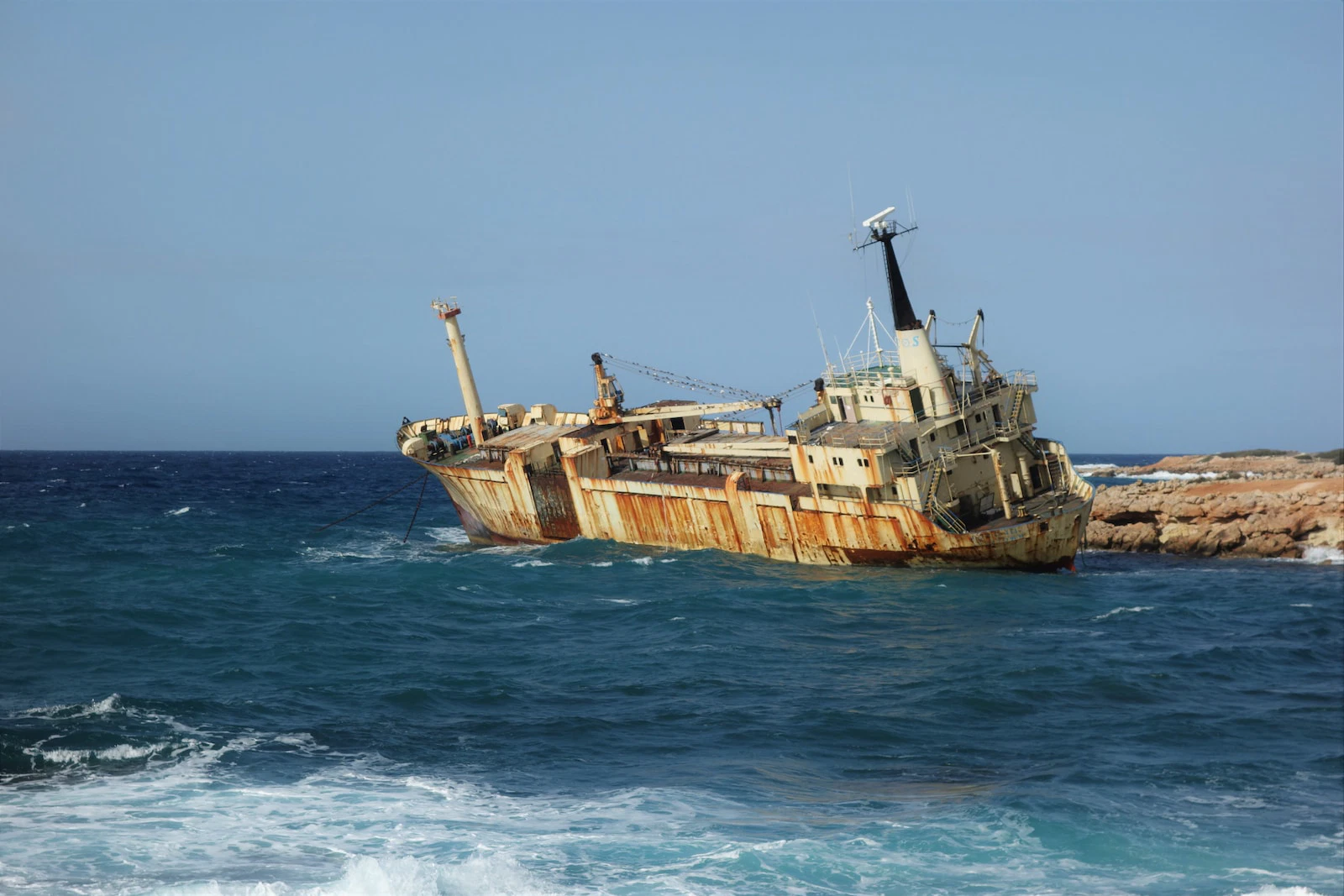
Study 12 official ship blackout and loss-of-propulsion investigations, from Viking Sky to Dali, with practical lessons for engineers, officers and cadets.
“Dead ship” is an operational expression for a vessel unable to manoeuvre after losing propulsion, steering power or electrical supply. It is not a precise accident category. A stopped main engine may leave electrical power available, while a blackout can disable several systems at once. That distinction shapes both the immediate response and the investigation.
These 12 investigations show how machinery failures become navigational emergencies. The cases include groundings, contact with shore facilities, a near grounding and recoveries made possible by timely assistance. They are selected for their different lessons, rather than ranked by fatalities or cost.
1. Moondance: Generator cooling failure, blackout and grounding (2008)
While manoeuvring in Warrenpoint Harbour, Moondance suffered high cooling-water temperatures in both generators and then a total blackout. Loss of hydraulic power caused its controllable-pitch propellers to default to full astern. The vessel moved astern and grounded.
The UK Marine Accident Investigation Branch (MAIB) found that an isolating valve in the generator seawater-cooling supply had been left shut or partly open. The emergency generator had been left in manual mode and did not start automatically. The report also identified shortcomings in communication and emergency coordination. Read the MAIB investigation. gov.uk
Safety lesson: Check the cooling-system line-up and emergency-generator readiness before manoeuvring. Bridge and engine teams must understand how the propeller will respond if hydraulic power fails.
2. Norwegian Star: Loss of both propulsion pods (2017)
Norwegian Star was sailing with one Azipod propulsion unit under repair when its remaining unit failed in Bass Strait. The cruise ship drifted with more than 3,000 passengers and crew aboard before tugs brought it back to Melbourne.
The Australian Transport Safety Bureau (ATSB) examined three propulsion-unit failures over several weeks. Electrical insulation breakdown was involved in the earlier exciter failures; the final failure was associated with a modification made during repair of the remaining unit. Read the ATSB investigation. atsb.gov.au
Safety lesson: When propulsion redundancy has already been lost, the condition of the remaining unit and the quality of its repairs become critical voyage-planning considerations.
3. Orient Centaur: Main-engine cooling failure in a narrow channel (2017)
The fully laden bulk carrier Orient Centaur lost main-engine propulsion while departing Weipa, Australia, and grounded on both sides of a narrow channel. A cracked cylinder cooling jacket allowed jacket water to escape, leading to the shutdown.
The ATSB also found a gap in the port’s contingency assessment for the larger vessel: it considered engine failure before entry into the channel but did not sufficiently address failure farther along the transit. Read the ATSB investigation. ATSB
Safety lesson: Maintain cooling-system integrity and plan for propulsion failure throughout a constrained transit, including sections where there is little room to recover.
4. Bulk India: Generator overheating and failure of emergency power (2018)
Bulk India blacked out while departing Dampier, losing propulsion and steering before grounding. The ATSB found that a malfunctioning cooling-water temperature controller caused auxiliary generator engines to overheat and shut down.
Machinery problems had appeared about 13 minutes before the blackout, but the pilots were not informed. The emergency generator started and then stopped because its radiator fan belt failed; a request for a replacement belt had remained unresolved. Read the ATSB investigation. ATSB
Safety lesson: Tell the bridge and pilot about developing machinery problems immediately. Emergency-power checks should establish that the generator can sustain its required load.
5. Viking Sky: Blackout in heavy seas (2019)
The cruise ship Viking Sky lost power, propulsion and steering near the Norwegian coast in severe weather, with 1,374 people aboard. It came close to grounding.
The Norwegian Safety Investigation Authority found that lubricating-oil levels in the operating diesel generators’ sump tanks were insufficient for the ship’s pitching and rolling, leading to shutdowns. The ATSB, which assisted the investigation, recorded that 39 minutes passed before both propulsion motors were available with enough power for 1–5 knots ahead. Read the Norwegian investigation and the ATSB summary. nsia.no
Safety lesson: Check generator oil levels against manufacturer guidance and expected vessel motion. Practise recovery from a full blackout under realistic conditions.
6. APL England: Heavy rolling and temporary propulsion loss (2020)
APL England rolled heavily off New South Wales, lost 50 containers and temporarily lost main-engine propulsion. The ATSB found that vessel motion exceeded the main-engine machinery’s dynamic design limits. A lubricating-oil pump briefly lost suction, causing a low-pressure engine shutdown.
The investigation also identified severely corroded container-securing arrangements. The engine shutdown was a consequence of the heavy rolling, not the reported cause of the container loss. Read the ATSB investigation. ATSB
Safety lesson: Connect adverse-weather navigation decisions with engine-room preparation, including the machinery’s motion limits and permitted oil-sump operating conditions.
7. Dali: Electrical failure and bridge contact (2024)
The container ship Dali lost electrical power, propulsion and steering while leaving Baltimore. It struck the Francis Scott Key Bridge, which collapsed; six highway workers died.
The US National Transportation Safety Board (NTSB) traced the initiating blackout to a loose signal-wire connection at a terminal block associated with improperly installed wire-label banding. The investigation also examined the bridge’s vulnerability and communication with workers. Read the NTSB investigation. ntsb.gov
Safety lesson: A small control-wiring defect can have consequences across the ship. Inspect and test electrical work carefully, especially before transiting waters with little room to manoeuvre.
8. Algoma Discovery: Unresolved generator fault and repeat propulsion loss (2024)
The bulk carrier Algoma Discovery lost electrical power and propulsion while docking in Wisconsin and contacted a loading facility. The NTSB found that an earlier malfunction of an online generator’s automatic voltage regulator had not been adequately evaluated and repaired.
After the power loss, low control-air pressure contributed to another loss of propulsion during the manoeuvre. Read the NTSB investigation. ntsb.gov
Safety lesson: Resolve a known generating-system fault before relying on that equipment in restricted waters. Verify a repair under a load representative of manoeuvring.
9. Heemskerkgracht: False oil-mist alarm and grounding (2024)
Heemskerkgracht grounded in Canada’s South Shore Canal after its main engine shut down automatically. The Transportation Safety Board of Canada found that a replacement oil-mist detector measuring head needed a separate power supply for its anti-condensation heater. The heater had been left unpowered.
Water vapour accumulated, triggered a false oil-mist alarm and caused the detector to shut down the engine. Read the TSB investigation. Transportation Safety Board of Canada
Safety lesson: When replacing a protective sensor, verify its supporting power supplies and features as well as its alarm function.
10. Al Messilah: Pneumatic reversing-control failure (2025)
The livestock carrier Al Messilah experienced two main-engine failures while entering Fremantle. Tugs assisted the vessel to berth safely.
The ATSB identified a malfunction involving the servo piston in the main air distributor. Degraded seals most likely allowed control-air leakage that disrupted the engine’s reversing mechanism. The investigation also found shortcomings in how maintenance of these critical components was recorded and scheduled, and examined difficulties contacting vessel traffic services during the emergency. Read the ATSB investigation. atsb.gov.au
Safety lesson: Include pneumatic manoeuvring components and their seals in traceable maintenance. Confirm emergency communication arrangements before pilotage.
11. Gaschem Homer: Generator modes and bow-thruster demand (2025)
Gaschem Homer blacked out while turning out of the Port of Brisbane, losing propulsion and steering. The ATSB found that two of its three generators had inadvertently been left in manual rather than automatic mode. The sole generator available to respond to bow-thruster demand overloaded and tripped.
Power returned after about two minutes, while an assisting tug helped keep the gas carrier in the channel. Read the ATSB investigation. ATSB
Safety lesson: Before a high-demand manoeuvre, verify generator operating modes, available capacity and the expected bow-thruster load.
12. FMG Nicola: False low-oil-pressure shutdown (2025)
The fully laden bulk carrier FMG Nicola lost main-engine propulsion while departing Port Hedland. Pilots and tugs kept it clear of danger as engineers restored the engine.
The ATSB found that an independent low-lubricating-oil-pressure shutdown switch had operated erroneously despite normal system parameters. It found no evidence that the vessel grounded. Read the ATSB investigation. ATSB
Safety lesson: Protective sensors can fail, but their alarms must be treated seriously. Compare independent indications and follow vessel-specific diagnostic and restart procedures.
Common failure paths
| Failure path | Cases | Operational defence |
|---|---|---|
| Generator cooling or lubrication failure | Moondance, Bulk India, Viking Sky | Verify cooling line-up, oil levels, alarms and emergency-generation readiness. |
| Electrical defect or incorrect generator configuration | Dali, Algoma Discovery, Gaschem Homer | Inspect wiring, test repairs and confirm generator modes and capacity. |
| Main-engine cooling or control fault | Orient Centaur, Al Messilah | Maintain cooling and pneumatic controls; plan for engine failure during pilotage. |
| Protective shutdown triggered by a faulty detector or switch | Heemskerkgracht, FMG Nicola | Maintain complete sensor assemblies and assess alarms against independent indications. |
| Reduced redundancy or extreme vessel motion | Norwegian Star, APL England | Reassess voyage risk and apply machinery operating limits. |
A technical failure explains how control was lost. The outcome also depends on the ship’s position and speed, available sea room, communication, tug assistance and the time needed to restore control.
A response framework for bridge and engine teams
Before manoeuvring: Confirm the number and operating mode of online and standby generators. Check essential cooling, lubrication, control air and emergency-power readiness. Tell the bridge and pilot about unresolved limitations.
When power or propulsion is lost: Identify and communicate which systems have failed: electrical supply, main engine, steering, pitch control or a combination. Update the bridge as the estimated restoration time changes. Bridge personnel manage the vessel’s remaining way and navigational options while engineers diagnose the fault.
During recovery: Understand a protective trip before resetting it. Restore essential auxiliaries and stable generation in the ship’s prescribed sequence. Confirm the location and direction of propulsion control with the bridge before applying power.
Afterward: Preserve alarm and event records. Record defects, verify temporary repairs and consider whether the same failure could affect similar equipment elsewhere in the fleet.
Frequently asked questions
Does a stopped main engine always mean a blackout?
No. Orient Centaur and FMG Nicola lost main-engine propulsion, while Dali and Gaschem Homer suffered electrical blackouts that affected propulsion. The response depends on which systems remain available.
Will an emergency generator restore propulsion?
That depends on the vessel’s design. An emergency generator supplies designated emergency services; it should not be assumed to power the main propulsion plant. The ship’s electrical drawings and procedures identify its actual loads.
Can a false alarm shut down an operating engine?
Yes. The investigations into Heemskerkgracht and FMG Nicola show how faulty detection or switching can initiate a shutdown. A suspected false alarm still requires careful diagnosis; it is not, by itself, a reason to defeat machinery protection.
Where can readers find official casualty reports?
Each case above links to its investigating authority. The International Maritime Organization’s casualty information page also describes its GISIS Marine Casualties and Incidents module and published analyses. www.imo.org
Conclusion
Loss of manoeuvring ability can begin with a cooling valve, a generator setting, a control wire or a faulty sensor. These investigations show the value of reliable auxiliaries, tested standby systems, complete maintenance records and prompt communication between the engine room, bridge, pilots and tugs. Recovery drills should reflect the dependencies and time pressure of the actual ship.
Editorial note: The case facts and attributed findings are summarized from the linked official investigations. The safety lessons are educational interpretations, not quotations from investigators or universal operating instructions.