
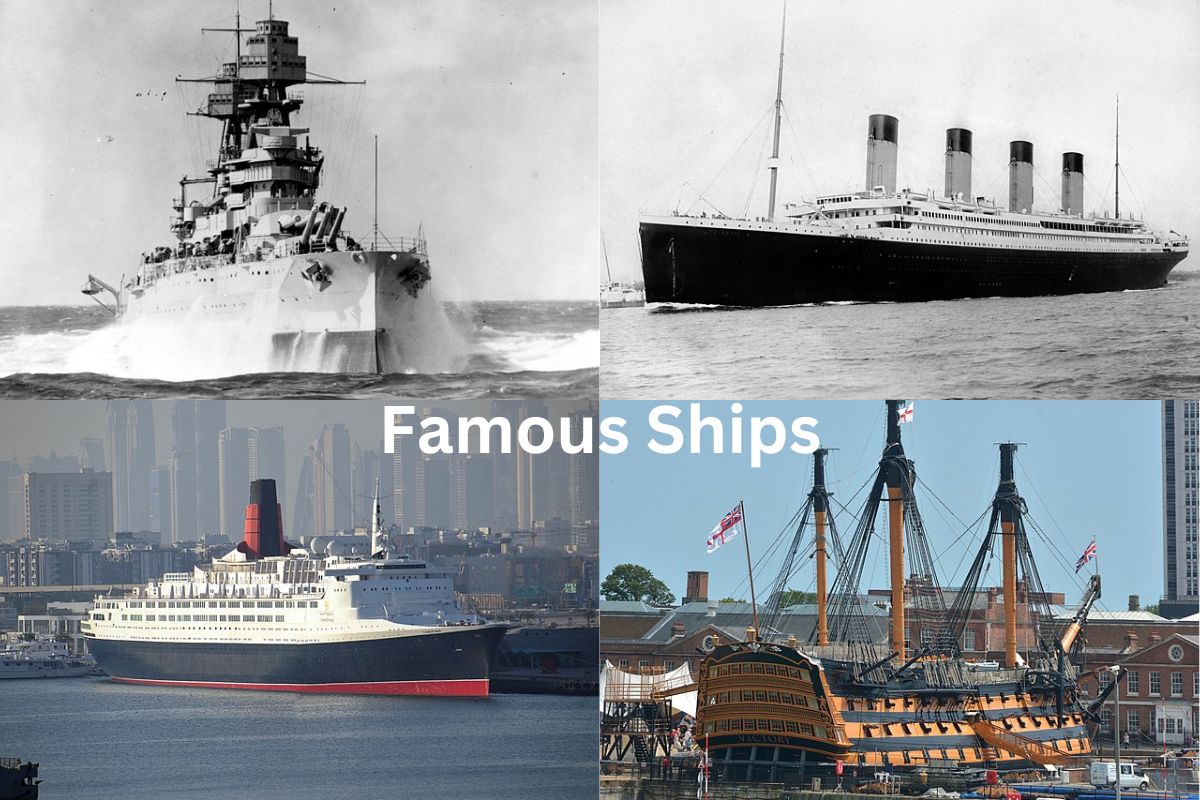
Some ships become famous because they win battles or cross unknown oceans. Others are remembered because they sink—and expose failures that the world can no longer ignore. A rare few survive long enough to become floating museums, allowing modern visitors to walk through the physical spaces where history unfolded.
These 12 famous ships in history span more than four centuries of exploration, migration, science, trade, warfare and passenger travel. They were not necessarily the largest or most technologically advanced vessels of their time. Their importance comes from what happened aboard them, what followed in their wake and how their stories continue to shape maritime culture.
Quick Answer
The most famous ships in history include RMS Titanic, Santa María, HMS Victory, Mayflower, USS Constitution, HMS Beagle, Cutty Sark, Bismarck, USS Enterprise (CV-6), Mary Rose, RMS Queen Mary and Golden Hind. Together, they influenced maritime safety, exploration, science, migration, naval warfare, global trade and public memory.
| Ship | Era | Best known for | Lasting significance |
|---|---|---|---|
| RMS Titanic | 1912 | Sinking on maiden voyage | Accelerated international safety reform |
| Santa María | 1492 | Columbus’s flagship | Symbol of Atlantic contact and colonisation |
| HMS Victory | 1765–present | Battle of Trafalgar | Enduring Royal Navy heritage |
| Mayflower | 1620 | Voyage to New England | Central—and contested—US founding story |
| USS Constitution | 1797–present | War of 1812 victories | Oldest commissioned warship afloat |
| HMS Beagle | 1831–1836 voyage | Darwin’s scientific journey | Helped shape evolutionary thought |
| Cutty Sark | 1869–present | Tea and wool trades | Preserved peak of commercial sail |
| Bismarck | 1940–1941 | Atlantic sortie and sinking | Power and vulnerability of battleships |
| USS Enterprise (CV-6) | 1938–1947 | Pacific War service | Most decorated US warship of WWII |
| Mary Rose | 1511–1545 | Tudor warship and recovery | Maritime-archaeology time capsule |
| RMS Queen Mary | 1936–1967 | Luxury liner and troopship | Icon of the Atlantic liner age |
| Golden Hind | 1577–1580 voyage | Drake’s circumnavigation | Exploration, privateering and empire |
What Makes a Ship Historically Famous?
A famous ship is more than a recognisable name. It usually stands at the centre of a wider turning point: a safety disaster, a decisive battle, a scientific breakthrough, a migration story or a change in global trade.
Historical reputation also evolves. Earlier accounts often celebrated conquest and exploration without giving sufficient attention to Indigenous peoples, enslaved people, ordinary sailors or the human consequences of empire. A trustworthy maritime history should explain both the achievement and its cost.
1. RMS Titanic: The Ship That Changed Maritime Safety
RMS Titanic left Southampton on 10 April 1912 for her maiden voyage to New York. The White Star liner was celebrated for her scale, luxury and engineering, but she struck an iceberg late on 14 April and sank in the early hours of 15 April. More than 1,500 people died.
The disaster became a lasting study in risk management. The ship carried lifeboat capacity that complied with outdated rules but was insufficient for everyone aboard. Investigations also examined speed in ice, wireless communications, lookout arrangements and emergency preparation.
The most important legacy was regulatory. The first International Convention for the Safety of Life at Sea was adopted in 1914 in response to the disaster. Modern SOLAS has been revised many times, but it remains the principal international treaty governing merchant-ship safety. Titanic therefore matters not only as a wreck, but as a painful catalyst for safer navigation, lifesaving appliances, radio watchkeeping and emergency procedures.
Did you know? The Titanic tragedy helped establish practices that seafarers now take for granted, including stronger international rules for lifeboats, distress communications and ice monitoring.
Internal link suggestion: How the Titanic Disaster Changed SOLAS and Modern Ship Safety
2. Santa María: Columbus’s Famous Flagship
Santa María was the flagship of Christopher Columbus’s 1492 expedition across the Atlantic, sailing with the smaller Niña and Pinta. Although frequently called a caravel, historians usually describe the larger flagship as a nao, a broad-beamed Iberian sailing ship related to the carrack tradition.
The vessel did not return to Spain. It ran aground off Hispaniola around Christmas 1492 and could not be refloated. Timber from the wreck was used to build a small settlement known as La Navidad.
Its fame requires careful context. The voyage created sustained contact between Europe and the Americas, transforming navigation, trade, politics and world history. It also opened the way to conquest, forced labour, disease and catastrophic disruption for Indigenous societies. Santa María is therefore both an icon of oceanic navigation and a symbol of the beginning of European colonial expansion in the Americas.
Because no verified wreck has been conclusively identified and reliable plans do not survive, modern replicas are interpretations rather than exact copies.
[Suggested Image: Map of the 1492 Atlantic voyage showing Palos, the Canary Islands, the Caribbean landfall and the loss of Santa María off Hispaniola]
Alt text: Route of Santa María and Columbus’s first Atlantic voyage in 1492
Internal link suggestion: Niña, Pinta and Santa María: Ships, Navigation and Life at Sea in 1492
3. HMS Victory: Nelson’s Legendary Warship
HMS Victory was laid down in 1759 and launched in 1765 as a 104-gun first-rate ship of the line. Her defining moment came on 21 October 1805, when she served as Vice-Admiral Horatio Nelson’s flagship at the Battle of Trafalgar.
The British victory over the combined French and Spanish fleets prevented Napoleon from challenging Britain at sea. Nelson was fatally wounded during the battle, giving the ship an enduring association with command, sacrifice and national memory.
Today, Victory remains a commissioned Royal Navy warship and the flagship of the First Sea Lord. Preserved at Portsmouth Historic Dockyard, she is undergoing a major, long-term conservation programme. Her surviving structure demonstrates how an eighteenth-century fighting ship combined timber construction, sail power, heavy artillery and the labour of a very large crew within a confined and dangerous environment.
Internal link suggestion: Life Below Deck on an Eighteenth-Century Ship of the Line
4. Mayflower: The Ship That Shaped American History
In 1620, Mayflower carried 102 passengers from England to New England. After a difficult 66-day Atlantic crossing, the ship reached Cape Cod rather than the intended area near the Hudson River. Most adult male passengers signed the agreement now known as the Mayflower Compact before the community established itself at Plymouth.
The ship became central to the traditional story of the United States, particularly ideas about religious migration, self-government and settlement. Yet the familiar heroic version is incomplete. The passengers arrived in Wampanoag homelands, where complex Indigenous communities had existed for thousands of years. Early diplomacy and assistance were vital to the settlers’ survival, while later colonial expansion brought dispossession, conflict and profound harm to Native peoples.
The original ship’s final fate is uncertain. Visitors can instead explore Mayflower II, a full-scale reproduction maintained by Plimoth Patuxet Museums. The replica helps people understand just how crowded, wet and uncomfortable the crossing would have been.
Internal link suggestion: The Mayflower Voyage: Navigation, Living Conditions and the Wampanoag Context
5. USS Constitution: America’s Old Ironsides
USS Constitution was launched in Boston on 21 October 1797 as one of the United States Navy’s original six frigates. Designer Joshua Humphreys gave the ship a strong hull and a combination of speed and heavy armament intended to outfight smaller frigates while escaping more powerful ships of the line.
During the War of 1812, British cannon shot was reported to have bounced from her thick oak sides during the fight with HMS Guerriere. The episode helped create the nickname “Old Ironsides.” Her victories strengthened the reputation of the young US Navy.
The ship survived proposed disposal, aided by public support and Oliver Wendell Holmes’s famous poem. Based in Boston, she remains the world’s oldest commissioned warship afloat. Unlike a static replica, Constitution is a living naval command and an unusually direct connection between the sailing navy and the modern service.
Did you know? HMS Victory is older and remains commissioned, but USS Constitution is recognised as the oldest commissioned warship still afloat.
6. HMS Beagle: The Ship Behind Darwin’s Voyage
HMS Beagle was a Royal Navy survey vessel, not a purpose-built scientific research ship. On her second voyage, from 1831 to 1836, Captain Robert FitzRoy led hydrographic survey work while the young Charles Darwin joined as a gentleman naturalist.
Darwin observed geology, fossils, animals, plants and human societies across South America, the Galápagos and other regions. The specimens and notes he gathered did not instantly produce the theory of evolution by natural selection, but they supplied critical evidence and questions that shaped his later work.
The voyage also illustrates how maritime surveying supported imperial navigation. Accurate coastal charts improved safety and scientific knowledge, while also serving commerce and state power. Beagle‘s fame lies at the intersection of seamanship, hydrography, natural history and the development of modern biology.
The ship was later employed in coastguard service and eventually broken up; no preserved hull survives.
[Suggested Image: Illustrated world map of HMS Beagle’s 1831–1836 voyage with key scientific observation sites]
Alt text: HMS Beagle voyage route and Charles Darwin’s scientific observations
Internal link suggestion: How Hydrographic Survey Ships Changed Navigation and Science
7. Cutty Sark: The Iconic Tea Clipper
Launched at Dumbarton, Scotland, in 1869, Cutty Sark was built for the China tea trade. Her composite construction—iron framing with wooden planking—combined strength with a fine hull form and a vast spread of sail.
Her tea-trading career was relatively short. The Suez Canal opened in the same month she was launched, favouring steamships that could use the shorter route reliably. Sailing vessels remained dependent on wind and generally had to travel around Africa.
Cutty Sark found greater success carrying Australian wool. Under Captain Richard Woodget, she completed the Sydney-to-London passage in a record 73 days in 1886. Her story captures a pivotal transition: the commercial sailing ship operating at its peak just as steam power was taking control of global shipping.
Preserved at Greenwich, London, Cutty Sark is one of the world’s most recognisable historic merchant ships and an important source for studying crew life, cargo trades and nineteenth-century ship technology.
Internal link suggestion: From Sail to Steam: Why Clipper Ships Disappeared
8. Bismarck: Germany’s Most Feared Battleship
Commissioned in August 1940, the German battleship Bismarck combined heavy armour, eight 380 mm main guns and high speed. Her reputation was sealed during a single operational sortie into the Atlantic in May 1941.
In the Battle of the Denmark Strait, Bismarck and the cruiser Prinz Eugen engaged HMS Hood and HMS Prince of Wales. Hood exploded and sank with the loss of more than 1,400 crew, leaving only three survivors. Britain then committed major forces to finding the German battleship.
Aircraft from HMS Ark Royal damaged Bismarck‘s steering, allowing British warships to catch her. After intense gunfire and torpedo attacks, the battleship sank on 27 May 1941. Debate continues over the relative roles of British damage and German scuttling, but the operational result is clear.
Bismarck became a symbol of battleship power—and vulnerability. Air power, reconnaissance, radio intelligence, fuel constraints and fleet coordination mattered as much as gun calibre and armour.
Internal link suggestion: How the Royal Navy Hunted and Sank Bismarck
9. USS Enterprise: The Legendary Aircraft Carrier
Several US Navy ships have carried the name Enterprise. The historic carrier meant here is USS Enterprise (CV-6), the Yorktown-class ship nicknamed the “Big E,” not the later nuclear-powered CVN-65.
Commissioned in 1938, CV-6 fought across the Pacific War. Her aircraft played a central role at Midway in June 1942, sinking or helping to sink three Japanese carriers and a cruiser. The ship also participated in the Guadalcanal campaign, the battles of the Eastern Solomons and Santa Cruz Islands, the Philippine Sea, Leyte Gulf and later operations against Japan.
The Naval History and Heritage Command describes Enterprise as the most decorated US warship of the Second World War, with 20 battle stars as well as major unit awards. Damaged repeatedly but returned to combat, she became a powerful symbol of the US Navy’s carrier-centred war.
Despite preservation efforts, CV-6 was scrapped after the war. Her name and legacy continued through later vessels, including the world’s first nuclear-powered aircraft carrier.
[Suggested Image: USS Enterprise CV-6 launching aircraft in the Pacific with an inset identifying the flight deck, island and arresting gear]
Alt text: USS Enterprise CV-6 aircraft carrier during the Second World War
10. Mary Rose: Henry VIII’s Lost Warship
Built in 1510–1511, Mary Rose served Henry VIII’s navy for 34 years. She sank in the Solent on 19 July 1545 while engaging a French invasion fleet. Henry VIII reportedly witnessed the disaster from nearby Southsea Castle.
The precise cause remains uncertain. Evidence and contemporary accounts have supported several explanations, including instability, overloading, water entering open gunports during a turn, wind conditions and operational error. It is safer to describe the sinking as unresolved than to repeat one theory as fact.
The surviving starboard portion of the wreck was rediscovered in the twentieth century, excavated and raised on 11 October 1982. The project required divers, archaeologists, engineers and conservation scientists working together on an exceptional scale.
Thousands of objects—from weapons and tools to clothing, musical instruments and personal possessions—make Mary Rose a Tudor time capsule. The wreck reveals not only a king’s warship, but also the health, skills, diet and daily lives of ordinary people at sea.
Internal link suggestion: Why Did Mary Rose Sink? Evidence, Theories and Archaeology
11. RMS Queen Mary: The Ocean Liner of Luxury
RMS Queen Mary entered transatlantic service in 1936. Built for Cunard-White Star, the immense liner combined high-speed steam-turbine propulsion with Art Deco interiors and the social hierarchy of three passenger classes. She soon captured the Blue Riband for a record Atlantic crossing.
The Second World War transformed the luxury liner into a troopship. Painted grey and nicknamed the “Grey Ghost,” she carried Allied personnel at speeds that made her difficult for submarines to intercept. After the war, she returned to passenger service, but long-distance air travel eventually displaced the traditional ocean-liner business.
Retired in 1967, Queen Mary is permanently moored at Long Beach, California, where she operates as a hotel, visitor attraction and event venue. She preserves the scale and atmosphere of the great North Atlantic liners better than almost any other surviving ship.
Internal link suggestion: Ocean Liner vs Cruise Ship: What Is the Difference?
12. Golden Hind: Drake’s Famous Circumnavigation Ship
In 1577, Francis Drake departed England with a small fleet on an expedition that combined exploration, commerce and state-supported privateering against Spanish interests. His flagship began the voyage as Pelican and was renamed Golden Hind during the expedition.
When the ship returned in 1580, Drake and his surviving crew had completed the second circumnavigation of the globe and the first led by an English commander. The voyage brought enormous wealth to England and demonstrated the strategic possibilities of long-distance ocean navigation.
The achievement cannot be separated from violence and empire. Drake raided Spanish ships and settlements, and his broader career included participation in early English slave-trading voyages. Calling him simply an explorer leaves out essential historical context.
Queen Elizabeth I knighted Drake aboard Golden Hind in 1581. The original ship was later displayed at Deptford but did not survive; modern replicas keep its distinctive image alive.
How These Historic Ships Changed the Maritime World
These vessels left different kinds of legacies:
- Safety: Titanic exposed regulatory and operational weaknesses that demanded international action.
- Navigation and science: Santa María, HMS Beagle and Golden Hind connected ocean voyaging with exploration, surveying and imperial expansion.
- Migration and national identity: Mayflower became part of a national founding narrative, although the story must include Wampanoag history and colonial consequences.
- Naval strategy: HMS Victory, USS Constitution, Bismarck and USS Enterprise represent the evolution from wooden battle fleets to carrier air power.
- Trade and passenger travel: Cutty Sark and RMS Queen Mary embody two high points in commercial shipping before new technologies changed their markets.
- Maritime archaeology: Mary Rose demonstrates how a wreck can preserve evidence about technology and everyday human life that written records overlook.
[Suggested Image: Horizontal timeline placing all 12 ships from 1492 to 1941, colour-coded by exploration, warfare, trade, migration, science and safety]
Alt text: Timeline of 12 famous ships in maritime history
Frequently Asked Questions
What is the most famous ship in history?
RMS Titanic is probably the world’s most widely recognised historic ship. Its maiden-voyage sinking, enormous loss of life, later wreck discovery and influence on maritime safety have kept it prominent in education, research and popular culture. The answer can vary by country: HMS Victory, Mayflower and USS Constitution, for example, carry especially strong national significance.
Which famous historic ships can still be visited?
Visitors can explore HMS Victory in Portsmouth, USS Constitution in Boston, Cutty Sark in Greenwich, Mary Rose at Portsmouth Historic Dockyard and RMS Queen Mary in Long Beach. Mayflower II is a full-scale reproduction at Plymouth, Massachusetts. Access and conservation arrangements can change, so check each museum’s official website before travelling.
What is the oldest ship on this list?
By original construction date, Santa María is the earliest vessel on the list, sailing in 1492, but the original did not survive. Among surviving original hulls, Mary Rose dates from 1510–1511. HMS Victory, launched in 1765, is the oldest commissioned warship, while USS Constitution, launched in 1797, is the oldest commissioned warship afloat.
Why is USS Enterprise considered legendary?
USS Enterprise (CV-6) fought in many of the Pacific War’s most important carrier battles and earned 20 battle stars, making her the most decorated US warship of the Second World War. Her aircraft played a decisive role at Midway, and the ship repeatedly returned to operations after suffering damage.
Did Titanic directly create SOLAS?
The disaster was the decisive catalyst for the first SOLAS Convention, adopted in 1914. It did not create every modern provision in one step: SOLAS evolved through later conventions and amendments. Nevertheless, the direct historical link between Titanic and international merchant-ship safety regulation is formally recognised by the International Maritime Organization.
Are replicas historically accurate?
Replicas can offer valuable insight into space, rigging, handling and life aboard historic ships, but their accuracy depends on the surviving evidence. When original plans and archaeological remains are incomplete—as with Santa María and Golden Hind—builders must make informed interpretations. A replica should therefore be understood as an educational reconstruction, not an exact replacement for the lost vessel.
Conclusion
The most famous ships in history are remembered because their stories extend far beyond their hulls. They changed safety rules, carried people between continents, supported scientific discovery, transformed naval warfare and revealed both the ambition and the violence of maritime expansion.
Taken together, these 12 vessels show that maritime history is not only about ships. It is about the people who designed, sailed, fought, travelled and died aboard them—and the societies that were changed by their voyages.
Explore more maritime history, ship technology and professional educational resources from MaritimEducation.
About the Authors
MaritimEducation Team
The MaritimEducation Team develops professional, educational, and informative content covering maritime education and training, shipping, marine engineering, ship technology, maritime safety, ports, oceans, and developments shaping the global maritime industry.
References
- International Maritime Organization. International Convention for the Safety of Life at Sea (SOLAS), 1974.
- US National Oceanic and Atmospheric Administration. R.M.S. Titanic: History and Significance.
- Royal Navy. HMS Victory and Trafalgar Day.
- Royal Navy. HMS Victory: construction, conservation and the Big Repair.
- Plimoth Patuxet Museums. Mayflower and Mayflower Compact.
- Plimoth Patuxet Museums. Who Were the Pilgrims?.
- US Naval History and Heritage Command. USS Constitution Fact Sheet.
- Natural History Museum, London. Bird Skin Collections: Voyage of HMS Beagle (1831–1836).
- Royal Museums Greenwich. Cutty Sark History.
- Imperial War Museums. How the Royal Navy Tracked and Sank the Bismarck.
- US Naval History and Heritage Command. USS Enterprise (CV-6): The Big E.
- Mary Rose Trust. The Life of the Mary Rose.
- Mary Rose Trust. Raising the Mary Rose.
- The Queen Mary. Timeline, Statistics and Historical Facts.
- Royal Museums Greenwich. Francis Drake’s Circumnavigation.
- Royal Museums Greenwich. Sir Francis Drake: Facts and Historical Context.