
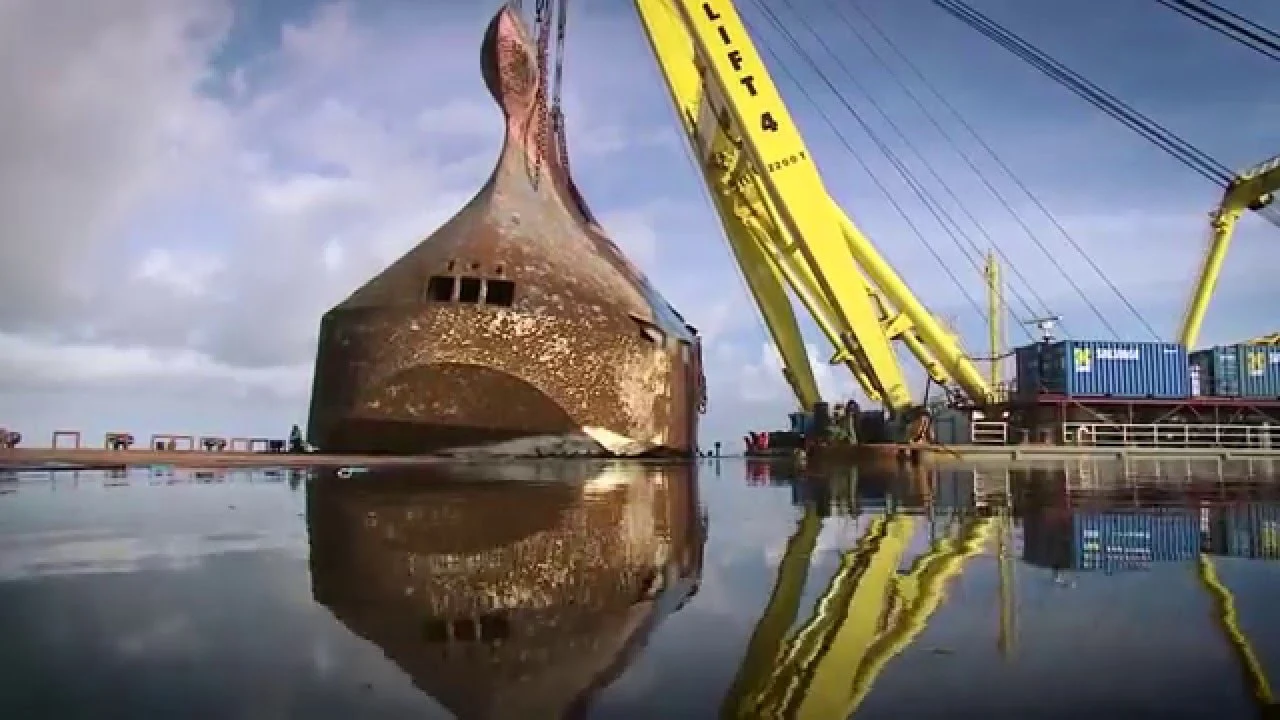
After the car carrier Baltic Ace sank in the North Sea in December 2012, its wreck threatened shipping and the marine environment. This article explains how salvors removed fuel, cut the 148-metre wreck underwater and lifted it from the seabed in eight major sections.
When the car carrier Baltic Ace sank in the North Sea on 5 December 2012, it left behind more than a tragic maritime casualty.
The 148-metre ship came to rest on its side in approximately 35 metres of water, close to a heavily used route serving the Port of Rotterdam. Its cargo included 1,417 vehicles, while fuel, lubricants, batteries and automotive fluids created a long-term environmental concern.
Removing the wreck required much more than attaching lifting cables and raising the vessel. The structure was severely damaged, partly embedded in the seabed and too weak to recover intact.
The solution combined fuel removal, underwater drilling, a specially engineered cutting wire, motion-compensated barges, powerful floating cranes and controlled recycling ashore.
Quick answer: Salvors first pumped approximately 460,000 litres of fuel oil from the wreck. They then passed an abrasive cutting wire beneath the hull, divided the ship into eight major sections and lifted the sections onto barges. Smaller wreckage and vehicles were recovered with a heavy wreck grab.
Baltic Ace: Key Facts
| Item | Verified information |
|---|---|
| Vessel | Baltic Ace |
| Vessel type | Purpose-built vehicle carrier |
| IMO number | 9386213 |
| Flag | Bahamas |
| Length overall | 147.93 metres |
| Gross tonnage | 23,498 GT |
| Collision date | 5 December 2012 |
| Collision time | Approximately 18:15 UTC |
| Other vessel | Corvus J, a Cyprus-registered feeder containership |
| Location | Noordhinder Junction area, southern North Sea |
| Cargo | 1,417 vehicles |
| People aboard | 24 crew members |
| Survivors | 13 |
| Lives lost | 11 |
| Wreck depth | Approximately 35 metres |
| Salvage client | Rijkswaterstaat |
| Main contractors | Boskalis/SMIT Salvage and Mammoet Salvage |
| Fuel-removal phase | 2014 |
| Wreck cutting and lifting | 2015 |
| Completion | September 2015 |
What Happened to the Baltic Ace?
On 5 December 2012, Baltic Ace was sailing from Zeebrugge, Belgium, to Kotka, Finland. It had loaded 1,417 vehicles before departure.
At the same time, the feeder containership Corvus J was approaching the southern North Sea from Grangemouth, Scotland, bound for Antwerp.
The vessels encountered each other in the Noordhinder Junction area. This is a precautionary area where several traffic flows meet near the ends of traffic-separation schemes.
At approximately 18:15 UTC, the two ships collided. The impact caused a catastrophic breach in the side of Baltic Ace, allowing seawater to enter its large vehicle decks.
The Bahamas Maritime Authority concluded that neither vessel took appropriate collision-avoidance action despite detecting the risk in advance. Ambiguous VHF communication and actions that did not follow the intended COLREGs passing arrangement contributed to the developing emergency. Bahamas Maritime Authority investigation
Why did the ship sink so quickly?
A pure car and truck carrier has large enclosed cargo decks extending across much of its breadth and length. These open vehicle spaces are essential for loading and moving cars but can allow floodwater to spread over a wide area after serious hull damage.
Water entering a broad vehicle deck produces a large free-surface effect. As the water moves from side to side, it reduces the ship’s effective stability.
Following the collision, Baltic Ace developed a severe list and sank within about 15 minutes.
The ship’s rapid deterioration left little time for an organised abandonment. Thirteen of the 24 crew members were rescued. The final investigation recorded eight recovered fatalities and three crew members missing and presumed dead.
The loss of 11 seafarers must remain central to any account of the wreck and its removal.
Why Did the Baltic Ace Wreck Have to Be Removed?
Not every shipwreck is recovered. Some are left on the seabed when they are sufficiently deep, stable and environmentally manageable.
The position and condition of Baltic Ace made complete removal necessary.
1. Hazard to navigation
The wreck lay in approximately 35 metres of water, but its highest point was only around 10–12 metres below the surface.
This was a serious concern for deep-draught shipping. About 16,000 ships were reported to use the nearby route toward Rotterdam each year at the time of the operation.
A collision with the wreck could have caused another major casualty, pollution incident or closure of an important shipping route.
2. Fuel and lubricant pollution
The vessel was reported to contain approximately 540,000 litres of potential pollutants, including heavy fuel oil and lubricants.
A steel wreck continues to corrode. Damage from currents, storms or passing equipment can also open tanks that initially remain intact. Fuel could therefore escape gradually or through a sudden structural failure.
3. Pollution from the vehicle cargo
The 1,417 cars created additional environmental concerns. Their fuel, engine oil, coolant, brake fluid and batteries could release contaminants as the vehicles deteriorated.
Loose cars and broken ship sections could also spread across the seabed during storms or structural collapse.
4. Long-term structural deterioration
The wreck was already seriously damaged. Continued exposure to seawater, wave-induced pressure and tidal currents would weaken it further.
Leaving it in place could make a later removal more dangerous, technically difficult and expensive.
–
Who Removed the Baltic Ace?
Rijkswaterstaat—the executive agency of the Dutch Ministry of Infrastructure and Water Management—awarded the complete wreck-removal contract to a partnership involving Boskalis, its SMIT Salvage business and Mammoet Salvage.
The project was divided into two principal offshore seasons:
- 2014: Remove fuel and other major pollutants and conduct detailed investigations.
- 2015: Cut, lift, transport and dismantle the wreck and its cargo.
The work therefore did not begin in 2015, as sometimes reported. Offshore execution started in April 2014 with the fuel-removal phase. The underwater cutting and heavy-lift campaign followed in 2015. Boskalis project record
Phase One: Surveying and Stabilising the Wreck
Before cutting or lifting could begin, engineers needed an accurate picture of the wreck’s condition.
Inspection work examined:
- The wreck’s position and orientation
- Hull deformation and collision damage
- Location and condition of fuel tanks
- Structural strength of the decks and bottom
- Seabed penetration and sediment
- Potential cutting routes
- Loose vehicles and wreckage
- Safe access for divers and equipment
- Tidal currents, weather and underwater visibility
The inspections revealed that the upper structure was more extensively damaged than initially expected.
The upper decks of a car carrier are relatively light structures compared with the double bottom and lower hull. After the sinking, the weakened upper decks could not provide reliable lifting points for recovering large sections.
The salvage team consequently revised its original plan. The main lower-hull sections would be lifted separately, while damaged upper structures, loose vehicles and smaller debris would be recovered with a wreck grab.
Salvage lesson: A wreck-removal plan must remain adaptable. Survey information gathered after a contract begins may reveal damage that could not be identified from surface observations or preliminary data.
Phase Two: Removing the Fuel Oil
Fuel removal was the first major physical operation because cutting the wreck while significant oil remained inside would have increased the pollution risk.
What is hot tapping?
The salvors used a technique known as hot tapping. Despite its name, this does not mean burning or welding directly into a fuel tank.
In a controlled hot-tapping operation:
- Divers identify and prepare an access point on the tank.
- A sealed valve and drilling arrangement are fitted to the tank boundary.
- The tank is penetrated through the sealed system.
- Hoses are connected without leaving a large opening exposed to the sea.
- Fuel is heated where necessary and pumped to a receiving vessel or barge.
The method allows liquid to be removed while maintaining control over the opening.
Why did the oil have to be heated?
Heavy fuel oil becomes highly viscous at low temperature. In cold North Sea conditions, it may be too thick to pump efficiently.
The salvage team inserted heating units into the bunker tanks. Steam from a plant installed on a barge warmed the oil sufficiently to make it flow.
Boskalis reported that approximately 460 cubic metres—460,000 litres—of fuel oil were pumped from the wreck. The main pumping operation took about 36 hours once the required temperature had been reached.
The tanks were then flushed several times with heated water to remove sticky residues. Boskalis account of the salvage operation
Environmental safeguards during fuel removal
Pollution prevention measures included:
- Sealed tank-entry systems
- Controlled pumping and receiving tanks
- Monitoring for leakage
- Heating equipment operated from a barge
- Tank flushing
- Emergency spill-response resources
- Weather and current monitoring
- Inspection of tanks after pumping
Removing the accessible fuel before cutting greatly reduced the environmental consequences of the next phase.
Why Could the Wreck Not Be Lifted in One Piece?
Lifting an intact shipwreck sounds simpler than cutting it apart, but it was not a safe option for Baltic Ace.
Several factors worked against a single lift:
- The collision had caused extensive structural damage.
- The ship had capsized and was lying on its side.
- Upper vehicle decks were weakened and distorted.
- Parts of the wreck contained sediment, vehicles and trapped water.
- The total submerged and out-of-water loads were difficult to distribute safely.
- The structure could break apart during lifting.
- A complete lift would require enormous crane capacity and suitable lifting points.
A steel ship is designed to be supported by distributed buoyancy along its hull. A wreck suspended from a few lifting points experiences a completely different load pattern.
Cutting the hull into calculated sections allowed the salvors to control individual lifting weights and use the stronger lower structure more effectively.
Phase Three: Passing the Cutting Wire Beneath the Wreck
The most striking part of the project was the underwater cutting system.
The salvors needed to pass a long abrasive wire underneath the hull. Because the vessel lay on the seabed, the wire could not simply be dropped around it.
Mammoet developed a horizontal drilling arrangement that created a route beneath the wreck. Once the bore reached the other side, the cutting wire could be drawn through and connected between the working barges.
This was a demanding subsea operation. The route had to:
- Pass beneath the intended cut position
- Avoid excessive deviation
- Remain accessible at both ends
- Accommodate the long cutting wire
- Work within the surrounding seabed material
- Support safe tensioning between the barges
After the wire was in position, the cutting system was prepared above the wreck.
How Did the Underwater Cutting Wire Work?
The wire was not an ordinary steel cable. It carried hard cutting elements—described as metal bushes with hard, sharp material on their outer surfaces.
The pre-tensioned cutting wire was connected to powerful winches aboard two barges positioned on opposite sides of the wreck.
As the winches worked, the wire moved repeatedly up and down through the hull. The abrasive elements gradually cut through:
- Shell plating
- Frames
- Decks
- Internal bulkheads
- Pipes and fittings
- Vehicle cargo and loose material encountered along the cut
The wire lengths used were approximately 80–120 metres, depending on the cutting position.
Each major cut reportedly required around 30 hours.
Why were two floating barges used?
An earlier wire-cutting approach used for the wreck of the car carrier Tricolor relied on a jack-up platform. For Baltic Ace, the team used floating barges fitted with heave compensation.
A floating barge rises and falls with the waves. If these vertical movements were transferred directly to the cutting wire, tension could vary sharply:
- Too little tension could cause the wire to stop cutting or become trapped.
- Excessive tension could break the wire or damage equipment.
- Unequal barge motion could pull the wire away from the intended cut.
The heave-compensation system adjusted for vessel movement and helped maintain controlled wire loading.
Did you know? The same basic principle resembles a large wire saw, but the cutting medium had to pass through a complete steel ship while working between two moving platforms in the North Sea.
Dividing the Baltic Ace into Eight Sections
The cutting campaign began in April 2015. By the end of May, the lower wreck had been divided into eight principal sections.
The cut locations were chosen to produce sections that:
- Remained structurally stable enough to lift
- Stayed within the available crane capacity
- Had suitable points for lifting connections
- Could be placed safely on transport barges
- Reduced the risk of uncontrolled breakup
- Allowed damaged upper material to be recovered separately
This was not simply a matter of dividing the vessel into eight equal lengths. Engineers had to estimate the weight of each section, including steel, vehicles, residual liquids, marine growth, sediment and trapped debris.
These estimates also needed to consider breakout force—the additional load required to free an object that has settled into or become attached to the seabed.
Phase Four: Lifting the Wreck Sections
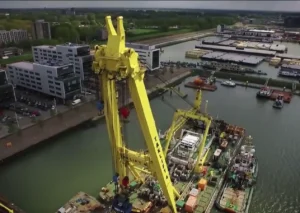
Once cutting was complete, the major sections were prepared for recovery by large floating sheerleg cranes.
A sheerleg is a powerful floating crane with a fixed or limited-movement lifting structure. It is designed for extremely heavy marine lifts.
The lifting operation involved:
- Inspecting the completed cut.
- Installing and checking lifting connections.
- Positioning the crane and transport barge.
- Applying lifting force gradually.
- Breaking the section free from the seabed.
- Raising it through the water.
- Allowing water and loose sediment to drain safely.
- Controlling the suspended load.
- Placing the section onto a prepared barge support arrangement.
Why is a submerged load different from a load in air?
While a section remains underwater, buoyancy supports part of its weight. As it emerges, that buoyant support decreases.
The crane load can therefore increase significantly during the final stage of recovery. Water trapped inside the wreck may add further weight until it drains.
Engineers must account for:
- Steel and cargo weight
- Buoyancy loss during emergence
- Water trapped in compartments
- Seabed suction
- Dynamic movement from waves
- Crane and sling geometry
- Uneven weight distribution
- Possible structural failure
The lift must be slow and controlled because sudden movement of a section, cargo or trapped water can alter the load within seconds.
Recovering Cars and Smaller Debris
Cutting and lifting the eight lower-hull sections did not remove everything from the seabed.
Parts of the upper decks were too damaged to lift as complete structural blocks. Vehicles and smaller wreckage also separated during cutting and recovery.
A large hydraulic wreck grab was used to collect this material. The grab could close around cars, twisted steel and mixed debris and then lift it into a receiving barge.
By the end of September 2015, the eight main sections and approximately 5,000 tonnes of smaller material had been loaded onto four barges, according to Boskalis.
The method allowed the seabed to be cleared without relying on the weak upper structure to remain intact.
Bringing the Wreck Ashore
The loaded barges transported the recovered sections and debris to a recycling facility in Vlaardingen, near Rotterdam.
Onshore processing involved:
- Draining residual liquids
- Removing hazardous materials
- Separating steel from mixed waste
- Dismantling large wreck sections
- Processing the damaged vehicle cargo
- Recovering recyclable metals
- Disposing of non-recyclable waste through controlled routes
Jansen Recycling Group was responsible for dismantling and processing the recovered wreckage. The company reported completing the work in late 2015. Jansen Recycling Group
Recycling on land was much safer and more controllable than trying to dismantle every component underwater.
Baltic Ace Salvage Timeline
| Date | Event |
| 5 December 2012 | Baltic Ace collided with Corvus J and sank within about 15 minutes |
| 2013 | Dutch authorities assessed the navigation and environmental risks and decided on removal |
| March 2014 | Rijkswaterstaat awarded the removal contract to Boskalis/SMIT Salvage and Mammoet Salvage |
| April–June 2014 | Fuel-removal campaign conducted; approximately 460,000 litres pumped out |
| Summer 2014 | Detailed inspection revealed greater structural damage than expected |
| Late 2014–early 2015 | Salvage method revised to recover strong lower sections separately from damaged upper material |
| April 2015 | Underwater wire-cutting campaign began |
| End of May 2015 | Wreck divided into eight major sections |
| June–September 2015 | Main sections, vehicles and smaller wreckage lifted and transported ashore |
| September 2015 | Offshore wreck-removal operation completed |
| Late 2015 | Recovered material dismantled and processed ashore |
Main Equipment Used in the Operation
| Equipment | Function |
| Diving-support vessel | Supported underwater inspection, tank access and installation work |
| Work barges | Carried winches, heating equipment and cutting systems |
| Steam-heating plant | Reduced heavy-fuel viscosity before pumping |
| Hot-tapping equipment | Created sealed access into submerged fuel tanks |
| Horizontal drilling system | Formed a path beneath the wreck for the cutting wire |
| Abrasive cutting wire | Cut through the steel hull, decks and internal structure |
| Heave-compensation system | Reduced the effects of wave-induced barge movement on cutting-wire tension |
| Floating sheerlegs | Lifted the eight main wreck sections |
| Wreck grab | Recovered cars, damaged upper decks and smaller debris |
| Transport barges | Carried wreck sections and debris to Vlaardingen |
| Tugs and support craft | Positioned barges and supported the offshore spread |
–
Environmental Protection During the Salvage
Environmental protection was integrated into each phase rather than treated as a final cleanup task.
Pollution-source removal
Fuel and lubricants were removed before major structural cutting began.
Controlled cutting
The wreck was cut in planned positions to reduce uncontrolled breakup and the spread of cargo or debris.
Debris recovery
Cars, batteries and smaller wreckage were recovered instead of being left to corrode on the seabed.
Waste separation ashore
Steel and other reusable materials were separated for recycling, while contaminated and non-recyclable waste could be handled through controlled disposal systems.
Monitoring
The work required continuing observation of weather, tides, pollution risk, wreck condition and surrounding navigation.
The final objective was not merely to lift visible parts of the ship. The seabed had to be left sufficiently clear for safe navigation and with the principal pollution sources removed.
–
What Made the Baltic Ace Salvage So Difficult?
A heavily damaged car-carrier structure
The collision and sinking weakened the upper decks, forcing the salvage team to revise its lifting concept.
A busy shipping location
The worksite was close to a major route toward Rotterdam. Salvage vessels, barges, anchors and lifting operations needed to be managed without creating a new navigational danger.
North Sea weather
Strong winds, waves and currents restricted diving, cutting and lifting windows. Offshore heavy lifting requires conditions within carefully defined limits.
Heavy fuel in cold water
The remaining fuel had to be heated before it could be pumped effectively.
Cutting from floating platforms
The use of two floating barges demanded accurate control of cutting-wire tension despite wave-induced motion.
Uncertain section weights
Cars, sediment, water and loose wreckage made the recovered weights more difficult to predict than those of newly fabricated structures.
Environmental responsibility
Every cut or lift could disturb oil residue, batteries, fuel from vehicles or loose debris. The operation had to balance removal speed against pollution control.
–
Maritime Engineering Lessons from the Baltic Ace
1. Remove pollutants before structural work
Cutting a wreck can open tanks and release trapped liquids. Early fuel removal reduces the consequences of later operations.
2. Do not rely only on original ship drawings
Plans show how the ship was built, not how it behaves after collision, capsizing and years on the seabed. Underwater surveys are essential.
3. Expect the salvage plan to change
The discovery of greater upper-deck damage required a revised recovery method. Adaptability is a core part of salvage engineering.
4. Consider buoyancy throughout the lift
A load becomes heavier for the crane as it emerges from the water and loses buoyant support.
5. Control platform motion
Heave compensation enabled the abrasive wire to cut effectively between two floating barges.
6. Plan the full waste route
Wreck removal does not finish when material reaches the surface. Transport, draining, dismantling, recycling and waste disposal are all part of the project.
7. Human loss should not disappear behind the engineering
The removal operation was technically impressive, but it followed a collision in which 11 seafarers lost their lives. Maritime education should connect engineering achievement with the navigation and safety lessons that made the operation necessary.
–
Frequently Asked Questions
When did the Baltic Ace sink?
Baltic Ace sank on 5 December 2012 after colliding with the containership Corvus J in the southern North Sea.
How many people died in the Baltic Ace accident?
Eleven of the 24 crew members lost their lives. Thirteen crew members were rescued.
How deep was the Baltic Ace wreck?
The wreck lay on its side in approximately 35 metres of water. Its uppermost structure was only about 10–12 metres below the surface, making it a concern for deep-draught shipping.
Why was the wreck removed instead of marked and left in place?
Its shallow clearance, proximity to busy shipping traffic, large quantity of fuel and cargo of 1,417 vehicles created continuing navigation and environmental risks.
How was fuel removed from the sunken ship?
Salvors used sealed hot-tapping equipment to enter the tanks. Steam-heated inserts warmed the heavy fuel oil so that approximately 460,000 litres could be pumped out. The tanks were subsequently flushed.
How was the Baltic Ace cut underwater?
A horizontal drilling system created routes beneath the wreck. Abrasive cutting wires were passed through these routes and operated by winches aboard two heave-compensated barges. The wreck was divided into eight principal sections.
Was the Baltic Ace raised intact?
No. Its damaged structure made a single intact lift impractical. Eight major lower-hull sections were lifted separately, while cars and smaller wreckage were recovered using a heavy wreck grab.
–
Conclusion
The Baltic Ace wreck removal was a carefully staged maritime engineering project.
It began with underwater investigation and the removal of hundreds of thousands of litres of fuel. When inspections revealed that the upper structure was too badly damaged for the original lifting concept, the project team adapted.
Abrasive wires passed beneath the hull divided the wreck into eight major sections. Floating sheerlegs then lifted those sections, while a wreck grab recovered thousands of tonnes of damaged steel, vehicles and seabed debris. The material was transported to Vlaardingen for controlled dismantling and recycling.
Completed in September 2015, the operation removed a serious navigation hazard and reduced the long-term pollution threat. It also demonstrated the importance of detailed surveying, adaptable engineering, motion compensation, environmental planning and cooperation between divers, naval architects, salvage masters, heavy-lift specialists and public authorities.
For more practical articles and documentaries about shipwrecks, maritime casualties, salvage engineering and ship safety, explore MaritimEducation and subscribe to our latest educational videos.
–
Suggested More Links To Read:
-
Top 10 Biggest Marine Salvage Companies: Giants of Maritime Recovery
-
Emergency Refloating Services: The Critical Lifeline for Ships, Vessels, Wrecks, and Offshore Platforms
About the Authors — MaritimEducation Team
MaritimEducation Team creates clear, practical and research-informed content about ships, marine engineering, maritime education, shipping, ports, technology, safety and sustainability.
References
- Bahamas Maritime Authority, Report of the Investigation into the Loss of MV Baltic Ace Following a Collision with MV Corvus J, 27 May 2016.
- Boskalis, “Wreck Removal, Baltic Ace”.
- Boskalis Horizons, “Baltic Ace Wreck Removal—Car Carrier Safely Removed Months Before Deadline”.
- SMIT Salvage, “Wreck Removal—Baltic Ace Project Highlight”.
- Jansen Recycling Group, “Project Baltic Ace Completed”.
- NOS, “First Wreck Section of Baltic Ace Recovered,” 9 June 2015.
Top 10 Biggest Marine Salvage Companies: Giants of Maritime Recovery
One thought on “Baltic Ace Wreck Removal: Inside the North Sea Salvage Operation”