
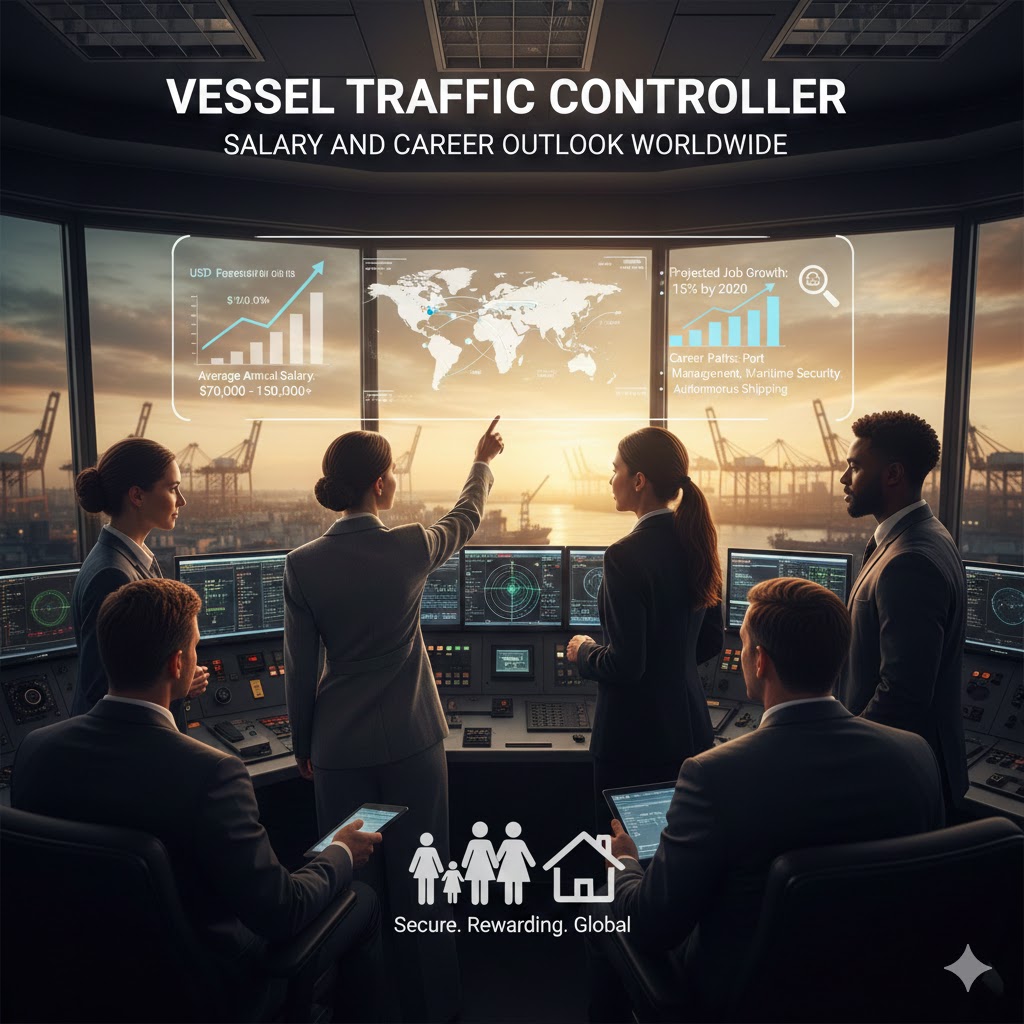
 Discover the global salary ranges, career pathways, and future outlook for vessel traffic controllers (VTS operators). This in‑depth guide covers regional pay data, required training, industry trends, and how to start a rewarding shore‑based maritime career.
Imagine a busy port at night: giant container ships, oil tankers, and ferries all moving through the same narrow waterways. Now picture a quiet room high above the waterline, where specialists stare at radar screens, listen to radio chatter, and issue precise instructions to every vessel. These are vessel traffic controllers – the unseen guardians of port safety and efficiency. Often called VTS (Vessel Traffic Services) operators, they are the maritime equivalent of air‑traffic controllers, ensuring that ships navigate safely, avoid collisions, and keep global trade flowing smoothly.
For anyone considering a shore‑based maritime career, or for industry professionals looking to understand the value of these critical roles, knowing the salary and career outlook for vessel traffic controllers worldwide is essential. This article provides a detailed, region‑by‑region analysis of VTS operator earnings, the steps to enter the profession, the skills and certifications required, and how technological changes are shaping the future of the field. Whether you are a cadet exploring options, an experienced mariner seeking a shore position, or a maritime educator guiding students, this guide offers the data and insights you need.
Why This Topic Matters for Maritime Operations
Vessel traffic controllers are the linchpin of modern port and waterway management. Their work directly impacts safety, environmental protection, and operational efficiency in some of the world’s busiest shipping lanes. A single mistake can lead to a collision, grounding, or spill, with devastating human, financial, and environmental consequences. Conversely, a well‑run VTS centre can reduce delays, optimize traffic flow, and prevent accidents. Understanding the career and remuneration landscape for VTS operators is therefore not just a matter of personal career planning; it is a window into the health and professionalism of the entire maritime‑safety ecosystem. When ports invest in skilled, well‑compensated VTS staff, they invest in the safety of their waters and the reliability of the global supply chain.
–
Key Developments in VTS Technology and Training
The role of a vessel traffic controller has evolved far beyond simply watching radar and talking on the radio. Today’s VTS centres are high‑tech nerve centres that integrate multiple data streams, and the training required to operate them has become standardized globally.
The IMO Framework and IALA Model Courses
The International Maritime Organization (IMO) provides the overarching framework for VTS. IMO’s Guidelines for Vessel Traffic Services (originally adopted in 1985 and updated in 2021) establish the principles for establishing and operating VTS. These guidelines stress the importance of proper recruitment, qualifications, and training for VTS personnel. The International Association of Marine Aids to Navigation and Lighthouse Authorities (IALA) has developed a series of model courses that translate these guidelines into practical training. The IALA Model Course C0103‑1 is the internationally recognized standard for VTS operator training, covering modules on communication, traffic management, equipment use, and emergency procedures. This standardization ensures that a VTS operator trained in Singapore, Rotterdam, or Houston possesses the same core competencies.
Technology: From Radar to Integrated Digital Platforms
The first VTS systems in the late 1940s relied on basic radar and voice radio. Modern VTS centres now use integrated maritime‑domain awareness platforms that combine:
-
High‑resolution radar with automatic tracking
-
Automatic Identification System (AIS) data
-
Closed‑circuit television (CCTV) feeds
-
Electronic navigational charts (ENCs)
-
Meteorological and hydrological sensors
-
Communication‑recording and replay systems
This fusion of data gives operators a real‑time, comprehensive picture of traffic, allowing them to predict conflicts, manage traffic sequencing, and respond to emergencies much more effectively. The next wave of innovation includes artificial intelligence (AI) for conflict prediction, digital twins for simulation and planning, and remote VTS centres that can monitor multiple ports from a central location.
–
Salary Outlook for Vessel Traffic Controllers by Region
Salaries for VTS operators vary significantly depending on the country, the employer (public port authority, private terminal, coast guard), the level of responsibility, and the cost of living. The following sections provide a snapshot of current earnings in key regions, drawn from official government sources, union advertisements, and industry job postings.
North America
In Canada, the Canadian Coast Guard hires Marine Communications and Traffic Services officers. The salary range for an entry‑level officer (RO‑01) is $49,712 to $70,700 per year. With experience and promotion to higher classifications (e.g., GT‑04), salaries can reach $74,995 to $85,266 annually. The Coast Guard provides paid training at its academy in Sydney, Nova Scotia, making it an attractive entry point for those without prior sea experience.
In the United States, VTS operators are often employed by the U.S. Coast Guard, port authorities, or private contractors. Public salary data is less centralized, but job‑board aggregates suggest average annual salaries range from $48,000 to $92,000, with higher figures for supervisory roles in major ports like Houston or Los Angeles.
Europe
In the United Kingdom, a Watch Manager (supervisory VTS role) at the Port of London Authority is advertised with a salary starting at approximately £66,000 per annum inclusive of allowances. Entry‑level VTS Officer positions in UK ports typically start between £30,000 and £40,000, rising with experience and qualifications.
In the European Union, salaries vary by country and port. In major hubs like Rotterdam, Antwerp, or Hamburg, experienced VTS operators can earn €50,000 to €70,000 annually. Public port authorities often follow collective bargaining agreements that set competitive wages, shift allowances, and pension benefits.
Asia‑Pacific
In Singapore, a major global hub, VTS operators are employed by the Maritime and Port Authority (MPA). While official salary scales are not publicly posted, job‑portal estimates suggest average annual salaries for VTS operators range from SGD 30,000 to 45,000 (approx. $22,000 to 33,000 USD). However, these figures often represent base pay and do not include substantial bonuses, housing allowances, and other benefits common in the Singapore maritime sector.
In Australia, VTS operators are employed by port corporations or state maritime authorities. According to job advertisements, salaries for qualified VTS Officers typically range from AUD 80,000 to 110,000 (approx. $53,000 to 73,000 USD), with higher rates for supervisors and managers in busy ports like Sydney or Melbourne.
Middle East and International Contract Positions
The Middle East, with its massive port developments and oil‑export infrastructure, offers competitive packages for experienced VTS personnel. Additionally, international contract positions are available for operators willing to work on a rotation basis (e.g., 2 months on/2 months off). One such advertisement for a “MASTER‑VTS Operator” offers a salary of $7,000 USD per month while on duty, plus bonuses, resulting in an annual package of about $48,000 USD. These contracts often include free accommodation, food, medical care, and flights, making them financially attractive for mobile professionals.
Career Path and Advancement Opportunities
A career as a vessel traffic controller is not a dead‑end job; it offers a clear ladder of progression for those who develop their skills and assume greater responsibilities.
Typical Career Progression
-
Trainee/VTS Assistant: Usually requires a high‑school diploma and passing initial aptitude tests. Involves shadowing experienced operators and completing formal training courses.
-
Certified VTS Operator: After completing the IALA Model Course and a period of on‑the‑job training, individuals become fully qualified to manage traffic independently.
-
Senior VTS Operator/Specialist: With several years of experience, operators may handle complex traffic sectors, train newcomers, or specialize in areas like emergency response or system maintenance.
-
Watch Manager/Supervisor: Responsible for a team of operators during a shift, ensuring procedures are followed and making high‑level decisions during incidents.
-
VTS Manager/Head of Operations: Oversees the entire VTS centre, manages budgets, liaises with port management and regulatory bodies, and sets long‑term strategy.
Skills and Qualifications
Beyond formal certification, successful VTS operators need:
-
Excellent communication skills in English (the international language of the sea)
-
Strong situational awareness and the ability to think ahead
-
Calm decision‑making under pressure
-
Technical aptitude to work with complex systems
-
Teamwork and leadership abilities
Many operators come from a seafaring background (as deck officers or pilots), bringing invaluable practical knowledge of ship handling. However, shore‑based training programs like Canada’s Coast Guard academy also successfully prepare candidates without prior sea time.
–
Challenges and Practical Solutions in the VTS Profession
The job of a VTS operator is demanding, both mentally and physically. Recognising these challenges is the first step toward mitigating them.
Key Challenges
-
High Stress and Mental Fatigue: Controllers must maintain intense concentration for long shifts, monitoring multiple screens and making split‑second decisions that carry serious consequences.
-
Shift Work and Irregular Hours: VTS centres operate 24/7, requiring night, weekend, and holiday shifts, which can disrupt sleep patterns and family life.
-
Keeping Pace with Technology: Continuous software updates and new system integrations demand ongoing learning.
-
Language and Cultural Barriers: Communicating with ships from all over the world can sometimes lead to misunderstandings due to accents or varying levels of English proficiency.
Industry Solutions
-
Ergonomic Centre Design: Modern VTS centres are designed to reduce fatigue, with adjustable chairs, optimal lighting, and screen placement.
-
Structured Rest Breaks: Mandatory break schedules are implemented to maintain alertness.
-
Advanced Simulation Training: Regular drills using high‑fidelity simulators help operators practice emergency scenarios without real‑world risk.
-
Standardized Phraseology: IMO and IALA promote the use of standardized maritime English phrases to minimize communication errors.
-
Continuing Professional Development (CPD): Port authorities increasingly support ongoing training, including refresher courses and training on new technologies.
Case Studies: VTS in Action
Real‑world examples illustrate the critical value of skilled VTS operators.
The Port of Singapore: Managing the World’s Busiest Port
Singapore’s VTS, operated by the MPA, manages over 1,000 vessel movements daily in one of the world’s most congested waterways. Its integrated system uses radar, AIS, and CCTV to track every ship from the Singapore Strait to the anchorages. VTS operators here not only prevent collisions but also coordinate with pilotage, towage, and emergency services. The efficiency of Singapore’s VTS is a key reason the port consistently tops global performance rankings.
The Port of Rotterdam: Embracing Digital Innovation
Europe’s largest port has invested heavily in a digital twin of its entire port area. This virtual model, fed by real‑time data, allows VTS operators and port planners to simulate traffic flows, test new layouts, and optimize scheduling. Rotterdam’s VTS centre is a showcase of how technology can augment human expertise, making operations safer and more efficient.
–
Future Outlook and Maritime Trends
The profession of vessel traffic controller is poised for significant evolution in the coming decade.
The Impact of Autonomous Ships
As remotely controlled and autonomous vessels become more common, the VTS operator’s role may shift from direct traffic instruction to monitoring and system oversight. Controllers will likely interface with shore‑based control centres for these ships, requiring new protocols and communication skills.
Remote and Centralized VTS Centres
Technology already allows for the remote monitoring of radar and sensor feeds. We may see the emergence of regional VTS hubs that oversee traffic for multiple smaller ports, improving cost‑effectiveness and standardizing service levels.
Enhanced Data Integration and AI
Future VTS systems will integrate even more data sources, including satellite AIS, port‑community system data, and environmental sensors. AI‑powered predictive analytics will alert operators to potential conflicts long before they become visible on radar, transforming the role from reactive to proactive.
Strong Job Prospects
Despite automation, the human element in VTS remains irreplaceable for complex decision‑making and crisis management. The continued growth of global seaborne trade, the expansion of port capacities, and the mandatory implementation of VTS in more waterways (as per SOLAS Regulation V/12) will sustain steady demand for qualified VTS operators worldwide. The profession offers a stable, rewarding, and respected shore‑based career path within the maritime industry.
Frequently Asked Questions (FAQ)
1. What is the difference between a VTS operator and a pilot?
A pilot boards a ship to provide local knowledge and directly advise the captain on navigating specific waterways. A VTS operator remains ashore, monitoring overall traffic flow from a control centre and providing information, warnings, and, in some cases, instructions to all ships in a designated area. They work in coordination with pilots.
2. Do I need to be a former seafarer to become a VTS operator?
While many operators are ex‑deck officers or pilots, it is not always a requirement. Authorities like the Canadian Coast Guard run comprehensive training programs for candidates with no prior sea experience. Strong cognitive skills, language ability, and the aptitude to handle technology are often just as important.
3. How long does it take to become a certified VTS operator?
Basic certification courses, such as the IALA Model Course C0103‑1, typically last 4‑6 weeks. This is usually followed by several months of on‑the‑job training under supervision before an operator is deemed fully competent.
4. Is the job stressful?
Yes, it can be. VTS operators carry significant responsibility for safety. However, proper training, supportive team environments, modern ergonomic facilities, and clear procedures are all designed to manage this stress effectively.
5. What are the typical shift patterns?
Most VTS centres operate 24/7, so shift work is standard. Common patterns include 12‑hour shifts (day/night rotation) or 8‑hour shifts across three cycles. Schedules often follow a pattern of several days on followed by several days off.
6. Are VTS operators in demand globally?
Yes. As global trade grows and ports implement or upgrade VTS systems to enhance safety, the demand for trained operators is consistent. Opportunities are particularly strong in emerging maritime economies in Asia, the Middle East, and Africa.
7. Can I work as a VTS operator in different countries?
Certification based on IALA standards is internationally recognized, making mobility possible. However, you must still meet the specific licensing, language, and immigration requirements of the country where you wish to work.
Conclusion and Take‑away
A career as a vessel traffic controller offers a unique blend of technical challenge, operational responsibility, and the satisfaction of contributing directly to maritime safety. As this guide has shown, salaries are competitive and vary by region, with clear pathways for advancement. The profession is underpinned by robust international standards set by the IMO and IALA, ensuring high levels of training and professionalism.
The future of VTS is inextricably linked to technological advancement, but the skilled human operator will remain at its heart. For those with sharp minds, calm demeanors, and a passion for the maritime world, becoming a VTS operator represents a stable, respected, and deeply rewarding shore‑based career.
If you are considering this path, we encourage you to reach out to your national maritime administration, port authorities, or recognized training institutions to learn about specific entry requirements and opportunities in your region. The world’s ports rely on the eyes and ears of VTS operators – perhaps your future is in that control room.
References
-
Canadian Coast Guard. (2025). Shore‑based careers in marine traffic, and search and rescue. Government of Canada.
-
International Maritime Organization (IMO). (n.d.). Vessel Traffic Services.
-
Nautilus International. (2023). Watch Manager – Vessel Traffic Services (job advertisement). Port of London Authority.
-
Maritime‑Union.com. (n.d.). MASTER‑VTS Operator (job advertisement).
-
International Association of Marine Aids to Navigation and Lighthouse Authorities (IALA). (n.d.). VTS – Vessel Traffic Service Training.
-
Government of Canada. (2023). Marine traffic regulators (NOC 72604.02).
Note: Salary figures are indicative and based on publicly available data as of early 2026. Actual offers may vary based on experience, specific employer, and economic conditions.