
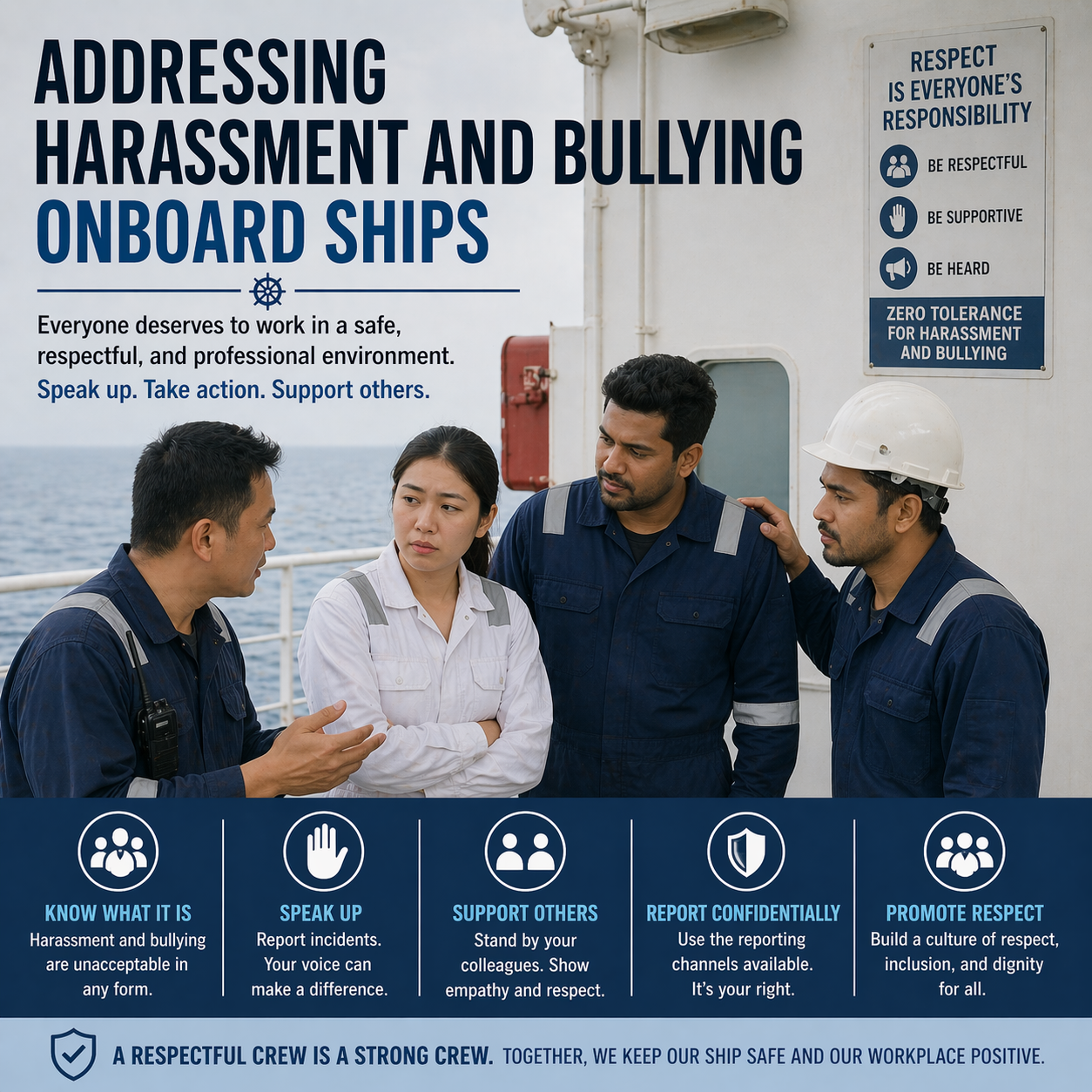
Harassment and bullying onboard ships include verbal abuse, intimidation, discrimination, sexual harassment, exclusion, and abuse of authority that undermine a seafarer’s dignity, safety, and mental wellbeing. These behaviors are especially serious at sea because ships are isolated, hierarchical workplaces where victims may find it difficult to report abuse or escape it. From 1 January 2026, updated IMO STCW requirements include mandatory training on preventing violence and harassment, reflecting the growing recognition that respectful shipboard culture is essential for both crew welfare and maritime safety.
Working at sea demands discipline, teamwork, and trust. A ship is not only a workplace. It is also a temporary home, a high-risk operational environment, and a tightly shared social space. When harassment or bullying enters that space, the effects can be severe. The harm does not stop with one individual. It can spread across watchkeeping, communication, morale, safety reporting, and overall shipboard performance. Recent IMO and ILO action has reinforced that violence and harassment at sea are not side issues. They are serious maritime concerns that require prevention, reporting systems, and proper training.
For many seafarers, the hardest part is not only the abuse itself, but the closed nature of life at sea. A person may be weeks away from shore, dependent on the same people they work with, and unsure whether reporting a problem will lead to help or retaliation. ISWAN has continued to highlight abuse, bullying, harassment, discrimination, and violence as recurring concerns reported by seafarers seeking support, including cases where crew felt their company had not dealt with complaints effectively.
What harassment and bullying mean at sea?
Harassment and bullying onboard ships refer to unwelcome behavior that humiliates, intimidates, excludes, threatens, degrades, or undermines a crew member. It can be verbal, psychological, physical, sexual, discriminatory, or linked to rank and authority. It may come from a superior officer, a peer, a group of colleagues, or, in some cases, from a shipboard culture that normalizes abusive conduct. The ICS and ITF guidance on eliminating shipboard harassment and bullying was developed precisely because seafarers have the right to work without being subjected to this kind of treatment.
In practical terms, harassment may involve offensive behavior related to sex, race, nationality, religion, age, or another personal characteristic. Bullying more often takes the form of repeated conduct intended to intimidate, belittle, isolate, or control someone. Sexual harassment includes unwanted comments, gestures, advances, messages, or touching. Abuse of authority may involve threats connected to promotion, evaluations, duties, training opportunities, or future contracts. The terminology used by IMO and ILO now increasingly refers to “violence and harassment, including sexual harassment, bullying and sexual assault,” which reflects the seriousness and breadth of the problem.
Why ships are especially vulnerable to this problem
The shipboard environment creates conditions in which harmful behavior can be harder to challenge and easier to hide. Crew members live and work in confined spaces for long periods. Hierarchy is strong. Fatigue is common. Multinational crews may face language barriers or cultural misunderstandings. Access to outside support may be limited while at sea. These conditions do not excuse abuse, but they do help explain why harassment and bullying can persist onboard and why reporting can feel risky. The new STCW-related training requirements explicitly connect violence and harassment with their effects on safety, health, and wellbeing.
This matters because ships depend on effective communication and mutual trust. A seafarer who is being mocked, intimidated, or isolated may stop asking questions, stop raising concerns, or stop reporting errors and near misses. Once that happens, the issue is no longer only personal. It becomes operational. A hostile shipboard atmosphere can weaken teamwork and directly affect safe operations. The updated training framework introduced from 1 January 2026 reflects exactly that link between respectful conduct and vessel safety.
Common examples of harassment and bullying onboard
Harassment and bullying at sea are not always dramatic or obvious. Sometimes they appear as repeated small acts that slowly isolate a person or damage their confidence. In other cases, the behavior is direct and openly abusive.
Common forms include:
- shouting, insults, or public humiliation
- racist, sexist, or degrading jokes disguised as “banter”
- repeated criticism aimed at embarrassment rather than improvement
- social exclusion from meals, meetings, or team interaction
- unreasonable workload allocation used as punishment
- withholding information, tools, or operational support
- intimidation linked to rank, appraisals, or future contracts
- unwanted sexual comments, messages, gestures, or touching
- targeting cadets, trainees, women seafarers, or minority crew members because they are seen as less able to resist.
–
Why many cases go unreported
Underreporting remains one of the biggest challenges in addressing harassment at sea. A seafarer may fear losing a contract, damaging future career prospects, becoming isolated by the crew, or simply not being believed. If the alleged perpetrator is a senior officer, the reporting route may feel compromised from the start. ISWAN’s support material notes that some crew contact them because they feel their company has ignored the problem or failed to deal with the complaint effectively.
There is also the issue of normalization. In some environments, aggressive supervision or degrading humor may be treated as part of “life at sea.” That mindset is one reason the industry has moved toward more formal guidance, clearer definitions, and mandatory training. The problem is not only that abuse happens. It is also that in some shipboard cultures, it is minimized until the damage is already serious.
Impact on seafarers
The consequences for individuals can be severe. Seafarers who experience ongoing bullying or harassment may suffer anxiety, depression, sleep problems, exhaustion, poor concentration, fear, or loss of confidence. Some leave their contracts early. Some leave the profession entirely. ISWAN’s reporting has repeatedly linked abuse-related contacts with wider concerns about seafarer mental health and wellbeing.
Women seafarers face particular risks. ITF resources and allied welfare material have emphasized that women report harmful onboard behaviors, including abuse, bullying, harassment, discrimination, and violence, at especially concerning levels. The issue is therefore also tied to gender equality, retention, and the industry’s effort to become more inclusive and sustainable as a workplace.
Impact on ship safety and operations
A respectful crew culture is not only good for morale. It is essential for safe navigation and engine room operations. Bullying and harassment can increase distraction, fatigue, silence, conflict, and communication breakdown. Crew members may become reluctant to question unsafe orders, challenge mistakes, or ask for clarification during critical tasks. In a safety-sensitive industry, that is a major risk. The new IMO training requirements explicitly recognize the effects of violence and harassment on safety, health, and wellbeing.
The operational consequences can include weaker teamwork, higher turnover, lower reporting rates, reduced trust in leadership, and a damaged safety culture. For shipowners and managers, this also creates legal, reputational, and retention risks. A company that fails to act may face complaints, recruitment difficulties, and long-term damage to crew confidence.
Regulation and industry response
The legal and regulatory picture is stronger today than it was a decade ago. The maritime industry now has clearer language, stronger guidance, and updated training obligations.
IMO and STCW
From 1 January 2026, amendments to the STCW framework entered into force requiring mandatory training on preventing violence and harassment, including bullying, sexual harassment, and sexual assault. This marks an important shift because it places respectful behavior and response competence within formal seafarer training rather than treating it as an optional HR topic.
ILO and the Maritime Labour Convention
ILO work related to the MLC has also strengthened the policy environment around shipboard violence and harassment. ILO materials and reports from the 2025 Special Tripartite Committee show strong support for measures protecting seafarers against harassment and bullying onboard ships, building on earlier MLC-linked references to industry guidance.
ICS and ITF guidance
The joint ICS/ITF guidance remains one of the most practical industry references for shipping companies, seafarers, and unions. It sets out ways to recognize, prevent, report, and address shipboard harassment and bullying and reinforces the principle that all seafarers have the right to work free from such behavior.
–
What shipping companies should do
A professional response must go beyond a statement in the crew handbook. Companies need prevention, reporting, support, and accountability.
Strong company practice should include:
- a clear zero-tolerance policy
- accessible reporting channels, including confidential options
- protection against retaliation
- regular anti-harassment and anti-bullying training
- leadership training for masters and senior officers
- support systems for cadets and junior crew
- access to independent welfare or counselling support
- documented investigation and disciplinary procedures.
The most effective companies also treat this as a leadership and safety-management issue. That means not waiting until a severe complaint appears, but actively monitoring crew culture, supporting bystander intervention, and ensuring that senior officers are trained to lead without intimidation or abuse.
What seafarers can do if they face harassment or bullying
A seafarer experiencing abuse may not always be in a position to act immediately, especially while at sea. Even so, certain steps can help protect both safety and evidence.
Practical steps include:
- record dates, times, locations, and witnesses
- keep messages or other evidence where possible
- use onboard complaint procedures if safe
- contact the company ashore, union, or welfare body
- seek confidential external support if internal reporting fails
- prioritize immediate safety if there is a threat of assault or severe intimidation.
ISWAN’s support channels remain particularly relevant where seafarers feel they have been ignored or do not trust the onboard chain of command.
Building a safer future at sea
The maritime industry is moving in the right direction, but real change depends on daily practice onboard. Policies matter. Training matters. Reporting systems matter. But culture matters most. A ship cannot truly be safe if crew members are afraid to speak, afraid to report, or afraid of the people they work under. The trend in IMO, ILO, welfare, and industry guidance is clear: a safer ship is also a more respectful ship.
Harassment and bullying onboard ships should no longer be dismissed as private conflict or old-fashioned tough leadership. They are professional, safety-critical issues that affect individuals, crews, and the whole industry. Preventing them is part of building a modern maritime sector that is fairer, safer, and more sustainable for everyone who works at sea.
Quick facts box
| Topic | Key point |
|---|---|
| What is it? | Unwelcome behavior that humiliates, intimidates, excludes, threatens, or degrades a crew member |
| Why serious at sea? | Ships are isolated, hierarchical, and shared living-working spaces |
| Safety impact | Weakens communication, reporting, trust, and teamwork |
| Major update | STCW training on violence and harassment became mandatory from 1 January 2026 |
| Support options | Company procedures, unions, welfare groups, and confidential helplines such as ISWAN |
FAQ
What is harassment onboard a ship?
Harassment onboard a ship includes unwanted verbal, psychological, physical, discriminatory, or sexual behavior that offends, intimidates, humiliates, or threatens a crew member.
Is bullying at sea common?
Official support organizations continue to report substantial numbers of contacts related to abuse, bullying, harassment, discrimination, and violence, showing that the problem remains significant and underreported.
Why is bullying onboard a safety issue?
Bullying can reduce concentration, stop people from speaking up, damage teamwork, and weaken the ship’s safety culture.
Are seafarers trained on this topic now?
Yes. Updated IMO STCW requirements in force from 1 January 2026 include mandatory training related to preventing violence and harassment, including bullying and sexual harassment.
Where can seafarers seek help?
Seafarers can use onboard complaint routes, contact their company ashore, speak to a union, or reach out confidentially to welfare organizations such as ISWAN.
–
References
- International Maritime Organization. Raft of shipping rules in force from 1 January 2026.
- International Maritime Organization. Preventing and combatting violence and harassment in the maritime sector.
- International Labour Organization. Special Tripartite Committee materials on MLC protections against harassment and bullying onboard ships.
- ISWAN. Abuse, bullying, harassment, discrimination and violence.
- ISWAN. Growing number of seafarers reporting abuse, bullying, harassment and discrimination.
- ICS. ICS/ITF Guidance on Eliminating Shipboard Harassment and Bullying.
- ITF Seafarers. How to be an ally.