
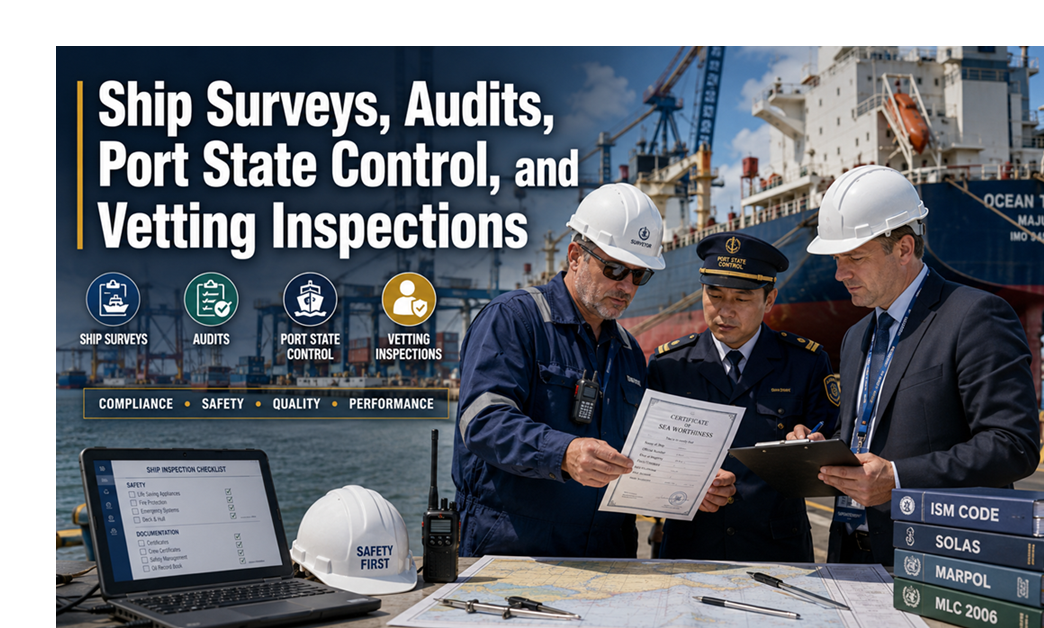
Ship inspection is a central part of maritime safety, environmental protection, regulatory compliance, and commercial risk management. Modern merchant ships are not controlled through one single inspection system, but through several overlapping regimes: surveys, audits, Port State Control inspections, and vetting inspections. Although these mechanisms are often mentioned together, they have different purposes. A survey verifies the ship’s technical and statutory condition. An audit checks whether the ship and company are effectively applying their Safety Management System. Port State Control is a public enforcement mechanism used by port States to identify substandard foreign ships. Vetting is a commercial risk-assessment process used mainly by charterers, oil majors, terminals, and cargo interests.
International shipping operates within a complex framework of flag State responsibilities, classification society rules, port State enforcement, statutory conventions, insurance expectations, and commercial acceptance standards. A vessel is not considered safe simply because it can sail and carry cargo. It must continuously demonstrate that it is technically sound, properly managed, legally compliant, environmentally responsible, and commercially acceptable.
The Role of Inspections in Maritime Safety
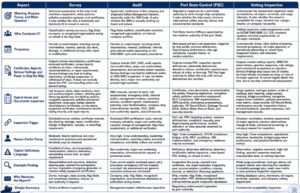
These inspection regimes overlap, but they are not interchangeable. Each one asks a different question. A survey asks whether the ship is technically and statutorily fit. An audit asks whether the management system works in practice. Port State Control asks whether a foreign ship meets minimum international standards. Vetting asks whether the vessel is acceptable for a specific commercial risk profile. This distinction explains why a ship can pass one inspection but fail another, and why inspection readiness must be continuous rather than occasional.
Ship inspection regimes developed because ships operate internationally while responsibility is shared among several actors. The flag State has primary responsibility for ships flying its flag, while classification societies develop and apply technical rules and may also conduct statutory surveys on behalf of flag States. However, flag State control alone cannot guarantee safe shipping. Some vessels may continue trading with weak maintenance, poor documentation, inadequate crew management, or substandard operating practices. Port State Control therefore acts as a second line of defence by allowing port States to inspect foreign ships and require corrective action when serious deficiencies are found.
Commercial stakeholders also need their own assurance systems. Charterers carrying oil, LNG, chemicals, or other high-risk cargoes may require standards beyond minimum legal compliance. They need confidence in the vessel, crew, cargo systems, operator, and safety culture. This is why vetting inspections are especially important in tanker and energy trades. The modern ship inspection ecosystem is therefore layered: surveys provide technical verification, audits verify management systems, Port State Control provides public enforcement, and vetting provides private commercial screening. Together, these layers reduce risk and support safer, cleaner, and more reliable maritime operations.
–
1 – Ship Survey as Technical Verification
A ship survey is primarily a technical examination. It verifies whether the vessel’s structure, machinery, equipment, and statutory arrangements remain in acceptable condition. Surveys may be conducted by classification society surveyors, flag State surveyors, or recognized organizations acting on behalf of the flag State.
Surveys are strongly connected to the concept of class. A ship that is “in class” has been assessed against the technical rules of a classification society. These rules cover areas such as hull structure, machinery, electrical systems, stability, safety equipment, and sometimes specialized systems depending on vessel type. For ships in service, IACS explains that classification societies carry out surveys to verify that the ship remains in compliance with class rules, and that owners must inform the society if defects or damage that may affect class occur between surveys.
Surveys are also linked to statutory certificates. Many international conventions require ships to carry valid certificates demonstrating compliance with safety, pollution-prevention, load line, and other requirements. These include instruments such as SOLAS, MARPOL, the Load Line Convention, Ballast Water Management requirements, and other applicable regimes depending on the ship type and trade.
The survey cycle includes annual surveys, intermediate surveys, renewal or special surveys, dry-docking surveys, bottom surveys, damage surveys, and additional surveys after repairs or modifications. During a survey, the surveyor may inspect hull plating, ballast tanks, cargo tanks, steering gear, main engines, auxiliary engines, boilers, emergency generators, fire pumps, lifeboats, fire-detection systems, navigation equipment, pollution-prevention equipment, and certificates.
The consequences of serious survey findings can be severe. A classification society may issue a condition of class, require repairs before sailing, suspend a certificate, or withdraw class. Although a surveyor does not usually “detain” a ship in the same way as a Port State Control Officer, class or flag action can effectively prevent the vessel from trading.
2 – Audit as Management-System Verification
An audit examines whether the company and ship are implementing an approved management system. In shipping, the most important framework is the International Safety Management Code, or ISM Code. IMO states that the purpose of the ISM Code is to provide an international standard for the safe management and operation of ships and for pollution prevention.
The ISM Code changed the philosophy of maritime safety. It moved attention beyond the physical condition of the ship and toward organizational responsibility. A vessel may have functioning equipment, but accidents can still occur if procedures are poor, communication is weak, training is inadequate, or corrective actions are not implemented. The ISM Code therefore requires companies to establish a Safety Management System covering safe operating practices, risk management, emergency preparedness, accident reporting, maintenance, internal audits, and management review.
An audit asks whether the Safety Management System exists only on paper or is genuinely implemented. Auditors may review manuals, permits to work, risk assessments, internal audit reports, non-conformity records, emergency drills, maintenance planning, accident reports, crew familiarization records, and company–ship communication. They may also interview officers and crew to test whether procedures are understood in practice.
The main ISM certificates are the Document of Compliance, issued to the company, and the Safety Management Certificate, issued to the ship. A major non-conformity may lead to additional audits, corrective-action requirements, or suspension of certification. Although an auditor normally does not detain a ship directly, loss or suspension of ISM certification can prevent legal operation.
The audit therefore represents a management and human-factor inspection. It is not enough for a ship to have valid equipment. The crew must know how to use it, the company must maintain it properly, and non-conformities must be reported, analysed, and corrected.
3 – Port State Control as Public Enforcement
Port State Control, commonly abbreviated as PSC, is an inspection conducted by the maritime authority of a port State on foreign ships visiting its ports. It is one of the most important enforcement tools in international shipping.
The logic of PSC is simple: although the flag State has primary responsibility, port States must be able to protect their waters, ports, workers, seafarers, and coastal environment from substandard foreign ships. PSC inspections are conducted under international conventions and regional memoranda of understanding, such as the Paris MoU, Tokyo MoU, Mediterranean MoU, Indian Ocean MoU, and others.
IMO’s procedures for Port State Control are intended to provide basic guidance on the conduct of inspections under relevant conventions and the IMO Instruments Implementation Code. PSC inspections may include checks under SOLAS, MARPOL, STCW, MLC, Load Line, ISM, ISPS, COLREG, Ballast Water Management, and other applicable instruments.
A PSC inspection usually begins with certificate verification and a general inspection. If the Port State Control Officer finds clear grounds, the inspection may become more detailed. Clear grounds may include invalid certificates, poor general condition, defective safety equipment, crew unfamiliarity, evidence of pollution, missing records, accommodation problems, or complaints from crew or third parties.
PSC has legal power. If deficiencies are serious enough, the ship may be detained until rectification. Detention damages the ship’s commercial reputation and may increase future PSC targeting. It can also affect chartering, insurance review, terminal acceptance, and company performance records.
PSC therefore operates as a public enforcement mechanism. It does not replace flag State control, class surveys, or audits, but it provides a powerful external check on ships that trade internationally.
4 – Vetting Inspection as Commercial Risk Assessment
A vetting inspection is different from survey, audit, and PSC because it is primarily commercial. It is used by charterers, cargo owners, terminals, oil majors, and vetting departments to decide whether a vessel is acceptable for a particular cargo, terminal, voyage, or operation.
Vetting is especially important in tanker, chemical, gas, and offshore sectors. In these trades, the consequences of an accident can be catastrophic. A tanker spill, chemical release, gas-carrier incident, cargo contamination, terminal accident, or mooring failure can create massive financial, environmental, and reputational losses. For this reason, commercial stakeholders often require standards that go beyond minimum legal compliance.
The best-known tanker vetting framework is the Ship Inspection Report Programme, or SIRE, developed by OCIMF. SIRE 2.0 is described by OCIMF as a new and updated inspection programme designed to future-proof tanker inspection in response to evolving risks, technology, and expertise. It places greater emphasis on digitalization, vessel-specific inspection, human factors, and risk-based assessment.
Vetting inspectors may examine cargo systems, inert gas systems, crude oil washing arrangements, tank-cleaning procedures, mooring equipment, bridge procedures, engine-room condition, pollution-prevention practices, crew matrix, operational records, previous inspection history, and operator responses. They may also assess whether officers and crew understand procedures practically, not just whether procedures exist in manuals.
A vetting inspector cannot legally detain a ship. However, a negative vetting outcome can prevent the vessel from obtaining cargo, entering a terminal, or securing a charter. In commercial terms, vetting rejection can be as damaging as a regulatory detention. It may remove the ship from profitable trades and reduce confidence among charterers and cargo interests.
–
A Comparative Table
–
Why These Inspections Are Often Confused
These inspection types are often confused because they may examine similar documents, equipment, and procedures. For example, the Oil Record Book may be checked during a survey, an audit, a PSC inspection, and a vetting inspection. Firefighting equipment may be examined by a class surveyor, PSC officer, or vetting inspector. Crew familiarity may be assessed during an audit, PSC inspection, or vetting inspection.
However, the interpretation is different. A class surveyor may focus on whether the equipment meets technical and statutory requirements. An auditor may focus on whether maintenance and emergency procedures are implemented through the Safety Management System. A PSC officer may focus on whether the ship can safely proceed to sea and whether serious deficiencies justify detention. A vetting inspector may focus on whether the vessel meets the commercial risk expectations of a charterer or terminal.
This difference in purpose explains why the same ship condition can produce different types of findings. A defective emergency generator may be a statutory survey deficiency, a PSC detainable deficiency, an ISM non-conformity if maintenance procedures failed, and a vetting observation if it indicates poor operational control.
The Link Between Technical Condition and Management Culture
A major lesson from modern inspection practice is that technical condition and management culture cannot be separated. Poor technical condition is often a symptom of weak management. Repeated equipment failures may indicate poor maintenance planning, insufficient spare parts, inadequate training, or ineffective shore support. Similarly, incomplete records may indicate weak safety culture rather than mere administrative error.
The ISM Code is important because it connects technical safety with organizational responsibility. A ship’s condition is not only the responsibility of the master and crew. It is also shaped by company policies, budgets, maintenance systems, purchasing decisions, training programmes, and management oversight.
This is why audits have become central to maritime safety. They ask whether the company has created a working safety system, not merely whether the ship has valid certificates. A vessel with clean certificates but poor internal reporting, weak risk assessment, and poor corrective-action culture remains vulnerable.
Port State Control and the Fight Against Substandard Shipping
Port State Control is one of the strongest tools against substandard shipping. It provides an independent check on foreign ships that may otherwise continue trading despite weak flag State oversight or poor company performance.
PSC also creates a reputational record. Detentions and repeated deficiencies are not isolated administrative events. They influence future targeting, charterer confidence, vetting outcomes, and sometimes insurance perception. A company with a poor PSC history may face increased scrutiny in multiple jurisdictions.
PSC is therefore both corrective and preventive. It corrects unsafe conditions by requiring rectification, and it prevents unsafe ships from proceeding to sea when deficiencies are serious. It also encourages owners and managers to maintain continuous compliance because any port call may result in inspection.
Vetting as Private Maritime Governance
Vetting represents a form of private maritime governance. It is not public law in the same way as PSC, but it strongly influences market access. This is especially true in tanker trades, where oil majors and large charterers apply strict acceptance standards.
The power of vetting lies in commercial choice. A charterer does not need to prove that a ship is legally unfit. It only needs to decide that the ship does not meet its risk standard. This makes vetting more flexible but also more demanding than statutory inspection. It can consider issues such as crew experience, operator reputation, management response quality, previous inspection trends, and terminal feedback.
For shipowners, this means that minimum compliance is not enough. A vessel must be maintained and operated to a standard that satisfies commercial stakeholders. In tanker operations, vetting performance may determine whether a vessel can access premium cargoes and reputable charterers.
Inspection Outcomes and Commercial Consequences
The commercial consequences of inspection findings can be significant. A survey condition may require repairs and delay a voyage. A major audit non-conformity may lead to additional verification and management scrutiny. A PSC detention may disrupt cargo operations, damage reputation, and increase future targeting. A negative vetting outcome may result in loss of charter, terminal refusal, or exclusion from oil-major business.
These consequences are connected. A poor PSC record may influence vetting decisions. Repeated vetting observations may reveal management weaknesses relevant to ISM audits. Survey deficiencies may raise questions about planned maintenance. Audit findings may explain why technical defects are repeated. Thus, inspections create a combined profile of the vessel and company.
A strong inspection record, by contrast, supports commercial confidence. It helps charterers, insurers, terminals, flag administrations, and cargo interests trust the ship. In a competitive market, inspection performance becomes part of the vessel’s commercial value.
Human Factors Across the Four Regimes
Human factors are increasingly important in all inspection regimes. Earlier inspection systems often focused heavily on documents and equipment. Modern inspections also examine whether officers and crew understand procedures, communicate effectively, manage risk, and respond properly to emergencies.
This is especially visible in audits and vetting inspections. Auditors examine whether crew members understand the Safety Management System. Vetting inspectors may test practical knowledge of cargo systems, mooring operations, bridge procedures, emergency response, and pollution-prevention measures. PSC officers may also ask crew members to demonstrate emergency equipment, explain duties, or conduct operational tests.
Human-factor assessment matters because many maritime accidents involve a combination of technical failure, procedural weakness, fatigue, communication breakdown, and poor supervision. Therefore, inspection readiness requires more than clean equipment and complete certificates. It requires a trained crew, effective leadership, practical drills, and a reporting culture that identifies problems before they become casualties.
Toward Integrated Inspection Readiness
A mature ship-management company should not prepare separately for surveys, audits, PSC, and vetting. Instead, it should develop an integrated inspection-readiness system. This means that the vessel should be maintained and operated every day as if an inspection could occur at any time.
Integrated readiness includes continuous maintenance, accurate records, practical drills, effective risk assessments, crew familiarization, timely corrective actions, and management review. It also requires trend analysis. If the same type of finding appears in PSC, audit, and vetting reports, the company should treat it as a systemic weakness rather than an isolated incident.
An integrated model also helps reduce inspection fatigue. Ships are frequently inspected by different stakeholders, and crews may feel that inspections repeat the same questions. A unified approach allows the ship to maintain one high operational standard instead of preparing differently for each inspector.
For example, a company may create a common inspection matrix linking survey items, ISM procedures, PSC focus areas, and vetting observations. Findings can then be analysed together. This supports continuous improvement and reduces the risk of repeated deficiencies.
Educational Value for Maritime Students and Professionals
For maritime education and training, the distinction between survey, audit, PSC, and vetting should be taught clearly. Cadets and junior officers often encounter inspections before fully understanding their purpose. They may see different inspectors asking similar questions and assume the inspections are the same.
A comparative approach helps students understand the wider system. A chief engineer must know survey requirements for machinery and statutory equipment. A chief officer must understand cargo readiness, mooring safety, record books, and vetting expectations. A master must understand PSC procedures, ISM implementation, and commercial inspection consequences. Shore managers must understand how inspection findings influence safety, insurance, chartering, and company reputation.
Training should include practical scenarios. Students can be given sample findings and asked whether they are survey deficiencies, audit non-conformities, PSC deficiencies, vetting observations, or all of them. This develops professional judgment and prepares future officers for real inspection environments.
Conclusion
Ship surveys, audits, Port State Control inspections, and vetting inspections are four essential but distinct components of the maritime assurance system. A survey confirms the technical and statutory fitness of the vessel. An audit verifies whether the Safety Management System is effectively implemented. Port State Control provides public enforcement against substandard foreign ships. Vetting evaluates commercial acceptability and risk from the perspective of charterers, terminals, and cargo interests.
The key lesson is that these regimes overlap but cannot replace one another. A vessel may be in class, ISM-certified, and free from PSC detention, yet still fail vetting. Conversely, a ship may be commercially accepted but still face regulatory consequences if PSC identifies serious deficiencies.
Modern ship management therefore requires continuous and integrated inspection readiness. Compliance should not be treated as a temporary exercise before an inspector arrives. It must be embedded into daily maintenance, documentation, crew training, safety culture, and shore-based management. In a maritime industry shaped by stricter environmental regulation, digital inspections, human-factor assessment, and rising commercial scrutiny, understanding the differences between surveys, audits, PSC, and vetting is a core professional competence.
Multiple-Choice Questions for the End of the Article
1. What is the main purpose of a ship survey?
A. To check the ship’s technical and statutory condition
B. To approve the commercial charter rate
C. To replace the ship’s Safety Management System
D. To inspect only crew accommodation
Correct answer: A
2. What does an ISM audit mainly check?
A. The market value of the vessel
B. The cargo quantity on board
C. The working implementation of the Safety Management System
D. The charterer’s commercial requirements
Correct answer: C
3. Which inspection can legally detain a foreign ship in port?
A. Vetting inspection
B. Port State Control inspection
C. Charterer’s screening
D. Internal company review
Correct answer: B
4. Why may a ship pass PSC but still fail vetting?
A. Vetting only checks certificates
B. PSC is not used for tankers
C. Vetting may apply higher commercial standards
D. PSC replaces class surveys
Correct answer: C
5. Which inspection is mainly used by charterers, oil majors, terminals, and cargo interests?
A. Dry-docking survey
B. Flag State survey
C. Tonnage measurement
D. Vetting inspection
Correct answer: D
6. Why are surveys, audits, PSC, and vetting sometimes confused?
A. They may check similar items for different purposes
B. They are all done by the same authority
C. They always produce the same result
D. They apply only to passenger ships
Correct answer: A
7. What is the best approach to inspection readiness?
A. Prepare only before the inspector arrives
B. Keep continuous operational readiness
C. Focus only on valid certificates
D. Treat each finding as unimportant
Correct answer: B
–
References
International Maritime Organization. International Safety Management Code. The IMO states that the ISM Code provides an international standard for safe ship management, ship operation, and pollution prevention.
International Maritime Organization. Procedures for Port State Control, 2023, Resolution A.1185(33). This document provides guidance for the conduct of Port State Control inspections under relevant conventions and the IMO Instruments Implementation Code.
Oil Companies International Marine Forum. SIRE 2.0 Programme. OCIMF describes SIRE 2.0 as an updated tanker inspection programme designed to respond to evolving risks, technology, and industry expertise.
International Association of Classification Societies. Classification: What, Why and How? IACS explains the role of classification societies in verifying that ships in service remain in compliance with class rules.
European Maritime Safety Agency. Classification Societies and Recognised Organisations. EMSA explains that classification societies develop and apply technical standards for ship design, construction, and survey, and may be authorized by flag States to conduct statutory survey and certification work.
OCIMF. SIRE 2.0 Programme Introduction and Guidance. The guidance explains the digitalized inspection process and vessel-operator declaration requirements under SIRE 2.0.