
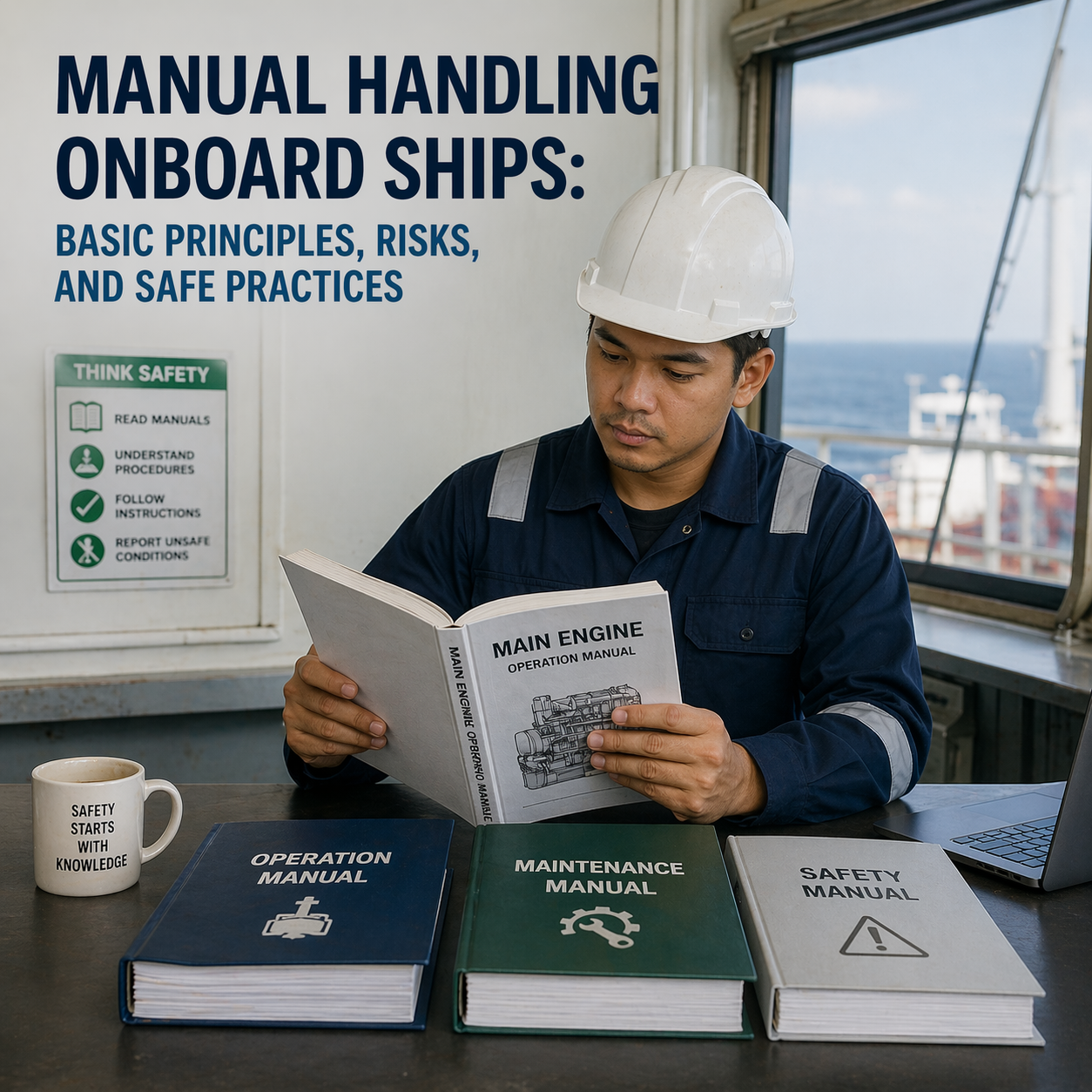
Manual handling is one of the most common everyday tasks onboard a ship. It includes lifting, lowering, carrying, pushing, pulling, holding, or moving an object by hand or by bodily force. On ships, these tasks happen in areas such as the deck, engine room, galley, stores, workshops, and accommodation spaces. Because the ship is moving, space is limited, and surfaces may be wet or uneven, manual handling at sea can become much more hazardous than the same task ashore. The basic safety principle is therefore simple: avoid hazardous lifting where possible, assess the risk before the task starts, and use safer methods, better technique, and appropriate equipment to reduce the chance of injury. This approach is consistent with official occupational safety guidance and maritime manual-handling guidance.
What Manual Handling Means Onboard
In practical shipboard terms, manual handling covers much more than lifting a box. It may involve moving mooring ropes, handling stores and provisions, shifting spare parts, carrying tools, opening or moving heavy components, pulling hoses, or repositioning portable equipment. A “load” does not have to be a cargo unit only. It can also be a piece of machinery, a container of chemicals, a line, a ladder, or any awkward object that requires physical effort. Official health and safety guidance defines manual handling broadly as transporting or supporting a load by hand or bodily force, including lifting, putting down, pushing, pulling, carrying, or moving it.
This matters because many seafarers treat manual handling as a routine activity and underestimate its risk. In reality, even a familiar task can become unsafe when the load is too heavy, the route is obstructed, the weather is poor, the deck is slippery, or the person is tired.
Why Manual Handling Is a Serious Safety Issue at Sea
Manual handling injuries are not minor issues. They can cause back strain, shoulder damage, knee problems, muscle tears, slips, trips, crush injuries, and long recovery periods. Onboard a ship, one injury can affect much more than the injured person. It can reduce manpower, delay work, increase fatigue for the rest of the crew, and create operational risk during cargo work, mooring, maintenance, or emergency response.
The shipboard environment makes the risk higher. Vessel motion can suddenly change body balance. Narrow passages and machinery arrangements can force awkward posture. Lighting may be poor in some areas. Work may be done in heat, noise, vibration, and time pressure. Maritime guidance from the UK Maritime and Coastguard Agency specifically addresses these factors for work on board ships, while ILO guidance on accident prevention onboard ships emphasizes hazard identification and preventive measures in ship operations.
Common Manual Handling Tasks on Ships
Manual handling can appear in almost every department onboard. On deck, crew may move ropes, shackles, hoses, paint drums, tools, spare gear, and stores. In the engine room, personnel may handle filters, pumps, valves, spare parts, hoses, cylinders, and maintenance tools. In the galley and accommodation areas, staff may move food supplies, cleaning materials, waste bags, and storage boxes. During bunkering, mooring, maintenance, and stores operations, the frequency and intensity of manual handling often increase.
For this reason, safe manual handling is not only a personal habit. It is part of safe shipboard organization.
Main Risk Factors
A manual handling task becomes dangerous when one or more risk factors are present. The most common are the load, the task, the environment, and the person performing it.
1. Load-related factors
A load may be too heavy, too large, difficult to grasp, unstable, unbalanced, or sharp-edged. Sometimes the weight is unknown, which causes people to make unsafe assumptions.
2. Task-related factors
The task may require lifting from the floor, reaching above shoulder level, twisting the body, carrying over a long distance, or repeating the same movement many times.
3. Environmental factors
On ships, the environment is often the key problem. Rolling, pitching, wet decks, poor access, narrow spaces, ladder use, heat, insufficient lighting, and obstacles all increase the risk.
4. Individual factors
Fatigue, poor footwear, lack of training, rushing, poor communication, or overconfidence can turn a manageable task into an injury.
These principles align closely with official manual-handling risk assessment guidance, which focuses on avoiding hazardous tasks where possible and then assessing task, load, working environment, and individual capability.
Common Unsafe Practices
Many injuries happen not because the task is impossible, but because it is done carelessly. Some of the most common unsafe practices onboard include:
- lifting with a bent back instead of bending the knees
- twisting the body while holding a load
- carrying an object that blocks vision
- attempting to lift alone when team lifting is needed
- underestimating the weight of the item
- moving too quickly without clearing the route
- lifting on wet or unstable surfaces
- continuing the task when balance is affected by ship motion
These actions are especially dangerous when combined with time pressure or fatigue.
Basic Principles of Safe Manual Handling
Safe manual handling starts before the load leaves the ground. A seafarer should first stop and assess the job. Good technique matters, but technique alone is not enough. Planning, communication, and risk control are equally important.
Plan before lifting
Check what is being moved, how heavy it is, where it must go, and whether the route is clear. Ask whether the load can be divided into smaller parts. Confirm whether help or mechanical assistance is needed.
Keep the load close to the body
A load held close to the body is easier to control and places less strain on the back and shoulders.
Maintain a stable position
Feet should be placed firmly and apart enough to maintain balance. On a moving ship, extra caution is needed. The person should avoid starting the lift during sudden vessel motion if possible.
Bend the knees, not the back
The legs should do most of the work. The back should remain as straight as reasonably possible, and the lift should be smooth rather than sudden.
Avoid twisting
Turn the feet and the whole body instead of twisting the spine while carrying the load.
Lift only within your ability
If the load is too heavy, too awkward, or too unstable, do not continue alone.
Put the load down safely
Lowering the load is also part of manual handling. Fingers, toes, and body position should be protected when setting the load down.
These basic lifting points are consistent with official good-handling guidance that recommends keeping the load close, avoiding twisting, and using stable body positioning.
Team Lifting
Some shipboard items are too long, too heavy, or too awkward for one person. In such cases, team lifting may be necessary. But team lifting is safe only when it is properly organized. Crew members should agree on the route, the method, and who gives the commands. One person should lead the movement. Everyone should lift, walk, turn, and lower the load together.
Poor coordination in a team lift can be just as dangerous as lifting alone.
Use of Mechanical Aids
One of the most important safety rules is that hazardous manual handling should be avoided where possible. This means using equipment rather than relying only on physical strength. Depending on the ship and the task, useful aids may include trolleys, hand carts, hoists, chain blocks, lifting beams, winches, cranes, pallet devices, or other approved handling tools. Official guidance on manual handling places strong emphasis on avoiding manual lifting where reasonably practicable and reducing risk through better work methods and equipment.
However, equipment must also be used correctly. Crew should be trained, the device should be suitable for the load, and the operation should follow shipboard safety procedures.
Good Practice by Work Area
Deck department
Deck work often combines manual handling with weather exposure, slippery surfaces, and line tension hazards. Loads should be secured before movement. Crew should wear suitable gloves and anti-slip footwear, and should avoid carrying heavy items across wet or cluttered deck areas without preparation.
Engine department
Engine-room tasks may involve heat, noise, restricted access, and heavy components. Before moving parts, crew should check clearances, temperature, and the safest path. Hoists or other lifting aids should be used whenever possible for machinery parts and maintenance jobs.
Galley and hotel services
Galley and accommodation staff also face manual handling risk. Repeated lifting of food boxes, waste containers, and supplies can lead to strain injuries. Heavier items should be stored near waist height where possible, and carts should be used instead of repeated hand carrying.
Training and Safety Culture
Manual handling should not be treated as “common sense only.” It requires instruction, supervision, and repeated reinforcement. STCW establishes international minimum training requirements for seafarers, and IMO lists Personal Safety and Social Responsibilities as part of its training framework. In addition, shipowners and operators are expected to address onboard occupational safety through practical procedures, familiarization, and safe work systems.
Effective onboard training usually includes:
- basic body mechanics and correct lifting method
- recognition of risk factors
- when to stop and ask for help
- correct use of mechanical aids
- team-lift communication
- examples from real onboard tasks
- refresher toolbox talks and visual reminders
A strong safety culture is also essential. Crew should feel able to say that a load is too heavy, that the route is unsafe, or that mechanical assistance is needed. Preventing injury is more professional than trying to “prove strength.”
Practical Challenges Onboard
Even when the rules are clear, shipboard reality creates difficulties. Crews may be busy, undermanned, tired, or under schedule pressure. Some ships have limited handling equipment. In some cases, unsafe habits develop over time because “this is how it has always been done.”
This is why supervisors and senior officers play a key role. Safe manual handling should be part of planning, not only part of accident investigation after someone gets hurt.
A Simple Five-Step Check Before Any Lift
A practical way to improve daily safety is to remember five short questions before starting:
- What is the load?
Do I know its weight, shape, and balance? - What is the route?
Is the path clear, dry, and well lit? - Can I do it safely alone?
Or do I need help? - Can I use equipment instead?
Is there a trolley, hoist, or other aid? - What could go wrong if the ship moves suddenly?
Am I ready for loss of balance?
This kind of pause often prevents avoidable injury.
Conclusion
Manual handling onboard ships may look like a basic task, but it is a major part of shipboard safety. Poor lifting technique, bad planning, awkward posture, vessel motion, and rushing can all turn a simple task into a painful injury. The solution is not complicated: avoid hazardous lifting when possible, assess the task, use the right method, use equipment where available, communicate clearly, and never ignore early signs of risk.
For cadets, ratings, officers, and shore-based maritime trainers, manual handling should be taught and practiced as a professional safety skill. When done correctly, it protects health, supports operational efficiency, and strengthens the overall safety culture onboard.
Reference List
- International Maritime Organization (IMO). International Convention on Standards of Training, Certification and Watchkeeping for Seafarers (STCW). IMO overview page.
- International Maritime Organization (IMO). Current IMO Publications — including Personal Safety and Social Responsibilities.
- International Maritime Organization (IMO). MSC 108 summary — amendments to STCW Code table A-VI/1-4 on personal safety and social responsibilities.
- International Labour Organization (ILO). Accident Prevention on Board Ship at Sea and in Port.
- International Labour Organization (ILO). Guidelines for Implementing the Occupational Safety and Health Provisions of the Maritime Labour Convention, 2006.
- UK Health and Safety Executive (HSE). Manual handling at work: Overview.
- UK Health and Safety Executive (HSE). Manual handling at work. INDG143.
- UK Health and Safety Executive (HSE). Manual Handling Operations Regulations 1992: Guidance on Regulations (L23).
- UK Health and Safety Executive (HSE). Good handling technique.
- Maritime and Coastguard Agency (MCA), UK. MGN 90 (M+F) Amendment 5: Manual Handling Operations Regulations 1998. Guidance with particular reference to work on board merchant ships and fishing vessels.