
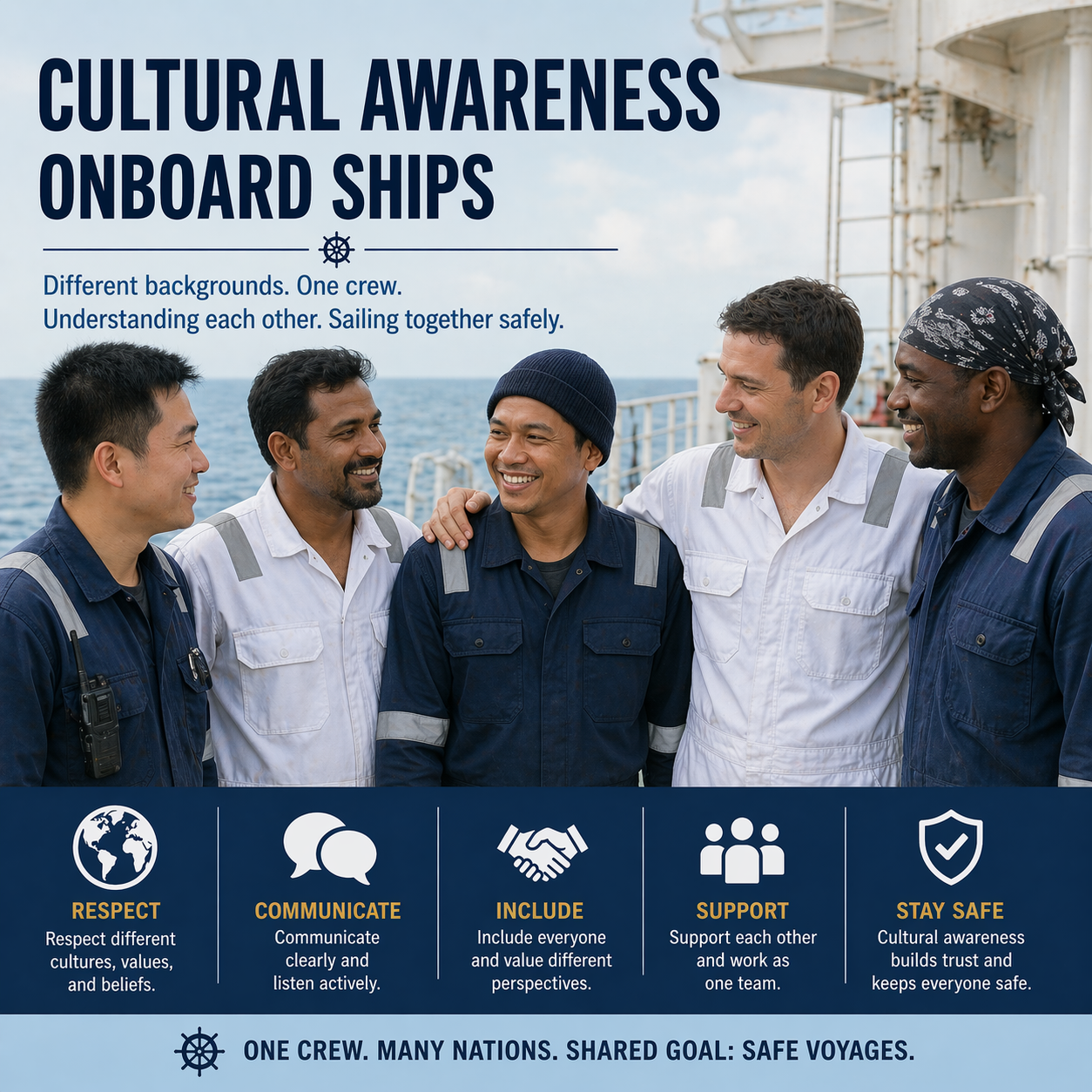
Modern ships are often operated by multinational crews. It is common for seafarers from different countries, languages, religions, and social backgrounds to live and work together in the same limited space for long periods. This diversity is one of the strengths of the maritime industry, but it also creates practical challenges. When cultural differences are not understood, simple misunderstandings can affect communication, trust, teamwork, and even safety. In shipping, cultural awareness is therefore not only a social value. It is also part of professional seamanship and the human element of safe ship operation. The IMO’s STCW framework specifically includes leadership, teamwork, and communication-related training, while the IMO Standard Marine Communication Phrases were developed to reduce language barriers and avoid misunderstandings that can cause accidents.
What Cultural Awareness Means Onboard
Cultural awareness means understanding that people may think, communicate, react, and work differently because of their cultural background. It also means respecting those differences and adapting communication and behavior so that work can be done safely and effectively.
On a ship, cultural awareness does not mean memorizing stereotypes about nationalities. It means recognizing that people may differ in how directly they speak, how they respond to authority, how they ask questions, how they show disagreement, or how they react under pressure. In a multicultural crew, these differences can influence watchkeeping, maintenance, teamwork, toolbox meetings, drills, and daily social life. ISWAN notes that multicultural crews are common in shipping and can work very well, but language barriers, different cultural ways of behaving and communicating, and power imbalances can also create tension and misunderstanding if they are not managed properly.
Why Cultural Awareness Matters for Safety
Safety at sea depends heavily on communication. During routine operations and especially during emergencies, crew members must understand instructions clearly, ask questions when necessary, report problems without hesitation, and cooperate across ranks and departments. Cultural misunderstanding can weaken each of these actions. For example, a crew member from a culture with strong respect for hierarchy may hesitate to question an unclear order. Another may say “yes” to show politeness, even when the message has not been fully understood. These are not small issues. On a ship, misunderstanding can affect response time, teamwork, and decision-making.
The IMO’s human-element framework treats communication, leadership, teamwork, and management as essential safety issues, not optional soft skills. The STCW Convention also highlights leadership and teamwork training, and the Standard Marine Communication Phrases exist specifically to reduce language-related misunderstanding in safety-critical communication.
Cultural Awareness and Daily Shipboard Life
Cultural awareness is just as important outside emergencies. Most shipboard conflict does not begin in a formal meeting or drill. It often begins in daily life: a tone of voice that sounds rude to one person, a joke that feels offensive to another, silence that is misread as agreement, or a direct correction that feels humiliating instead of helpful. Because seafarers live and work in the same place, small tensions can build over time if they are not understood and managed properly.
This is why cultural awareness supports not only safety, but also morale, welfare, and crew harmony. ISWAN’s wellbeing resources emphasize that life at sea is affected by communication quality, group dynamics, and social interaction. Its guidance notes that stronger intercultural understanding can improve social cohesion onboard.
Common Areas Where Cultural Differences Affect Ship Operations
Cultural differences may affect several important parts of shipboard work.
One area is communication style. Some people communicate very directly, while others prefer indirect or softer wording. If this difference is not understood, one person may seem aggressive and another may seem unclear or evasive.
Another area is attitude to hierarchy. In some cultures, questioning a senior officer is seen as disrespectful. In others, asking questions is considered normal and responsible. Onboard, this difference may affect reporting, feedback, and bridge or engine-room teamwork.
A third area is group behavior and responsibility. Some seafarers may focus strongly on individual initiative, while others may focus more on group harmony and collective agreement. This can affect how people participate in discussions, solve problems, or respond to criticism.
A fourth area is conflict expression. Some people address disagreement immediately and openly. Others avoid open disagreement and may remain silent even when tension exists. Without cultural awareness, both sides may misjudge each other.
These differences do not mean one culture is better than another. They mean leaders and crews must work consciously to create clarity and mutual respect.
The Role of Maritime English and Standardized Communication
One of the most practical tools for reducing cultural and language problems onboard is standardized communication. The IMO Standard Marine Communication Phrases were created to help overcome language barriers in ship-to-ship, ship-to-shore, and onboard communication. Their purpose is operational clarity, especially in safety-related situations. This shows an important point: cultural awareness does not replace clear procedures. It works together with them. Cultural sensitivity is helpful, but in critical operations, clarity, confirmation, and standard phraseology are essential.
Leadership and Cultural Awareness
Cultural awareness becomes especially important in officers and supervisors. Leaders onboard set the tone for how multicultural crews function. An officer who understands cultural differences is more likely to brief clearly, check understanding properly, avoid unnecessary humiliation, encourage reporting, and resolve tension before it becomes serious.
The STCW framework includes leadership and teamwork as part of modern seafarer competence. This reflects the reality that ship safety depends not only on technical skill, but also on how people are managed and how teams work together. A technically strong officer who cannot lead a diverse crew effectively may still create operational risk.
Cultural Awareness, Fair Treatment, and Seafarer Welfare
Cultural awareness is also linked to fairness and dignity onboard. The Maritime Labour Convention supports the principle that seafarers should have decent working and living conditions, protection of health and safety, and access to fair treatment regardless of nationality or background. ILO materials on maritime labour also emphasize that welfare facilities and protections should be available to seafarers without discrimination. In practice, this means that cultural awareness is not only about being polite. It is part of professional conduct, equal treatment, and healthy shipboard life.
How Cultural Awareness Can Be Improved Onboard
Cultural awareness can be developed through practical action. It should not remain only a theory in training slides.
First, crews need clear and respectful communication habits. Important instructions should be simple, confirmed, and repeated when necessary.
Second, ships benefit from good familiarization and briefing practices. New crew members should understand not only technical procedures but also the expected communication culture onboard.
Third, officers should encourage a climate where people can ask questions without fear. This is essential in multicultural crews where some members may hesitate to speak up.
Fourth, companies can support cultural awareness through leadership training, onboard welfare measures, and anti-bullying or anti-harassment policies. ISWAN and other welfare-focused maritime bodies repeatedly emphasize the value of inclusion, communication, and social support in improving crew wellbeing.
Fifth, crews should use shared operational language and standard procedures in safety-critical contexts. This reduces the chance that cultural style or language ability will create confusion at the wrong moment.
Common Barriers
Although cultural awareness is important, several barriers often make it difficult onboard. One is time pressure. Busy ships may leave little space for meaningful team-building. Another is fatigue, which reduces patience and increases misunderstanding. A third is overconfidence, where people assume their own communication style is “normal” and others are the problem. Language limitations also remain a major barrier, especially where crew members have very different levels of English ability.
These barriers cannot be removed completely, but they can be managed through better leadership, clearer communication, and a stronger safety culture.
For Cadets, Students, and Young Officers
For cadets and junior seafarers, cultural awareness is a career skill. It helps them adapt more quickly, communicate more effectively, and build trust in international crews. It also prepares them for leadership. In shipping, professional success does not depend only on technical knowledge. It also depends on whether a person can work well with others under pressure and across differences.
From an academic perspective, cultural awareness also connects to wider maritime topics such as the human element, safety culture, fatigue, communication failure, leadership, and crew welfare. This makes it an important area for maritime education and research as well.
Conclusion
Cultural awareness onboard ships is not an optional social topic. It is a practical part of safe and efficient ship operation. Multicultural crews are now a normal reality in global shipping, and they can be a major strength when communication is clear, leadership is fair, and differences are understood with professionalism and respect. When cultural awareness is weak, misunderstanding and tension may affect morale, cooperation, and safety. When it is strong, crews work better together, trust increases, and the ship operates more effectively. In modern shipping, understanding people is part of understanding safety.
–
Reference List
- International Maritime Organization (IMO). International Convention on Standards of Training, Certification and Watchkeeping for Seafarers (STCW). IMO Human Element page.
- International Maritime Organization (IMO). Standard Marine Communication Phrases (SMCP).
- International Maritime Organization (IMO). Human Element. IMO overview of human-element work in maritime safety.
- International Labour Organization (ILO). Maritime Labour Convention, 2006, as amended.
- International Labour Organization (ILO). Maritime Labour Convention, 2006 overview and explanatory materials.
- International Seafarers’ Welfare and Assistance Network (ISWAN). Mentally Healthy Ships. Guidance on crew dynamics, multicultural crews, language barriers, and onboard wellbeing.
- International Seafarers’ Welfare and Assistance Network (ISWAN). Talking Point: Addressing the human element: improving communication at all levels in maritime companies.
- International Seafarers’ Welfare and Assistance Network (ISWAN). Creating a culture of inclusion.
- International Seafarers’ Welfare and Assistance Network (ISWAN). Half-year helpline data on the changing nature of life and work at sea.
- International Seafarers’ Welfare and Assistance Network (ISWAN). Social Interaction Matters (SIM) Project materials on social cohesion and intercultural understanding onboard.