


Imagine joining a ship as an engine cadet. During your first engine-room round, you notice that a seawater pump has started to vibrate more than usual. The pump is still delivering water, and there is no alarm. Is this an urgent problem, something to mention at handover, or a maintenance job for next week?
A well-run Planned Maintenance System (PMS) helps the crew answer that question. It shows when the pump was last inspected, what its normal readings were, whether similar defects have occurred, which maintenance tasks are due, and who should act on the new observation.
The PMS is one of the main tools used to keep a ship safe and reliable. It covers much more than engines. Depending on the vessel, it may include generators, cargo pumps, steering gear, fire pumps, cranes, mooring equipment, navigation equipment, safety systems, accommodation machinery, and parts of the hull and deck.
This article explains the PMS in practical terms for maritime students, ship cadets and junior officers. You will learn how maintenance is scheduled, what happens inside a work order, why accurate records matter, and how to respond when equipment develops a fault between planned inspections.
What does PMS mean?
PMS stands for Planned Maintenance System. It is the organised process a ship and its company use to identify equipment, schedule maintenance, assign work, record results and follow up on defects.
You may also hear the term preventive maintenance system. Preventive maintenance is a major part of a PMS: work is done at planned intervals to reduce the chance of failure. A modern PMS can also contain condition-based tasks, inspections, repairs after defects, spare-parts information and maintenance history. For that reason, planned maintenance system is the broader term.
Think of a PMS as a continuing cycle:
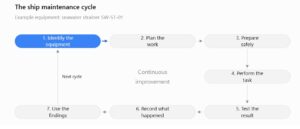
Ship maintenance cycle
Select a stage to explore the work and a shipboard example.
Pump example:
1. Identify the equipment
Confirm the correct equipment, its function, identification tag and applicable instructions.
Match the cooling-water pump tag to the maintenance job and the correct manufacturer’s manual.
2. Plan the work
Define the task, people, tools, spares, timing and criteria for a satisfactory result.
Plan a pump inspection, confirm spare availability and arrange continued cooling while the pump is unavailable.
3. Prepare safely
Complete the required risk assessment, permits, communication and verified isolations before starting work.
Follow the ship’s procedure to prevent unexpected starting and release of stored energy, and verify that the pump is safe to work on.
4. Perform the task
Follow approved instructions, use suitable tools and report unexpected conditions.
Inspect and service the pump as specified; record observed wear and measurements during the work.
5. Test the result
Restore and test under the approved procedure. Compare results with acceptance criteria before release to service.
Check the specified operating parameters and inspect for abnormal leakage, noise or vibration. Report unacceptable results for corrective action.
6. Record what happened
Enter the work completed, parts used, measurements, defects and test results in the maintenance system.
Record the pump’s condition, any replaced parts and the outcome of the operational test, including outstanding defects.
7. Use findings to plan the next task
Review the findings and trends to identify follow-up work and propose authorised changes to future maintenance.
Use repeated wear or abnormal test findings to plan investigation and review the next inspection with the responsible engineer.
A computer programme can support this cycle, but it cannot replace the people making technical decisions. A reminder on a screen does not prove that machinery is safe. The crew must inspect the equipment, carry out the work correctly and report its real condition.
Why do ships need planned maintenance?
A ship operates far from repair workshops and may have little opportunity to stop. Its equipment also works under demanding conditions: vibration, salt water, humidity, changing loads and continuous operation. A small fault can grow while the vessel is at sea.
Consider a diesel generator. Routine checks may detect cooling-water leakage, deteriorating lubricating oil, a dirty filter or a change in exhaust temperature. Addressing the cause early may prevent a breakdown. If the generator fails unexpectedly during a manoeuvre, the crew faces a much more difficult situation.
Planned maintenance helps a ship:
- Keep essential equipment available
- Find deterioration before it becomes a serious failure
- Organise people, spare parts and suitable work periods
- Record defects and confirm that corrective action was effective
- Support statutory and classification requirements
- Reduce avoidable downtime, waste and fuel consumption
It does not mean that failures will never happen. The purpose is to manage equipment condition systematically and respond to problems before their consequences become greater.
Is a PMS required by maritime rules?
The key international reference is the International Safety Management (ISM) Code, made mandatory through SOLAS chapter IX. Section 10 of the Code addresses maintenance of the ship and equipment. It calls for procedures that keep the ship in conformity with relevant requirements, inspections at appropriate intervals, reporting of non-conformities, corrective action and records. It also calls for particular attention to equipment whose sudden failure could create a hazardous situation, including the regular testing of standby arrangements. imo.org
The ISM Code sets out what the company’s maintenance arrangements must achieve. It does not require every ship to buy one particular PMS software product or use the same work-order screen. The company develops a suitable process within its Safety Management System (SMS).
Other obligations affect individual equipment. Manufacturers provide operating and service instructions. Flag-state and statutory requirements apply to relevant ship systems. Classification societies set survey and machinery requirements. A ship’s PMS brings these sources together so that important tasks do not depend solely on someone remembering them.
For a cadet, the practical lesson is simple: always check the source of a maintenance requirement. A task may come from the maker’s instructions, a company procedure, a class survey arrangement, a statutory requirement or an observed defect. Its origin affects who may change its interval and how its completion must be documented.
What equipment appears in a ship’s PMS?
Most systems begin with an equipment register: a structured list of the machinery and fittings onboard. It may be arranged by department, system, location and individual item.
For example:
Engine department → seawater cooling system → No. 2 seawater pump → motor, bearings, seal and strainer
Each item may have an identification number, maker, model, serial number, location, manual, spare-parts list, maintenance instructions and history. The register needs to reflect what is actually installed. If a pump motor is replaced but the PMS still lists the old motor, future tasks and spare-parts orders may be wrong.
A PMS may include items such as:
| Ship area | Examples of equipment and tasks |
|---|---|
| Engine room | Diesel generators, pumps, purifiers, compressors, boilers, heat exchangers and valves |
| Propulsion | Main engine components, shafting support systems and associated controls |
| Deck | Windlass, mooring winches, cranes, cargo equipment, hatch covers and coatings |
| Safety | Fire detection, emergency fire pump, emergency generator and other standby equipment |
| Electrical and automation | Switchboards, batteries, alarms, sensors and control panels |
| Hull and accommodation | Structural inspections, ventilation, refrigeration, freshwater and sanitary systems |
The exact scope depends on the ship. A tanker, container ship and passenger ship do not have identical maintenance priorities.
How does the PMS decide when a job is due?
A maintenance task needs a trigger. Common triggers include calendar time, equipment running hours, an operating event or a measured change in condition.
| Trigger | Simple example |
|---|---|
| Calendar interval | Inspect an emergency pump each month |
| Running hours | Service a generator component after the specified operating hours |
| Operating event | Inspect equipment following an abnormal trip or repair |
| Condition | Investigate a rising vibration trend or deteriorating oil analysis |
| Survey or inspection date | Prepare a component for an applicable class or statutory examination |
These are examples of scheduling methods, not universal intervals. A maker’s instructions, operating experience and applicable requirements determine the correct task and timing. For an approved class machinery PMS, IACS guidance expressly considers manufacturer recommendations, documented operator experience and condition monitoring where fitted.
Running-hour schedules are particularly useful on ships with several similar machines. Suppose two generators were installed together. One runs most days; the other is used less often. A calendar-only schedule could treat them identically even though their accumulated use is different. Running hours allow some work to follow actual operation, while calendar-based checks still cover age-related deterioration and equipment that is seldom used.
That last point matters. Standby equipment needs attention too. An emergency pump may appear new because it rarely runs, yet its seals, battery, fuel supply or starting arrangement may fail when needed. The ISM Code specifically addresses regular testing of standby equipment and systems that are not continuously used. wwwcdn.imo.org
Preventive, corrective and condition-based maintenance
A PMS is easier to understand when you distinguish the main types of maintenance.
Preventive maintenance is planned before a known failure. Examples include inspecting a strainer, servicing a compressor or replacing a component at a specified interval. The task aims to keep equipment within an acceptable condition.
Corrective maintenance responds to a defect already found. A leaking mechanical seal, failed pressure switch or damaged cable needs investigation and repair. Corrective work may be scheduled if the equipment remains safe under an approved arrangement, or it may require immediate action.
Condition-based maintenance uses observations and measurements to decide when further inspection or work is needed. Examples include vibration readings, lubricating-oil analysis, temperature trends and insulation-resistance measurements. The important word is trend: one reading becomes more useful when compared with previous readings taken under comparable operating conditions.
Some companies also use reliability-centred maintenance, which examines how equipment can fail and what the consequences would be, then selects suitable tasks. This approach requires reliable data and competent review. It does not give the crew permission to discard a maker’s instructions or extend a class-related interval on its own. Classification guidance describes approved approaches that incorporate operational experience, condition data and the risk impact of equipment failure.
A modern ship often uses a combination of these methods. A seawater pump might have a monthly visual inspection, a running-hour service, regular vibration readings and a corrective work order if its seal begins to leak.
What does a maintenance work order contain?
A work order is the instruction and record for a particular job. It connects the equipment, the required action, the people doing the work and the result.
A typical work order may show:
- Equipment name and identification number
- Job title and reason for the task
- Due date or running-hour trigger
- Step-by-step instructions and reference manual
- Required competence, tools and spare parts
- Safety precautions, permits and isolation requirements
- Measurements or acceptance criteria
- Findings, parts used and work completed
- Functional test and return-to-service confirmation
- Names, dates and any review or approval
Here is a simplified example.
Equipment: No. 2 seawater cooling pump
Task: Inspect coupling and check for leakage
Reason: Scheduled inspection, with vibration concern reported on the previous watch
Before work: Confirm operational need for the pump; prepare an approved alternative cooling arrangement if required; isolate and secure the equipment under the ship’s procedure
Findings: Record coupling condition, leakage, vibration and any abnormal wear
After work: Restore guards and connections, test under normal operating conditions, record readings and report unresolved defects
A good work order says what was found, not only “job done.” If the pump remains noisy, the record must say so. Closing the task without recording the unresolved condition hides information from the next watchkeeper and the shore technical team.
The maintenance cycle in practice
Let us follow a routine task from start to finish.
1. The task becomes due. The PMS generates a reminder based on its interval or running-hour counter. The responsible officer reviews it alongside operational needs, outstanding defects and other work.
2. The work is planned. The team checks the manual, spare parts, tools, personnel and time required. They consider whether the equipment can be stopped safely. Maintenance on a pump supplying a live cooling system may need an alternative pump running first.
3. Risks are controlled. The team follows the ship’s permit-to-work and isolation procedures where required. They consider electrical energy, pressure, hot surfaces, moving parts, stored energy and substances inside the equipment. Isolation is verified before anyone begins opening machinery.
4. The work is carried out. The crew follows the applicable instructions and records unexpected findings. If the job reveals additional damage, they do not simply continue beyond their authority or conceal it inside the original task.
5. The equipment is restored and tested. Tools and temporary materials are removed, guards are replaced, isolations are cleared under the procedure, and the equipment is tested. The team checks for leaks, alarms and correct operation.
6. The result is recorded. The work order states what was done, what was measured, which parts were used and whether the equipment was returned to service. Any remaining problem becomes an open defect with a follow-up action.
The final test is as important as the maintenance itself. A repaired pump that has not been tested under suitable conditions is not yet proven ready for service.
What should cadets learn about maintenance safety?
Cadets often help with cleaning, inspection, measurements and preparation. These are valuable learning opportunities, but maintenance can expose a person to hazards that are not obvious when the machine is running normally.
Before joining a task, ask:
- What equipment are we working on, and what does it supply?
- Can it start automatically or remotely?
- What electrical, hydraulic, pneumatic or mechanical energy is present?
- Is the system pressurised, hot or filled with a hazardous substance?
- Which isolation and permit procedures apply?
- Who will supervise the work?
- How will we prove that the equipment is safe to return to service?
For example, pressing stop on a control panel is not necessarily a safe electrical isolation. A standby pump may receive an automatic start command if the running pump fails. The work team must identify and control that possibility under the ship’s procedure.
If the job changes, the risk assessment may need to change too. Replacing a filter is different from discovering a cracked housing or opening a connected pipe. Stop and consult the responsible officer when the actual condition no longer matches the planned task.
What happens when a defect is found early?
A planned inspection is valuable because it can reveal a problem while equipment still works. The correct response is to describe and report the defect, assess its effect and decide on a controlled action.
Suppose a cadet notices small amounts of oil beneath a generator. The first report should be factual: the location, approximate amount, whether leakage appears active, and any related changes in pressure or temperature. The responsible engineer can then inspect it, assess the risk and determine whether the machine can continue running, must be changed over or must be stopped.
A defect may create a separate corrective work order. It may also require a company report or notification to class or the flag Administration, depending on the equipment and the seriousness of the damage. The PMS record should connect the original observation, investigation, repair and successful test.
An overdue task and an equipment defect are different things. A task can be overdue even when equipment appears healthy; a serious defect can occur the day after scheduled maintenance. Both need attention.
What if a planned job cannot be completed on time?
Ship operations do not always allow a task to be performed on its due date. The vessel may be at sea, equipment may be needed continuously, weather may prevent deck work, or a spare part may be unavailable.
A controlled postponement starts with an assessment: What is the risk of waiting, what temporary measures are needed, who has authority to approve the change, and when will the task be done? The answer depends on the task, the company’s SMS, the maker’s instructions and any class or statutory conditions.
The crew should record the reason, revised plan and approval required by its procedures. A critical safety test cannot be treated in the same way as a low-priority cosmetic task. Nor should an overdue job be marked complete merely to clear a warning on the screen.
Repeated postponements are useful information. They may reveal an unrealistic interval, inadequate spares, poor access to equipment or insufficient time allocated to maintenance. The company should address the underlying cause.
Spare parts: maintenance depends on preparation
A work order may be ready, but the job cannot be completed without the correct seal, filter, gasket or bearing. Many PMS products therefore connect equipment records with spare-parts lists, stock levels and purchasing systems.
Good preparation means checking the part number and equipment version, not merely finding something with a similar description. The wrong material or size can cause a leak or repeat failure. Consumables also need appropriate storage and shelf-life control where relevant.
Ships must decide which spares are especially important to carry. The decision depends on equipment criticality, redundancy, voyage pattern, delivery time and repair options. A low-cost part can be operationally important if its absence stops a vital system.
When a spare is used, the maintenance record should identify it and the inventory should be updated. This helps the next crew know what was fitted and whether stock must be replenished.
Who is responsible for the PMS onboard?
Responsibility is shared, but tasks and approval levels should be clear. The master has overall command of the ship. The chief engineer normally leads machinery maintenance; the chief officer commonly oversees deck and cargo equipment maintenance. Other officers, ratings and specialists carry out assigned tasks within their competence. Shore superintendents provide technical support, resources and oversight.
On a ship using a class-approved machinery Planned Maintenance Scheme, IACS UR Z20 identifies the chief engineer as the responsible person onboard for that scheme and sets requirements for signing overhaul documentation and controlling changes to computerised maintenance records. This is a specific class survey arrangement; it should not be confused with every routine PMS entry across all departments.
Cadets contribute by observing carefully, using the correct equipment identification, making accurate measurements and asking questions. They should not sign off work they did not perform or understand. An honest note that a task was completed under supervision is more useful than a confident but inaccurate record.
PMS records and class surveys: what is the difference?
Almost every ship needs organised maintenance arrangements under its SMS. Separately, a classification society may approve a machinery Planned Maintenance Scheme as an alternative way of handling certain machinery survey items.
Under IACS UR Z20, the approved scheme applies to specified machinery within its scope. It involves submitted documentation, an implementation survey, records, annual review and an annual audit. Machinery outside the scheme remains subject to its usual survey arrangements. Poor records, unsatisfactory machinery condition or exceeded agreed overhaul intervals can affect the approval.
This explains a distinction that often confuses cadets:
| Term | What it means |
|---|---|
| Shipboard PMS | The company’s process or software for planning and recording maintenance |
| Class-approved machinery PMS scheme | A formally approved survey arrangement for specified machinery, subject to class rules and audit |
Having PMS software does not automatically mean the ship has a class-approved machinery scheme. Lloyd’s Register has also distinguished widespread use of computerised maintenance systems from the smaller number of vessels enrolled in its approved machinery planned-maintenance arrangement. LR
How does maintenance affect energy efficiency?
A ship can be safe to operate yet consume more fuel than necessary because equipment condition has deteriorated. Maintenance and energy efficiency therefore connect in practical ways.
A fouled seawater cooler may force pumps to work harder or reduce the performance of machinery it cools. An inefficient air compressor may run longer to maintain pressure. Leaks in steam, compressed-air or fuel systems waste energy and may indicate a safety concern. Poor engine condition can affect combustion and performance. Hull and propeller fouling increase resistance, so maintaining their condition can reduce the power needed to maintain speed.
The relationship is not always as simple as “complete a PMS job and fuel use falls.” Ship speed, weather, draft, loading and operating mode affect consumption. Engineers should compare performance under reasonably similar conditions and look for consistent trends.
The IMO describes the Ship Energy Efficiency Management Plan (SEEMP) as an operational mechanism for improving efficiency through good practice and monitoring. IMO guidance also notes that managing hull biofouling can improve hydrodynamic performance and reduce fuel use and emissions. A PMS can help turn suitable efficiency measures into assigned, recorded work. 4 October 2024
For a junior officer, this is a useful shift in thinking: maintenance is not only about preventing a blackout or passing an inspection. The condition of equipment also affects how much energy the ship needs to perform its work.
What makes a modern PMS “modern”?
Many current systems are computerised. They can show jobs due across the fleet, send work orders to ships, attach manuals and photographs, link spare parts, and help shore staff review defects. Some accept running-hour data from machinery systems or import condition-monitoring results.
These features can help, but they introduce new responsibilities. The equipment register must be accurate. Running-hour counters must be checked. Users need appropriate access rights. Ships with limited connectivity need reliable synchronisation and backups. Instructions must remain available when a network or screen is unavailable.
More advanced systems may use sensor data to flag changes in machinery condition. A trend can direct attention to a developing problem, but it still needs technical interpretation. A temperature increase might indicate a bearing problem—or a change in load, cooling conditions or sensor performance. The value of digital monitoring depends on the quality of the data and the crew’s response.
Classification guidance recognises the growing role of condition monitoring and data-based maintenance, while keeping approval and survey controls around schemes that use those methods. LR
A day in the life of a junior engineer using the PMS
At the beginning of the day, a junior engineer reviews due work with the supervising engineer. A generator inspection is due by running hours, and a seawater pump vibration check is due by calendar interval. The ship is approaching port, so the team considers which machine can be released without affecting manoeuvring readiness.
They check the generator’s manual and the required spares. The generator job is scheduled for a suitable operating window. Meanwhile, the pump vibration reading is taken under a recorded load and compared with earlier readings. It is higher than before, although still below the relevant alarm setting.
The engineer records the reading and reports the trend. The chief engineer decides on further investigation and creates a follow-up task. Nothing has failed, yet the PMS has already done useful work: it has connected a measurement, previous history and a planned response.
This example also shows why a junior officer should read the history before starting the job. The earlier record may explain that a coupling was recently changed or that the pump has shown a rising trend over several weeks.
-
Common PMS mistakes to avoid
Closing jobs without doing them. This produces reassuring records but leaves the ship exposed to the original risk.
Writing “checked and found OK” for every task. A useful record includes relevant measurements, observations or test results where the job requires them.
Treating due dates as the only source of maintenance. Watchkeeping observations and unexpected defects must enter the system too.
Ignoring repeat faults. Replacing the same component several times without investigating the cause may leave a larger problem unresolved.
Using the wrong equipment record. Similar pumps and generators may have different histories, parts or running hours.
Changing intervals casually. A maintenance interval may have a maker, company or class basis. Changes need the appropriate technical review and approval.
Forgetting the return-to-service test. Completion means the equipment has been restored, checked and reported accurately—not merely reassembled.
-
Questions cadets often ask
Is the PMS the same as the engine-room logbook?
No. The logbook records operations and events required by the ship’s procedures. The PMS plans maintenance and keeps the history of work and defects. A significant event may need to appear in both, with each record serving its own purpose.
Does every PMS task involve dismantling machinery?
No. Many tasks are inspections, operational tests, measurements, cleaning or lubrication. Opening equipment unnecessarily can itself introduce risk, so the task should match the approved instructions and equipment condition.
Can condition monitoring replace all routine maintenance?
No. Measurements can improve decisions about some machinery, but they do not reveal every failure mode. Safety tests, inspections, maker instructions and applicable survey requirements still need to be considered.
What should I do if I see a defect that has no PMS job?
Report it to the responsible officer promptly. Record it through the ship’s defect-reporting process rather than waiting for the next planned task. Follow the immediate safety instructions given for that equipment.
Who decides whether an overdue job may be postponed?
The company’s SMS identifies the necessary assessment and approval. The decision also depends on the equipment’s importance and any maker, statutory or class requirement. A cadet or junior officer should report the constraint, not silently change the due date.
Final takeaway
A ship’s Planned Maintenance System is a working record of how the crew looks after the vessel. It tells people what needs attention, helps them prepare the work safely, preserves what they found, and ensures defects receive follow-up.
For cadets and junior officers, the best starting habit is to connect three things every time you encounter a PMS task: the equipment in front of you, its maintenance history, and its role in the ship’s operation. That turns a scheduled job into an informed technical decision.
References and further reading
- IMO: International Safety Management (ISM) Code
- IACS UR Z20: Planned Maintenance Scheme for Machinery
- IMO: Improving the energy efficiency of ships
- IMO: Biofouling and ship performance
Questions for Students and Ship Cadets: Planned Maintenance Systems
For each question, choose one answer, then answer the open-ended prompt in your own words.
1. What is the main purpose of a ship’s Planned Maintenance System (PMS)?
A. To replace the need for engine-room inspections
B. To organise, schedule and record maintenance and defects
C. To monitor cargo quantity only
D. To ensure equipment never fails
Explain your choice: How does a PMS help the crew maintain equipment?
2. What does the ISM Code require in relation to ship maintenance?
A. Every ship must use the same PMS software
B. Maintenance should be organised, inspected, recorded and followed up under the company’s procedures
C. Only the chief engineer may report defects
D. Standby equipment does not need regular testing
Explain your choice: Why should the crew check the applicable company, maker, class or statutory requirements for a task?
3. Which item is a common trigger for a PMS task?
A. A change of watch
B. A running-hour reading reaching the specified interval
C. The arrival of a new cadet
D. A change in the ship’s destination
Explain your choice: Give one example of a task triggered by calendar time, equipment hours or a change in condition.
4. A seawater pump’s vibration readings have risen compared with previous readings taken under similar operating conditions. Which maintenance approach does this best illustrate?
A. Corrective maintenance
B. Condition-based maintenance
C. Emergency maintenance only
D. No maintenance, because the pump is still running
Explain your choice: Why is comparing readings over time useful?
5. A cadet notices a defect, but there is no planned PMS job for it. What should the cadet do?
A. Wait until the next scheduled maintenance task
B. Close a work order to show that the defect was checked
C. Report it promptly to the responsible officer and follow the ship’s defect-reporting process
D. Repair it without informing anyone
Explain your choice: Why should an unexpected defect be reported even if the equipment is still operating?
6. What should normally happen before a maintenance task is considered complete?
A. The equipment is reassembled, appropriately tested and the work and findings are recorded
B. The work order is closed before testing
C. Only the spare parts used are recorded
D. The equipment is returned to service without checking it
Explain your choice: Name two useful details that should be included in the maintenance record.
7. How can maintenance support a ship’s energy efficiency?
A. By keeping equipment in good condition and identifying problems such as fouled coolers or leaks
B. By increasing equipment running hours
C. By replacing every component at every inspection
D. By recording fuel use without inspecting machinery
Explain your choice: Describe one way poor equipment condition could increase energy use onboard.
Answer key for instructors
B
B
B
B
C
A
A