
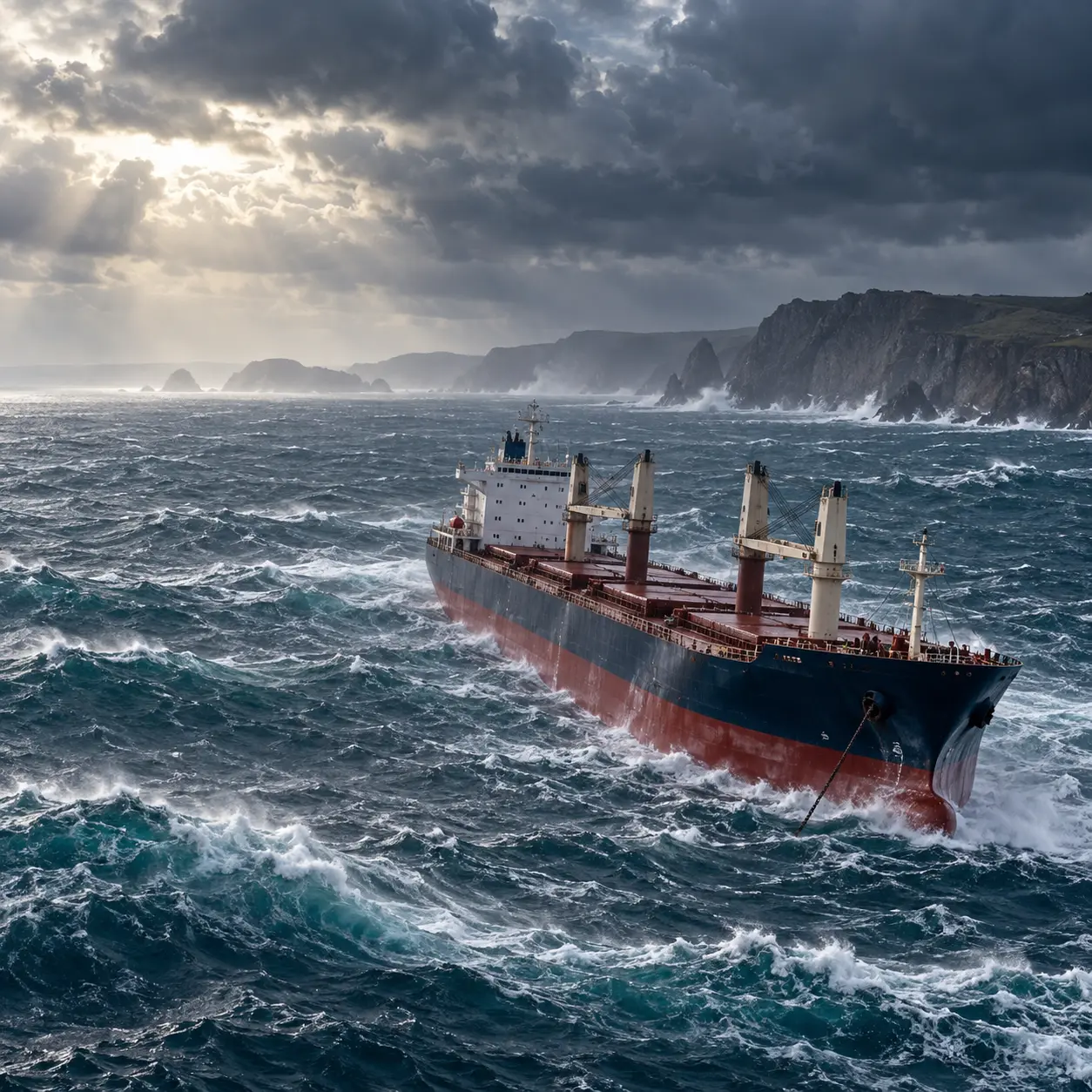
 Learn why ships drag anchor in rough seas, how bridge teams identify loss of holding, and why early action, a safe anchor watch and good voyage planning matter near the coast.
An anchored ship can look calm and secure. The anchor is down, the engines may be stopped, and the bridge team is watching the weather. But when wind strengthens, waves build and the ship begins to move downwind, the situation can change very quickly.
This is known as dragging anchor. The anchor, cable and seabed are no longer providing enough holding force to keep the vessel in its intended position. The ship may slowly creep across the chart, or it may move rapidly towards shallow water, another vessel, a breakwater, a reef or the shore.
Near a lee shore in rough weather, there may be very little time to recover. A grounding can damage the hull, flood spaces, release fuel or cargo, block a port, and put the crew and rescuers in danger. The lesson is simple: anchoring is not a passive activity. In heavy weather, it is an active navigational operation that needs planning, watchkeeping, early decisions and clear communication.
This article explains how anchor dragging develops, the warning signs bridge teams should take seriously, and the practical lessons that apply to cadets, officers and masters. It is written for learning and awareness. Every actual response must follow the master’s judgement, the vessel’s Safety Management System (SMS), class and flag requirements, local VTS instructions and the conditions at the time.
What does “dragging anchor” mean?
An anchor holds when it has properly engaged with the seabed and the anchor cable helps maintain a favourable pulling direction. The ship should remain within its expected swinging circle, allowing for changes in wind, tide and current.
Dragging begins when the anchor loses its grip, does not fully set, or the forces acting on the vessel become greater than the available holding power. The anchor may skip or plough over the seabed. The ship then drifts or moves in an unplanned direction, often with wind and current.
Dragging anchor is sometimes confused with normal swinging at anchor. A vessel can rotate around its anchor as wind or tide changes, and this is expected. The concern begins when the vessel’s position moves outside the anticipated anchorage area, when the distance from the anchor position increases unexpectedly, or when the ship is clearly making way over the ground in a dangerous direction.
The anchor itself is only one part of the holding system. Safe holding depends on the complete arrangement:
- the type and condition of the anchor;
- the cable, windlass, brakes, stoppers and associated equipment;
- the depth of water and the length of cable used;
- the nature of the seabed;
- the ship’s draught, trim, windage and loading condition;
- wind, waves, swell, current and tidal stream; and
- the time and sea room available if the ship must leave the anchorage.
This is why there is no simple rule such as “use more cable and the ship will be safe.” More cable can help in suitable circumstances, but it also changes the swinging circle, the loading on equipment and the time needed to weigh anchor. It must be a deliberate decision, not an automatic reaction.
Why rough seas make anchoring dangerous
Rough weather does more than push a ship sideways. It creates a combination of loads that can become severe.
Wind pressure acts strongly on accommodation blocks, deck cargo, container stacks, cranes and large hull sides. A lightly loaded ship with a large exposed area can be particularly vulnerable.
Waves and swell make the vessel yaw, pitch and surge. These movements can repeatedly load and unload the cable, creating shock loads.
Current and tide may act from a different direction to the wind. The ship may lie at an angle, sheering from side to side instead of remaining steadily head-to-wind.
Poor holding ground can prevent the anchor from digging in securely. Mud, sand, clay, gravel, rock and mixed seabeds do not all behave in the same way. Charted anchoring information, local knowledge and port advice matter.
Limited sea room turns a manageable drift into an emergency. A ship may technically have time to re-anchor in open water but have no safe margin when a rocky coast or shallow bank lies downwind.
The International Association of Classification Societies makes an important design distinction: normal anchoring equipment is intended for temporary mooring in a harbour or sheltered area, while awaiting a berth, tide or similar purpose. It is not intended to hold a vessel off a fully exposed coast in rough weather or to stop a ship that is already moving or drifting.
This point is often missed in dramatic videos of vessels close to shore. An anchor is not a storm-proof brake.
Watch the video and subscribe to MaritimEducation YouTube channel:
Common reasons why ships drag anchor
Anchor dragging rarely has only one cause. A chain of technical, environmental and human factors is usually involved.
1. The anchorage is too exposed for the forecast
An anchorage that is acceptable in moderate weather can become unsafe when the wind backs or veers, a frontal system arrives, swell increases or the tidal stream strengthens. The problem is not simply the wind speed. The direction of the force and the amount of sheltered water are equally important.
An exposed anchorage may have no safe escape route once weather deteriorates. If the coast is downwind, the ship can become trapped between the risk of weighing anchor in difficult conditions and the risk of remaining at anchor until it drags.
2. Poor anchor setting or unsuitable ground
An anchor may initially appear to hold but may not be fully embedded. This can happen if the vessel is not carefully brought astern to set the anchor, if the cable is not led and controlled as intended, or if the seabed does not provide reliable holding.
The bridge team should not assume that an anchor is holding simply because the cable has been paid out. Position checks, cable behaviour and the vessel’s movement over time are needed to confirm the result.
3. Insufficient scope for the actual conditions
The correct amount of cable is a ship-specific and situation-specific decision. Water depth, tidal range, chart datum, freeboard, wind, current, holding ground, nearby traffic and available swinging room must all be considered.
Too little cable may produce an unfavourable cable angle and reduce the anchor’s ability to hold. However, paying out excessive cable in a crowded anchorage can create collision risk and large swinging circles. In rough weather, large lengths of cable can also experience high dynamic loads. The answer is proper planning, not a universal number of shackles.
4. Ship movement, yawing and shock loading
A vessel may sheer repeatedly from side to side in gusts, waves and changing current. The cable can snatch as it comes tight. Heavy yawing changes the direction and magnitude of force on the anchor and can help it break out of the seabed.
The risk becomes greater for ships with high windage, reduced draught or unusual loading conditions. These factors should be discussed before anchoring, especially when a deteriorating forecast is expected.
5. Anchor equipment condition or failure
Wear, corrosion, damaged links, brake problems, slipping, windlass defects and poor maintenance can weaken the system. Prolonged anchoring in adverse weather can accelerate wear and increase the chance of failure.
The UK Marine Accident Investigation Branch highlighted this risk after multiple cruise-ship anchor failures during prolonged anchoring in strong winds and tidal streams. The message applies more widely: anchor equipment requires inspection, maintenance and operational limits that reflect the actual conditions.
6. Waiting too long to act
This is often the most important operational factor. A bridge team may see the weather worsening but wait for a clearer sign that the anchor is dragging. By then, the cable may be heavily loaded, the anchor party may not be ready, engines may not be on immediate notice, and the ship may have lost the sea room needed for a safe departure.
Early action does not mean leaving an anchorage without thought. It means making the decision while safe options still exist.
How can a bridge team recognise anchor dragging?
No single instrument should be trusted alone. The best protection is to combine visual observation, electronic navigation equipment, cable observation and local information.
Watch the position trend, not only one position
An anchor watch should use more than one position reference where practical. GPS/ECDIS, radar ranges and bearings, visual marks, AIS information from nearby ships and VTS advice can all contribute to situational awareness.
An anchor-drag alarm can be useful, but it must be set with care. A ship has a normal swinging circle. If the alarm radius is too small, it produces nuisance alarms and may be ignored. If it is too large, it activates too late. The alarm should consider the anchor position, the length of cable, water depth, expected swing, navigational hazards and the time needed to respond.
The important question is not only, “Has the alarm sounded?” It is, “Where will the ship be in 10, 20 or 30 minutes if the movement continues?”
Use radar and visual bearings
Radar can show whether fixed objects or shoreline ranges are changing unexpectedly. Repeated bearings to prominent objects, buoys or radar targets can reveal movement that a single GPS display may not make obvious.
In poor visibility, radar becomes even more important. It also helps the team maintain awareness of other vessels that may be dragging or manoeuvring in the same anchorage.
Observe the anchor cable
The anchor party’s observations are valuable. The direction in which the cable leads, whether it is tight or slack, and whether it is surging or snatching can give early clues about the forces acting on the ship.
However, deck work near an anchor cable in rough weather is hazardous. The cable and fittings can move suddenly, and the risk of injury is real. The master must balance the need for information with the safety of the crew on deck. Communication between bridge and forecastle must be clear, disciplined and compatible with the vessel’s procedures.
Take changing weather seriously
Forecasts, barometric pressure, wind trend, swell direction, tides and current should be reviewed continuously. A calm period after anchoring does not guarantee a safe night ahead.
The master should establish clear call-out criteria: for example, a specified wind trend, reduced distance to a downwind hazard, abnormal cable behaviour, loss of position margin or a change in forecast. The exact criteria must suit the vessel and anchorage.
Safe anchor watch: more than watching a screen
STCW watchkeeping provisions require a safe anchor watch. IMO guidance for masters at open or unsheltered anchorages stresses the need for watchkeeping arrangements that are adequate at all times. This is especially relevant when the anchorage is effectively “at sea” because of exposure to wind, swell and current.
A good anchor watch has three elements: people, information and readiness.
People
The officer of the watch needs enough support and enough rest to remain alert. Anchor watch can become demanding when weather deteriorates, traffic is dense, pilots are being arranged or deck activity is required. Fatigue is a safety issue, not a personal weakness.
The master must be called in accordance with the standing orders and the developing risk. A high-risk anchor watch is not the time for hesitation or informal decision-making. The engine room should also receive timely information so that propulsion can be made ready without avoidable delay.
Information
The watch should know the anchor position, cable length, water depth, tidal information, planned swinging circle, nearby vessels, charted dangers, local reporting requirements and the ship’s emergency departure plan.
The record of anchor-watch events should show significant weather changes, position checks, radar observations, alarms, communications and decisions. This is useful for continuity between watches and for later learning.
Readiness
Readiness means more than “engines on standby” written in a logbook. It includes practical preparation: machinery status, steering readiness, bridge manning, anchor-party readiness, tug availability where relevant, pilot or VTS communication, and a realistic escape route.
If strong weather is forecast, it may be safer to move early to a more sheltered anchorage or proceed to sea, if this is consistent with the ship’s capabilities, port instructions and the master’s assessment. MAIB safety lessons emphasise this exact point: do not wait until the anchor is dragging or until most of the cable has already been paid out before deciding to weigh anchor.
What should happen if a ship starts dragging?
There is no universal emergency manoeuvre. The right response depends on depth, sea room, traffic, machinery condition, weather, cable load, proximity to shore and local authority instructions.
But the immediate priorities are clear: recognise the danger, bring the master and the ship’s emergency resources into the decision, protect life, and prevent grounding or collision.
Typical actions, directed by the master and the ship’s emergency procedures, may include:
- Confirm the developing movement. Check position, track, radar ranges and bearings. Determine the drift direction and the time remaining before a hazard is reached.
- Call the master without delay. Do not wait for certainty when there is a credible risk of grounding, collision or loss of sea room.
- Alert the engine room and prepare propulsion. The timing and machinery state are critical. Starting engines or changing machinery condition may take longer than expected.
- Increase bridge-team awareness. Establish clear roles for navigation, radar monitoring, communications and record keeping. Additional watchkeepers may be needed.
- Inform VTS, port control or the relevant coastal authority as required. VTS can provide traffic information, warnings and local support, but navigation and manoeuvring decisions remain with the master.
- Assess whether to weigh anchor, use propulsion, re-anchor, move to a safer position or proceed to sea. The plan must be based on the actual conditions, not a fixed sequence.
- Protect personnel during anchor operations. Do not expose the anchor party to dangerous deck conditions without a clear operational need and safe arrangements.
- Prepare for a possible grounding or loss of propulsion. This may include checking emergency steering, watertight integrity, communications, emergency response arrangements and pollution-prevention equipment, depending on the vessel and circumstances.
One point deserves special emphasis: the windlass is not designed to stop a ship that is moving or drifting. Attempting to hold a drifting vessel with the windlass or overstressed anchor equipment can cause serious equipment damage and put crew members at risk.
Decisions to heave, veer, hold or use machinery must be made with full awareness of equipment limits and the forces involved.
Why grounding near shore can become catastrophic
A ship grounding after dragging anchor is dangerous because it often happens in bad weather, close to land and with limited external assistance. The vessel may strike rocks, a sandbank, harbour works, offshore structures or another ship.
Possible consequences include:
- hull damage and flooding;
- injury to crew or passengers;
- loss of propulsion, steering or electrical power;
- cargo shift, cargo damage or loss of containers;
- pollution from fuel oil, lubricants, chemicals or cargo;
- closure of a port or waterway;
- difficult salvage operations; and
- damage to coastal habitats, beaches, fisheries or underwater infrastructure.
The environmental risk is especially serious in enclosed waters, near sensitive coastlines, or where a damaged vessel may remain exposed to repeated wave action. Even when the ship is safely evacuated, salvage can take weeks or months.
This is why the “last safe moment” is usually earlier than people think. Once the vessel is close to the shore, the options have already narrowed sharply.
Lessons for cadets and junior officers
The most valuable lesson is that good anchoring begins before the anchor is let go. Cadets and junior officers should learn to ask practical questions:
- Is this anchorage sheltered from the forecast wind, swell and current?
- What is the nature of the bottom, and what information supports that assessment?
- How much cable is planned, and why?
- What is the expected swinging circle and what hazards are nearby?
- What is the abort plan if the ship cannot hold?
- How long would it take to have engines, steering and anchor party ready?
- When must the master be called?
- Which position checks and alarms will be used during the anchor watch?
Training should also include communication. IMO Standard Marine Communication Phrases contain useful anchoring language, including “How is the cable leading?”, “How is the cable growing?” and “Is the anchor holding?”
Clear, closed-loop communication between bridge, deck team, engine room and VTS reduces misunderstanding at exactly the time when stress is high.
Simulator exercises are especially useful. A good scenario can combine anchoring in a congested roadstead, a worsening forecast, a dragging-anchor alarm, reduced machinery readiness and a downwind grounding risk.
The objective is not simply to press the correct control. It is to build situational awareness, prioritise actions, communicate early and understand that a safe decision made early is often less dramatic than a late recovery attempt.
Prevention is better than recovery
Preventing anchor dragging is not about never anchoring in strong weather. Ships must sometimes wait at anchor, and conditions can change unexpectedly. Prevention means managing the risk before it becomes an emergency.
Before anchoring, the bridge team should review the forecast, holding ground, depth, tidal range, cable plan, available swinging room, nearby traffic, charted hazards, engine readiness and contingency route. The master’s night orders and standing orders should identify what changes require an immediate call.
During the anchor watch, the team should monitor the ship’s trend, not just its present position. They should question assumptions when the weather changes and act before the sea room is lost.
For ship managers, prevention also means maintaining anchors, chains, windlasses, brakes, stoppers and associated equipment; auditing anchor-watch practices; using incident and near-miss reports to improve procedures; and ensuring crews are not fatigued when high-risk weather arrives.
Final message
Dragging anchor in rough seas is not a minor inconvenience. It is a navigational emergency that can quickly lead to grounding, collision, pollution and loss of life.
The anchor must be seen for what it is: an important tool for temporary holding in suitable conditions, not a guarantee that a ship can remain safely off an exposed coast in severe weather. Good seamanship means recognising the limits of the equipment, monitoring continuously, preparing the machinery and crew, communicating clearly and moving early when the risk grows.
The safest outcome often comes from a decision made before the anchor drags—not after the shore is already close.
Sources and further reading
- International Maritime Organization (IMO), Safety of Navigation, SOLAS Convention, and STCW Convention and Code.
- IMO, Guidance for Masters on Keeping a Safe Anchor Watch, STCW.7/Circ.14.
- IMO, Standard Marine Communication Phrases, Resolution A.918(22).
- IMO, Vessel Traffic Services.
- IACS anchoring-equipment design basis, summarised by the Nautical Institute.
- UK Marine Accident Investigation Branch (MAIB), Safety Digest 2/2021, including lessons from cruise-ship anchor failures.