
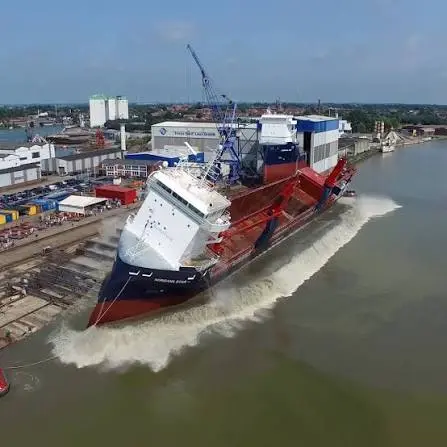
The moment a vessel is born
Few scenes in the maritime world are as dramatic as a newly built ship entering the water for the first time. A vessel that has spent months or years as a collection of steel plates, structural frames, machinery, cables, pipes and accommodation modules suddenly becomes a floating object. It may slide down a launchway, move sideways into a river, emerge from a flooded dry dock or be lowered from a floating platform. In every case, the instant is visually powerful because the ship appears to come alive.
Ship launching is often called the moment a vessel is born. The phrase is more than ceremonial language. Before launch, the ship is supported by land, blocks, cradles, transporters or a dock structure. After launch, the hull is supported primarily by buoyancy and is subject to the forces of wind, waves, current and water pressure. The ship has crossed a physical and engineering boundary between construction on land and operation at sea.
The spectacular images in videos about incredible ship launches show only the visible part of a carefully prepared operation. Behind the movement are calculations of weight, buoyancy, trim, stability, hull strength, friction, water depth, tidal level and stopping distance. Specialists must also coordinate tugs, winches, ballast systems, mooring lines, cranes, transporters, safety teams, marine traffic control and emergency arrangements.
A launch therefore combines shipbuilding, naval architecture, heavy transport and marine operations. It can last only a few seconds from the viewer’s perspective, yet the preparation may continue for weeks. The final movement is not a stunt and it is not simply a matter of releasing the brakes. It is a controlled transfer of a very large mass from one support system to another.
–
What does “launching a ship” actually mean?
In everyday language, launching means putting a new vessel into the water. Technically, shipyards use several terms. A ship may be launched from a slipway, floated out of a dry dock, transferred on a barge and then floated off, lowered by a shiplift, or moved on a cradle and submerged in a controlled facility. The result is similar—the hull becomes waterborne for the first time—but the engineering process is different.
The distinction between launching and float-out is especially important. Traditional launching normally involves a vessel moving along a sloping building berth or slipway until it reaches the water. Float-out normally describes a ship built inside a dry dock or construction basin. The dock is flooded, the water level rises around the hull, and the ship lifts away from its blocks when its displacement is supported by buoyancy.
The ship does not necessarily leave the shipyard after this event. A launch often takes place before the vessel is fully completed. The hull may be structurally complete and watertight, but accommodation spaces, electrical systems, navigation equipment, piping, propulsion machinery, paintwork, communications systems and mission equipment may still require installation or testing. The ship is then moved to an outfitting quay or another dock where construction continues.
This is why a launch is a milestone rather than a delivery. A ship that has entered the water still has to demonstrate that it can function safely, efficiently and reliably. Harbour trials, machinery tests, steering tests, builder’s trials, sea trials, classification inspections and flag-state requirements may all follow.
Watch the video:
–
The main methods used to put large ships into the water
End launching from a slipway
The traditional end launch is the image most people associate with shipbuilding. The vessel is constructed on an inclined slipway with its stern facing the water. It rests on a launching cradle or on a system of sliding ways. When the retaining arrangements are released, gravity causes the ship and its supporting structure to move down the slope.
The movement must be controlled. Friction between the sliding surfaces, the angle of the slipway, the vessel’s weight and the condition of the launching gear determine whether the ship starts moving and how quickly it accelerates. The operation may use lubricated ways, mechanical restraints, winches, hydraulic systems or other control equipment. Drag chains or tugs may be required to slow and guide the vessel after it reaches the water.
End launching is particularly demanding during the transition from land support to water support. At the beginning, the ship’s weight is carried by the slipway. As the stern enters the water, buoyancy begins to support part of the hull. The distribution of support changes continuously. For a short period, the ship may pivot around the forward edge of the submerged end of the slipway. This creates concentrated loads and changes the ship’s trim.
The launch designer must ensure that the ship does not become unstable, strike the end of the slipway, touch the bottom or continue moving beyond the safe area. Water depth is critical because a vessel that floats at the end of the launch must have adequate under-keel clearance. The waterway must also be wide and long enough for the ship to stop or be controlled by tugs.
Side launching
In a side launch, the vessel enters the water broadside rather than moving stern first. The ship may slide sideways from a shore-based berth or from a platform designed for transverse launching. This method can be useful when the shipyard does not have enough length of shoreline for a conventional end launch, or when local geography makes a longitudinal slipway impractical.
Side launching can look particularly dramatic because a large surface suddenly falls or slides into the water, producing a high wave. The visual effect, however, should not be confused with uncontrolled movement. The launching structure, support points, water depth, vessel stability and likely heel must all be assessed.
The water impact can be significant. As the hull contacts the water, its motion is converted into wave energy and hydrodynamic forces. The ship may roll or yaw as it becomes buoyant. Tugs, guide wires, fenders and other arrangements may be needed to prevent contact with the opposite bank or nearby structures. Side launches are often associated with smaller or medium-sized vessels, inland shipyards, barges, landing craft and vessels built near restricted waterways, although the method has also been used for much larger ships in suitable locations.
Float-out from a dry dock
Modern shipyards frequently build large ships in graving docks or covered construction docks. In this arrangement, the ship does not slide into the water. Instead, the dry dock is gradually flooded until the hull becomes buoyant and floats clear of its blocks.
The process appears gentle, but it demands precise control. The dock must be watertight and its gates, pumps, ballast systems, drainage arrangements and monitoring instruments must operate correctly. The water level is raised in a controlled sequence. Personnel monitor the vessel’s position, draft, trim, list, clearances and the condition of the blocks.
When the ship begins to float, it is no longer supported in the same way as it was during construction. Mooring lines and tugboats are prepared to control the vessel. Once the dock is flooded to the required level, the ship can be moved to an outfitting quay or fitting-out basin.
Float-out is common for container ships, tankers, cruise ships, naval vessels, offshore support vessels and other large ships. It allows shipyards to build very large vessels without requiring an extremely long inclined slipway. It also makes it possible to carry out much of the construction under shelter or inside a controlled dock.
Floating dry docks and semi-submersible barges
Another method uses a floating dry dock or a submersible heavy-lift barge. The ship may be assembled on land and moved by self-propelled modular transporters, often called SPMTs, onto a barge. The barge then transports the vessel to a deep-water location or a floating dry dock.
The floating dock is submerged by admitting water into its ballast tanks. As the deck goes below the ship’s waterline, the vessel becomes supported by water and can float free. The dock is then raised, or the ship is towed away, depending on the arrangement.
This method is valuable when a shipyard has limited waterfront space, when the construction hall is separated from the launch basin, or when the vessel is too large or too heavy for a conventional slipway. It also demonstrates how modern shipbuilding separates construction from launching. A ship can be fabricated in one area, transported across a yard or along a river, and floated in a facility designed specifically for the final transition.
Shiplifts and vertical transfer systems
A shiplift uses a large platform raised and lowered by synchronized mechanical or hydraulic equipment. The vessel is moved onto the platform while it is above water. The platform is then lowered until the ship floats, or raised to transfer a vessel from the water to a construction level.
Shiplifts offer precise vertical control and can use waterfront space efficiently. They are especially useful for shipyards that build many vessels of different sizes or that need a repeatable system for launching and docking. The platform and lifting mechanisms must remain synchronized so that the ship is supported evenly. Uneven movement can impose unacceptable loads on the hull or on the support structure.
Airbag launching and temporary systems
Inflatable marine airbags can be used to move and launch certain vessels, especially smaller and medium-sized ships, barges and vessels in locations where permanent launch infrastructure is limited. The ship is supported by a series of high-strength cylindrical airbags and moved down a prepared slope or onto the water.
This method may reduce the need for a permanent slipway, but it does not remove the need for engineering analysis. The airbag diameter, spacing, pressure, hull shape, slope, ground condition, vessel weight distribution, towing force and stopping arrangements all matter. Stability can change as the vessel moves and as the airbags deform. The method is therefore appropriate only when the equipment and procedure are designed for the particular hull and load.
–
The engineering behind a successful launch
Weight and buoyancy
The basic physical principle is simple: a floating vessel displaces a quantity of water whose weight equals the vessel’s weight. The challenge is that the transition to this condition occurs gradually and unevenly.
Before launch, the vessel’s weight is carried by keel blocks, side blocks, cradles, transporters, dock blocks or launching ways. During launch, the water supports an increasing part of the hull. Engineers calculate how the buoyant force changes as more of the hull enters the water and how this affects the load remaining on the supports.
The ship’s weight is not distributed uniformly. Heavy machinery, tanks, batteries, ballast, generators, propulsion components and structural reinforcements may be concentrated in particular areas. If the weight distribution is different from the launch calculation, the vessel’s trim and support loads may also be different. This is why the launch condition is carefully controlled and why changes made late in construction can require a new review.
Trim, list and stability
A ship must enter the water with acceptable longitudinal trim and transverse stability. Trim describes the difference between the forward and aft drafts. List describes an unintended inclination to port or starboard. Both can affect how the hull contacts the water, how it moves through a dock or slipway, and how safely it can be controlled.
During a slipway launch, the vessel may rotate around a temporary pivot point as buoyancy increases. Research on longitudinal launches identifies the transition between partial buoyancy and full float-off as a critical stage because the hull can experience a change in support and a risk of tipping or excessive local pressure if the design is not properly calculated.
The launch condition is not always the same as the final operating condition. A ship may be launched with incomplete machinery, empty fuel tanks, temporary ballast, unfinished superstructure or limited stores. Engineers therefore evaluate the vessel’s stability in the specific condition in which it will enter the water. Later, when the ship is fully outfitted, its displacement and centre of gravity will change again.
Hull strength and local pressure
A ship’s hull is designed to withstand the loads imposed by waves, cargo, machinery and water pressure during service. Launching can create a different set of loads. Supports may be concentrated at blocks, cradle points or transport beams. As buoyancy rises under the hull, some areas may be relieved while others continue to carry weight.
The shipyard checks longitudinal bending, local plate pressure, block reactions, cradle forces and the capacity of the launching structure. A hull that is strong enough at sea is not automatically safe during every stage of launch because the support pattern may be very different from the distribution of hydrodynamic pressure during normal operation.
Friction, acceleration and stopping distance
For an end launch, friction is both a useful control factor and a source of uncertainty. Too much resistance may prevent movement or create excessive forces in the restraint system. Too little resistance may allow the ship to accelerate more quickly than planned.
Engineers consider the slope of the ways, the condition of the sliding surfaces, lubrication, temperature, rain, contamination and the condition of the cradle. The launch must also account for the ship’s speed when it becomes waterborne. A ship cannot simply be allowed to continue forward until natural resistance stops it. Drag chains, winches, tugs or other control systems may be arranged to limit the motion.
Water depth and hydrodynamic effects
The waterway outside the launch site must be surveyed. The available depth changes with tide, river level, dredging, weather and sediment. A vessel that is safe at one water level may have inadequate clearance at another.
Hydrodynamic effects also become important as the hull enters the water. The moving hull creates waves and water resistance. Restricted channels can amplify the effect of the displaced water and may reduce the room available for turning or stopping. Nearby banks, moored vessels, bridges, dolphins and quay walls must be considered.
The launch plan may specify a particular tide or water level. It may also set limits for wind, current, visibility and wave conditions. These limits are not formalities. Environmental conditions can change the ship’s speed, yaw, mooring loads and tug performance.
–
What happens before launch day?
The launch itself is usually the final step in a long preparation process. A shipyard may coordinate the following activities:
- **Completion of the launch condition.** The hull must be sufficiently complete, watertight and structurally ready to float. Temporary arrangements are checked, and equipment that could shift or create an unsafe condition is secured.
- **Weight verification.** The shipyard confirms the estimated displacement, centre of gravity, tank contents and distribution of heavy items. If actual weights differ from the design condition, the launch calculations may be updated.
- **Inspection of supports and equipment.** Blocks, cradles, launching ways, rails, transporters, lifting points, winches, hydraulic systems, ballast systems and mooring arrangements are inspected.
- **Waterway and weather assessment.** The launch team verifies tide, draft, water depth, current, wind, visibility, forecast conditions and the availability of a safe receiving berth.
- **Tug and line planning.** Tugboats are positioned and briefed. Mooring lines, messenger lines, emergency towlines and communication channels are prepared. Each tug must understand its intended role and the conditions under which the plan will change.
- **Exclusion zones.** Workers and spectators are kept away from pinch points, moving structures, tensioned lines, the predicted path of the vessel and areas where a sudden release of energy could occur.
- **Communication and command.** One person or team has operational control. Clear commands are agreed in advance, and radio channels are tested. The operation is stopped if a critical uncertainty appears.
- **Emergency planning.** The team prepares for failures such as a jammed cradle, loss of power, unexpected movement, line failure, ballast malfunction, excessive list, tug communication loss or contact with a structure.
The U.S. Occupational Safety and Health Administration describes launching as a process in which a new or repaired ship is either floated in place or slid from its berth. Its guidance emphasizes qualified supervision, careful planning, control of movement and the use of tugs where necessary. These principles apply even when the launch is presented publicly as a short ceremony.
–
Why launches look so dramatic on video
Ship-launch videos compress a complicated operation into a few unforgettable seconds. The ship may appear motionless and then begin to move with surprising speed. A side launch can generate a large wave. A dry dock can fill slowly until the ship suddenly lifts away from the blocks. A floating dock can sink beneath a completed vessel and then leave it floating in open water.
The drama comes from scale. A small boat can be lifted by a crane or carried on a trailer, but large ships can weigh thousands of tonnes. Their movement is slow compared with a car or train, yet their momentum is enormous. The water itself reacts to the hull, producing waves, spray and visible changes in the vessel’s motion.
There is also a strong human element. Hundreds of people may have contributed to the vessel’s construction. The launch represents the result of welders, designers, electricians, pipefitters, painters, engineers, naval architects, crane operators, dock workers, inspectors and project managers working over a long period. When the hull finally floats, the event turns an industrial process into a shared public achievement.
Ceremonies often include naming traditions, flags, speeches, music and the breaking of a bottle against the bow. These customs vary across countries and ship types, but they express the same idea: the ship is moving from a shipyard project toward an independent life at sea.
–
Different ships, different launch challenges
Container ships and bulk carriers
Large cargo ships have considerable length, displacement and structural weight. Their launch condition must account for heavy engines, generators, propeller shafts, cargo-handling equipment, hatch covers and other concentrated loads. The hull may be launched before all cargo systems and accommodation areas are complete, which means temporary ballast and unfinished spaces must be considered.
Tankers and gas carriers
Tankers and gas carriers require careful control of tank condition, internal structures, piping and safety systems. Tanks may be empty, partially filled or fitted with temporary arrangements. The distribution of liquid weight can affect trim and stability, so the launch plan must specify the permitted condition. The ship may also require controlled gas-free or inert conditions depending on its construction stage and the equipment installed.
Cruise ships and passenger vessels
Cruise ships are complex, tall and heavily outfitted. They contain accommodation modules, public spaces, hotel services, elevators, pools, machinery and extensive electrical systems. Their superstructure creates windage, and their centre of gravity can change as interiors and equipment are installed. A cruise ship may therefore be floated out early so that detailed outfitting can continue at a dedicated quay.
Naval vessels and submarines
Naval vessels often use dry docks, floating docks, shiplifts or specialized transfer systems. Their launch may be followed by extensive equipment integration, combat-system testing, acoustic trials or other acceptance procedures. Submarines require particular attention to support arrangements, hull integrity, appendages and the controlled transition to waterborne conditions.
Offshore and specialized vessels
Tugs, dredgers, research vessels, offshore support vessels, ferries and service ships may have unusual hull forms, high superstructures, large cranes or mission equipment. Their launch method is chosen according to the shipyard’s geography, the vessel’s dimensions, the local waterway and the type of work required after launch.
–
A ship in the water is not yet a finished ship
One of the most common misunderstandings about ship launches is that the launch marks completion. In reality, it often marks the beginning of the final integration phase.
After float-out, workers may install propulsion components, generators, switchboards, navigation equipment, radar, communication systems, ventilation, accommodation interiors, lifesaving equipment, cargo systems and mission modules. The ship may be connected to shore power and services while its own machinery is tested.
The vessel then undergoes commissioning. Engines and auxiliary machinery are operated under controlled conditions. Pumps, valves, alarms, automation, steering gear, electrical distribution and safety systems are tested. The ship may complete harbour acceptance trials before it leaves for sea trials.
Sea trials allow the shipyard and owner to assess speed, manoeuvring, stopping, steering, vibration, noise, fuel consumption, propulsion performance, endurance and the operation of mission or cargo systems. Classification societies and flag administrations may participate in surveys and certification. Only after these stages are complete can the ship be accepted into service.
This sequence explains why a vessel may be described as “launched” months before its delivery date. Launching means that the ship has entered the water. Delivery means that the vessel has completed the required construction, testing, documentation and acceptance process.
–
Safety and environmental responsibility
The most important purpose of launch planning is the protection of people, the vessel, the shipyard and the surrounding environment. A failed launch can damage a hull, dock, quay, bridge, riverbank or nearby vessel. Tensioned lines and moving structures can release large amounts of energy. A ship that enters the water with excessive speed or an unexpected list can create an emergency for workers and tug crews.
Environmental planning is also part of modern shipbuilding. The launch team must prevent leaks of fuel, hydraulic oil, paint residues, chemicals and contaminated water. The operation should avoid unnecessary disturbance to nearby communities and waterways. Spill response equipment, absorbent materials and containment arrangements may be kept ready near the launch area.
Noise, vibration and wave effects may matter in enclosed harbours or rivers. A large hull entering a restricted waterway can displace water toward banks and neighbouring facilities. Scheduling, speed control and exclusion zones help reduce these risks.
Good launch practice is therefore based on engineering discipline rather than spectacle. The most successful launch is not necessarily the fastest or most dramatic one. It is the one in which the vessel enters the water exactly as planned, with no injuries, no damage and no surprise.
–
How technology is changing ship launches
Shipyards are increasingly using digital models, laser measurement, load monitoring, hydraulic control and real-time communication systems. Digital ship models can help estimate weight distribution and identify interference between the hull, support structures and transport equipment. Sensors can monitor load, pressure, position, tilt and movement during transfer operations.
Self-propelled modular transporters have expanded the possibilities for land-based ship construction. These vehicles can move large loads with individually controlled wheel lines and precise steering. They allow shipbuilders to relocate sections or completed hulls between assembly halls, barges, docks and quays.
Modern floating docks and shiplifts also make launches more repeatable. Ballast tanks can be controlled to lower a dock evenly. Hydraulic lifting systems can synchronize multiple points. Computerized monitoring can warn operators if a platform begins to deviate from its expected level.
Technology does not eliminate risk. It changes the way risk is measured and controlled. The quality of the launch still depends on accurate data, competent people, tested equipment, clear procedures and the willingness to delay the operation when conditions are not acceptable.
–
The lasting meaning of the launch
The most incredible ship launches are memorable because they unite engineering precision with human imagination. A ship may begin as a set of drawings and a contract. It becomes a physical structure through steel, labour and technology. Then, at launch, it acquires the essential quality that defines a ship: it floats.
The moment is also a beginning. The vessel may eventually carry cargo across oceans, transport passengers, support offshore energy, conduct scientific research, protect a coastline or serve a navy. Its career will be measured in voyages, cargoes, missions and the people who work aboard it. Everything begins with the first controlled contact between hull and water.
When viewers watch massive ships entering the water, they are seeing more than a large object moving down a ramp or rising from a flooded dock. They are seeing the final result of naval architecture, structural design, heavy transport, hydrodynamics, project management and maritime tradition. The spray, the movement and the cheering crowd are the visible expression of calculations and preparation that began long before launch day.
That is why ship launching remains one of the most exciting stages of shipbuilding. It is powerful, technical and deeply symbolic—the moment when a vessel leaves the land behind and begins its life on the water.
–
Frequently asked questions about ship launches
What is the difference between a launch and a float-out?
A launch usually refers to a vessel moving from a slipway or building berth into the water. A float-out normally occurs when a dry dock, construction basin or floating dock is flooded until the ship becomes buoyant. Both events mark the vessel’s first entry into the water, but the physical methods are different.
Are ships complete when they are launched?
Usually not. Many ships are launched when the hull is watertight and structurally ready, while machinery, accommodation, electrical systems, navigation equipment and mission systems are still being installed. Final outfitting and commissioning normally continue after launch.
How are very large ships launched?
Very large ships are commonly floated out from graving docks or floating docks. Some are moved on heavy-lift barges or SPMTs and then floated off. The method depends on the ship’s size, weight, hull design, shipyard facilities, water depth and local geography.
Why do ship launches create large waves?
When a hull enters the water, it displaces water and transfers energy to the surrounding water. The effect is greater when the vessel enters quickly, moves sideways, or enters a restricted waterway. Engineers consider the wave and current effects when planning the launch.
What happens after a ship enters the water?
The ship is usually secured at an outfitting berth or moved to another dock. The shipyard continues installing equipment and conducts harbour trials, machinery tests, safety checks and sea trials before delivery.
Why is ship launching called the birth of a vessel?
Before launch, the ship is supported by land or dock structures. After launch, it floats through its own buoyancy and begins the testing and commissioning stages that lead to its working life. The launch is therefore both a physical transition and a powerful maritime symbol.
–
Sources and technical references
- U.S. Occupational Safety and Health Administration, “Shipbuilding and Ship Repair: Process—Dry Docking and Launching.”
- U.S. Navy, “Future USS Fort Lauderdale Amphibious Transport Dock Ship Launched.”
- Austal USA, “Austal USA Launches the Future USS Augusta.”
- Hapag-Lloyd, “First floating of our Berlin Express.”
- Volenyuk, L. S., & Rashkovskyi, A. S. (2017). “Ship stability analysis during launching from longitudinal sloping slipway by pneumatic airbags.” *International Shipbuilding Progress*, 64(1–2), 41–50.
- “Computation of Longitudinal Launching for a Multi-Purpose Cargo Ship.” *Applied Mechanics and Materials*, 97–98, 783–786.