

Lloyd’s Register FOBAS data for H1 2026 highlights continuing marine fuel risks involving sulphur, sediment, catalytic fines, water, flash point, stability and complex fuel blends.
Marine fuel quality remains unpredictable in 2026
Marine fuel quality remained highly variable during the first half of 2026, with shipowners continuing to encounter sulphur exceedances, excessive sediment, catalytic fines, water contamination and low-flash-point distillate fuels.
The latest FOBAS Fuel Insight: Fuel Quality Report H1 2026, published by Lloyd’s Register, indicates that these problems are not isolated or merely seasonal. The relatively consistent number of off-specification results recorded throughout the reporting period points to continuing structural variability within the international marine fuel supply chain.
Although most tested fuels met the applicable ISO 8217 limits, a significant minority presented either specification deviations or characteristics capable of causing operational difficulties. The more serious cases included very high water content, elevated sediment, potentially damaging catalytic fines and distillate fuels with flash points below the 60°C safety threshold.
Key message: Passing a routine fuel specification test does not always guarantee satisfactory performance onboard.
H1 2026 fuel-quality snapshot
| Fuel-quality area | Main concern | Potential consequence |
|---|---|---|
| Sulphur | Exceeding global or ECA limits | MARPOL non-compliance, debunkering and operational delay |
| Total sediment potential | Poor stability or incompatible blends | Sludge, purifier overload and filter blockage |
| Aluminium and silicon | Catalytic-fine contamination | Abrasive wear of pumps, injectors, liners and piston rings |
| Water | Excessive water in residual fuel | Treatment-system overload, corrosion and reduced usable fuel |
| Flash point | Distillate fuel below 60°C | SOLAS and fire-safety concerns |
| Cold-flow properties | High pour point or CFPP | Wax formation, restricted fuel flow and filter blockage |
| Blend composition | Unusual or unstable components | Problems not immediately identified by routine testing |
| Biofuel composition | Unclear FAME percentage or feedstock | Handling, reporting and cold-weather suitability concerns |
Residual fuels produce the majority of off-specification findings
Residual fuel oils continued to account for most off-specification samples in H1 2026.
FOBAS data show that approximately 86.63% of tested residual fuels were on specification. The remaining samples included fuels exceeding the nominal RMG 380 limits, fuels classed as off specification after applying test precision, and a smaller proportion exceeding levels considered particularly difficult or unsafe to manage.
For marine gas oil and other DMA-grade distillates, approximately 90.94% of samples were on specification, confirming that distillates generally provided more consistent quality than residual fuels. Nevertheless, their lower overall off-specification rate should not obscure the safety significance of properties such as flash point.
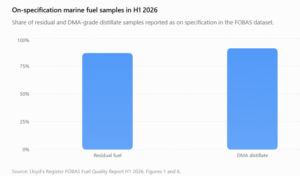
Comparison of on-specification residual and DMA marine fuel samples during H1 2026.”
Sulphur exceedances remain a compliance risk
Sulphur remained one of the most frequently reported off-specification parameters.
For very-low-sulphur fuel oil, many results were only marginally above the 0.50% m/m limit and remained within the recognised test-confidence range up to approximately 0.53% m/m. These cases require careful interpretation because laboratory test precision may be considered when assessing compliance.
However, results exceeding 0.53% m/m present a clearer regulatory problem. Such fuel may become unusable for its intended purpose and can create substantial commercial disruption if segregation, replacement or debunkering is required.
FOBAS data indicate that the proportion of VLSFO samples falling between 0.51% and 0.53% sulphur rose during H1 2026 compared with the preceding years. More substantial exceedances above 0.53% remained less common but continued to occur.
The risks become particularly significant when a vessel has insufficient compliant fuel to enter or operate within an Emission Control Area.
Sediment and fuel stability require closer attention
Total Sediment Potential, or TSP, remained one of the most important indicators of residual-fuel risk.
The applicable ISO limit is generally 0.10% m/m, but averages shown for several major bunkering ports exceeded that level during the reporting period. Singapore and Yeosu were among the locations displaying comparatively high average sediment values in the report’s top-20-port analysis.
High or increasing sediment can indicate reduced stability or poor blend compatibility. Once onboard, the fuel may produce:
- excessive sludge in settling and service tanks;
- increased purifier discharge;
- rapidly blocked filters and strainers;
- restricted fuel flow;
- unstable fuel pressure; and
- loss of propulsion or generating capacity in severe cases.
Water content also remained a recurring concern. Although water concentrations around 1–2% v/v can sometimes be handled by properly operated treatment systems, they increase purifier workload and reduce the quantity of usable fuel received. Extreme concentrations may exceed the vessel’s treatment capacity altogether.
Suggested graph: Reproduce or adapt the report’s Figure 4 showing average total sediment by major bunkering port. The original graph appears on page 7 of the report and provides an effective regional comparison.
Suggested photo: A close-up photograph of sludge removed from a purifier bowl or a heavily contaminated automatic fuel filter.
Suggested caption: High-sediment and unstable residual fuels can rapidly overload separators and fuel filters.
Catalytic fines continue to threaten machinery
Catalytic fines—principally aluminium and silicon particles originating from refinery catalytic-cracking processes—remain a major engine-damage risk.
Elevated concentrations were identified particularly in high-volume blending hubs. If they are not removed effectively, these hard abrasive particles can damage:
- fuel pumps;
- injector components;
- cylinder liners;
- piston rings; and
- other precision surfaces within the combustion system.
FOBAS stresses that purifier effectiveness should not simply be assumed. Operators should verify treatment performance by comparing representative samples taken before and after purification.
This is an important operational point. A fuel may meet the delivery specification while still containing enough catalytic fines to require efficient onboard reduction before entering the engine. Inadequate settling, incorrect purifier temperature, excessive throughput, poor gravity-disc selection or malfunctioning separators can therefore convert a manageable fuel into a machinery casualty.
Elevated sodium was also detected in some regions. Sodium can indicate seawater contamination or the presence of certain blending components. When combined with vanadium, it may promote high-temperature deposits and corrosion in combustion and exhaust-gas components.
Low-flash-point distillate fuels create direct safety concerns
Distillate fuels were generally more consistent than residual grades, but flash point continued to be one of their most consequential quality parameters.
Marine gas oil is normally required to have a flash point of at least 60°C. Unlike some fuel-quality parameters, the relevant SOLAS requirement does not establish a routine acceptance margin below this threshold. Consequently, even a marginal result under 60°C requires careful attention and may need consultation with the vessel’s flag Administration and classification society.
Some H1 2026 samples were only slightly below the limit. FOBAS notes that subsequent tank samples may occasionally show a modest increase as lighter volatile components evaporate. Further representative sampling and testing may therefore help establish the actual condition of the onboard fuel before irreversible action is taken.
Extremely low results are different. They represent an immediate fire and explosion concern and may require the fuel to be isolated or debunkered.
The report also recorded distillate sulphur exceedances. Results between approximately 0.10% and 0.11% m/m may fall within the applicable confidence interval, but results above 0.11% create a more substantial concern, especially for vessels requiring the fuel for operation inside a 0.10% sulphur ECA.
Suggested graph: Use the report’s Figure 8, which compares MGO flash-point findings from 2022 to H1 2026.
Suggested photo: A marine fuel laboratory technician performing a closed-cup flash-point test.
Cold-flow properties must match the vessel’s intended voyage
Pour point and Cold Filter Plugging Point remain important operational parameters, particularly when a fuel is bunkered in a warm location but consumed later in colder waters.
A fuel that performs normally at the bunkering port can become difficult or impossible to pump once its temperature approaches its cold-flow limits. Wax formation may block suction strainers, filters and transfer lines, potentially restricting supply to engines and boilers.
Operators should therefore assess more than whether the fuel complies with a generic grade limit. Fuel suitability should be evaluated against:
- the anticipated ambient temperature;
- seawater temperature;
- tank-heating capability;
- trace heating of fuel lines;
- planned storage duration; and
- the lowest expected operating temperature during the voyage.
This consideration is also increasingly relevant to FAME-containing biofuel blends, whose cold-flow behaviour depends partly on the feedstock and blend composition.
Suggested photo: A vessel operating in a cold-weather region, preferably showing snow or ice around exposed deck areas.
On-specification fuel can still perform poorly
One of the report’s most important findings is that standard ISO 8217 testing does not always reveal the full operational risk.
During March and April 2026, several vessels reportedly experienced difficulties after receiving fuel in Singapore. Forensic analysis indicated that a number of these fuels contained relatively high concentrations of Estonian shale oil, potentially around 10–15% in some cases.
Shale oil is not automatically an unacceptable blend component, and its presence does not mean that every fuel will cause problems. However, FOBAS experience suggests that relatively high concentrations can reduce the margin for stable operation and may be associated with problems involving filters, separators and fuel pumps.
These fuels may initially appear broadly acceptable under routine ISO 8217 analysis. The problem only becomes evident during storage, heating, purification or engine operation.
This illustrates the difference between two important concepts:
Specification compliance determines whether measured parameters fall within prescribed limits.
Operational suitability considers whether the fuel will remain stable, treatable and safe under actual onboard conditions.
Modern fuels are produced from increasingly diverse blend components. Interactions among these materials may not be fully represented by conventional pass-or-fail parameters. Investigative techniques such as gas chromatography–mass spectrometry and other forensic analyses may therefore be necessary after unexplained operational problems.
Stability margin matters as much as the initial result
Two technically compliant fuels can behave very differently onboard.
One may remain stable throughout storage and treatment, while another may produce sludge after heating, extended storage or mixing with an existing bunker. The difference lies partly in the fuel’s stability margin—the distance between its delivered condition and the point at which asphaltenes begin to precipitate.
The H1 2026 findings show that problems can develop when fuels are:
- stored for long periods;
- exposed to uneven heating;
- mixed without compatibility testing;
- transferred repeatedly between tanks; or
- blended onboard with an incompatible product.
A marginal sediment result should therefore not be treated in isolation. It should be considered together with storage plans, treatment capacity, fuel age, compatibility and operational feedback.
The report concludes that some of the most difficult fuels occupy the area between formal non-compliance and satisfactory service performance. They may not support a straightforward contractual claim, yet they can still create persistent maintenance and reliability problems.
FAME biofuel blends continue to gain market share
FAME-based biofuels remained the most widely used marine biofuel type during H1 2026.
They were commonly supplied as blends with VLSFO, particularly at approximately 30% FAME content, generally known as B30. This concentration offers a practical route to reducing lifecycle greenhouse-gas emissions while maintaining handling characteristics broadly comparable to conventional fuel.
Supply was concentrated in established bunkering regions, including:
- Singapore;
- Belgium and the Netherlands within the ARA region;
- Spain;
- South Korea;
- Germany;
- Italy; and
- the United Kingdom.
Some ports recorded particularly high quantities because individual companies or vessels on fixed routes repeatedly obtained biofuel from the same supply location.
Importantly, FOBAS data did not identify biofuel itself as a principal cause of off-specification events in H1 2026. When difficulties occurred in blended products, they were generally linked to the conventional VLSFO fraction rather than the FAME component.
Nevertheless, FAME blends require attention to:
- pour point and CFPP;
- oxidation during prolonged storage;
- microbial growth in the presence of water;
- material compatibility;
- blend stability;
- accurate declaration of bio-derived content; and
- emissions-accounting documentation.
Clear information about the nature and percentage of the renewable component is essential for both onboard management and regulatory reporting.
Suggested graph: Adapt Figure 11 from page 18, showing biofuel quantities by country and fuel category.
Suggested photo: A bunker barge supplying a vessel, with a caption specifying that the image represents marine biofuel bunkering rather than conventional fuel transfer.
High-risk bunkering regions require enhanced due diligence
Fuel-quality problems were reported across Europe, Asia, the Mediterranean and the Americas. Nevertheless, major blending and bunkering centres displayed a greater concentration of complex cases.
Singapore remained prominent because of its enormous supply volume and the variety of feedstocks and blending operations involved. The ARA region—Amsterdam, Rotterdam and Antwerp—also continued to display variable characteristics, including cases involving sediment and catalytic fines.
This does not necessarily mean that fuel supplied in these ports is generally poor. High sample numbers and large bunker volumes naturally generate more findings. However, the complexity and diversity of the supply chain justify greater attention to supplier history, individual terminals and recent fuel alerts.
Shipowners should assess risk at the supplier and delivery level rather than relying solely on the general reputation of a port.
Practical recommendations for shipowners and engineers
The report supports a proactive fuel-management strategy extending from procurement to final consumption.
Before bunkering
Review the requested ISO 8217 grade, sulphur requirement and machinery limitations. Investigate recent regional alerts and the supplier’s quality history. Confirm the declared biofuel content and obtain available certificates or sustainability documentation.
During delivery
Take properly witnessed and sealed representative samples. Maintain segregation from existing fuel wherever possible. Record temperatures, quantities and relevant bunker-delivery information accurately.
Before use
Do not begin using newly bunkered fuel before receiving laboratory results unless operationally unavoidable. Conduct compatibility testing before commingling. Prepare a fuel-treatment plan based on density, viscosity, water, sediment and catalytic-fine results.
During treatment
Operate settling tanks and separators at the correct temperatures. Avoid excessive purifier throughput and verify separator efficiency through upstream and downstream sampling. Closely monitor filter differential pressure, sludge production and fuel-pump behaviour.
During operation
Trend exhaust temperatures, injection performance and combustion condition. Treat rapidly rising filter pressure, abnormal purifier discharge or unstable fuel pressure as early warnings. Preserve samples and operating records if problems develop.
When routine analysis cannot explain the problem
Seek expanded investigative testing rather than assuming the fuel is acceptable simply because conventional parameters passed. Detailed chemical analysis can identify unusual blend components or contaminants that routine ISO 8217 analysis may not reveal.
Outlook for the remainder of 2026
FOBAS expects global marine fuel variability to persist during the second half of 2026.
Traditional issues—sulphur exceedances, sediment, water, catalytic fines and flash point—are unlikely to disappear. At the same time, increasingly complex blending practices and a broader range of feedstocks may produce more cases in which technically compliant fuel performs poorly in service.
Biofuel use is also expected to expand, led by FAME-based blends and supported by emissions-reduction policies. These fuels have not emerged as a primary quality problem, but their increasing use requires improved transparency, careful cold-flow assessment and appropriate storage and monitoring.
The report emphasises that routine compliance testing remains essential but may not be sufficient. Supplier due diligence, compatibility assessment, forensic analysis and continuous onboard monitoring will become increasingly important parts of marine fuel-risk management.
Conclusion
The marine fuel market in H1 2026 was defined less by one dominant global problem than by persistent and widespread variability.
Most fuels continued to meet ISO 8217 specifications, yet a meaningful proportion presented compliance, safety or operational concerns. Residual fuels were particularly affected by sulphur, sediment, water and catalytic fines, while flash point and cold-flow characteristics remained critical for distillates.
The most significant lesson is that formal specification compliance and reliable onboard performance are not always the same. Fuel testing must therefore be combined with effective segregation, compatibility management, purification, machinery monitoring and, where necessary, forensic investigation.
As the industry introduces more diverse feedstocks and increases its use of biofuels, fuel-quality management will need to become more—not less—comprehensive.