
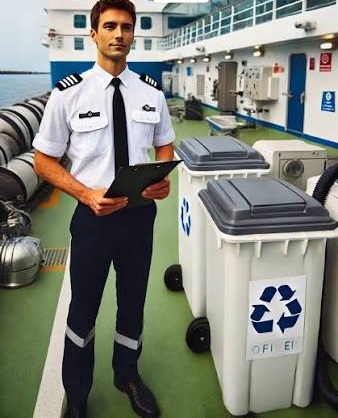
Environmental compliance has become a major operational responsibility in modern shipping. Ships must comply not only with the International Convention for the Prevention of Pollution from Ships—MARPOL—but also with flag-state legislation, port-state requirements, regional environmental rules, local discharge restrictions, company procedures and increasingly demanding sustainability objectives.
On many conventional cargo ships, responsibility for pollution prevention remains distributed among the Master, Chief Engineer, Chief Officer and other licensed officers. However, large passenger vessels—especially cruise ships—commonly carry a dedicated Environmental Officer, sometimes called an Environmental Compliance Officer, Environmental Management Officer or Environmental Health and Safety Officer.
The position is particularly important aboard cruise ships because these vessels operate complex wastewater-treatment plants, large waste-management facilities, incinerators, food-waste systems, ballast-water treatment systems, exhaust-gas cleaning systems and extensive hotel-service operations. They also visit many jurisdictions, each of which may impose different environmental restrictions.
Nevertheless, the Environmental Officer is not presently a universally defined statutory shipboard rank comparable to Master, Chief Engineer, Chief Officer or Second Engineer. International conventions establish environmental duties and competence requirements, but companies generally determine whether a dedicated Environmental Officer is carried, what qualifications are required and where that officer sits within the shipboard hierarchy.
1. Is an Environmental Officer Required by IMO Regulations?
There is currently no general provision in MARPOL, SOLAS or the STCW Convention requiring every merchant ship to carry a person holding the specific title Environmental Officer.
The International Safety Management Code requires shipping companies to establish a Safety Management System for safe ship operation and pollution prevention. It also requires clear responsibilities, reporting arrangements, procedures for responding to emergencies, internal verification and communication between ships and shore management. However, the ISM Code does not prescribe a universal Environmental Officer rank.
Similarly, the STCW Convention establishes minimum international standards for the training, certification and watchkeeping of masters, deck officers, engineer officers, electro-technical officers and ratings. It includes competence in preventing pollution of the marine environment within several officer certification standards, but it does not currently provide a separate Certificate of Competency for an Environmental Officer.
Therefore, the position normally exists because of:
- company environmental-management policies;
- the complexity and environmental risk profile of the vessel;
- corporate compliance commitments;
- previous regulatory or enforcement experience;
- voluntary environmental certification;
- the need for independent shipboard monitoring;
- the scale of waste and wastewater operations;
- the number of jurisdictions visited;
- charterer, client or stakeholder requirements.
A company may designate an Environmental Officer as a full-time specialist, combine the role with another officer’s duties, or assign environmental responsibilities to the ship’s existing senior officers.
2. On Which Ships Are Environmental Officers Commonly Employed?
2.1 Cruise ships
Cruise ships represent the sector in which dedicated Environmental Officers are most widely established.
A large cruise vessel functions simultaneously as a ship, hotel, accommodation complex, restaurant centre, power station, wastewater facility and waste-processing installation. Thousands of passengers and crew may generate substantial quantities of sewage, grey water, food waste, plastics, packaging, hazardous materials, cooking oil, chemicals and other waste streams.
Cruise itineraries may also include marine protected areas, sensitive coastal zones, emission-control areas and ports with special wastewater or waste-delivery requirements. A dedicated officer therefore helps the Master and senior management control environmental risks across both marine and hotel departments.
Carnival Corporation has publicly stated that its ships carry full-time Environmental Officers responsible for monitoring environmental compliance and implementation of environmental procedures.
Royal Caribbean describes its Environmental Officer as an internal compliance specialist whose work covers waste management, crew training, chemical handling, voyage planning, energy efficiency, protected-area restrictions and wastewater testing.
MSC Cruises also recruits Environmental Compliance Officers to oversee MARPOL compliance, wastewater and effluent sampling, waste management and associated records.
Other cruise operators known to use comparable shipboard environmental positions include brands within Carnival Corporation, Royal Caribbean Group, MSC Cruises, Norwegian Cruise Line Holdings and a number of luxury, expedition and river-cruise operators. The exact title, rank and departmental placement vary between companies.
2.2 Passenger ferries
Large ferries may carry an Environmental Officer, Environmental Superintendent or combined Safety and Environmental Officer, particularly where the vessel:
- carries many passengers;
- operates frequently in environmentally sensitive waters;
- has extensive hotel and catering facilities;
- uses scrubbers, LNG or alternative fuels;
- operates under an ISO 14001 environmental-management system;
- must comply with strict regional discharge requirements.
On other ferries, the environmental function is divided among the Master, Chief Engineer, Chief Officer, hotel manager and shore-based environmental department.
2.3 Tankers
Oil, chemical and gas tankers do not normally carry a separate Environmental Officer as a standard industry rank. Their environmental risks are managed through a well-established command structure.
Typical allocations include:
- the Master retaining overall command and statutory responsibility;
- the Chief Officer supervising cargo, ballast and deck pollution-prevention operations;
- the Chief Engineer supervising machinery-space discharges, fuel management, emissions and pollution-prevention equipment;
- other licensed officers maintaining records and operating relevant systems;
- the company’s designated person, marine superintendent or environmental superintendent providing shore support.
Some tanker companies may appoint a Health, Safety, Security, Environment and Quality officer or combine environmental duties with those of the Safety Officer. This remains a company arrangement rather than a universal international requirement.
2.4 Offshore vessels and offshore installations
Offshore support vessels, drilling units, construction vessels and production installations may employ:
- Environmental Officers;
- HSE Officers;
- HSSEQ Officers;
- Environmental Advisors;
- Marine Environmental Specialists.
These positions may cover environmental compliance together with occupational safety, permit conditions, spill prevention, waste manifests, chemical control, environmental monitoring and client reporting.
Requirements are often influenced by coastal-state legislation, offshore operating permits, oil-company standards and contractual obligations rather than STCW alone.
2.5 Conventional cargo ships
Dedicated Environmental Officers remain relatively uncommon aboard container ships, bulk carriers, general cargo vessels and smaller commercial ships.
On these vessels, environmental duties are normally allocated as follows:
| Shipboard position | Typical environmental responsibilities |
|---|---|
| Master | Overall compliance, reporting, notification and command decisions |
| Chief Engineer | Oily-water systems, sludge, fuel, emissions, machinery waste and technical pollution-prevention equipment |
| Chief Officer | Garbage management, deck waste, ballast water, cargo residues and deck pollution controls |
| Second Engineer | Operation and maintenance of machinery-space pollution-prevention equipment |
| Other deck and engineer officers | Record keeping, inspections, sampling, maintenance and watchkeeping controls |
| Ratings | Waste segregation, equipment operation and compliance with established procedures |
A shipping company may instead assign one officer as the Environmental Coordinator, but this is normally an additional duty rather than a separate rank.
3. Principal Duties of a Shipboard Environmental Officer
The precise job description depends on the company and vessel, but the role normally combines compliance monitoring, operational verification, training, auditing, record control and technical oversight.
3.1 Monitoring regulatory compliance
The Environmental Officer must understand which environmental requirements apply to the vessel at each stage of the voyage. These may include:
- MARPOL Annexes I–VI;
- the Ballast Water Management Convention;
- the Anti-Fouling Systems Convention;
- local sewage and grey-water restrictions;
- port waste-reception requirements;
- emission-control area requirements;
- protected-area restrictions;
- national environmental legislation;
- company environmental procedures;
- environmental provisions within the ship’s Safety Management System.
The officer must identify where company standards are stricter than the legal minimum and ensure that the higher company standard is applied.
3.2 Conducting inspections and environmental rounds
Regular inspections may cover:
- oily-water separator spaces;
- sludge and bilge systems;
- sewage-treatment plants;
- advanced wastewater-treatment systems;
- incinerators;
- food-waste systems;
- garbage rooms;
- recycling facilities;
- chemical stores;
- bunker stations;
- ballast-water treatment systems;
- scrubber systems;
- hazardous-waste lockers;
- refrigerant records;
- spill-response equipment.
Carnival’s published responsibilities include environmental rounds and inspections, assistance to crew, shipboard training, participation in spill response, attendance at management meetings and recommendations for waste, water and energy reduction.
3.3 Waste management
On cruise vessels, waste management may be one of the largest parts of the job.
The Environmental Officer verifies that waste is:
- correctly identified;
- segregated at source;
- stored safely;
- processed only by approved equipment;
- discharged only where legally permitted;
- delivered to authorised reception facilities;
- documented through receipts and manifests;
- recorded correctly in the Garbage Record Book and company systems.
MARPOL Annex V generally prohibits the discharge of garbage into the sea except for narrowly defined categories and conditions.
3.4 Wastewater and effluent control
The Environmental Officer may inspect or verify the operation of:
- sewage-treatment plants;
- advanced wastewater-treatment plants;
- grey-water systems;
- holding tanks;
- disinfection systems;
- sampling arrangements;
- overboard valves;
- monitoring instruments.
Duties may include routine sampling, checking laboratory results, verifying treatment parameters, maintaining calibration records and coordinating external effluent testing.
Royal Caribbean’s description of the role includes daily wastewater testing, recording key parameters and coordinating with personnel working in waste-handling areas.
3.5 Oil-pollution prevention
Although engineering officers remain responsible for operating machinery-space systems, the Environmental Officer may independently verify:
- oily-water separator condition;
- oil-content monitor operation;
- bilge and sludge tank levels;
- valve alignment;
- seal integrity;
- Oil Record Book entries;
- sludge landing receipts;
- bunker-transfer controls;
- availability of spill-response equipment.
The Environmental Officer should not normally replace the Chief Engineer’s technical responsibility. The role provides oversight, verification and compliance assurance.
3.6 Air-emission compliance
Depending on the ship, duties may include monitoring:
- fuel sulphur compliance;
- fuel-changeover procedures;
- bunker-delivery documentation;
- exhaust-gas cleaning systems;
- incinerator restrictions;
- ozone-depleting substances;
- refrigerant inventories;
- NOx-related documentation;
- fuel consumption and emissions data;
- energy-efficiency measures;
- local smoke and opacity restrictions.
On ships using exhaust-gas cleaning systems, a separate Scrubber Officer or specialised engineer may operate the plant, while the Environmental Officer verifies regulatory compliance and reporting.
3.7 Ballast-water management
The Environmental Officer may assist the deck department by checking:
- the approved Ballast Water Management Plan;
- ballast-water treatment-system records;
- treatment alarms and bypasses;
- ballast operations;
- sampling arrangements;
- Ballast Water Record Book entries;
- reporting to port and coastal authorities.
Operational control normally remains with the deck department under the Chief Officer.
3.8 Environmental voyage planning
Before entering a port, coastal state or sensitive sea area, the Environmental Officer may prepare an environmental voyage brief covering:
- prohibited discharge zones;
- sewage and grey-water restrictions;
- scrubber wash-water limitations;
- ballast-water requirements;
- incinerator restrictions;
- protected areas;
- local waste-delivery rules;
- reporting requirements;
- fuel and emission requirements.
The Environmental Officer communicates these restrictions to the bridge, engine department, hotel department and waste-management teams.
3.9 Record keeping
Environmental records must be complete, internally consistent and supported by operational evidence.
The Environmental Officer may review:
- Oil Record Books;
- Garbage Record Books;
- Ballast Water Record Books;
- bunker-delivery notes;
- fuel-changeover records;
- sewage and wastewater logs;
- incinerator records;
- scrubber-monitoring records;
- refrigerant logs;
- waste manifests and landing receipts;
- laboratory reports;
- environmental inspection checklists;
- defect and corrective-action reports.
The officer should verify records but must not falsify, retrospectively reconstruct or improperly alter entries. The officer signing or making a statutory entry remains accountable for its accuracy.
3.10 Training and environmental awareness
Environmental compliance cannot be achieved by one officer alone. The Environmental Officer therefore trains personnel from the deck, engine, hotel, catering, housekeeping and waste-management departments.
Training may cover:
- waste segregation;
- prohibited discharges;
- spill reporting;
- chemical handling;
- use of environmental equipment;
- record keeping;
- emergency response;
- consequences of bypassing equipment;
- local port restrictions;
- company environmental policy.
Environmental Officers may conduct induction training, departmental briefings, toolbox talks, drills, computer-based training and competency assessments.
3.11 Emergency response
During an actual or threatened pollution incident, the Environmental Officer commonly:
- advises the Master;
- gathers technical and regulatory information;
- assists with spill-response procedures;
- verifies notifications;
- coordinates sampling and evidence preservation;
- maintains an incident chronology;
- supports investigation and reporting;
- monitors waste generated during the response;
- communicates with shore environmental personnel.
Command of the response remains with the Master, supported by the Chief Engineer, Chief Officer and relevant emergency teams.
3.12 Audits and inspections
Environmental Officers help prepare the ship for:
- flag-state inspections;
- port-state control;
- class surveys;
- coastal-state inspections;
- US Coast Guard examinations;
- company audits;
- ISO 14001 audits;
- charterer or client inspections;
- public-health inspections where responsibilities overlap.
They track findings, identify root causes, assign corrective actions and verify closure.
4. Position in the Shipboard Line of Command
The Environmental Officer is normally a senior or specialist officer but is not the ship’s ultimate environmental authority.
A typical reporting arrangement is:
Master
↓
Staff Captain or directly reporting Environmental Officer
↓
Environmental team, waste-management personnel or assigned departmental coordinators
However, organisational structures vary.
In some cruise companies, the Environmental Officer belongs administratively to the deck or nautical department and reports to the Staff Captain. Carnival describes the Environmental Officer as part of the deck team.
In other companies, the officer may report directly to the Master or have a dual reporting line:
- operationally to the Master or Staff Captain;
- functionally to a shoreside Environmental Compliance Manager.
This dual-reporting arrangement gives the officer access to corporate environmental specialists while preserving the Master’s overriding authority aboard the ship.
Important command principle
The Environmental Officer does not supersede:
- the Master’s overall authority;
- the Chief Engineer’s responsibility for machinery;
- the Chief Officer’s responsibility for cargo, ballast and deck operations;
- the Staff Captain’s management duties;
- the Hotel Director’s responsibility for hotel operations.
Instead, the officer verifies, advises, monitors and escalates.
A mature company system should provide the Environmental Officer with sufficient independence to report serious non-compliance without interference. However, this independent reporting channel does not remove the Master from command.
5. Relationship with Shoreside Personnel
The Environmental Officer normally communicates with several shore departments.
5.1 Environmental compliance department
This is generally the principal functional contact. The ship may report to:
- Fleet Environmental Manager;
- Environmental Superintendent;
- Director of Environmental Compliance;
- Marine Operations Department;
- HSSEQ Department;
- Corporate Maritime Compliance Department.
The officer submits reports, requests regulatory interpretation, reports incidents and receives updates to company procedures.
5.2 Designated Person Ashore
Under the ISM framework, the Designated Person Ashore provides a link between the company and those aboard each ship and has access to the highest level of management. The DPA monitors safety and pollution-prevention aspects and ensures adequate shore support.
The Environmental Officer may contact the DPA when an environmental matter affects the effectiveness of the Safety Management System, although routine matters may pass through the environmental department.
5.3 Technical department
Communication with technical superintendents may concern:
- defective treatment equipment;
- spare parts;
- modifications;
- maintenance planning;
- instrumentation;
- scrubber or wastewater-system performance;
- ballast-treatment defects;
- dry-dock upgrades.
5.4 Marine operations
Marine superintendents may support:
- voyage planning;
- ballast management;
- fuel-changeover procedures;
- port restrictions;
- navigation through sensitive areas;
- reporting to authorities.
5.5 Legal and compliance departments
Serious incidents may require involvement from:
- legal counsel;
- corporate compliance;
- insurance and claims personnel;
- emergency-response teams;
- public-affairs personnel.
The Environmental Officer must provide factual, accurate and contemporaneous information without speculation.
6. Qualifications and Minimum Knowledge
Because no universal STCW Environmental Officer certificate exists, entry requirements vary considerably.
Companies commonly recruit candidates from three main backgrounds:
- licensed deck officers;
- licensed marine engineer officers;
- graduates in environmental science, marine science, environmental engineering, chemistry or a related discipline.
Some companies accept either a deck or engine officer licence or an environmental-science degree, together with relevant leadership and compliance experience.
6.1 Recommended technical knowledge
A competent Environmental Officer should understand:
- all six MARPOL Annexes;
- the ISM Code;
- the Ballast Water Management Convention;
- the Anti-Fouling Systems Convention;
- shipboard pollution-emergency plans;
- waste segregation and disposal;
- sewage and wastewater treatment;
- oily-water separation;
- sludge processing;
- incinerator operation;
- ballast-water treatment;
- air-emission controls;
- fuel-sulphur requirements;
- exhaust-gas cleaning systems;
- environmental sampling;
- chemical safety;
- environmental record keeping;
- audit and inspection methods;
- incident investigation;
- environmental risk assessment.
6.2 Ship-system knowledge
The officer should understand the practical operation and limitations of relevant machinery, including:
- oily-water separators;
- oil-content monitors;
- sewage-treatment plants;
- advanced wastewater-treatment systems;
- food pulpers and digesters;
- incinerators;
- compactors, shredders and balers;
- sludge tanks and transfer systems;
- ballast-water treatment systems;
- scrubbers;
- emission-monitoring equipment;
- overboard discharge arrangements.
A science graduate without maritime experience may possess strong environmental knowledge but initially lack ship-system competence. Conversely, a licensed marine officer may understand ship operations but require additional environmental-law and audit training.
The strongest candidates combine both areas.
7. STCW Training and Certification
7.1 No dedicated STCW Certificate of Competency
STCW does not presently issue an internationally standardised Certificate of Competency titled “Environmental Officer.”
An Environmental Officer serving as an additional specialist may therefore not need a deck or engineer officer CoC unless the company job description requires one or the person also performs licensed duties.
7.2 Basic safety training
Anyone employed as a seafarer with assigned safety or pollution-prevention duties generally requires appropriate STCW safety training and familiarisation.
This normally includes:
- personal survival techniques;
- fire prevention and firefighting;
- elementary first aid;
- personal safety and social responsibilities;
- security awareness or designated security duties, as applicable.
Additional certification may be required according to the vessel and emergency duties, such as:
- proficiency in survival craft;
- advanced firefighting;
- medical first aid;
- passenger-ship emergency training;
- crowd management;
- crisis management and human behaviour;
- tanker familiarisation;
- ship security training.
7.3 Passenger-ship training
Environmental Officers working on passenger ships may need STCW Regulation V/2 training appropriate to their assigned duties.
This may include:
- passenger-ship familiarisation;
- crowd-management training;
- crisis-management and human-behaviour training;
- passenger-safety and cargo-safety training.
The precise requirement depends on whether the officer has designated responsibilities in the muster list and emergency plan.
7.4 Company-specific environmental training
Cruise companies commonly provide additional training in:
- corporate environmental policy;
- company Environmental Management System;
- MARPOL compliance;
- environmental record keeping;
- wastewater sampling;
- waste-management procedures;
- incident escalation;
- internal auditing;
- local and regional environmental restrictions;
- environmental information systems.
This training may be provided ashore before joining, onboard under supervision or through company learning platforms.
7.5 Useful professional qualifications
Although not universally mandatory, valuable additional qualifications include:
- ISO 14001 Environmental Management Systems;
- ISO 14001 internal or lead auditor;
- environmental auditing;
- hazardous-materials management;
- dangerous-goods awareness;
- spill-response training;
- wastewater-treatment training;
- ballast-water management;
- scrubber operation;
- incident investigation;
- root-cause analysis;
- occupational health and safety;
- environmental sampling and laboratory procedures.
8. Required Sea Service
There is no internationally prescribed minimum sea-service period for the title Environmental Officer.
Requirements depend on the employer.
Typical company expectations
Cruise companies may require:
- previous cruise-ship experience;
- previous employment as a deck or engineer officer;
- environmental compliance experience;
- experience operating waste or wastewater systems;
- previous supervisory or leadership experience;
- familiarity with passenger-vessel operations.
A candidate progressing from a licensed marine-officer background may have several years of sea service before appointment. A candidate from an environmental-science background may enter through an Environmental Officer trainee programme and complete supervised shipboard familiarisation.
Current cruise-vacancy information frequently requires prior shipboard or cruise experience and valid STCW certificates, although specific requirements differ among employers.
A reasonable competence benchmark
Even where a company does not prescribe a fixed sea-time threshold, appointment should ideally follow sufficient supervised experience to demonstrate competence in:
- shipboard organisation;
- emergency response;
- permit-to-work procedures;
- waste and wastewater systems;
- environmental documentation;
- communication with multinational crews;
- reporting to senior management;
- port and flag-state inspections.
For a full Environmental Officer appointment, six to twelve months of relevant supervised shipboard experience would be a reasonable company benchmark, but it is not an IMO statutory requirement.
9. Environmental Officer Trainee Programmes
Some operators recruit Environmental Officer Trainees.
A trainee programme may include:
- ship familiarisation;
- MARPOL instruction;
- shadowing the appointed Environmental Officer;
- supervised environmental rounds;
- waste-management training;
- wastewater sampling;
- record-book review;
- audit preparation;
- incident-reporting exercises;
- formal performance assessments.
The trainee does not normally hold the full authority of the appointed Environmental Officer until the company’s competency requirements have been completed.
Such programmes are particularly useful for environmental-science graduates who possess academic knowledge but limited marine operational experience.
10. Salary and Contract Conditions
Environmental Officer compensation varies according to:
- company;
- vessel type;
- nationality and employment market;
- experience;
- licence or academic qualifications;
- seniority;
- contract length;
- leave arrangement;
- whether pay is continuous or only paid onboard;
- taxation and social-security arrangements.
Published cruise-industry estimates commonly place Environmental Officer earnings at approximately USD 5,000–8,500 per month while onboard, although actual contracts may fall outside this range. One current industry salary source reports approximately USD 5,500–8,300 monthly, while individual passenger-vessel vacancies have advertised salaries around USD 8,500 per month.
Recent employee-reported salary data show examples around USD 4,000–7,000 per month at major cruise groups, but these figures are not official salary scales and should be treated as indicative only.
Indicative market ranges
| Position | Indicative monthly onboard pay |
|---|---|
| Environmental Officer Trainee | USD 2,000–4,000 |
| Junior or Assistant Environmental Officer | USD 3,500–5,500 |
| Environmental Officer | USD 5,000–8,500 |
| Senior Environmental or Compliance Officer | USD 6,500–9,500 or more |
| Shoreside Environmental Superintendent | Highly dependent on country and employment package |
These are broad market estimates, not statutory rates.
Common rotations include:
- three months onboard followed by two months’ leave;
- four months onboard followed by two months’ leave;
- four months onboard with a variable relief period.
A salary advertised “per month” may apply only during onboard service. Candidates should therefore compare annualised income rather than the onboard monthly figure alone.
Food, accommodation, joining travel, repatriation and basic medical care are commonly provided under the employment contract. Exact conditions remain subject to the Maritime Labour Convention, flag-state law, collective agreements and company policy.
11. Legal and Professional Responsibility
The Environmental Officer may carry significant professional responsibility even where the position is not a statutory rank.
Potential areas of accountability include:
- failure to report a suspected illegal discharge;
- inaccurate environmental records;
- failure to escalate defective pollution-prevention equipment;
- inadequate crew training;
- incorrect advice concerning discharge restrictions;
- failure to preserve evidence after an incident;
- non-compliance with company procedures;
- deliberate concealment of environmental violations.
However, environmental compliance is not the responsibility of the Environmental Officer alone.
Master
The Master retains overall command and responsibility for the ship.
Chief Engineer
The Chief Engineer remains responsible for machinery operation, engineering personnel and technical systems under their authority.
Chief Officer
The Chief Officer remains responsible for deck operations, cargo, ballast and other assigned pollution-prevention functions.
Department heads
Each department head must ensure that personnel follow environmental procedures.
Individual crew members
Every crew member must comply with the ship’s procedures, correctly segregate waste, report incidents and refrain from unauthorised discharges.
The Environmental Officer coordinates and verifies the system but cannot personally operate every piece of equipment or supervise every activity continuously.
12. Authority to Stop an Operation
A properly designed Safety Management System should authorise personnel to stop an operation where there is an immediate environmental or safety risk.
The Environmental Officer should therefore be empowered to:
- challenge a proposed discharge;
- suspend an operation pending clarification;
- require verification of valve alignment;
- request the presence of the responsible senior officer;
- escalate non-compliance to the Master;
- notify the shoreside environmental department;
- initiate corrective-action procedures.
Nevertheless, the Environmental Officer should normally act through the established chain of command. In an urgent situation, the officer should clearly state the risk, stop the unsafe or non-compliant activity where authorised, and immediately inform the Master and responsible department head.
13. Environmental Officer Versus Other Shipboard Positions
Environmental Officer and Safety Officer
The Safety Officer concentrates primarily on occupational safety, accident prevention, risk assessments, inspections and safety meetings.
The Environmental Officer concentrates on pollution prevention, discharges, waste, emissions, environmental systems and regulatory compliance.
On some ships, both functions are combined into an HSE or HSSEQ role.
Environmental Officer and Public Health Officer
The Public Health Officer normally focuses on:
- potable water;
- food hygiene;
- sanitation;
- pest control;
- communicable-disease prevention;
- public-health inspections.
The Environmental Officer focuses more on MARPOL, waste, wastewater, emissions and environmental systems.
There may be overlap in water testing, sanitation, chemical management and waste handling, particularly on cruise ships.
Environmental Officer and Chief Engineer
The Environmental Officer verifies environmental compliance but does not replace the Chief Engineer as head of the engine department.
For example, the Environmental Officer may inspect an oily-water separator and review its records, while the Chief Engineer remains responsible for its safe operation, maintenance and engineering control.
Environmental Officer and Chief Officer
The Environmental Officer may review garbage and ballast records, but operational responsibility for deck activities generally remains with the Chief Officer.
14. Competence Profile for an Effective Environmental Officer
A competent Environmental Officer requires more than knowledge of MARPOL.
Technical competence
The officer must understand ship systems, treatment processes, monitoring equipment and the operational consequences of equipment failure.
Regulatory competence
The officer must interpret international, regional, national and local requirements and translate them into clear operational instructions.
Audit competence
The officer must identify non-conformities, examine objective evidence, determine root causes and verify corrective action.
Communication competence
The officer must explain requirements to personnel with different ranks, nationalities, educational backgrounds and first languages.
Ethical competence
The officer must be willing to report uncomfortable facts, resist pressure to conceal deficiencies and preserve the integrity of official records.
Leadership competence
The role requires influence across departments even where the officer has no direct line authority over the personnel involved.
Digital competence
Modern environmental compliance increasingly uses:
- electronic record books;
- environmental dashboards;
- emissions-reporting systems;
- digital waste manifests;
- laboratory databases;
- remote equipment monitoring;
- corporate incident-reporting systems.
The officer must be able to verify data quality rather than merely enter information.
15. Recommended Minimum Training Standard
In the absence of a dedicated IMO standard, companies employing Environmental Officers should establish a documented competence framework.
A robust minimum programme should contain:
- applicable STCW safety and security training;
- passenger-ship training where relevant;
- complete MARPOL training;
- ISM Code and company Safety Management System training;
- Ballast Water Management Convention training;
- waste and hazardous-material management;
- oily-water and sludge-system familiarisation;
- sewage and wastewater-treatment training;
- air-emission and fuel-compliance training;
- scrubber and ballast-treatment familiarisation where fitted;
- environmental sampling and instrument calibration;
- record-book and documentation training;
- internal auditing;
- incident investigation and root-cause analysis;
- spill-response training;
- supervised onboard familiarisation;
- formal competence assessment before independent appointment.
Competence should be reassessed periodically and whenever major equipment, legislation or company procedures change.
16. Future Development of the Role
The importance of the Environmental Officer is likely to increase as shipping faces more complex requirements involving:
- greenhouse-gas emissions;
- carbon-intensity management;
- alternative fuels;
- methane and nitrous-oxide emissions;
- EU emissions trading;
- FuelEU Maritime;
- shore-power requirements;
- underwater noise;
- biofouling;
- microplastics;
- digital environmental reporting;
- lifecycle sustainability;
- environmental, social and governance reporting.
However, future expansion also creates a risk of overloading one officer with unrelated responsibilities.
Companies should distinguish clearly between:
- statutory pollution compliance;
- technical environmental-system operation;
- occupational safety;
- public health;
- energy management;
- corporate sustainability reporting.
A shipboard Environmental Officer should primarily ensure operational environmental compliance. Wider decarbonisation and ESG functions should be supported by competent technical and shoreside specialists.
Conclusion
The shipboard Environmental Officer has evolved into an important compliance and assurance position, especially within the cruise and passenger-ship sectors. The officer monitors environmental operations, conducts inspections, reviews records, trains crew, supports emergency response and links shipboard departments with shoreside environmental management.
Nevertheless, the position is not currently a universally mandatory IMO rank, and STCW does not prescribe a dedicated Environmental Officer Certificate of Competency. Qualification, sea-service and training requirements are therefore largely determined by individual shipping companies.
The most effective Environmental Officers combine maritime operational experience, environmental-regulatory knowledge, technical understanding, audit skills, leadership and professional independence. They support—but do not replace—the Master, Chief Engineer, Chief Officer and department heads.
As environmental regulation becomes more technical and data-driven, the industry would benefit from a more standardised competence framework for this role. Such a framework could define minimum knowledge, practical training, supervised sea service and assessment standards while allowing companies to adapt the position to different vessel types and operational profiles.