
07/02/2026
The updated mandatory performance standards introduce significant changes to design, construction, and operational requirements for pilot transfer arrangements. Existing vessels installed before January 2028 face retroactive compliance deadlines of 2029 for SOLAS ships and 2030 for non-SOLAS vessels, potentially requiring physical modifications to securing points, winch reels, stanchions, and handholds.
Executive summary – key deadlines at a glance
| Requirement | Applicability | Deadline |
|---|---|---|
| New installations – design, manufacturing, construction, securing, and installation | Vessels with arrangements installed on or after 1 January 2028 | Comply from 1 January 2028 |
| Operational requirements – stowage, maintenance, inspection, familiarisation | All vessels (regardless of installation date) | Comply from 1 January 2028 |
| Retroactive design compliance – SOLAS Convention ships | Vessels with arrangements installed before 1 January 2028 | First survey on or after 1 January 2029 |
| Retroactive design compliance – Non-SOLAS Convention ships | Vessels with arrangements installed before 1 January 2028 | First survey on or after 1 January 2030 |
Background and regulatory context
In June 2025, the 110th session of the IMO Maritime Safety Committee (MSC 110) adopted two key resolutions:
-
Resolution MSC.572(110) – amendments to SOLAS Regulation V/23
-
Resolution MSC.576(110) – new mandatory performance standards for pilot transfer arrangements
These amendments are designed to enhance safety for marine pilots and other personnel embarking and disembarking ships across all conditions of draught and trim. The new framework replaces earlier non-mandatory guidelines with binding requirements that apply both to new installations and, crucially, to existing arrangements already in service.
Technical changes – essential modifications to design and installation
The new performance standards introduce several critical changes to the physical configuration of pilot transfer arrangements. Shipowners and managers should pay particular attention to the following technical specifications (summarised from Appendix 1 of the statutory news):
Strong points and securing arrangements
| Component | New Requirement |
|---|---|
| Strong point positioning | Must be positioned ≥ 915 mm from the deck edge. Where this is not physically possible, the maximum distance permitted by the available deck width shall be applied. |
| Strong point strength | Minimum breaking load (MBL) shall be ≥ 48 kN. The MBL value must be marked on or near each strong point and formally documented. |
| Dedicated strong points | Separate, dedicated strong points must be provided for manropes in addition to those for the pilot ladder. |
| Ring or eye for manropes | A ring or eye with an inner diameter of not less than 60 mm must be fitted at stanchion height above the deck. |
Stanchions and handholds
| Component | New Requirement |
|---|---|
| Diameter | Stanchions and handholds shall have a diameter of between 32 mm and 36 mm (minimum 32 mm, maximum 36 mm). |
| Positioning | Stanchions/handholds shall be positioned no more than 0.12 m (120 mm) inboard of the deck edge. |
Winch reels and side doors
| Component | New Requirement |
|---|---|
| Winch reel drum diameter | Where winch reels are provided, the drum diameter shall be ≥ 0.16 m (160 mm) . |
| Winch reel securing | The drum must feature sunken securing points for the thimble ends of the pilot ladder. |
| Side doors without boarding platform | Strong points for the pilot ladder must be provided on the lowest deck and inboard of the opening. |
| Side doors with boarding platform | The platform must be marked with safe working load limits, and certification of successful testing shall be maintained onboard and available for inspection. |
Combination arrangements
| Component | New Requirement |
|---|---|
| Visual marking | A two-tone visual mark of at least 4 metres in height is required on all ships provided with a combination arrangement. |
| Accommodation ladder angle | The length of the accommodation ladder must be sufficient to ensure its angle of slope does not exceed 45 degrees (this is a new requirement compared to pre-2012 standards). |
Important note: The above list is not exhaustive. For complete details, stakeholders are directed to DNV’s guidance document Pilot Transfer Arrangement (PTA) Guidance for Managers (document code PIL 901) and the original text of IMO Resolution MSC.576(110).
Operational requirements – stowage, maintenance, and inspection
Effective from 1 January 2028, all pilot transfer arrangements—regardless of their installation date—must be:
-
Stowed in accordance with the new performance standards (Part D)
-
Maintained to the required specification
-
Inspected at appropriate intervals
-
Operated following the prescribed procedures (Part E)
-
Subject to familiarisation requirements for ships’ personnel
These operational requirements apply universally, meaning even vessels that have not yet completed retroactive design modifications must still comply with the stowage, maintenance, and inspection protocols from the start of 2028.
Certificate updates and documentation
From 1 January 2028, the forms of records of equipment annexed to relevant safety certificates (under SOLAS, HSC Codes, and the SPS Code) will be revised to include the following specific entries:
-
Pilot ladder and manropes
-
Spare pilot ladder and manropes
-
Means of securing a pilot ladder at intermediate length
Until the revised records of equipment can be formally re-issued—which must occur no later than the first survey on or after 1 January 2029—a Statement of Compliance may be used to document a satisfactory verification survey result.
Guidance for early preparation
Early preparation is critical to ensuring compliance by the stated due dates. The following practical guidance is recommended for shipowners and managers:
| Action Required | How to Achieve | Key Considerations |
|---|---|---|
| Assess fleet compliance | Include RR 1088 in survey scope; evaluate in advance using guidance document PIL 901 and MSC Resolution 576(110) | Identify vessels requiring modifications early |
| Request plan approval | Navigate to Vessel services in the My Services fleet portal → Request approval of documentation → Select “Alteration” | A separate RR will be issued for plan approval to be carried out before survey |
| Plan for load testing of securing points | If required and not witnessed during survey, the surveyor will issue a separate RR for witnessing of load testing | Include this in scope when requesting the load test survey; guidance is provided in document PIL 901 |
| Request further support | Contact the technical helpdesk via DATE (Direct Access to Technical Experts) | Available through My Services on Veracity |
Updated reference materials
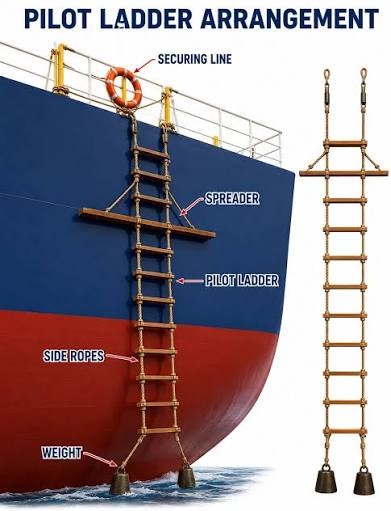
To reflect the IMO amendments, the illustration of pilot transfer arrangements contained in MSC.1/Circ.1428/Rev.1 (commonly known as the IMPA poster) has been updated. However, industry stakeholders are cautioned that:
“The IMPA poster should not be entirely relied upon for the design or approval of pilot transfer arrangements.”
Instead, stakeholders should refer to the authoritative sources listed below.
Recommendations for industry stakeholders
The amendments described in this statutory news bring substantial changes to both the design and operational requirements for pilot transfer arrangements—with clear retroactive implications for existing tonnage. The following parties should take immediate action:
| Stakeholder | Recommended Action |
|---|---|
| Shipowners and managers | Evaluate fleet compliance, plan modifications, and coordinate with surveyors well in advance of the 2029/2030 deadlines |
| Shipyards and designers | Ensure newbuild and retrofit designs comply with Parts A, B, and C of MSC.576(110) from 1 January 2028 |
| Suppliers and manufacturers | Verify that equipment (winch reels, stanchions, strong points, etc.) meets the new technical specifications |
| Flag states | Prepare for updated certification processes and surveyor guidance |
Early planning is essential, as modifications may require yard stays, hot work, or more extensive alterations. The retroactive nature of the requirements means that even vessels not due for major surveys in the near term may need to schedule modifications well ahead of the compliance deadlines.
References and further reading
-
IMO resources on pilotage – official IMO documentation
-
IMPA resource page – industry guidance and poster updates
-
DNV Technical & Regulatory News from 30 June 2025 – summary of MSC 110 outcomes
-
Pilot transfer arrangement (PTA) for managers (PIL 901) – DNV guidance document (available for download for DNV clients)
Reference: This article is based on DNV Technical & Regulatory News No. 23 – 2026, incorporating IMO resolutions MSC.572(110) and MSC.576(110) adopted at MSC 110 (June 2025). For complete technical details, refer to the original statutory news, the full text of the performance standards, and DNV guidance document PIL 901.