
The Hidden Safety System Behind Every Ship at Sea
A ship may look like steel, engines, cargo holds, navigation equipment, and lifeboats. But behind these visible parts, another system keeps the ship legally safe, technically safe, and operationally ready: international maritime regulations.
At the centre of this system is SOLAS, the International Convention for the Safety of Life at Sea. SOLAS is the backbone of modern ship safety. It sets minimum standards for how ships must be built, equipped, operated, inspected, managed, and protected.
However, SOLAS does not work alone. Many of its detailed technical requirements are explained through IMO Codes. These Codes give practical rules for fire safety systems, life-saving appliances, dangerous goods, safety management, ship security, gas carriers, chemical tankers, polar ships, bulk cargoes, and other specialised areas.
This is why seafarers and maritime students often hear names such as the FSS Code, LSA Code, ISM Code, ISPS Code, IMDG Code, IGC Code, IBC Code, IGF Code, IMSBC Code, Polar Code, ESP Code, and IP Code. At first, these names may seem confusing because many are connected to SOLAS and IMO. But each Code has a specific purpose.
In simple terms, SOLAS gives the main safety obligation, while the Codes provide the detailed technical rules needed to apply that obligation in real ship operations.
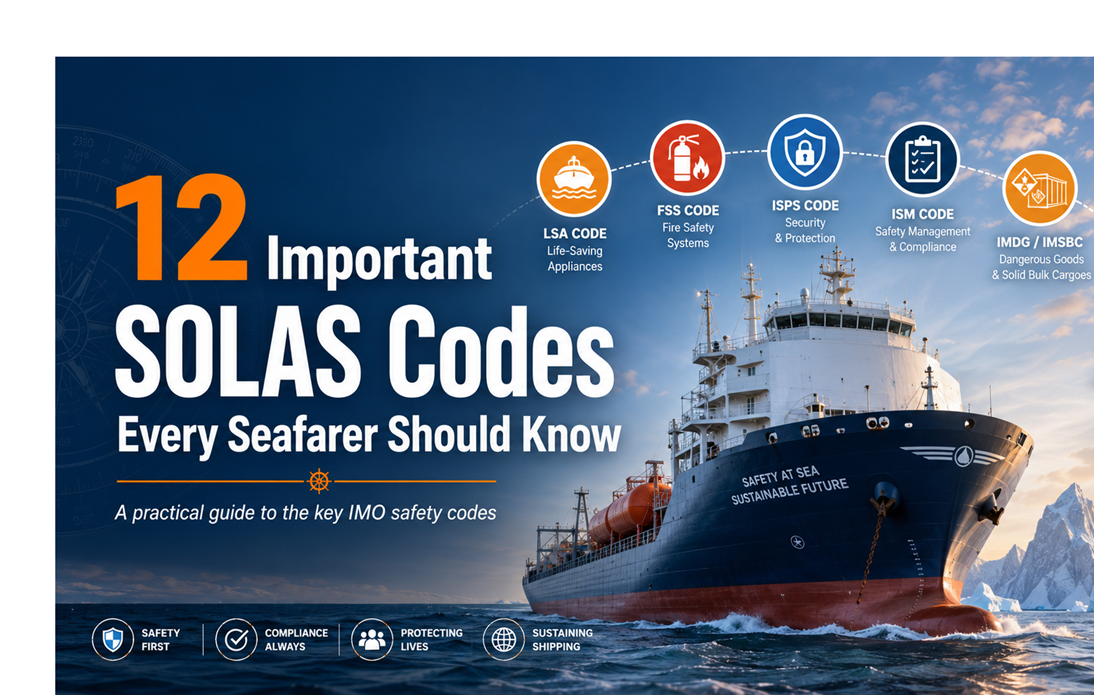
These Codes are not just paperwork. They directly affect daily work onboard. The FSS Code covers fire detection, fixed firefighting systems, sprinklers, fire mains, and emergency escape breathing devices. The LSA Code covers lifeboats, liferafts, lifejackets, immersion suits, rescue boats, and launching appliances. The ISM Code governs the Safety Management System, emergency procedures, audits, drills, and non-conformity reporting. The ISPS Code controls ship security, access control, restricted areas, security levels, visitor records, and port facility interaction.
Cargo-related Codes are equally important. The IMDG Code controls the declaration, marking, labelling, stowage, and segregation of dangerous packaged goods. The IMSBC Code helps prevent risks linked to bulk cargoes, including cargo shift, liquefaction, oxygen depletion, toxic gases, and unsafe hold preparation.
For maritime students and junior officers, understanding these Codes builds a strong foundation for safe ship operations. For experienced seafarers, reviewing them is essential for inspections, vetting, audits, and emergency readiness. Together, SOLAS and its related Codes form the practical safety framework that supports every ship at sea.
1. FSS Code: Fire Safety Systems Code
The FSS Code means the International Code for Fire Safety Systems.
It is one of the most important technical Codes under SOLAS Chapter II-2. SOLAS Chapter II-2 deals with construction, fire protection, fire detection, and fire extinction. The FSS Code provides detailed international standards for the fire safety systems required by SOLAS.
A ship fire can develop very quickly. In an engine room, fuel oil leakage, hot surfaces, electrical faults, or purifier problems can create serious fire risks. In accommodation spaces, electrical equipment, galley operations, and combustible materials can also become hazards. On ro-ro ships and passenger ships, fire can be especially dangerous because of the number of people onboard and the complexity of evacuation.
The FSS Code helps standardize the systems used to detect, control, and extinguish fires.
It covers systems such as:
- Fixed gas fire-extinguishing systems
- Fixed foam systems
- Fixed pressure water-spraying systems
- Automatic sprinkler systems
- Fire detection and alarm systems
- Emergency escape breathing devices
- Low-location lighting systems
- Fixed deck foam systems
- Inert gas systems
- Firefighter communication systems
For example, if a cargo ship has a fixed CO2 system for the engine room, the system must meet certain design, capacity, control, alarm, and release requirements. These details are not left only to personal judgment. They are regulated so that ships around the world follow a common safety level.
For seafarers, the FSS Code becomes real during fire drills. When engineers test fire dampers, remote quick-closing valves, fire pumps, emergency fire pumps, and fixed fire-extinguishing controls, they are working within the safety philosophy of SOLAS and the FSS Code.
A practical way to understand the FSS Code is this:
SOLAS says the ship must be protected against fire.
The FSS Code explains how the fire safety systems must be designed and perform.
2. LSA Code: Life-Saving Appliance Code
The LSA Code means the International Life-Saving Appliance Code.
It is closely connected with SOLAS Chapter III, which deals with life-saving appliances and arrangements. The LSA Code gives technical standards for life-saving appliances carried onboard ships.
Every seafarer knows that lifeboats and liferafts are essential. But the important question is: what makes a lifeboat acceptable? What equipment must be inside it? What strength must it have? How should it float? What survival items must be carried? What are the requirements for launching appliances?
The LSA Code answers these questions.
It covers life-saving appliances such as:
- Lifeboats
- Rescue boats
- Fast rescue boats
- Liferafts
- Marine evacuation systems
- Lifejackets
- Immersion suits
- Anti-exposure suits
- Lifebuoys
- Line-throwing appliances
- Survival craft launching appliances
- Embarkation ladders
The LSA Code is very important because during an emergency there may be no second chance. If a ship must be abandoned, survival equipment must work properly in difficult conditions. The sea may be rough. Visibility may be poor. People may be injured, tired, cold, or afraid.
This is why SOLAS and the LSA Code require not only carriage of equipment, but also testing, approval, maintenance, and training.
For ship officers, LSA knowledge is important during safety rounds, drills, flag State surveys, port State control inspections, and onboard maintenance. Defects related to lifeboats, launching appliances, hooks, falls, liferafts, hydrostatic release units, and lifejackets can become serious inspection findings.
For students, a simple summary is:
The LSA Code makes sure that life-saving appliances are not just present onboard, but are technically suitable for survival at sea.
3. ISM Code: International Safety Management Code
The ISM Code means the International Safety Management Code.
It is mandatory under SOLAS Chapter IX. Unlike the FSS Code and LSA Code, which focus mainly on technical equipment, the ISM Code focuses on management.
Before the ISM Code, many maritime accidents showed that ship safety was not only about steel, engines, and equipment. Many accidents happened because of poor communication, weak procedures, unclear responsibilities, lack of maintenance, poor emergency preparation, or failure of company support.
The ISM Code was introduced to create a structured Safety Management System for ships and companies.
The main idea is simple:
- The company must manage safety in a systematic way.
- The ship must follow documented procedures.
- Responsibilities must be clear.
- Risks must be controlled.
- Emergencies must be prepared for.
- Non-conformities must be reported and corrected.
- Continuous improvement must be part of the system.
Under the ISM Code, shipping companies must have a Safety Management System, often called SMS. Ships must carry a Safety Management Certificate, and companies must have a Document of Compliance.
The ISM Code affects many practical onboard activities, including:
- Bridge procedures
- Engine room procedures
- Permit-to-work systems
- Enclosed space entry
- Bunkering
- Hot work
- Emergency drills
- Maintenance planning
- Accident reporting
- Internal audits
- Master’s review
- Company audits
- Corrective actions
The ISM Code is one of the most human-centred SOLAS Codes. It recognizes that human organization is part of ship safety. A technically good ship can still be unsafe if the company has poor safety culture.
For example, if a crew member reports a near miss during mooring operations, the ISM system should not only blame someone. It should investigate, identify root causes, and prevent repetition.
A simple way to remember the ISM Code:
It is the Code that turns safety from a slogan into a managed system.
4. ISPS Code: International Ship and Port Facility Security Code
The ISPS Code means the International Ship and Port Facility Security Code.
It is linked with SOLAS Chapter XI-2, which deals with special measures to enhance maritime security. It became globally important after the security concerns of the early 2000s.
The ISPS Code is different from many other SOLAS Codes because it focuses on security rather than safety. Safety usually means protection from accidents. Security means protection from intentional unlawful acts, such as terrorism, sabotage, stowaways, piracy-related threats, smuggling, or unauthorized access.
The ISPS Code applies to ships and port facilities. It requires both sides to manage security risks.
Important ISPS elements include:
- Ship Security Plan
- Ship Security Officer
- Company Security Officer
- Port Facility Security Officer
- Security levels
- Ship security assessment
- Declaration of Security
- Access control
- Restricted areas
- Security drills and exercises
- Security records
- Gangway control
- Visitor identification
For seafarers, ISPS is visible during port calls. Crew may need to control access to the ship, check visitor passes, maintain gangway watch, secure restricted areas, and report suspicious activity.
Security levels are also important.
Security Level 1 is normal.
Security Level 2 means increased risk.
Security Level 3 means probable or imminent threat.
When the security level changes, the ship must apply stronger measures. This may affect access control, cargo operations, stores delivery, communication with port facility security officers, and crew movement.
The ISPS Code reminds us that modern maritime safety is not only about accidents. Ships are part of global trade, and global trade can be exposed to security threats.
A simple summary:
The ISPS Code protects ships and ports from intentional security threats.
5. IMDG Code: International Maritime Dangerous Goods Code
The IMDG Code means the International Maritime Dangerous Goods Code.
It is used for dangerous goods carried in packaged form by sea. It is closely connected with SOLAS Chapter VII, which deals with the carriage of dangerous goods.
Dangerous goods can include explosives, flammable liquids, toxic substances, corrosive substances, radioactive materials, oxidizing substances, gases, and environmentally hazardous substances.
If dangerous goods are wrongly packed, declared, labelled, stowed, or segregated, the consequences can be severe. Fires, explosions, toxic gas release, pollution, and crew injuries may occur.
The IMDG Code provides a global system for handling these risks.
It includes rules on:
- Classification of dangerous goods
- UN numbers
- Proper shipping names
- Packing groups
- Packaging requirements
- Marking and labelling
- Placarding
- Documentation
- Stowage
- Segregation
- Emergency response
- Marine pollutants
- Container packing
For container ships, the IMDG Code is extremely important. A large container vessel may carry thousands of containers, and many of them may contain dangerous goods. The ship’s crew may not physically see the cargo inside the containers. They depend on correct declaration and documentation.
Wrong declaration of dangerous goods is a serious problem in global shipping. A container declared as general cargo may actually contain flammable or reactive materials. If such cargo is stowed in the wrong place, it can increase fire risk.
For ship officers, IMDG knowledge is important during cargo planning, dangerous goods checks, stowage review, emergency response, and port State control inspections.
A simple summary:
The IMDG Code makes dangerous packaged goods safer to carry by sea.
6. IMSBC Code: International Maritime Solid Bulk Cargoes Code
The IMSBC Code means the International Maritime Solid Bulk Cargoes Code.
It applies to solid bulk cargoes carried by sea, except grain, which has its own Code. The IMSBC Code is closely related to SOLAS Chapter VI and Chapter VII because it supports safe cargo carriage and dangerous bulk cargo management.
Bulk cargoes may look simple. A ship loads coal, iron ore, nickel ore, bauxite, fertilizers, concentrates, or other solid material into cargo holds. But solid bulk cargoes can create serious risks.
- Some may liquefy.
- Some may shift.
- Some may emit toxic gases.
- Some may reduce oxygen inside cargo spaces.
- Some may heat by themselves.
- Some may corrode ship structures.
- Some may be dangerous when wet.
The IMSBC Code classifies cargoes into groups.
Group A cargoes may liquefy.
Group B cargoes have chemical hazards.
Group C cargoes are neither liable to liquefy nor have chemical hazards, but still require safe handling.
One of the most dangerous risks is cargo liquefaction. Cargoes such as nickel ore or certain mineral concentrates may appear solid when loaded, but under ship motion they can lose strength and behave like liquid. This can create free surface effect and cause sudden loss of stability. Several serious bulk carrier accidents have been linked to cargo liquefaction.
The IMSBC Code requires important information before loading, including cargo declaration, moisture content, transportable moisture limit where applicable, trimming requirements, and special precautions.
For bulk carrier officers, the IMSBC Code is not optional knowledge. It is central to safe cargo operations.
A simple summary:
The IMSBC Code helps prevent bulk cargo accidents such as liquefaction, cargo shift, poisoning, fire, and structural risk.
7. International Grain Code
The International Grain Code deals with the safe carriage of grain in bulk.
Grain may seem harmless compared with chemicals, gases, or dangerous goods. However, grain cargo can shift during a voyage. If grain shifts inside the hold, it can reduce the ship’s stability and create a dangerous list.
This is why grain has special requirements.
The Grain Code provides rules for:
- Stability calculations
- Allowable heeling moments
- Cargo shifting risk
- Filling of compartments
- Trimming of grain
- Securing arrangements
- Documentation
- Loading conditions
A ship carrying grain must be able to show that it has enough stability for the intended voyage. The master and officers must understand the grain loading plan and confirm compliance.
Grain cargoes are often carried in large quantities. Even a small shift can create major stability problems because the cargo mass is high. The risk is not only theoretical. History has shown that cargo shift can cause serious accidents.
For maritime students, the Grain Code is a good example of how cargo safety and ship stability are connected.
A simple summary:
The Grain Code protects ships from stability risks caused by shifting grain cargo.
8. IBC Code: International Bulk Chemical Code
The IBC Code means the International Code for the Construction and Equipment of Ships Carrying Dangerous Chemicals in Bulk.
It applies to chemical tankers carrying dangerous liquid chemicals in bulk. It is connected with SOLAS and MARPOL because chemical tanker safety has both safety and pollution-prevention dimensions.
Chemical tankers are complex ships. They may carry many different cargoes, each with its own hazards. Some chemicals are toxic. Some are flammable. Some are corrosive. Some react with water, air, or other cargoes. Some may harm the marine environment even in small quantities.
The IBC Code provides technical requirements for chemical tanker design, construction, equipment, and operation.
It covers areas such as:
- Ship type requirements
- Cargo tank location
- Tank materials
- Cargo containment
- Piping systems
- Venting systems
- Fire protection
- Personal protection
- Cargo temperature control
- Cargo compatibility
- Instrumentation
- Emergency arrangements
The IBC Code also includes a product list that identifies carriage requirements for specific chemicals. This is very important because different cargoes need different safety measures.
For example, a highly toxic chemical may require stricter tank location, closed loading, special ventilation, protective equipment, and emergency procedures. A corrosive cargo may require specific tank materials and piping arrangements.
For chemical tanker crews, the IBC Code is part of daily professional knowledge. It connects with cargo data sheets, Procedures and Arrangements Manual, MARPOL Annex II requirements, cargo record book entries, and terminal procedures.
A simple summary:
The IBC Code tells chemical tankers how to safely carry dangerous liquid chemicals in bulk.
9. IGC Code: International Gas Carrier Code
The IGC Code means the International Code for the Construction and Equipment of Ships Carrying Liquefied Gases in Bulk.
It applies to gas carriers, such as LNG carriers and LPG carriers. These ships carry cargoes that may be extremely cold, flammable, toxic, or carried under pressure.
Gas carriers are among the most technically advanced merchant ships. They need special cargo containment systems, insulation, pressure control, gas detection, emergency shutdown systems, ventilation, fire protection, and cargo handling arrangements.
The IGC Code provides detailed safety requirements for such ships. It covers topics such as:
- Cargo containment systems
- Ship survival capability
- Cargo tank location
- Materials of construction
- Pressure and temperature control
- Vapour handling
- Gas detection
- Emergency shutdown systems
- Fire protection
- Ventilation
- Personnel protection
- Instrumentation
- Cargo transfer systems
LNG cargo may be carried at extremely low temperature. LPG may be carried under pressure or at low temperature. Some gas cargoes may also be toxic. A leak can create fire, explosion, asphyxiation, cold burn, or structural risks.
The IGC Code is therefore essential for protecting the ship, crew, cargo, terminal, and environment.
For officers on gas carriers, understanding the IGC Code supports safe cargo operations, emergency response, maintenance, and inspections.
A simple summary:
The IGC Code provides the safety framework for ships carrying liquefied gases in bulk.
10. IGF Code: International Code of Safety for Ships Using Gases or Other Low-Flashpoint Fuels
The IGF Code means the International Code of Safety for Ships using Gases or other Low-flashpoint Fuels.
This Code has become very important because the maritime industry is moving toward alternative fuels. LNG, methanol, hydrogen-related fuels, ammonia, and other low-flashpoint fuels are increasingly discussed in shipping decarbonization.
Traditional marine fuel oil has known risks, but low-flashpoint fuels introduce different hazards. For example, LNG is cryogenic and flammable. Methanol is flammable and toxic. Ammonia is toxic and corrosive. Hydrogen has very wide flammability characteristics.
The IGF Code provides safety requirements for ships using such fuels. It covers areas such as:
- Fuel storage
- Fuel supply systems
- Bunkering arrangements
- Ventilation
- Gas detection
- Fire protection
- Explosion prevention
- Emergency shutdown
- Crew training
- Risk assessment
- Control and monitoring systems
The purpose of the IGF Code is not to stop the use of alternative fuels. Its purpose is to make their use safe.
This is important because decarbonization must not reduce safety. A ship may reduce emissions, but it must still protect life, property, and the marine environment.
For maritime education, the IGF Code is now a key subject. Future engineers and deck officers will increasingly work on ships using new fuels. They must understand not only environmental benefits, but also safety risks.
A simple summary:
The IGF Code helps ships use low-flashpoint and alternative fuels safely.
11. ESP Code: Enhanced Survey Programme Code
The ESP Code means the International Code on the Enhanced Programme of Inspections During Surveys of Bulk Carriers and Oil Tankers.
It is linked with SOLAS Chapter XI-1 and focuses on structural safety. Bulk carriers and oil tankers are large ships exposed to heavy structural stresses. Their cargoes can also create corrosion, fatigue, and damage risks.
The ESP Code requires enhanced inspections during surveys. The aim is to detect structural problems before they become catastrophic. It is especially important for:
- Bulk carriers
- Oil tankers
- Aging ships
- Cargo holds
- Ballast tanks
- Cargo tanks
- Deck structures
- Structural members exposed to corrosion
For bulk carriers, cargo holds can suffer from mechanical damage during cargo operations. Grabs, bulldozers, cargo residues, and heavy cargoes can damage hold structures. For oil tankers, cargo tanks and ballast tanks may suffer from corrosion and coating breakdown.
The ESP Code supports detailed survey planning, close-up surveys, thickness measurements, tank inspections, and reporting.
For ship managers and chief officers, the ESP Code is important during dry docking, special surveys, intermediate surveys, and preparation for class inspections.
A simple summary:
The ESP Code strengthens structural inspection for bulk carriers and oil tankers.
12. Polar Code: International Code for Ships Operating in Polar Waters
The Polar Code means the International Code for Ships Operating in Polar Waters.
It applies to ships operating in Arctic and Antarctic waters. It has both safety and environmental parts. The safety part is linked with SOLAS, while the environmental part is linked with MARPOL.
Polar waters create special risks that normal ship operations may not face. These risks include:
- Ice navigation
- Low temperatures
- Remote location
- Limited search and rescue support
- Poor communication
- Rapid weather changes
- Ice accretion
- Long darkness
- Sensitive environment
- Limited pollution response
The Polar Code requires ships to consider these risks before operating in polar areas.
Important elements include:
- Polar Ship Certificate
- Polar Water Operational Manual
- Ship structure and ice class considerations
- Machinery operation in low temperatures
- Navigation in ice
- Crew training
- Life-saving appliances suitable for polar conditions
- Fire safety in cold environments
- Voyage planning
- Communication
- Environmental protection measures
The Polar Code is a good example of risk-based regulation. It recognizes that a ship safe in the Mediterranean or South China Sea may not automatically be safe in polar waters.
For crews, polar operations require preparation, caution, and special training. Equipment must work in extreme cold. Survival appliances must protect people for longer periods. Navigation must consider ice, limited charts, and changing conditions.
A simple summary:
The Polar Code adapts ship safety and environmental protection to Arctic and Antarctic conditions.
–
Other SOLAS-Related Codes Worth Knowing
The 12 Codes above are among the most important for general maritime training. However, several other IMO Codes are also closely related to SOLAS practice.
FTP Code
The FTP Code means the International Code for Application of Fire Test Procedures.
It supports fire safety by providing test procedures for materials and divisions used on ships. For example, it helps determine whether materials meet required fire resistance or flame-spread standards.
The FTP Code is closely linked with SOLAS fire protection requirements. While seafarers may not use it every day, ship designers, shipyards, classification societies, and surveyors use it frequently.
CSS Code
The CSS Code means the Code of Safe Practice for Cargo Stowage and Securing.
It provides guidance for cargo securing. This is important because cargo shift can endanger ship stability, damage the ship, injure crew, or cause cargo loss. It is especially relevant for general cargo ships, ro-ro ships, heavy-lift cargo, project cargo, and deck cargo.
HSC Code
The HSC Code means the International Code of Safety for High-Speed Craft.
It applies to high-speed craft such as fast ferries. These craft have different design and operational characteristics compared with conventional ships, so they need special safety standards.
SPS Code
The SPS Code means the Code of Safety for Special Purpose Ships.
Special purpose ships may carry special personnel for scientific, training, research, or offshore-related purposes. They are not normal passenger ships, but they carry persons in addition to crew. Therefore, safety rules must address their special operational profile.
MODU Code
The MODU Code means the Code for the Construction and Equipment of Mobile Offshore Drilling Units.
It applies to mobile offshore drilling units. Although MODUs are not ordinary merchant ships, they operate in marine environments and need strong safety standards for construction, stability, fire safety, lifesaving, and operations.
RO Code
The RO Code means the Code for Recognized Organizations.
Recognized organizations are often classification societies authorized by flag States to carry out surveys and certification on their behalf. The RO Code sets standards for these organizations. This supports consistent implementation of SOLAS and other IMO instruments.
III Code
The III Code means the IMO Instruments Implementation Code.
It supports the implementation of IMO instruments by flag States, port States, and coastal States. It is important because international rules are only effective if States implement and enforce them properly.
Casualty Investigation Code
This Code provides standards and recommended practices for marine safety investigations. Its purpose is not mainly to blame people, but to learn from accidents and prevent future casualties.
How to Remember the Main SOLAS Codes Easily
Many students struggle because the Codes sound similar. A simple method is to connect each Code with one keyword.
FSS Code: fire systems
LSA Code: survival equipment
ISM Code: safety management
ISPS Code: security
IMDG Code: packaged dangerous goods
IMSBC Code: solid bulk cargoes
Grain Code: grain stability
IBC Code: chemical tankers
IGC Code: gas carriers
IGF Code: low-flashpoint fuels
ESP Code: enhanced structural surveys
Polar Code: polar waters
IP Code: industrial personnel
This memory method is simple but effective. It helps students quickly identify the purpose of each Code during exams, oral assessments, onboard familiarization, and inspections.
Common Mistakes Students Make About SOLAS Codes
Many learners do not fail because the topic is too difficult. They fail because they mix up similar names and concepts.
One common mistake is confusing the IGC Code and IGF Code.
The IGC Code is for ships carrying liquefied gases in bulk as cargo.
The IGF Code is for ships using gases or other low-flashpoint fuels as fuel.
Another common mistake is confusing IMDG and IMSBC.
IMDG is for dangerous goods in packaged form.
IMSBC is for solid bulk cargoes.
A third mistake is thinking ISM and ISPS are the same type of Code.
ISM is about safety management.
ISPS is about maritime security.
Another common mistake is thinking the LSA Code only means lifeboats. In reality, it covers many life-saving appliances, including liferafts, rescue boats, lifejackets, immersion suits, lifebuoys, and launching appliances.
Students also sometimes forget that the Polar Code has both safety and environmental dimensions. The safety part is linked with SOLAS, while the pollution-prevention part is linked with MARPOL.
Understanding these differences helps you speak more professionally in maritime exams and onboard discussions.
Why SOLAS Codes Are Important During Port State Control
Port State Control officers do not only check certificates. They also check whether the ship is actually complying with safety standards.
A ship may be inspected for:
- Fire safety systems
- Lifesaving appliances
- Emergency drills
- Dangerous goods documentation
- Cargo securing
- Safety management records
- Security procedures
- Crew familiarization
- Structural condition
- Navigation safety
If deficiencies are found, the ship may receive observations, deficiencies, or even detention in serious cases.
Many PSC deficiencies are directly connected to SOLAS-related Codes. For example, defective fire doors, non-operational fire detection, expired liferaft service, damaged immersion suits, poor enclosed space procedures, missing dangerous goods documents, weak gangway security, or poor SMS implementation may all create problems.
This is why ship crews should not treat Codes as books that stay on a shelf. They must be translated into working practice.
A well-prepared ship usually has:
- Updated certificates
- Correct manuals
- Trained crew
- Good maintenance records
- Effective drills
- Clear emergency procedures
- Proper cargo documentation
- Controlled access
- Good housekeeping
- Functional safety equipment
The best approach is simple: do not prepare for inspections only when an inspector comes. Prepare every day through good routine.
How SOLAS Codes Support a Safety Culture
A good safety culture is not created only by rules. It is created when people understand why the rules exist.
The FSS Code exists because fire at sea can kill quickly.
The LSA Code exists because abandonment may happen in extreme conditions.
The ISM Code exists because poor management causes accidents.
The ISPS Code exists because ships and ports can be security targets.
The IMDG Code exists because dangerous goods can create fire, explosion, or toxic risk.
The IMSBC Code exists because bulk cargoes can liquefy, shift, or emit dangerous gases.
The IBC and IGC Codes exist because chemical and gas cargoes need special ship design and equipment.
The IGF Code exists because alternative fuels bring new hazards.
The Polar Code exists because polar waters are remote, cold, and dangerous.
The ESP Code exists because structural failure can be catastrophic.
The IP Code exists because industrial personnel need protection during modern offshore operations.
When seafarers understand this logic, compliance becomes easier. The rules are no longer just “requirements.” They become lessons learned from accidents, technical experience, and international cooperation.
Interactive Quiz for Readers
To improve engagement, a short quiz can be added after the article.
Example:
Which Code deals with life-saving appliances?
A. FSS Code
B. LSA Code
C. ISPS Code
D. IGF Code
Correct answer: B
Which Code applies to packaged dangerous goods?
A. IMDG Code
B. IMSBC Code
C. Grain Code
D. ESP Code
Correct answer: A
Which Code is mainly about safety management?
A. ISM Code
B. ISPS Code
C. IBC Code
D. IGC Code
Correct answer: A
Which Code applies to ships using LNG or other low-flashpoint fuels?
A. IGC Code
B. IGF Code
C. IMSBC Code
D. FTP Code
Correct answer: B
Which Code applies to ships operating in Arctic and Antarctic waters?
A. Polar Code
B. HSC Code
C. RO Code
D. IP Code
Correct answer: A
This kind of quiz helps readers test themselves and stay longer on the page.
Practical Example: A Day Onboard Through SOLAS Codes
Imagine a normal day on a cargo ship.
In the morning, the deck officer checks life-saving appliances before arrival. Lifebuoys, lifejackets, lifeboat condition, and embarkation arrangements are checked. This connects with the LSA Code.
The engineer tests the fire alarm panel and checks emergency fire pump readiness. This connects with the FSS Code.
The master reviews a near-miss report from the previous port. The company requests corrective action through the Safety Management System. This connects with the ISM Code.
At the gangway, the duty crew checks visitors and controls access during port stay. This connects with the ISPS Code.
The chief officer reviews dangerous goods documents for containers to be loaded. This connects with the IMDG Code.
If the ship is a bulk carrier, the cargo declaration is checked for moisture content and cargo hazards. This connects with the IMSBC Code.
If the ship is a tanker, structural survey planning may include requirements linked to the ESP Code.
If the ship uses LNG as fuel, bunkering preparation and gas detection checks connect with the IGF Code.
This example shows that SOLAS Codes are not separate from daily work. They are built into normal ship operations.
Future Trends: Why SOLAS Codes Will Become Even More Important
Shipping is changing quickly. New fuels, automation, digital systems, offshore wind operations, polar routes, larger ships, and stricter inspections are changing the way ships are designed and operated.
As shipping changes, SOLAS-related Codes will also continue to evolve.
Alternative fuels will make the IGF Code more important.
Offshore wind growth will make the IP Code more relevant.
Polar trade and cruise operations will keep the Polar Code important.
Digitalization may create future safety requirements for autonomous and remotely operated ships.
Cargo risks will continue to make IMDG and IMSBC knowledge essential.
Fire safety will remain critical as ship designs, batteries, vehicles, and alternative energy systems become more complex.
For maritime professionals, this means one thing: learning SOLAS Codes is not only for passing exams. It is part of staying competent in a changing industry.
Final Summary: The SOLAS Codes You Should Know First
SOLAS is the main international convention for ship safety. But many practical safety requirements are explained through IMO Codes.
The most important SOLAS-related Codes include:
FSS Code for fire safety systems
LSA Code for life-saving appliances
ISM Code for safety management
ISPS Code for maritime security
IMDG Code for packaged dangerous goods
IMSBC Code for solid bulk cargoes
International Grain Code for grain in bulk
IBC Code for chemical tankers
IGC Code for gas carriers
IGF Code for low-flashpoint fuels
ESP Code for enhanced surveys of tankers and bulk carriers
Polar Code for polar waters
IP Code for ships carrying industrial personnel
Other useful Codes include the FTP Code, CSS Code, HSC Code, SPS Code, MODU Code, RO Code, III Code, and Casualty Investigation Code.
For students, the best way to learn them is to connect each Code with its practical purpose. Do not memorize only the abbreviation. Understand the risk that the Code controls.
Fire kills. The FSS Code controls fire systems.
Abandonment is dangerous. The LSA Code controls survival equipment.
Poor organization causes accidents. The ISM Code controls safety management.
Security threats are real. The ISPS Code controls maritime security.
Dangerous cargo can explode, burn, poison, or pollute. The IMDG, IMSBC, IBC, IGC, and Grain Codes control cargo risks.
New fuels bring new hazards. The IGF Code controls low-flashpoint fuel safety.
Polar waters are extreme. The Polar Code controls polar operation risks.
Industrial personnel need protection. The IP Code controls safety for modern offshore work.
In the end, SOLAS Codes are not just exam topics. They are the working language of ship safety. Every officer, engineer, cadet, surveyor, auditor, and ship operator should understand them because they help turn international rules into real protection for people, ships, cargo, and the sea.