
By : Etemad-Shahidi, Bahareh Kamranzad, Vahid Chegini
Since the fossil fuels will be finished in the world, usage of other sources of energy such as renewable energies is very important. One of the most important sources of the renewable energies is wave energy that has the highest energy density among the other sources. In this paper, wave energy assessment is carried out in the Persian Gulf to determine the hot spots of energy in this basin. For this purpose, wave characteristics were modeled using SWAN numerical model. ECMWF wind field was used as the model input to predict wave characteristics for the 25-year period. Calibration and verification of the SWAN model were carried out using measurements obtained from a buoy deployed near the Boushehr port. Calibration of the model was conducted for wave power instead of the significant wave height. After verification of the model, the constructed model was used to produce the wave characteristics in the entire Persian Gulf domain. The spatial and temporal resolutions of the results were 0.2º and 3 hours, respectively. The results showed that the average values of the wave power are higher in the middle part of the Persian Gulf. This is due to the long fetch of the Persian Gulf in the NW-SE direction that is also the dominant wind direction in the Persian Gulf. The most appropriate site for wave energy extraction in the Iranian coasts was found to be near the Assalouyeh.
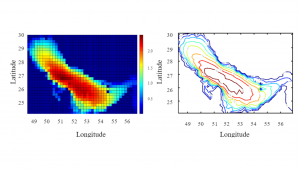
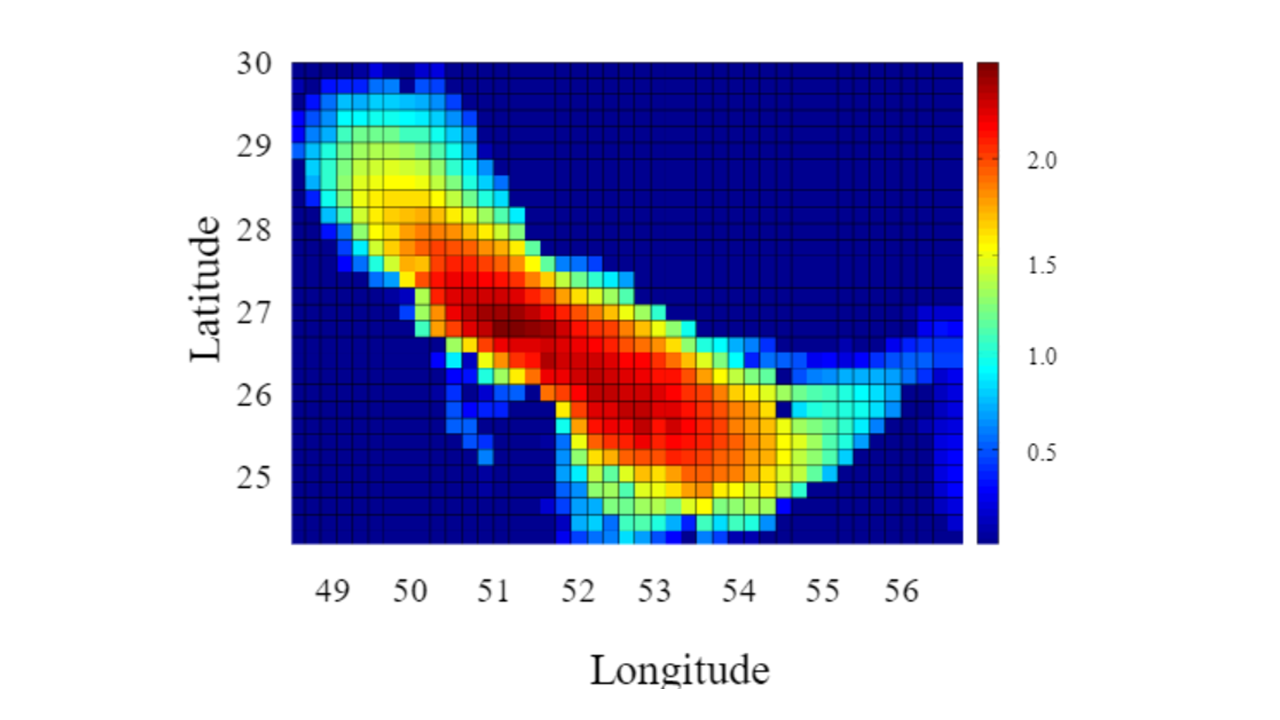
Fig. Wave power (m2s) distribution and contour plot in the Persian Gulf
Frequently Asked Questions
1. Why should we care about wave energy in the Persian Gulf?
Because fossil fuels won’t last forever. The article opens with a clear warning: fossil fuels will be finished. Wave energy is one of the most important renewable sources – and it has the highest energy density of any renewable (meaning you get more power from a smaller area).
For Persian Gulf countries built on oil wealth, wave energy offers a post‑oil future – and this study pinpoints exactly where to start.
2. How did researchers measure wave energy potential in the Gulf?
They used a scientific model called SWAN (Simulating WAves Nearshore) driven by ECMWF wind field data over a 25‑year period.
-
Calibration & verification – performed using real measurements from a buoy near Boushehr port (on the Iranian coast)
-
Spatial resolution – results every 0.2º (about 22 km)
-
Temporal resolution – results every 3 hours
This is not guesswork – it’s 25 years of modeled data validated against real waves.
3. Where is the best location in the Persian Gulf for wave energy?
The study identified two answers:
-
For the entire Persian Gulf – the middle part of the Gulf has the highest average wave power
-
For Iranian coasts specifically – the most appropriate site is near Assalouyeh (a major energy hub on Iran’s southern coast)
Why the middle? Because the Gulf’s longest “fetch” (distance wind blows over water) runs NW‑SE, which is also the dominant wind direction. That builds bigger, more powerful waves.
4. How much wave power are we talking about?
The article includes a wave power distribution map (see Fig. Wave power distribution in the original paper). While exact average kilowatt values aren’t listed in this summary, the key finding is that wave power is highest in the middle of the Gulf – not near the coasts – due to the long NW‑SE fetch.
For engineers and investors: the spatial and temporal patterns are now mapped at 3‑hour intervals over 25 years – a complete dataset for feasibility studies.
5. Why is wave energy better than solar or wind in some cases?
Because of energy density. The article states wave energy has the highest energy density among all renewable sources.
What does that mean for you?
-
Smaller equipment – fewer square meters of panels or turbine blades
-
More predictable – waves lag wind, so they’re less intermittent
-
Nighttime & calm‑weather production – waves keep rolling after wind dies
For the Persian Gulf – which has plenty of sun but also intense heat that degrades solar panels – wave energy could be a complementary, high‑density alternative.
6. Did the researchers just use computer models, or real data?
Both. They:
-
Ran the SWAN model with ECMWF wind data for 25 years
-
Calibrated the model using a real buoy near Boushehr port – and they calibrated for wave power itself, not just wave height (a more advanced approach)
-
Verified the model against the same buoy data
That means the results are ground‑truthed, not just theoretical.
7. Who conducted this research – and can I contact them?
Yes – the authors are academic experts:
-
Amir Etemad‑Shahidi & Bahareh Kamranzad – Iran University of Science and Technology (Tehran)
-
Vahid Chegini – Iranian National Institute for Oceanography (Tehran)
-
Bahareh Kamranzad is now a Lecturer & Chancellor’s Fellow at the University of Strathclyde, UK
You can contact them directly:
-
etemad@iust.ac.ir -
kamranzad@iust.ac.ir -
vahid.chegini@gmail.com
The full paper is available on ResearchGate (DOI/publication ID: 296396763).
8. What’s the single biggest takeaway for renewable energy developers?
The Persian Gulf has real wave energy potential – and it’s concentrated in predictable locations.
-
Middle of the Gulf – highest average wave power
-
Near Assalouyeh (Iranian coast) – best site for extraction on the Iranian side
-
Why now? Because fossil fuels are finite, and wave energy has the highest energy density of any renewable
To read more, you may contact:
Amir Etemad-Shahidi, Bahareh KamranzadIran University of Science and TechnologyNarmak, Tehran, Iranetemad@iust.ac.ir; kamranzad@iust.ac.ir
Vahid CheginiIranian National Institute for OceanographyNo. 3, Etemad Zadeh St., West Fatemi Ave., Tehran, Iranvahid.chegini@gmail.com
Bahareh Kamranzad, PhDLecturer & Chancellor’s fellow at University of Strathclyde , United Kingdom
(12) (PDF) Wave energy estimation in the Persian Gulf. Available from: https://www.researchgate.net/publication/296396763_Wave_energy_estimation_in_the_Persian_Gulf
–