
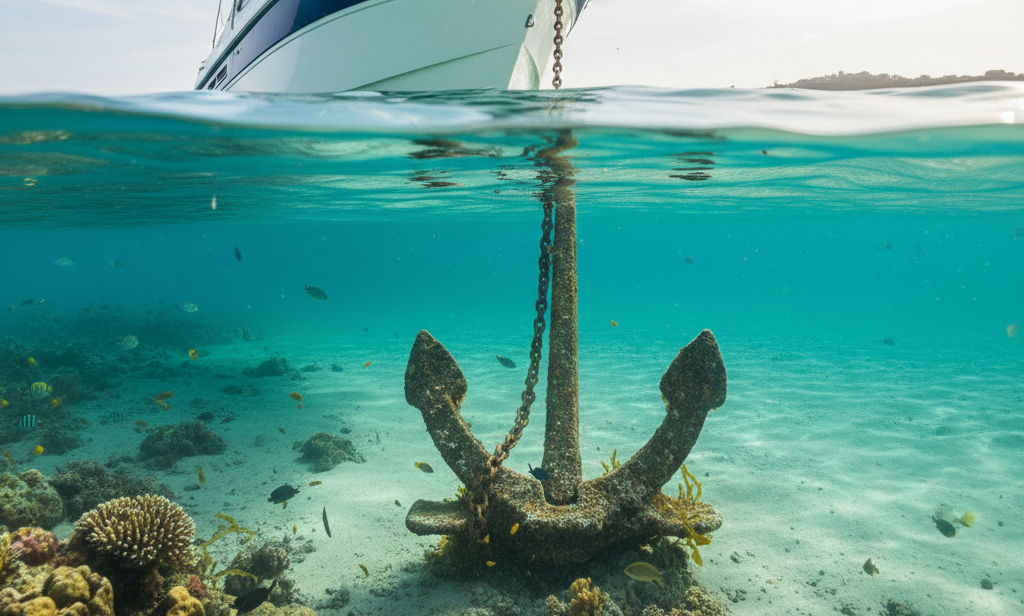
The Ghosts Beneath the Keel
For centuries, humanity has viewed the ocean as an infinite, resilient frontier. From the wooden dhows of the Indian Ocean to the ultra-large container vessels (ULCVs) of the modern era, we have relied on anchors and moorings to tether our floating world to the seabed. Yet, beneath the shimmering surface lies a silent crisis. While oil spills, plastic pollution, and overfishing dominate environmental headlines, the physical destruction wrought by the very act of stopping a ship—anchor scour and mooring drag—remains one of the most pervasive, yet least visible, threats to marine ecosystems.
Every day, approximately 80,000 merchant vessels transit the world’s oceans. When they enter ports, wait for berths, or shelter from storms, they deploy anchors weighing up to 20 tons, dragging chains hundreds of meters long across the seafloor. Simultaneously, the proliferation of offshore aquaculture, renewable energy installations, and recreational boating adds millions of fixed and semi-fixed moorings. The cumulative effect is a planetary “ploughing” of the seabed.
This article explores the geophysical and biological impacts of this phenomenon. We will analyze how anchors and chains crush fragile biogenic reefs, how mooring systems create “halos of desertification” around pristine areas, and how the infrastructure intended to support the blue economy is ironically destabilizing the very habitats it depends on. We will also examine mitigation strategies, from eco-moorings to spatial planning, that offer a path toward coexistence.
Part 1: The Mechanics of Destruction – How Anchors and Moorings Work (As Weapons)
To understand the impact, one must first understand the physics of holding power. Anchors are not designed to hook onto rocks like a climbing piton; they are designed to dig in.
1.1 The Plough Zone
When a vessel drops anchor, the initial impact can kill or crush organisms instantly. However, the primary damage occurs during the dragging phase. As wind or current shifts the vessel, the anchor shank pulls the fluke through the sediment. This creates a furrow—a “scour mark”—that can be meters wide and tens of meters long. In soft sediments, the displaced material forms berms on either side, burying sessile organisms that live adjacent to the scar.
1.2 The Chain’s “Lashing” Effect
The anchor chain is not a passive rope. It is heavy, abrasive, and mobile. As a vessel swings at anchor (a process known as “sailing”), the chain sweeps back and forth across the seabed in a radius known as the “swinging circle.” This chain cuts through seagrass rhizomes, shatters shell hash, and resuspends fine sediments. Unlike a discrete scar, the chain creates a zone of continuous mechanical abrasion, preventing any recovery.
1.3 Mooring Arrays
Permanent moorings (used for buoys, finfish farms, or tidal turbines) replace the ship’s engine with a fixed point. A typical system includes a helical screw anchor driven into the seabed, a heavy chain, and a surface buoy. While these prevent the “ploughing” of a dragging ship anchor, they create “scour pits” around the anchor point and the “chain lick” where the chain lies on the bottom. Over years, this creates a barren circle.
Part 2: Soft Sediment Habitats – The Muddy Graveyards
Soft sediments (mud, sand, silt) cover over 70% of the continental shelves. For decades, scientists assumed that if the bottom was soft, disturbance was irrelevant—that these habitats were natural deserts. We now know they are biodiversity hotspots.
2.1 The Infaunal Apocalypse
The majority of life in soft sediments lives inside the sediment (infauna). Polychaete worms, amphipods, and bivalves burrow to create oxygenated tubes. An anchor dragging through the mud does not just crush them; it homogenizes the sediment layers. The oxidized surface layer (where bacteria break down pollutants) is mixed with the anoxic lower layer (rich in toxic hydrogen sulfide). This chemical disruption can take months to revert.
Case Study: The Solent, UK
The Solent is a dense shipping channel and a protected area for rare seahorses and stalked jellyfish. Studies using side-scan sonar revealed that 25% of the seabed in designated anchorages showed evidence of chronic anchor scour. The diversity of infaunal nematodes in scoured zones was 60% lower than in undisturbed control sites. The sediment grain size shifted from complex muddy-sand to uniform coarse sand—a sign of ecological regression.
2.2 Resuspension and Smothering
When a chain stirs sediment, fine particles drift in the current. This has two impacts:
-
Light attenuation: Turbid water prevents photosynthesis in nearby seagrass beds.
-
Smothering: As the sediment settles, it blankets filter-feeding organisms (sponges, mussels, scallops) located down-current, clogging their siphons and causing starvation.
2.3 Nutrient Cycling Disruption
Soft sediments are the ocean’s kidneys. They denitrify excess nitrogen—a critical service in coastal areas plagued by agricultural runoff. Anchor scour churns this process to a halt. The physical mixing releases stored nitrogen and phosphorus back into the water column, potentially triggering harmful algal blooms (HABs) miles away from the anchor site.
Part 3: Hard Bottom and Biogenic Reefs – The Crushing of Cathedrals
While soft sediments suffer homogenization, hard bottoms (rocky reefs, coral gardens) suffer structural demolition. Biogenic reefs—built by living organisms like corals, mussels, and polychaete worms—are particularly vulnerable because they are three-dimensional and brittle.
3.1 Cold-Water Coral Reefs
Deep-sea corals (e.g., Lophelia pertusa) are foundation species that live in the dark, cold waters of the continental slope. They grow at a rate of only 1–10 mm per year, yet they form reef complexes thousands of years old. Shipping lanes often cross these reefs.
-
The Impact: A trawler’s anchor is devastating, but even a passing vessel dragging a chain will snap off centuries-old coral branches.
-
The Rubble Zone: Once fractured, the coral skeleton becomes loose rubble. This rubble is unstable; juvenile corals cannot recruit to it. The reef transitions from a living thicket to a dead gravel bed.
Quantified Data: Research in the Northeast Atlantic (Rockall Bank) showed that areas with anchor scour had a coral density reduction of 95%. The associated megafauna (brittle stars, crabs, deep-sea sharks) abandoned the area entirely. Recovery is measured in centuries, if it occurs at all.
3.2 Seagrass Meadows (Posidonia oceanica)
Seagrass is technically a flowering plant, but it anchors in soft sediment via a thick mat of roots and rhizomes known as the “matte.” This matte can be meters thick, accumulated over millennia.
-
The Anchor’s Effect: When an anchor drags through a Posidonia meadow, it doesn’t just pull leaves; it rips up the matte. This creates deep “scarring” visible from space. Unlike the foliage, the matte does not grow back.
-
Mooring “Halos”: In popular Mediterranean anchorages (e.g., the Balearic Islands, French Riviera), heavy mooring chains have created distinct “halos” of bare sand. The seagrass recedes exactly to the radius of the swinging chain.
The Tragedy of Shifting Baselines: Many boaters assume the sandy patches are natural. In reality, they are anthropogenic wounds. The loss of seagrass leads to coastal erosion, loss of nursery grounds for commercial fish (sea bream, lobster), and the release of “blue carbon” (CO2 stored in the matte for millennia).
3.3 Sabellaria Reefs (Honeycomb Worms)
Less famous than coral, but equally vital, are reefs built by Sabellaria alveolata (honeycomb worm) and Sabellaria spinulosa. These polychaetes glue sand grains into rigid, honeycomb-like structures. They are often called “the coral of the temperate zone.”
-
Vulnerability: These reefs are brittle. A single anchor drop or mooring chain drag can shatter a 100-square-meter reef instantly.
-
Ecological Collapse: The reef provides habitat for juvenile cod and sole. When the reef is crushed, the 3D structure collapses into flat sand. The fish leave, and the ecosystem shifts from a fish nursery to a worm flat.
Part 4: The Infrastructure Nexus – Pontoons, Piers, and Energy Devices
Anchor scour is the “moving” threat. However, static infrastructure (marina pontoons, offshore wind platforms, tidal turbines) creates a novel set of impacts that interact with vessel moorings.
4.1 Scour Pits Around Piles
Offshore wind turbines and oil platforms are fixed to the seabed via massive steel piles. The flow of water around these piles accelerates, creating a “scour hole.” This hole alters local hydrodynamics. When vessels moor to these platforms (for maintenance or supply), the dynamic load of the ship pulling against the pile exacerbates the erosion, deepening the pit by meters.
4.2 Electromagnetic Fields (EMFs) and Cable Burial
Subsea power cables from wind farms must be buried to avoid anchor strikes. Ironically, the burial process (jet trenching) fluidizes the sediment, killing infauna along the cable route. Furthermore, the EMFs from live cables alter the navigation of elasmobranchs (sharks and rays) which use electroreception. While not “scour,” this infrastructure-mooring interaction creates a cumulative stressor.
4.3 The “Ghost Mooring” Problem
Abandoned mooring infrastructure (chains, concrete blocks, synthetic rope) continues to impact the seabed decades after removal. Synthetic ropes degrade into microplastics within the sediment. Concrete blocks cause “shading” – preventing light from reaching epibiota. Steel chains rust, releasing heavy metals (zinc, copper) that are toxic to larval development.
Part 5: Biological Consequences – Beyond Physical Crushing
The physical scraping is the cause; the biological effects are the symptoms. These extend far beyond the immediate scar.
5.1 The Invasion Corridor
Disturbed seabed is a magnet for invasive species. Native species are specialists adapted to stable conditions. When an anchor plows a furrow, it creates a “pioneer” environment—a blank slate. Invasive species (e.g., the Japanese wireweed Sargassum muticum, the slipper limpet Crepidula fornicata) are generalists. They colonize the scar faster than natives. Consequently, anchorages act as “stepping stones” for invasive species to spread across bioregions.
5.2 Trophic Disruption (The Food Web)
Consider a simple food chain: Seagrass → Sea urchin → Octopus.
-
Anchor scour removes the seagrass.
-
Sea urchins, lacking habitat, starve or migrate.
-
Octopuses, lacking prey, leave.
The top predator (octopus) might survive, but the energy flow through the system collapses. In sandy habitats, the removal of burrowing shrimp and worms eliminates the food source for demersal (bottom-feeding) fish like plaice and sole. Studies of port anchorages consistently show fish biomass is 40-80% lower than in adjacent no-anchor zones.
5.3 Sound Pollution (The Acoustic Spoor)
The scraping of a chain on rock produces low-frequency vibration (20–200 Hz). Many marine invertebrates (squid, crabs, lobsters) and fish use low-frequency sound for communication and predator detection. A vessel dragging anchor generates a continuous acoustic “scream” that can mask the mating calls of toadfish or the snapping of pistol shrimp. This behavioral impact is only now being researched, but preliminary data suggests chronic anchor noise increases stress hormones (cortisol) in shellfish.
Part 6: Case Studies – Real-World Catastrophes
Case Study A: The Florida Keys National Marine Sanctuary (USA)
The Keys are a mosaic of coral reef, seagrass, and hardbottom. Before the implementation of “Morrison’s Cay” mooring buoys, the Sanctuary recorded 14,000 anchor drops per month in peak season.
-
The Damage: A single 40-foot sailboat swinging at anchor for one night destroyed 15 square meters of Thalassia testudinum seagrass. Over ten years, recreational anchoring destroyed 60,000 acres of seagrass.
-
The Fix: Installation of 500+ “eco-moorings” (helical screws with floating whips). Within five years, seagrass density recovered by 70% in buoyed areas, though scar tissue remains.
-
Lesson: Only 2% of boaters used the free buoys initially; enforcement (fines up to $10,000) was required to change behavior.
Case Study B: The Port of Rotterdam (The Netherlands)
As Europe’s largest port, Rotterdam deals with mega-ships (400m length). Anchorages cover 50 square kilometers of the North Sea floor.
-
The Damage: Sonar surveys revealed a “ploughed field” landscape. The average anchor scar depth was 0.5m, and the total resuspended sediment volume was estimated at 1.2 million cubic meters annually—enough to fill 500 Olympic pools. This sedimentation smothered the nearby Borkum Reefstone (a glacial erratic reef).
-
Mitigation: Rotterdam pioneered “dynamic anchoring”—using GPS to calculate holding ground without dragging. They also mandated “soft-start” anchoring (slow chain release to minimize impact velocity). Results reduced scour depth by 30%.
Case Study C: The Adriatic Sea – Mussels vs. Trawlers
This is a conflict of infrastructure. The Adriatic is filled with offshore mussel farms (longlines supported by heavy anchors). Winter storms cause fishing vessels to drag anchors for shelter.
-
Conflict: Trawlers claim the mussel anchors ruin their nets; mussel farmers claim trawler anchors cut their longlines.
-
Ecological Toll: The seafloor beneath the farms became a “dead zone” of crushed shell hash and discarded synthetic chain. However, the trawler anchor scour zone extended further, creating mobile sandy deserts.
-
Resolution: Adoption of “low-scour” plow anchors (less digging) and “sacrificial moorings” (designed to break before dragging far).
Part 7: Mitigation – Engineering a Solution
We cannot stop shipping, but we can change how we stop ships.
7.1 Ecological Moorings (Eco-Moorings)
Traditional moorings use a heavy block or deadweight that drags. Eco-moorings use a helical screw or suction embedment anchor that requires less chain length. They also use a “floating whip” (a section of polyform buoy or rubber hose) that keeps the chain off the bottom entirely.
-
Effectiveness: Eco-moorings reduce seabed contact by 99% compared to swinging chain moorings.
-
Cost: Expensive upfront ($2,000 vs $500 for a concrete block), but cheaper to maintain because chains don’t rust as fast.
-
Adoption Barrier: Port authorities often stick with cheap deadweights despite long-term ecological damage.
7.2 Anchorless Holding (Dynamic Positioning)
Modern vessels, particularly drill ships and cruise liners, use Dynamic Positioning (DP). GPS and thrusters hold the vessel stationary without dropping anchor.
-
Pros: Zero seabed impact.
-
Cons: High fuel consumption (burning diesel 24/7) and noise pollution (thruster cavitation harms marine mammals). It is a trade-off: physical scour vs. acoustic/climate impact.
7.3 Soft-Bottom Protection Mats
In critical habitats (e.g., Posidonia meadows), port authorities can install geotextile mats over the seagrass. These “anchor protection mats” distribute the load of the chain. However, they are expensive ($200 per m²) and can become plastic litter if not retrieved.
7.4 Spatial Planning (The Ultimate Solution)
The most effective mitigation is avoiding the problem entirely.
-
High-Resolution Seabed Mapping: Using multibeam echosounders (MBES) and LiDAR, ports can identify “hard ground” (rock, reef) versus “soft ground” (mud, sand).
-
Zoning: Anchorages are moved to low-sensitivity mud basins far from biogenic reefs or seagrass.
-
The Australian Model: The Great Barrier Reef Marine Park Authority (GBRMPA) established mandatory “no-anchor” zones with designated “yellow zones” for high-intensity moorings.
Part 8: Policy and Regulatory Frameworks
The law lags behind the science.
8.1 The London Convention (LC/LP)
The London Protocol governs dumping at sea. Anchor scour is technically “incidental discharge” but is rarely regulated. Some states argue that resuspended sediment constitutes a pollutant under Article 1(4)(b)—”matter displaced from the seabed.” To date, no enforcement action has been taken on this basis.
8.2 The EU Marine Strategy Framework Directive (MSFD)
Descriptor 1 (Biodiversity) and Descriptor 6 (Seafloor Integrity) require member states to ensure “no significant adverse impact” on the seabed. The MSFD explicitly lists “physical loss and damage (anchoring)” as a pressure. However, national reports (e.g., Spain, Greece) routinely classify anchor damage as “unquantified” despite clear evidence.
8.3 IMO’s Particularly Sensitive Sea Areas (PSSAs)
The International Maritime Organization can designate PSSAs where special routing and anchoring restrictions apply. Examples include the Wadden Sea and the Florida Keys. Within PSSAs, ships must use “Area To Be Avoided” (ATBA) or mandatory pilotage to prevent anchor dropping.
-
Critique: PSSAs cover less than 1% of the ocean. The high seas (beyond 200 nautical miles) have zero anchor regulation.
Part 9: The Economic Calculus – What Does It Cost?
One might ask: “Why bother? Fish are worth less than shipping.”
9.1 Fisheries Losses
Consider the North Sea. Anchor scour destroys nursery grounds for cod and sole. A 2019 study calculated that for every square kilometer of seabed severely scoured, the annual loss of fisheries revenue was €12,000 (due to reduced recruitment). With 500 km² scoured in the southern North Sea, the annual loss is €6 million.
9.2 Carbon Credits
Seagrass and salt marsh sediments store “blue carbon.” The global value of carbon stored in the top meter of seabed is estimated at $150 billion USD. When an anchor releases that carbon as CO2, it negates climate mitigation efforts. In theory, port authorities could be liable for carbon offset costs.
9.3 Insurance and Damage
When a ship drags anchor and strikes a pipeline or cable, the repair cost averages $2 million per incident. There were 47 such incidents globally in 2023. Better anchor management (and avoiding scour-prone areas) reduces these “black swan” events.
Part 10: Future Trajectories – The Next 50 Years
10.1 The Arctic Opening
As ice melts, the Northern Sea Route opens. The Arctic seabed is exceptionally sensitive because biological activity is slow (cold temperatures). A single anchor scar in the Laptev Sea might persist for 500 years. There is currently no regulation specific to Arctic anchoring.
10.2 Deep-Sea Mining Moorings
The rush for polymetallic nodules in the Clarion-Clipperton Zone (CCZ) will involve massive surface vessels anchored to the abyssal plain (4,000m depth). These anchors will destroy abyssal sponge communities that have never been disturbed. Deep-sea anchoring is a frontier of ignorance.
10.3 AI and Autonomous Monitoring
Machine learning algorithms now analyze satellite imagery (Sentinel-2) to detect anchor scars in shallow water (<20m depth). Soon, AIS (Automatic Identification System) data will be integrated with seabed sensitivity maps. When a vessel drops anchor in a sensitive area, an automatic warning will be sent to the captain. This “smart anchorage” system is currently being trialed in the Baltic Sea.
Conclusion: The Weight of Stillness
We tend to celebrate the journey of ships—the trade, the exploration, the connection. But we ignore the moment of stillness. When a vessel ceases to move, its anchor begins a different kind of motion: a slow, grinding, relentless creep across the seabed. It is a hidden scar, a silent plough, a submerged bulldozer that operates without permits or oversight.
The impacts are not theoretical. They are visible in the seagrass halos of the Mediterranean, the coral rubble of the North Atlantic, and the muddy deserts beneath our busiest ports. Every link of chain, every concrete mooring block, every swinging vessel contributes to a cumulative planetary wound.
Yet, the solutions exist. Eco-moorings, dynamic positioning, spatial planning, and robust enforcement of Marine Protected Areas (MPAs) offer a clear path forward. What is required is a shift in perspective: from viewing the seabed as inert dirt to recognizing it as the living foundation of the marine food web.
The next time you see a boat “safely” moored in a bay, look closer. Look beneath the waterline. You are not seeing a resting vessel; you are seeing the geological agent of a slow catastrophe. The question is whether we, as a maritime civilization, have the wisdom to lift the anchor before the bottom gives way entirely.