
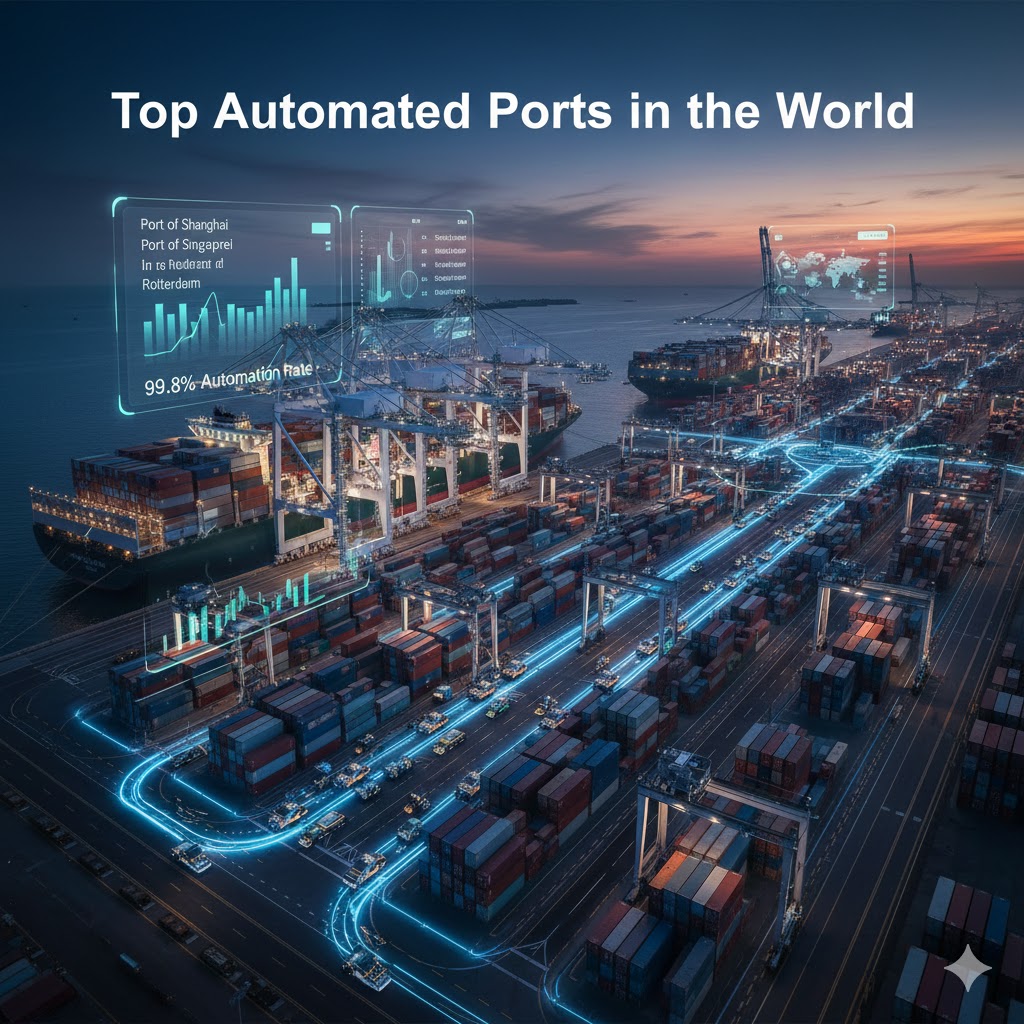
Port automation has moved decisively from experimentation to strategic necessity. By the mid-2020s, automation is no longer a niche innovation reserved for pilot projects or technology showcases. Instead, it has become a defining feature of ports seeking to remain competitive in an era shaped by mega-vessels, tighter environmental regulation, labour constraints, geopolitical volatility, and digitally integrated supply chains.
Automated ports combine robotics, electrified equipment, artificial intelligence, advanced terminal operating systems, and data-driven decision-making to transform how cargo is handled, stored, and moved. The objective is not merely higher productivity, but predictability, resilience, safety, and sustainability—qualities increasingly demanded by shipping lines, cargo owners, and regulators.
Importantly, not all “automated ports” are equal. Some operate fully automated container flows at massive commercial scale, while others rely on partial automation, hybrid human-machine models, or primarily digital optimisation rather than physical robotics. For this reason, any meaningful ranking must be based on automation depth and maturity, not reputation, geography, or overall throughput.
This article presents a global Top 12 ranking of automated ports, strictly from an automation perspective, and explains how smart terminals are redefining global trade logistics.
How Ports Are Ranked: Automation-Centric Criteria
To avoid subjective or branding-driven rankings, this list is based on five core criteria:
-
Degree of physical automation
Fully automated yards, automated or remotely operated quay cranes, and minimal manual container movement. -
Scale of automated operations
Automation deployed at full commercial scale, not limited pilot terminals. -
System integration and intelligence
Advanced terminal operating systems, AI-based planning, digital twins, predictive maintenance, and energy optimisation. -
Operational maturity
Multiple years of stable, high-volume automated operations under real-world conditions. -
Energy and sustainability integration
Electrification, smart energy management, and automation aligned with emissions reduction.
When assessed against these criteria, Chinese ports clearly dominate global automation leadership, followed by select Asian and European hubs, with North American ports trailing due to governance and labour constraints rather than lack of technology.
–
Tier 1 – Global Automation Leaders (China Dominant)
1. Port of Qingdao, China
Qingdao ranks first globally due to its fully automated, end-to-end container terminal operating at commercial scale. Electric automated guided vehicles, automated stacking cranes, and AI-driven scheduling systems work in an integrated environment with minimal human intervention. What truly distinguishes Qingdao is the convergence of automation and sustainability. Electrification, smart energy systems, and automation are deployed together, not as parallel initiatives. The terminal demonstrates that full automation can deliver both world-class productivity and significant emissions reduction simultaneously.
2. Port of Shanghai – Yangshan Deep-Water Port, China
Shanghai’s Yangshan terminal proves that automation can scale to unmatched global volumes. Remote-controlled quay cranes, automated rail-mounted gantry cranes, and highly sophisticated scheduling systems support continuous operations at extreme throughput levels. Yangshan’s significance lies not only in its technology, but in its operational maturity. Automation here is not experimental; it is fully embedded in daily operations, managing peak demand with reliability that few traditional terminals can match.
3. Port of Ningbo-Zhoushan, China
Ningbo-Zhoushan stands out for deploying automation across a multi-terminal ecosystem, rather than concentrating it in a single flagship project. Automated yards, smart scheduling, and electrified equipment are progressively rolled out in alignment with traffic growth. This incremental yet large-scale approach demonstrates how automation can be integrated into one of the world’s busiest port systems without disrupting ongoing operations.
4. Port of Xiamen, China
Xiamen combines high automation density with smart energy use and digital optimisation. Although smaller in volume than Shanghai or Ningbo-Zhoushan, its automation depth rivals the best globally. Xiamen is often underestimated internationally, but from a technical standpoint it belongs firmly among the world’s most advanced automated ports.
–
Tier 2 – Full Automation at Strategic Global Hubs
5. Port of Singapore – Tuas Mega Port
Singapore’s Tuas Mega Port is designed as a fully automated, fully electrified port from inception. Automated yard cranes, driverless vehicles, and AI-driven planning maximise land productivity and energy efficiency. Singapore ranks slightly below China’s top ports not due to ambition or sophistication, but because full operational maturity is still being reached as terminal consolidation progresses. Strategically, however, Tuas represents one of the most important automation projects globally.
6. Port of Busan, South Korea
Busan is the most automated port outside China operating at sustained commercial scale. Automated stacking cranes, remote quay cranes, and advanced terminal operating systems support Busan’s role as a major transshipment hub in Northeast Asia. Automation here focuses on reliability and schedule integrity, critical for transshipment-dependent operations.
–
Tier 3 – Advanced Automation in Hybrid and Legacy Environments
7. Port of Rotterdam, Netherlands
Rotterdam’s Maasvlakte 2 terminals remain Europe’s most advanced example of physical port automation. Automated guided vehicles, remotely operated cranes, and system-level optimisation deliver high productivity and predictability. However, when compared to leading Asian ports, Rotterdam operates automation at a smaller scale and within a more constrained regional market, placing it below the top Asian leaders from a pure automation standpoint.
8. Port of Antwerp-Bruges, Belgium
Antwerp-Bruges excels in digital and system automation rather than full physical robotics. Advanced port community systems, AI-supported planning, and real-time data integration allow the port to capture many automation benefits without fully automated container flows. Its strength lies in software-driven efficiency across a complex, multi-terminal environment.
9. Port of Hamburg, Germany
Hamburg demonstrates how automation can be deployed within a dense, legacy port. Automated stacking cranes and advanced yard systems coexist with human-operated processes. This hybrid model reflects spatial, regulatory, and labour realities, making Hamburg a leader in retrofitted automation, though not a full automation benchmark.
–
Tier 4 – Semi-Automated, Governance-Constrained Leaders
10. Port of Los Angeles, United States
Los Angeles features semi-automated terminals where automation focuses on yard operations rather than quay handling. Automated stacking cranes and digital platforms improve yard density and emissions performance. Automation depth is limited primarily by labour relations and governance frameworks, not by technological capability.
11. Port of Long Beach, United States
Long Beach follows a similar path to Los Angeles, with automation supporting cleaner operations and improved data visibility. The port prioritises environmental performance and community impact alongside productivity. Physical automation remains partial, placing it lower in a global automation ranking.
12. Port of Valencia, Spain
Valencia represents a Mediterranean leader in port automation and digitalisation. Automated yard equipment and smart traffic platforms enhance efficiency and reduce congestion. While technologically advanced, automation here operates at smaller scale and partial depth compared with global leaders.
–
What This Ranking Clearly Shows
When ports are ranked strictly by automation maturity, several conclusions emerge:
- China leads global port automation decisively, in depth, scale, and operational maturity
- Asian hubs prioritise automation as national and industrial strategy
- Europe excels in technical sophistication and digital integration, but at smaller scale
- North America lags in physical automation due to labour and governance constraints, not lack of technology
Automation leadership is therefore structural and strategic, not symbolic.
Automation’s Impact on Global Trade
Automated ports consistently deliver more predictable vessel turnaround, higher yard density, and lower safety risk. Electrified equipment supports emissions reduction and compliance with tightening environmental standards.
Equally important, automation enhances resilience. Smart terminals are better equipped to withstand labour disruptions, pandemics, and demand shocks, making reliability a core competitive advantage in volatile trade environments.
Challenges and Trade-Offs
Automation requires substantial capital investment, robust cybersecurity frameworks, and carefully managed workforce transitions. Ports that treat automation as a technology project rather than an organisational transformation often struggle to realise full benefits.
Successful automation depends on long-term planning, stakeholder engagement, and system redundancy.
The top 12 automated ports in the world demonstrate that smart terminals are fundamentally reshaping global trade logistics. From Qingdao and Shanghai to Singapore and Rotterdam, automation enables ports to handle larger vessels, tighter schedules, and stricter environmental requirements with greater confidence.
There is no single automation blueprint. Each port adapts automation to its geography, governance, and role within global supply chains. Yet one reality is clear: from a pure automation perspective, China sets the global benchmark.
Automation is no longer about the future of ports. It is about which ports remain competitive, resilient, and relevant today.
References
-
UNCTAD – Review of Maritime Transport 2025
https://unctad.org/publication/review-maritime-transport-2025 -
International Association of Ports and Harbors (IAPH) – Smart Ports and Port Automation Initiatives
https://sustainableworldports.org -
World Bank – Port Automation and the Future of Global Trade
https://www.worldbank.org/en/topic/transport/publication/port-automation -
OECD – Automation, Digitalisation and the Future of Ports
https://www.oecd.org/transport/ports/ -
Port of Qingdao – Fully Automated Container Terminal Overview
https://www.qingdao-port.com -
Shanghai International Port Group (SIPG) – Yangshan Deep-Water Automated Terminal
https://www.portshanghai.com.cn -
Port of Ningbo-Zhoushan – Smart Port and Automation Development
https://www.nbport.com.cn -
Port of Singapore Authority (PSA) – Tuas Mega Port Automation Programme
https://www.psa.com.sg -
Busan Port Authority – Automated Terminals and Smart Port Strategy
https://www.busanpa.com -
Port of Rotterdam Authority – Maasvlakte 2 Fully Automated Terminals
https://www.portofrotterdam.com/en/doing-business/terminals/maasvlakte-2 -
Port of Antwerp-Bruges – Digitalisation and Smart Port Ecosystem
https://www.portofantwerpbruges.com -
Hamburg Port Authority – Automation and Digital Port Infrastructure
https://www.hamburg-port-authority.de -
Port of Los Angeles – Terminal Automation and Clean Port Initiatives
https://www.portoflosangeles.org -
Port of Long Beach – Automated Terminals and Zero-Emissions Strategy
https://polb.com -
Port of Valencia – Smart Port and Automation Projects
https://www.valenciaport.com -
McKinsey & Company – The Future of Automated Ports
https://www.mckinsey.com/industries/travel-logistics-and-infrastructure/our-insights -
DNV – Digitalisation and Automation in Ports and Terminals
https://www.dnv.com/maritime -
World Economic Forum – TradeTech and Smart Port Transformation
https://www.weforum.org/agenda/archive/supply-chains
Thank youuuu!