
Throughout human history, ports have served as the lifeblood of civilization—gateways through which goods, ideas, and cultures have flowed across oceans and continents. While nature has generously endowed some coastlines with deep, sheltered harbors, many of the world’s most important maritime gateways are entirely human-made. These artificial ports represent some of the most impressive feats of civil engineering ever undertaken, transforming shallow mudflats, open roadsteads, and even open ocean into bustling hubs of global commerce.
An artificial harbor is one that has been deliberately constructed through the building of breakwaters, sea walls, jetties, or through extensive dredging and land reclamation. The oldest known artificial harbor dates back approximately 4,500 years to the Ancient Egyptian site at Wadi al-Jarf on the Red Sea coast. Today, the largest and busiest ports in the world are overwhelmingly artificial—products of human ingenuity that have reshaped coastlines and redefined the possibilities of maritime trade.
This article examines the top 12 artificial sea ports in the world, exploring their engineering marvels, strategic importance, and the immense volumes of trade they facilitate. From the sprawling man-made harbors of the Middle East to the automated megaports of East Asia, these ports collectively handle the majority of the world’s containerized cargo and stand as monuments to human achievement in the maritime domain.
–
1. Port of Jebel Ali – United Arab Emirates
The World’s Largest Man-Made Harbour
Located approximately 35 kilometers southwest of Dubai, the Port of Jebel Ali stands as the undisputed largest man-made harbor in the world. Completed in 1979, this colossal facility spans 134.68 square kilometers (52 square miles) and features 67 berths. The port’s construction was instrumental in Dubai’s transformation from a modest trading port into a modern commercial hub and global logistics powerhouse.
Jebel Ali is not only the largest artificial harbor but also the busiest port in the Middle East and Persian Gulf. In 2024, the port handled approximately 15.5 million TEUs (twenty-foot equivalent units), accounting for about 18% of DP World’s global throughput. The port serves as a critical node on the Maritime Silk Road and is the port most frequently visited by ships of the United States Navy outside the United States.
The port’s facilities include a 1.4 million square meter yard, providing not only loading and unloading services but also medium and long-term storage capabilities. The surrounding Jebel Ali area hosts over 5,500 companies from 120 countries, making it a complete industrial and commercial ecosystem. In recent years, DP World has also embarked on sustainability initiatives at the port, including the installation of 1,000 eco-engineered “Living Seawalls” panels designed to create habitats for marine life and enhance biodiversity.
2. Port of Shanghai – China
The World’s Busiest Port by Cargo Volume
The Port of Shanghai has been the world’s busiest container port since 2010, when it surpassed Singapore to claim the top position. In 2025, Shanghai International Port Group (SIPG) posted throughput of 55.06 million TEUs, a 6.9% increase over 2024’s 51.6 million TEUs, making it the first port in history to exceed 50 million TEUs in a single year.
What makes Shanghai particularly remarkable as an artificial port is its deep-water component: the Yangshan Deep-Water Port. Located approximately 30 kilometers off the coast on artificial islands built in four phases since the early 2000s, Yangshan was constructed to overcome the depth limitations of Shanghai’s riverine location. The Yangshan Port is widely recognized as the world’s largest automated container terminal, featuring the highest level of automation globally.
The automated terminal at Yangshan, operational since 2017, boasts a capacity of approximately 6.3 million TEUs annually, with 26 STS cranes, over 100 electric automated guided vehicles (AGVs), and 2,350 meters of quay length. The entire Port of Shanghai complex comprises both a river port and this deep-sea port, handling more than 800 million tons of cargo annually and responsible for approximately one-quarter of China’s maritime trade.
3. Port of Singapore – Singapore
The World’s First “Autonomous” Port
The Port of Singapore has long been one of the world’s premier maritime hubs, consistently ranking as the second-busiest container port globally. In 2025, the port processed 44.66 million TEUs, an 8.6% increase compared to the previous year. Singapore has also been named the world’s leading container port in the first comprehensive global ranking developed by DNV and Menon Economics, which assessed 160 ports worldwide based on 35 performance indicators.
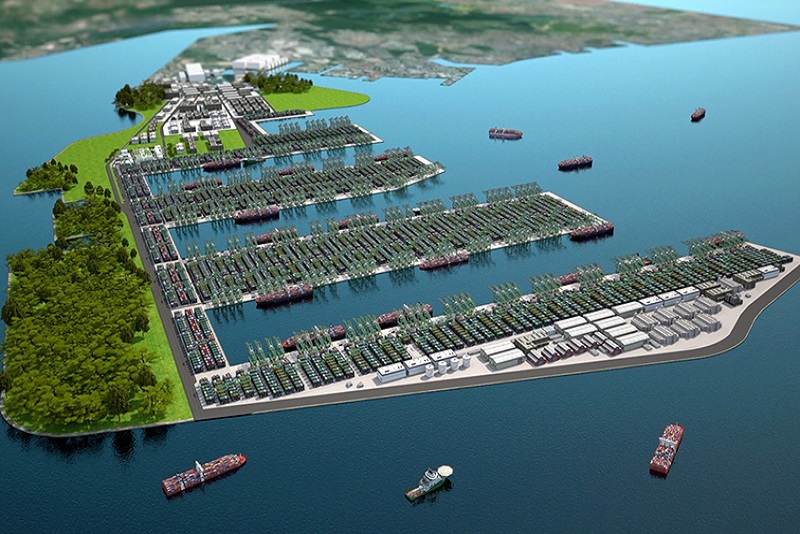
What sets Singapore apart is its ambitious vision for the future. The city-state is investing US$40 billion to build Tuas Port, which, upon completion in 2040, will become the world’s largest fully automated container terminal. The project involves placing 227 concrete caissons on the seabed, each the height of a ten-story building and weighing 15,000 tons. When fully operational, Tuas Port will have a handling capacity of 65 million TEUs annually—nearly double Singapore’s current throughput—across 1,300 hectares of land.
Tuas Port is being designed as the world’s first “autonomous” port, where artificial intelligence orchestrates the entire maritime logistics chain. The facility employs driverless AGVs, robotic cranes, and AI systems for terminal coordination, vessel traffic management, and port clearance. The port also utilizes a digital twin—a dynamic real-time virtual model powered by AI—to optimize operations. Singapore’s approach represents a fundamental reimagining of what a port can be: not merely a physical infrastructure but an intelligent digital platform.
4. Port of Ningbo-Zhoushan – China
The World’s Busiest Port by Cargo Tonnage
While Shanghai leads in container throughput, the Port of Ningbo-Zhoushan holds the distinction of being the world’s busiest port in terms of total cargo tonnage. In 2025, the port handled more than 1.4 billion tons of cargo. The port processed 43 million TEUs in 2025, securing third place globally in container volume.
Ningbo-Zhoushan is a combined port formed by the merger of the ports of Ningbo and Zhoushan, located in Zhejiang Province on China’s eastern coast. The port’s artificial nature is evident in its extensive reclamation and dredging works, which have created deep-water berths capable of accommodating the world’s largest vessels. The port’s strategic location at the mouth of Hangzhou Bay places it at the heart of China’s most economically dynamic region, serving the manufacturing heartland of the Yangtze River Delta.
The port’s immense cargo volume reflects its role as a primary gateway for China’s bulk commodity imports, including iron ore, crude oil, and coal, as well as its growing container business. The port’s ranking in the top three of the DNV/Menon Economics global container port assessment underscores its strong governance, high connectivity, and investments in digitalization and low-emission solutions.
5. Port of Rotterdam – Netherlands
Europe’s Largest Port
The Port of Rotterdam is Europe’s largest and busiest port, processing approximately 400 million tons of cargo annually. Located in the Netherlands, the port’s history as an artificial facility dates back to the late nineteenth century, when an artificial channel was constructed between Rotterdam and the North Sea at Hook of Holland, enabling the largest merchant ships to reach the port regardless of tide.
The port’s most ambitious artificial expansion came with the construction of Maasvlakte 2, an artificial peninsula built in 2008 to accommodate the latest generation of container ships. This expansion added container terminals and areas for the chemical industry and distribution, ensuring Rotterdam’s continued competitiveness as container ships have grown ever larger.
Rotterdam has also established itself as a pioneer in port automation. In 1993, the port became the first in the world to introduce machine automation, setting the model for fully automated terminals that have since been replicated globally. Today, the port is at the forefront of digital transformation, developing an extensive digital platform that directs transport movements throughout the port area without operating a single warehouse, train, or ship itself. The port has created a digital twin to track ship movements, infrastructure, weather, and water data, aiming for ships to enter and leave with unprecedented efficiency.
The port ranks among the top five in the global container port assessment, demonstrating strong governance, high connectivity, and targeted investments in sustainability. Rotterdam’s Maasvlakte II terminal is the largest automated container terminal in Europe, featuring robotic container handling, automated yard systems, and AI-optimized operations.
6. Port of Busan – South Korea
Asia’s Gateway to Northeast Asia
The Port of Busan is South Korea’s largest port and consistently ranks among the top six ports globally in container throughput. Located in Busan city on the southeastern tip of the Korean Peninsula, the port serves as the primary maritime gateway for South Korea’s export-driven economy.
Busan’s development as an artificial port has been shaped by extensive reclamation and dredging projects that have created deep-water berths capable of accommodating the world’s largest container ships. The port ranks fifth in the DNV/Menon Economics global container port assessment, reflecting its strong performance across enablers, connectivity and customer value, productivity, sustainability, and overall impact.
The port’s strategic location at the crossroads of major shipping routes connecting Northeast Asia to the rest of the world has made it a vital transshipment hub. Its container terminals are equipped with advanced automation and handling equipment, ensuring efficient cargo processing. The Port of Busan’s continued investment in infrastructure and technology has allowed it to maintain its position among the world’s elite ports, even as competition from Chinese ports has intensified.
7. Port of Tianjin – China
The Largest Artificial Port in Mainland China
The Port of Tianjin holds the distinction of being the largest artificial port in mainland China and one of the largest in the world. Located on the western shore of Bohai Bay, approximately 170 kilometers southeast of Beijing, the port serves as the primary maritime gateway to the Chinese capital.
The port was constructed on silty shallow flats through extensive dredging and land reclamation, creating an artificial deep-water harbor. Today, the port covers 121 square kilometers of land surface, with over 31.9 kilometers of quay shoreline and 151 production berths. The main channel has been dredged to a depth of 21 meters, capable of accommodating 300,000-ton crude oil vessels and the world’s most advanced container ships.
In January 2014, China’s first artificially excavated compound channel was officially opened at Tianjin Port. The port’s Dongjiang Port Area lies on an artificial peninsula 10 kilometers long and 3 kilometers wide. The Port of Tianjin is recognized as the world’s highest technical-level artificial deep-water port. It maintains 150 container shipping routes, with over 550 monthly sailings, connecting to more than 500 ports across 180 countries and regions. In the first quarter of 2024, the port set an unprecedented record by handling over 5.41 million TEUs, a 7.2% increase over the same period the previous year.
8. Port of Shenzhen – China
Southern China’s Trade Powerhouse
The Port of Shenzhen is one of the world’s busiest container ports, located in the Pearl River Delta in southern China. The port comprises three major container ports—Yantian Port, Nanshan Port, and Dachan Bay Port—along with several other facilities including DaChan Island, XiaoChan Island, Baoan, and Dapeng ports.
Shenzhen’s development as an artificial port has been driven by the explosive growth of the Pearl River Delta manufacturing region. Extensive dredging and reclamation have created the deep-water berths necessary to accommodate the world’s largest container vessels. During the first quarter of 2024, Yantian Port alone handled 3.03 million TEUs, an 8.1% increase over the same period the previous year.
The port’s strategic location adjacent to Hong Kong and its role as the primary export gateway for southern China’s manufacturing sector have made it an indispensable component of global supply chains. The port’s facilities are equipped with advanced automation and handling systems, ensuring efficient cargo processing for one of the world’s most dynamic manufacturing regions.
9. Port of Guangzhou – China
The Largest International Trade Port in Southern China
The Port of Guangzhou is located in the Pearl River Delta and is the largest international trade port in southern China. Situated across the Pearl River estuary along Guangzhou and Dongguan, the port ranks as the fifth busiest in the world.
Like Shenzhen, Guangzhou has been shaped by extensive artificial construction, with dredging and reclamation creating the deep-water berths necessary to serve the world’s largest vessels. In May 2024, the port was estimated to handle 2.14 million TEUs, a 2.5% increase over the same period the previous year. From January to May 2024, the port handled a total of 10.065 million TEUs.
The port’s importance extends beyond container traffic; it serves as a crucial hub for bulk cargo, including the import of raw materials for the Pearl River Delta’s manufacturing industries and the export of finished goods to global markets. Guangzhou’s position at the heart of one of the world’s most productive manufacturing regions ensures its continued prominence in global maritime trade.
10. Port of Hong Kong – China
Asia’s Historic Maritime Gateway
The Port of Hong Kong has long been one of the world’s premier maritime hubs. While Hong Kong’s Victoria Harbour is a natural harbor, the port’s container terminals at Kwai Tsing are extensively artificial, built on reclaimed land and featuring deep-water berths created through dredging.
In the first quarter of 2024, the Kwai Tsing Container Terminals handled 2.582 million TEUs, with other terminals handling 0.741 million TEUs, totaling 3.323 million TEUs. While the port has experienced some decline in throughput due to increasing competition from mainland Chinese ports, it remains among the top ten busiest ports globally.
Hong Kong’s port has historically served as the primary gateway for trade between China and the rest of the world. Its strategic location, free port status, and efficient operations have made it a favored transshipment hub for shipping lines serving the Asia-Pacific region. The port’s container terminals are among the most technologically advanced in the world, featuring automated handling systems and sophisticated logistics infrastructure.
11. Port of Colombo – Sri Lanka
One of the Biggest Artificial Harbours in the World
The Port of Colombo is one of the biggest artificial harbours in the world and ranks among the top 35 ports globally. Located on the southwestern shores of Sri Lanka, the port handles the majority of the country’s foreign trade and has an annual cargo tonnage of 30.9 million tons.
The creation of an artificial harbor at Colombo was first suggested in 1866, and construction of the breakwaters commenced in 1875. The project was completed in 1912, creating a large artificial harbor that encircled 260 hectares of water. This artificial harbor helped Colombo supplant Galle as the chief commercial port of the island.
Today, the port features 51 berths, a depth of over 18 meters, and a capacity of 7 million TEUs. The port’s strategic location on major trade routes crossing the Indian Ocean makes it an important terminal for shipping in Asia. In recent years, Chinese investment has further enhanced the port’s capabilities, with China Merchant Group investing $500 million in the Colombo South Container Terminal. The port’s container throughput has shown substantial growth, with the south terminal alone accomplishing 680,000 TEUs in 2014, a 14% increase over the previous year.
12. Port of Los Angeles / Long Beach – United States
America’s Premier Port Complex
The combined ports of Los Angeles and Long Beach, located on San Pedro Bay in Southern California, form the largest port facility in the Americas and the fifth-busiest in the world. Both ports are extensively artificial, created through massive dredging and landfill operations that transformed shallow mudflats and salt marshes into one of the world’s most important maritime gateways.
The Port of Los Angeles, also known as WORLDPORT LA, occupies 7,500 acres of land and water along 43 miles of waterfront. The south-facing San Pedro Bay was originally a shallow mudflat too soft to support a wharf. Breakwater construction began in 1899, and extensive dredging created the deep-water channel necessary for modern shipping. The port’s Pier 400 container terminal represents the largest single container handling facility in the world, spanning 484 acres created through what has been described as “the most immense dredging and landfill operation ever attempted in American waterways”.
The adjacent Port of Long Beach was founded on 800 acres of mudflats in 1911. Today, it occupies 3,200 acres of land with 25 miles of waterfront, featuring a main channel dredged to a depth of 23.2 meters. The port is a man-made harbour consisting of an outer harbor, middle harbor, and inner harbor.
Together, the two ports generated approximately US$300 billion in trade in 2024, with Long Beach alone handling 9.7 million TEUs and 200 million metric tons. The port complex employs more than 316,000 people in Southern California and serves as the primary gateway for US-Asian trade. Both ports continue to invest in expansion and modernization, with the Port of Los Angeles planning a new 200-acre deep-water terminal, provisionally titled Pier 500.
–
Conclusion
The twelve artificial ports profiled in this article represent the pinnacle of maritime engineering and serve as the backbone of global trade. From Jebel Ali’s 134-square-kilometer man-made harbor in Dubai to the automated megaports of East Asia, these facilities demonstrate humanity’s capacity to reshape coastlines and create the infrastructure necessary for modern commerce.
What unites these ports is not just their artificial origins but their role as engines of economic growth. The ports of Shanghai, Singapore, Ningbo-Zhoushan, Shenzhen, Guangzhou, Hong Kong, Busan, and Tianjin have been instrumental in Asia’s economic transformation, providing the maritime infrastructure that has enabled the region to become the world’s manufacturing heartland. Rotterdam serves as Europe’s gateway to global markets, while the Los Angeles-Long Beach complex connects the United States to Asia’s supply chains. Jebel Ali has been central to Dubai’s emergence as a global commercial hub, and Colombo continues to serve as a vital link in Indian Ocean trade routes.
The future of these ports lies in automation and digitalization. Singapore’s Tuas Port is setting the standard for what a fully autonomous port can achieve, while Rotterdam’s digital twin and Shanghai’s Yangshan automated terminal demonstrate the transformative potential of technology. As global trade continues to grow and vessels become ever larger, these artificial ports will continue to evolve, pushing the boundaries of what is possible in maritime engineering and logistics.
The oldest artificial harbor dates back 4,500 years to ancient Egypt. Today’s artificial ports represent the continuation of this ancient tradition—humanity’s enduring quest to conquer the sea and harness it for trade and prosperity. As we look to the future, these twelve ports will undoubtedly remain at the forefront of global commerce, their artificial harbors serving as enduring monuments to human ingenuity and the transformative power of infrastructure.