
The Persian Gulf is a marine paradox. It is at once one of the world’s most biologically extraordinary and most environmentally imperiled bodies of water. This semi-enclosed, marginal sea, covering approximately 240,000 square kilometers, supports an astonishing array of marine life: coral reefs that have evolved to withstand some of the highest temperatures and salinities on Earth, extensive mangrove forests that serve as critical nurseries for countless species, seagrass beds that sustain endangered dugongs and green turtles, and fisheries that provide livelihoods for coastal communities across eight nations.
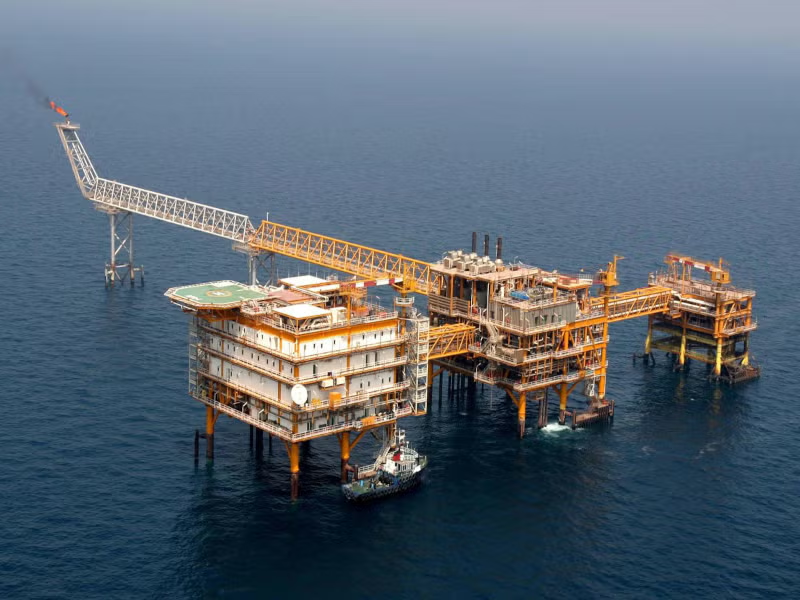
Yet beneath these waters lies the very source of the region’s wealth—and its ecological vulnerability. The Persian Gulf sits atop approximately two-thirds of the world’s proven oil reserves. It is home to some 800 offshore oil and gas platforms and 25 major terminals, with some of the largest oilfields and infrastructures for oil production anywhere on the planet. The eight riparian states—Bahrain, Iran, Iraq, Kuwait, Oman, Qatar, Saudi Arabia, and the United Arab Emirates—account for approximately one-quarter of global oil production.
For decades, the extraction, processing, and transportation of this oil have proceeded with relatively little regard for the marine environment that surrounds and sustains these operations. The cumulative impact has been profound. Researchers now describe the Persian Gulf as “the most polluted sea in the world”. Oil pollution from extraction, refining, and shipping activities remains a dominant and persistent threat, with cumulative impacts on microbial communities, benthic macrofauna, and coral reefs. The average level of oil pollution in the Gulf exceeds the minimum optimum level established for the global marine environment.
This article examines the multifaceted ways in which decades of oil and gas exploitation have affected the Persian Gulf’s marine ecosystem—from the chronic, everyday pollution of production activities to the catastrophic spills that have scarred the region, from the physical alteration of marine habitats to the complex and sometimes contradictory role of offshore platforms as artificial reefs.
The Persian Gulf: A Marine Ecosystem of Extreme Vulnerability
A Semi-Enclosed Sea with Limited Flushing
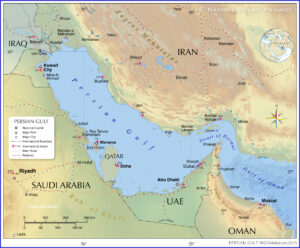
The Persian Gulf’s geography is its first and most fundamental vulnerability. As a semi-enclosed basin connected to the open ocean only through the narrow Strait of Hormuz, the Gulf has extremely limited water exchange with the broader Indian Ocean. Water entering from the Indian Ocean circulates in a cyclonic (counter-clockwise) pattern before exiting, but the overall residence time of water in the Gulf can extend to several years. This restricted circulation means that pollutants introduced into Gulf waters tend to persist and accumulate far longer than they would in more open marine systems.
This hydrological constraint is compounded by the Gulf’s extreme natural conditions. High evaporation rates—driven by intense solar radiation and the surrounding arid climate—continuously increase salinity, with surface salinity varying between 36 and 43 practical salinity units. The average depth of the Gulf is only about 50 meters, and the maximum depth is approximately 90 meters. This shallowness means that the water column is well-mixed and particularly susceptible to temperature fluctuations, with summer surface temperatures reaching 34°C.
Biodiversity Under Pressure
Despite—or perhaps because of—these extreme conditions, the Persian Gulf supports ecosystems of global significance. The Gulf’s coral reefs are among the most heat-tolerant in the world, having adapted over millennia to water temperatures that would cause mass bleaching in other regions. Over 700 species of fish have been recorded in Gulf waters, along with dugongs, sea turtles, dolphins, and whales. Mangrove forests line portions of the coast, providing critical habitat for juvenile fish and migratory birds. Seagrass beds are vital for herbivorous species like the dugong, a marine mammal whose populations in the Gulf are among the most significant globally.
Yet these ecosystems are already under unprecedented stress. The Gulf has experienced numerous severe bleaching events in recent years, with limited recovery observed in some areas. Coastal development, desalination brine discharge, overfishing, and pollution have pushed the Gulf’s marine ecosystems to a precarious tipping point.
Into this already stressed system comes the immense burden of oil and gas exploitation—a threat that operates at multiple scales, from the molecular to the ecosystem level, and whose effects are often cumulative, persistent, and irreversible.
The Scale of Oil and Gas Exploitation in the Persian Gulf
Infrastructure Footprint
The physical footprint of oil and gas infrastructure in the Persian Gulf is staggering. Approximately 800 offshore oil and gas platforms dot the Gulf’s waters, connected by thousands of kilometers of subsea pipelines. Major oilfields such as Umm Al Dalkh and Zakum in the United Arab Emirates, the South Pars/North Dome field shared by Iran and Qatar (the world’s largest natural gas field), and the supergiant fields off Saudi Arabia and Kuwait form the backbone of global energy supply.
These platforms are not isolated structures; they are nodes in an extensive industrial network that includes drilling rigs, production platforms, processing facilities, storage terminals, and an endless procession of tankers. Every stage of this network—from exploration to extraction to transportation—generates pollution and environmental disturbance.
Chronic vs. Catastrophic Pollution
The environmental impact of oil and gas exploitation in the Persian Gulf can be understood as operating along two axes: chronic, everyday pollution from routine operations, and catastrophic, episodic pollution from major spills and accidents.
Chronic pollution includes the continuous discharge of produced water (water extracted along with oil and gas), operational discharges from platform cleaning and maintenance, atmospheric emissions from flaring, and the accumulation of heavy metals and hydrocarbons in sediments. Catastrophic pollution includes major oil spills such as the 1991 Gulf War spill, tanker accidents, and, more recently, spills resulting from military strikes on oil infrastructure.
Both forms of pollution have left indelible marks on the Gulf’s marine ecosystem.
Petroleum Hydrocarbons: The Invisible Poison
PAHs in Marine Sediments
Polycyclic aromatic hydrocarbons (PAHs)—a class of toxic, mutagenic, and carcinogenic compounds—are among the most persistent and dangerous pollutants released by petroleum activities. In marine systems, PAHs originate primarily from anthropogenic activities such as petroleum leakage, wastewater discharge, maritime transport, and urban runoff. Their strong hydrophobicity causes them to rapidly bind to fine particles and accumulate in sediments, which become the principal environmental reservoir of PAHs.
A comprehensive 2026 study of PAH contamination in surface sediments from Bushehr Province—located adjacent to major offshore production zones in Bahregan and Kharg—revealed the extent of this problem. The region receives substantial PAH inputs from oil spills, ballast-water discharge, industrial effluents, fuel smuggling, and offshore extraction operations. Total PAH concentrations ranged from 203.81 to 2,139.9 ng per gram of sediment, with profiles dominated by low-molecular-weight and alkylated compounds—a clear signature of petrogenic (oil-derived) influence from offshore extraction and petroleum handling.
Source apportionment analysis identified two major factors: a petrogenic source accounting for 63 percent of contamination, enriched in low-molecular-weight and alkylated PAHs, and a pyrogenic (combustion) source accounting for 37 percent, dominated by combustion-derived high-molecular-weight PAHs. Spatial interpolation identified offshore hotspots near oil fields and terminals.
The ecological implications are serious. Sediment-bound PAHs can induce DNA damage and endocrine disruption in marine organisms and may enter the food web, with consequences for entire ecosystems. While the incremental lifetime cancer risk for humans was found to be below USEPA thresholds, the study concluded that “the combined influence of petroleum operations, maritime traffic, and coastal urbanization highlights the need for continued monitoring and source-specific management”.
Chronic Oil Pollution and Ecosystem Effects
Chronic oil pollution from extraction, refining, and shipping activities remains a dominant threat, with cumulative impacts on microbial communities, benthic macrofauna, and coral reefs. Modern research still shows significant changes in coral reef, benthic, and microbial ecosystems caused by hydrocarbon pollution.
Oil-related operations continue to dominate the pollution scene of the Persian Gulf. Oil spills from extraction, refining, and shipping activities emit hydrocarbons into the marine environment, affecting fish stocks, coral reefs, and seabird populations. Studies have confirmed that oil contamination on the Persian Gulf has significantly diminished biodiversity. Researchers have documented the effects of oil pollution on a wide range of marine creatures, including corals, sponges, bivalves, and fishes.
The Gulf’s extreme environmental conditions create a complex dynamic. While high temperatures and intense solar radiation can accelerate the natural degradation of some oil components, the Gulf’s semi-enclosed nature means that pollutants persist longer than in more open marine systems. The combination of high inputs and slow flushing creates a situation where the Gulf’s ecosystems are continuously exposed to hydrocarbon contamination.
Heavy Metals and Produced Water: The Less Visible Threats
Heavy Metal Contamination
Beyond hydrocarbons, oil and gas operations release significant quantities of heavy metals into the marine environment. During extraction, mercury associated with crude oil and natural gas is released in wastewater streams and solid waste streams. Other metals—including cadmium, lead, nickel, chromium, and copper—are also mobilized by petroleum activities.
Research on sediments from mangrove and coral habitats in the Northeast Persian Gulf has revealed elevated concentrations of heavy metals and total petroleum hydrocarbons, posing significant ecological risks. These metals do not degrade; they persist in sediments indefinitely, bioaccumulate in marine organisms, and biomagnify through food webs.
The spatial distribution of contamination is revealing. Studies have shown that some metals are at their highest concentrations beneath the central platforms, suggesting that production-related activities—including platform cleaning and maintenance—are currently a more relevant contamination source than the initial drilling phase.
Produced Water Discharge
Produced water—the water extracted along with crude oil and natural gas during production—represents the largest volume of waste associated with offshore oil and gas production operations. As oil fields age, the volume of produced water typically increases, creating a growing waste management challenge.
Produced water contains a complex mixture of contaminants, including dissolved and dispersed hydrocarbons, heavy metals, naturally occurring radioactive materials, and chemical additives used in production processes. These contaminants can cause severe environmental issues, especially in sensitive zones such as the Persian Gulf region.
With the development and expansion of Iran’s offshore gas reserves in the South Pars field, there is growing concern over the potential long-term impacts of produced water discharges in the Persian Gulf. Environmental requirements for new projects increasingly include provisions preventing the discharge of produced water into the sea. However, the legacy of past discharges and the challenge of enforcing such requirements across the region mean that produced water remains a significant source of marine pollution.
The Physical Alteration of Marine Habitats
Seafloor Disturbance
The installation and operation of offshore oil and gas platforms physically alter the marine environment in ways that extend beyond chemical pollution. Drilling operations disturb the seabed, creating plumes of suspended sediment that can smother benthic communities. The physical presence of platforms, pipelines, and other infrastructure fragments habitats and alters local hydrodynamics.
Studies examining sediment contamination and benthic communities around oil platforms in the Umm Al Dalkh and Zakum oilfields found significant differences in contamination levels and community composition between the two fields. While contamination levels were generally low, often below detection levels or international guideline values, the within-field variability was much lower—no clear structuring of contamination values and species composition was detectable in relation to distance from the platform. This suggests that the effects of platform installation may be diffuse rather than concentrated in a simple gradient around the structure.
The study also found that the relative abundance of feeding guilds—filter-feeders, deposit-feeders, and omnivores—did not correlate with either distance from the platform or contaminant concentrations. These patterns may reflect the long time that has elapsed since drilling (15-20 years), which appears to have allowed contaminants to disperse and degrade and assemblages to recover. However, the study also noted that production-related activities are currently a more relevant contamination source than the initial drilling phase.
Destruction of Critical Habitats
Oil and gas infrastructure development has also contributed to the direct destruction of critical coastal habitats. Seagrass beds and mudflats have been buried under land reclamation projects for industrial facilities, removing important nursery habitats for marine life. Mangrove forests—among the ecosystems most vulnerable to pollution and habitat disturbance—have been lost to coastal development associated with the oil industry.
The consequences have extended offshore as well. The cumulative effect of habitat loss, pollution, and physical disturbance has been a gradual degradation of the Gulf’s marine ecosystems, with implications for fisheries, biodiversity, and the ecosystem services that support coastal communities.
Catastrophic Spills: The Scars That Won’t Heal
The 1991 Gulf War Oil Spill
No discussion of oil pollution in the Persian Gulf would be complete without addressing the 1991 Gulf War oil spill—one of the largest and most devastating environmental disasters in history. In January 1991, retreating Iraqi forces deliberately opened oil valves in Kuwait and destroyed oil infrastructure, releasing an estimated 6 to 11 million barrels of oil into the Persian Gulf.
The scale of the disaster is almost incomprehensible. Up to 11 million barrels of oil (1.75 billion liters) were released, contaminating 640 kilometers of Saudi coastline. The spill was at least five times larger than the most recent estimate of oil spilled in the Gulf of Mexico during the Deepwater Horizon disaster. It killed more than 30,000 seabirds according to several studies, and up to 230,000 marine animals and seabirds overall. The ecological impacts took decades to recover, with some effects still evident today.
The spill devastated marine wildlife and coastal habitats in Kuwait and Saudi Arabia. It threatened industrial facilities in Al Jubayl because of the seawater cooling system for primary industries and threatened the supply of potable water. Coastal and marine environments experienced oil spills that killed wildlife and damaged the fishing industry.
The Gulf War spill is one of the first times in military history where a natural resource—and specifically pollution—was used as a tactic of war. The region is still feeling the effects of the spill, manifested in a loss of biodiversity and uninhabitable coastlines. Saudi Arabia was subsequently awarded US$463 million for damages to its coastal environment.
Long-Term Effects on Mangroves
The 1991 Gulf War oil spill had particularly devastating effects on mangrove ecosystems. Mangroves are highly susceptible to oil exposure; oil spills cause long-lasting mangrove loss, threatening their conservation and ecosystem services worldwide.
A 2024 study utilizing remote sensing technologies to investigate changes in mangrove area and health in response to the oil spill found significant degradation in mangroves closest to the contamination source. The oil spill degraded approximately 17.7 hectares of mangroves in the Nayband mangrove site, with poor or moderate greenness and health conditions. In Qheshm mangroves, the oil spill caused mangroves in healthier classes to transition into weaker classes. The Bandar-Abbas mangrove area experienced a significant decline across all classes of approximately 25 percent, or 129 hectares.
However, the study also revealed a remarkable story of resilience. Landward mangroves in Iran showed the ability to undergo rapid recovery within five years after the Gulf War, largely because the Iranian coastal mangrove areas were largely untouched and undeveloped, which provided a favorable environment for recovery. Additionally, the high temperatures and intense solar radiation in the region created suitable conditions for the degradation of oil, further contributing to the mangroves’ recovery.
This resilience should not be mistaken for invulnerability. The study highlighted the need for improved monitoring and conservation efforts to protect mangrove habitats, which are critical for supporting coastal communities and the broader environment.
Ongoing Spill Risks
The risk of catastrophic oil spills in the Persian Gulf has not diminished. Recent military confrontations in the Persian Gulf have significantly increased risks of environmental catastrophe, including oil spills, destruction of marine ecosystems, and contamination of fisheries and coastal infrastructure. Oil spills from military strikes on oil infrastructure continue to threaten the Gulf’s fragile ecosystems.
In May 2026, an oil slick reached a pristine Persian Gulf island in Iran following a military attack on the Lavan refinery complex. The pale coral beaches of this protected sanctuary were swallowed by a continuous band of tar as petroleum pollutants spread across its waters. The damage from oil spills to the Persian Gulf’s fragile ecosystem is still not fully known.
The threat extends beyond military conflicts. Routine shipping, aging infrastructure, and the sheer volume of oil passing through the Gulf mean that the potential for spills remains ever-present. Greenpeace has warned that dozens of tankers carrying around 21 billion liters of oil can be trapped in the Persian Gulf at any given time, creating a constant risk of catastrophic spills.
The Paradox of Platforms: Artificial Reefs or Ecological Disruptors?
Platforms as Biodiversity Hotspots
One of the most intriguing and controversial aspects of offshore oil platforms in the Persian Gulf is their role as artificial habitats for marine life. Despite their industrial purpose and the pollution they generate, these structures have become unexpected biodiversity hotspots.
The Arabian Gulf has more than 2,000 well heads and thousands of kilometers of subsea pipelines, providing an important habitat around which corals, fish, and other marine organisms can live. Oil platforms cover the whole water column of the Gulf, which is one of the world’s shallowest seas, and so can provide habitats for creatures specialized for living at different depths. The complexity of their structures provides a great range of suitable habitats where different species can settle and grow. Many are far from the coast and so provide refuge away from the disturbance caused by shoreline development and other human activities.
Research has shown that such structures are rapidly colonized by fish after construction and can often contain communities of fish that are denser than those occurring in surrounding habitats. In areas where structures are elevated well above the mobile sands of the seabed, there may be a higher abundance of corals than on nearby reefs.
Some have even proposed transforming obsolete platforms into permanent marine habitats. Qatar has explored programs to turn oil rigs into thriving marine habitats, a process that “not only preserves biodiversity but also creates new opportunities for fisheries, ecotourism, and carbon storage”.
The Limits of Artificial Habitat
However, the scientific community is careful to distinguish between platforms as artificial habitats and platforms as substitutes for natural ecosystems. Research has found “a sharp difference between fish-associated communities from offshore platforms and natural reefs,” suggesting that artificial structures “may not be suitable candidates” as surrogates for natural reefs.
“Most of the corals that you find on the natural reefs, you will not find in the oil platforms,” noted Dr. Radhouan Ben Hamadou of Qatar University. Echoing this, Dr. John Burt of New York University Abu Dhabi emphasized that such pieces of infrastructure are “certainly not surrogates for natural habitats”. He noted: “There have been many dozens of research papers on this topic here and across the globe and I know of no cases where the communities of fish or coral on an artificial structure closely resembled those of natural habitats”.
Instead, there are different types of fish or corals that tend to be abundant on these structures while rare on natural habitats, and those that are common to natural habitats may be rare to non-existent on infrastructure. Platforms should be seen as complementary to—not replacements for—natural ecosystems.
A Cautionary Note
The fact that platforms support marine life should not be interpreted as evidence that oil and gas exploitation is benign or beneficial to the Gulf’s ecosystems. The species that thrive on platforms are often generalists and opportunists, not the specialized species that depend on healthy coral reefs, seagrass beds, and mangroves. The presence of fish around platforms does not compensate for the loss of natural habitats or the chronic pollution that degrades ecosystem health across broader areas.
Moreover, the long-term effects of platform-associated communities on surrounding ecosystems are not fully understood. Platforms may serve as stepping stones for the spread of invasive species, alter local food webs, and create ecological traps where organisms are attracted to habitats that may expose them to pollutants.
Impacts on Specific Ecosystems and Species
Coral Reefs
Coral reefs in the Persian Gulf are among the most diverse systems of life in the marine environment of the Middle East. Unfortunately, they are highly threatened by local and global stressors, particularly oil pollutants.
The effects of oil pollution on coral reefs are multifaceted. Direct contact with oil can cause coral mortality. Sublethal exposure can impair reproduction, growth, and immune function. Oil can also disrupt the intricate balance of the coral reef food web, potentially causing cascading effects on higher trophic levels.
A 2025 study investigating diatom assemblages in northwestern Persian Gulf coral reefs compared communities in oil-polluted sites around Kharg Island with those in less-impacted conditions near Khargoo Island. While no significant difference in species richness was observed between the oil-polluted and control sites, the assemblages differed compositionally. Diatom communities growing on living corals from the polluted site showed the highest level of within-group dissimilarity, which may indicate habitat instability and a state of dysbiosis.
These findings suggest that community differences may be associated with chronic oil exposure. The results also signal the potential of certain diatom species as indirect bioindicators responding not only to pollutants but also to the condition of a possibly more sensitive host coral.
Multiple benthic indicators have been shown to be efficient for health assessment of coral reefs subjected to petroleum hydrocarbon contamination in the Persian Gulf. The extraction, exploitation, and transportation of oil have left the biggest role in the destruction of the coral coasts of the Persian Gulf.
Mangroves
Mangrove forests are among the ecosystems most vulnerable to oil pollution and habitat disturbance. These critical habitats serve as nurseries for fish, protect coastlines from erosion, and sequester significant amounts of carbon.
Oil contamination or chemical spills can destroy mangrove root systems and disrupt nursery habitats that sustain local fisheries. The 1991 Gulf War spill demonstrated the devastating effects of large-scale oil contamination on mangroves, with significant degradation observed in Nayband, Qheshm, and Bandar-Abbas mangroves.
The long-term effects of oil pollution on mangroves include reduced growth, altered species composition, and increased vulnerability to other stressors. While some Iranian mangroves showed remarkable recovery within five years of the Gulf War, this resilience should not be taken for granted. Continued monitoring and conservation efforts are essential to protect these critical habitats.
Fisheries
The Persian Gulf’s fisheries are vital for food security and livelihoods across the region. Oil pollution threatens this resource in multiple ways. Hydrocarbons can cause direct mortality of fish, impair reproduction and growth, and contaminate seafood with compounds that pose risks to human health.
The 1991 Gulf War spill devastated fisheries, with long-term adverse impacts on the ecosystem and fisheries resources of the northern Persian Gulf. Oil spills from extraction, refining, and shipping activities continue to affect fish stocks.
The contamination of seafood with petroleum hydrocarbons and heavy metals poses risks to human health, particularly for coastal communities that depend on fishing. The economic consequences of fisheries decline are felt throughout the region, affecting food security, livelihoods, and local economies.
Marine Mammals and Sea Turtles
The Persian Gulf is home to significant populations of dugongs, sea turtles, dolphins, and whales. These charismatic species are particularly vulnerable to oil pollution.
The 1991 Gulf War spill killed or harmed over 114,000 animals, including 102 species of birds, sea turtles, bottlenose dolphins, and whales. Up to 230,000 marine animals and seabirds died as a result of the spill.
Oil spills suffocate the mangroves that act as a natural coastal defense and poison the seagrass beds essential to sea turtles and juvenile fish. The Gulf’s dugongs, which depend on seagrass for food, are particularly vulnerable to habitat degradation and pollution.
Regional and International Responses
The Role of ROPME
The Regional Organization for the Protection of the Marine Environment (ROPME) was established in Kuwait in 1979 to coordinate environmental protection efforts among the eight Gulf states. ROPME has developed protocols concerning regional cooperation in combating pollution by oil and other harmful substances in cases of emergency.
The organization monitors water quality and coastal habitats and has developed numerous successful plans laying the basis for coastal management and development in the Persian Gulf region. With over four decades of experience, ROPME remains a vital platform for regional environmental cooperation.
However, the challenges are immense. The region has approximately two-thirds of the world’s proven oil reserves, and the eight riparian states currently account for approximately one-quarter of global oil production. The interrelation of oil transport, sea pollution, and coastal management tasks in the Persian Gulf area requires sustained coordination and commitment.
Regulatory Frameworks
The primary international instrument addressing marine pollution from ships is the International Convention for the Prevention of Pollution from Ships (MARPOL). Regulations address discharges from fixed and floating platforms engaged in the exploration and exploitation of mineral resources.
At the national level, environmental requirements for new projects increasingly include provisions for environmental protection. For example, the environmental review for the South Pars Phase 11 expansion covered key aspects including protection of the Persian Gulf marine ecosystem, drilling waste management, air pollution control, and operational wastewater treatment. Key environmental requirements include preventing the discharge of produced water into the sea and using flare gas recovery systems.
However, enforcement remains a challenge. Poor pollution control rule enforcement, inadequate monitoring initiatives, and fragmented government structures cause delayed reactions to developing contamination incidents. The lack of comprehensive, region-wide monitoring programs means that the full extent of pollution and its effects on marine ecosystems is not well understood.
The Need for Enhanced Action
The persistence of oil pollution in the Persian Gulf highlights the need for enhanced action at multiple levels. Continued monitoring of PAH contamination and other pollutants is essential. Source-specific management approaches are needed to address the different types of pollution from petroleum operations, maritime traffic, and coastal urbanization.
The development and implementation of comprehensive environmental monitoring programs should be included in the agenda of relevant organizations. Regional cooperation, through ROPME and other mechanisms, must be strengthened to address transboundary pollution issues.
The Paradox of Adaptation
Microbial Adaptation and Biodegradation
One of the most remarkable—and troubling—aspects of the Persian Gulf’s response to oil pollution is the adaptation of its microbial communities. Diverse microorganisms capable of consuming oil-based compounds have been identified in the Gulf, and their capacity to degrade crude oil has been examined. Biosurfactant-producing bacteria have been discovered in the Persian Gulf, and their capability to degrade crude oil has been evaluated.
Some researchers have suggested that the Persian Gulf’s marine biota may have “adapted to the pollution levels prevalent in this area”. The Gulf’s marine organisms “possess a distinct immune system or have adapted to the pollution levels prevalent in this area”.
This adaptation is a double-edged sword. On one hand, the presence of oil-degrading microorganisms means that some oil pollution is naturally attenuated. On the other hand, the fact that organisms have adapted to chronic pollution means that the Gulf’s ecosystems have already been fundamentally altered by human activities. The adaptation of microbial communities to oil does not mean that the Gulf’s ecosystems are healthy; it means they are surviving in a degraded state.
The Concept of “Shifting Baselines”
The adaptation of Gulf ecosystems to chronic oil pollution raises important questions about baselines and expectations. What is considered “normal” for the Persian Gulf today may be very different from what was normal before the onset of large-scale oil exploitation.
The concept of “shifting baselines” is relevant here. Each generation of scientists and policymakers may accept as normal a level of environmental degradation that would have been considered catastrophic by previous generations. The fact that some species have adapted to oil pollution does not mean that the Gulf’s ecosystems are healthy; it means they have been permanently altered.
The Limits of Resilience
The resilience of some Gulf ecosystems—such as the Iranian mangroves that recovered within five years of the Gulf War spill—should not be misinterpreted as invulnerability. Resilience has limits. Chronic, cumulative pollution can overwhelm the capacity of ecosystems to recover. The combination of oil pollution with other stressors—climate change, coastal development, overfishing, and desalination brine—creates synergistic effects that can push ecosystems past tipping points from which recovery is impossible.
The Gulf’s extreme environmental conditions—high temperatures and salinity—create both vulnerabilities and opportunities. High temperatures can accelerate the degradation of some pollutants, but they also stress marine organisms, making them more vulnerable to the effects of pollution. The Gulf’s semi-enclosed nature means that pollutants persist, but it also means that the Gulf’s ecosystems have evolved in relative isolation, making them potentially more vulnerable to novel stressors.
The Future: Challenges and Uncertainties
Climate Change and Oil Pollution
Climate change adds a new dimension to the challenges facing the Persian Gulf. Rising sea temperatures are already causing coral bleaching and stressing marine ecosystems. The combination of climate change and oil pollution creates synergistic effects that are greater than the sum of their parts.
Warmer waters may accelerate the degradation of some oil components, but they also stress marine organisms, making them more vulnerable to the toxic effects of hydrocarbons. Climate change may also alter ocean circulation patterns in ways that affect the transport and fate of pollutants in the Gulf.
The Threat of Conflict
The Persian Gulf’s strategic importance as a global energy artery means that it is perpetually at risk of conflict. Recent military confrontations have significantly increased risks of environmental catastrophe, including oil spills, destruction of marine ecosystems, and contamination of fisheries and coastal infrastructure.
The use of oil as a weapon of war—as occurred in 1991—remains a threat. Military strikes on oil infrastructure, whether intentional or collateral, can release massive quantities of oil into the marine environment. The damage from such spills can take decades to recover, if recovery is possible at all.
The Need for a New Approach
The Persian Gulf’s marine ecosystems cannot sustain the current level of oil pollution indefinitely. A new approach is needed—one that recognizes the intrinsic value of the Gulf’s biodiversity, the ecosystem services it provides, and the dependence of coastal communities on healthy marine environments.
This approach must include:
Stronger regulation and enforcement: Environmental regulations must be strengthened and enforced across the region. The discharge of produced water, operational wastes, and other pollutants must be minimized.
Investment in monitoring and research: Comprehensive, long-term monitoring programs are needed to track pollution levels and ecosystem health. Research is needed to understand the cumulative effects of multiple stressors on Gulf ecosystems.
Regional cooperation: Pollution does not respect national boundaries. Regional cooperation through ROPME and other mechanisms must be strengthened to address transboundary pollution issues.
Sustainable development: The Gulf’s economic development must be decoupled from environmental degradation. Investments in renewable energy, sustainable fisheries, and ecosystem restoration are needed.
Conflict prevention: The risk of conflict-related oil spills must be reduced through diplomatic engagement and the protection of critical energy infrastructure.
Conclusion
The Persian Gulf stands at a crossroads. Its marine ecosystems—coral reefs that have evolved to withstand extreme temperatures, mangrove forests that serve as critical nurseries, seagrass beds that sustain endangered dugongs, and fisheries that support millions of people—are among the most unique and resilient on Earth. Yet these same ecosystems have been subjected to decades of relentless oil and gas exploitation.
The scale of the impact is staggering. Approximately 800 offshore platforms dot the Gulf’s waters. Thousands of kilometers of pipelines crisscross the seabed. Millions of barrels of oil are extracted, processed, and transported through the Gulf every day. And with this activity comes pollution: petroleum hydrocarbons that accumulate in sediments and cause DNA damage in marine organisms; heavy metals that persist indefinitely and biomagnify through food webs; produced water that contains a toxic cocktail of contaminants; and the ever-present risk of catastrophic spills.
The 1991 Gulf War spill—the largest in history—released up to 11 million barrels of oil, contaminated 640 kilometers of coastline, killed hundreds of thousands of marine animals and seabirds, and left scars that persist to this day. More recently, military strikes on oil infrastructure have released oil into protected areas, reminding us that the threat of catastrophic pollution remains ever-present.
Yet the story is not one of unrelenting devastation. Some Gulf ecosystems have shown remarkable resilience. Iranian mangroves recovered within five years of the Gulf War spill. Offshore platforms have become unexpected biodiversity hotspots, supporting communities of fish and corals. Microbial communities have adapted to degrade oil. The Gulf’s extreme environmental conditions—high temperatures and intense solar radiation—can accelerate the degradation of some pollutants.
But resilience has limits. The adaptation of some species to chronic pollution does not mean that the Gulf’s ecosystems are healthy; it means they are surviving in a degraded state. The concept of “shifting baselines” reminds us that what is considered normal today may be very different from what was normal before the onset of large-scale oil exploitation. The combination of oil pollution with climate change, coastal development, and other stressors creates synergistic effects that can push ecosystems past tipping points.
The Persian Gulf’s marine ecosystems are irreplaceable. They provide food, livelihoods, and cultural identity to millions of people. They harbor biodiversity found nowhere else on Earth. They regulate climate, protect coastlines, and support global fisheries. The cost of their degradation—in economic, ecological, and human terms—is incalculable.
The path forward requires a fundamental shift in how the Gulf’s oil and gas resources are managed. Stronger regulation and enforcement, investment in monitoring and research, regional cooperation, sustainable development, and conflict prevention are all essential. The Gulf’s marine ecosystems cannot sustain the current level of pollution indefinitely. The time for action is now.
The price of black gold has been paid in the health of the Persian Gulf’s marine ecosystems. The question is whether we are willing to pay that price indefinitely, or whether we will choose a different path—one that recognizes the intrinsic value of the Gulf’s biodiversity and the dependence of coastal communities on healthy marine environments. The answer to that question will determine the future of one of the world’s most extraordinary and imperiled marine ecosystems.