
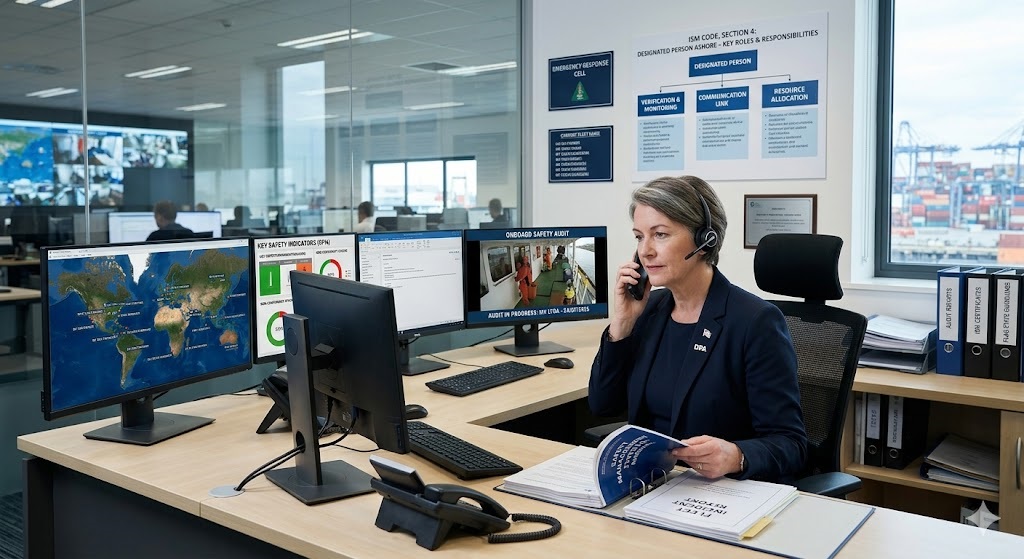
The maritime industry operates in a highly regulated, safety-critical environment where effective communication between ships and shore management is essential. Within this framework, the Designated Person Ashore (DPA) plays a central role in ensuring that shipping companies maintain safe operations, comply with international requirements, and provide continuous support to vessels and crews.
The DPA acts as a vital link between shipboard personnel and company management. This position is especially important under the International Safety Management (ISM) Code, which requires shipping companies to establish clear lines of responsibility, communication, and authority for safety and pollution prevention.

Understanding the Role of the Designated Person Ashore
The Designated Person Ashore is appointed by a shipping company to monitor the safety and pollution-prevention aspects of vessel operations and to ensure that adequate resources and shore-based support are available when required.
In practical terms, the DPA is not simply an administrative figure. The role involves active oversight of the company’s Safety Management System (SMS), regular communication with vessels, review of operational performance, and support during emergencies or non-conformities.
The DPA helps ensure that the company’s safety policies are not only written in manuals but are effectively implemented onboard ships.
Legal and Regulatory Background
The requirement for a DPA comes from the ISM Code, adopted by the International Maritime Organization. The ISM Code requires companies to designate a person or persons ashore who have direct access to the highest level of management.
This direct access is essential. It means that serious safety, environmental, or operational concerns raised by a vessel can be escalated quickly to senior decision-makers. The DPA therefore provides an important safeguard against communication gaps between the ship and the company office.
The DPA’s work is closely connected with major maritime regulatory frameworks, including:
| Framework | Relevance to the DPA |
|---|---|
| ISM Code | Establishes the Safety Management System and DPA requirement |
| SOLAS | Supports safety of life at sea and shipboard emergency preparedness |
| MARPOL | Supports pollution prevention and environmental compliance |
| STCW | Relates to crew competence, training, and watchkeeping standards |
| MLC 2006 | Supports seafarer welfare, working conditions, and onboard standards |
Core Responsibilities of the DPA
The responsibilities of a DPA are broad and require both technical understanding and strong management skills. The role covers safety monitoring, compliance, communication, emergency support, auditing, and continuous improvement.
Monitoring Shipboard Operations
The DPA monitors the safety and environmental performance of vessels under the company’s management. This may include reviewing reports related to navigation, machinery operation, cargo handling, maintenance, drills, inspections, near misses, accidents, and pollution-prevention measures.
The objective is to identify risks early and ensure that corrective actions are taken before minor issues develop into serious incidents.
Ensuring Regulatory Compliance
A key function of the DPA is to support compliance with international, flag-state, port-state, and company requirements. This includes ensuring that vessels follow the Safety Management System, maintain required records, conduct drills, report non-conformities, and prepare for audits and inspections.
The DPA also helps the company respond to findings from internal audits, external audits, Port State Control inspections, class surveys, and flag-state reviews.
Supporting Incident and Emergency Management
During emergencies, the DPA may coordinate communication between the vessel, company management, technical departments, charterers, insurers, classification societies, authorities, and other stakeholders.
This can include incidents such as machinery failures, collisions, groundings, fires, pollution events, cargo incidents, injuries, or security-related situations. The DPA helps ensure that the vessel receives timely support and that the company response remains organised and properly documented.
Auditing, Reporting, and Corrective Action
The DPA plays an important role in the continuous improvement of the Safety Management System. This includes reviewing internal audit results, accident investigations, near-miss reports, non-conformities, risk assessments, and corrective action plans.
A competent DPA does not treat reporting as a paperwork exercise. Instead, reporting is used to identify root causes, improve procedures, strengthen training, and prevent recurrence.
Crew Support and Safety Communication
The DPA provides a formal communication channel for seafarers to raise safety and environmental concerns. This is particularly important when crew members feel that an issue requires shore-side attention or escalation.
An effective DPA helps build a just and transparent safety culture where seafarers are encouraged to report hazards, near misses, and operational concerns without fear of unfair blame.
Liaison with External Stakeholders
The DPA may also communicate with flag administrations, port authorities, classification societies, auditors, insurers, emergency response services, and other maritime stakeholders. This requires professional communication, accurate documentation, and a strong understanding of regulatory expectations.

Qualifications and Competencies Required for a DPA
The DPA role requires a combination of maritime experience, regulatory knowledge, operational awareness, and leadership ability. While requirements may vary depending on the company, vessel type, and flag administration, a strong DPA profile usually includes:
| Competency Area | Description |
|---|---|
| Maritime operational experience | Preferably experience as a Master, Chief Engineer, senior officer, superintendent, or safety manager |
| ISM Code knowledge | Strong understanding of the Safety Management System and company responsibilities |
| Regulatory competence | Familiarity with SOLAS, MARPOL, STCW, MLC 2006, flag-state rules, and class requirements |
| Risk management | Ability to assess hazards, evaluate risk, and recommend effective controls |
| Incident investigation | Knowledge of root-cause analysis, corrective actions, and preventive measures |
| Communication skills | Ability to communicate clearly with ships, management, authorities, and technical teams |
| Crisis management | Capacity to support decision-making during emergencies |
| Leadership and integrity | Ability to escalate safety concerns and promote a strong safety culture |
Many maritime training providers offer dedicated DPA courses covering the ISM Code, auditing, risk assessment, emergency response, accident investigation, and safety management principles.
The DPA’s Contribution to Maritime Safety
A competent and active DPA can significantly improve the safety performance of a shipping company. The DPA helps ensure that safety procedures are implemented in practice, that reports from vessels are reviewed seriously, and that management provides the necessary resources to address operational risks.
The DPA also supports a proactive safety culture. Instead of waiting for accidents to occur, the DPA uses inspections, audits, near-miss reports, crew feedback, and operational data to identify weaknesses and strengthen the company’s Safety Management System.
For example, if a vessel reports repeated machinery alarms, poor spare-parts availability, or fatigue-related concerns, the DPA can escalate the issue to technical and senior management before it becomes a major incident.
Challenges Faced by DPAs
Although the DPA role is essential, it is also demanding. DPAs often work under pressure and must manage complex information from multiple vessels, departments, and regulatory sources.
Common challenges include:
Information Overload
Modern fleet operations generate large volumes of data, including inspection reports, audit findings, maintenance records, incident reports, and real-time vessel information. The DPA must identify which issues require urgent attention.
Global Operations
Ships operate across different time zones, jurisdictions, weather conditions, port requirements, and trading patterns. This makes coordination more complex, especially during emergencies.
Reporting Culture
Some crew members may hesitate to report safety concerns due to fear of blame, criticism, or commercial pressure. The DPA must help promote a culture where reporting is viewed as a safety improvement tool.
Balancing Safety and Commercial Pressure
Shipping is commercially demanding, but the DPA must ensure that safety and environmental protection are not compromised by operational or financial pressures.
Keeping Up with Regulatory Change
New requirements related to decarbonisation, cyber risk, ballast water, emissions, crew welfare, and digital systems continue to expand the DPA’s responsibilities.
Technology Supporting the DPA Function
Digital tools are increasingly supporting the work of DPAs. These systems help improve monitoring, reporting, communication, and decision-making.
Important tools include:
| Technology | Benefit for the DPA |
|---|---|
| Fleet management systems | Centralised monitoring of vessel performance, maintenance, certificates, and compliance |
| Incident reporting software | Easier reporting, tracking, investigation, and closure of corrective actions |
| Planned maintenance systems | Better visibility of technical risks and overdue maintenance |
| Document management systems | Improved control of SMS procedures, circulars, checklists, and records |
| Digital audit platforms | More efficient planning, recording, and follow-up of audits |
| Secure communication tools | Faster contact between vessels, office teams, and external stakeholders |
| Data analytics dashboards | Identification of trends, repeated deficiencies, and high-risk areas |
However, technology does not replace professional judgement. The DPA must still interpret information, prioritise risks, communicate effectively, and ensure that action is taken.
Future Development of the DPA Role
The DPA role is expected to become even more important as shipping moves through major technological, environmental, and social transitions.
Decarbonisation and Environmental Compliance
New environmental requirements are increasing the need for effective monitoring and management. DPAs may become more involved in supporting compliance with emissions regulations, fuel-change procedures, energy-efficiency measures, alternative fuels, and pollution-prevention systems.
Digitalisation and Cybersecurity
As ships become more connected, DPAs will need to understand cyber risk, digital reporting, remote monitoring, electronic documentation, and data integrity. Cybersecurity will become an increasingly important part of safety management.
Crew Welfare and Human Factors
The DPA’s role is also expanding in relation to crew welfare, fatigue management, mental health, harassment prevention, communication quality, and onboard working conditions. A strong Safety Management System must address not only technical risks but also human and organisational factors.
Predictive and Preventive Safety Management
Future DPA functions may rely more on data analytics, predictive maintenance, trend analysis, and leading safety indicators. This will allow companies to move from reactive incident response toward preventive risk management.
Conclusion
The Designated Person Ashore is a key figure in modern maritime safety management. By connecting shipboard operations with shore-based decision-making, the DPA helps ensure that vessels receive proper support, risks are addressed, and the company’s Safety Management System remains effective.
A competent DPA combines maritime experience, regulatory knowledge, communication skills, and professional judgement. The role supports compliance with the ISM Code, strengthens safety culture, improves incident response, and contributes to environmental protection.
As the maritime industry faces new challenges linked to decarbonisation, digitalisation, cybersecurity, and crew welfare, the DPA will remain an indispensable part of safe, responsible, and efficient ship management.