
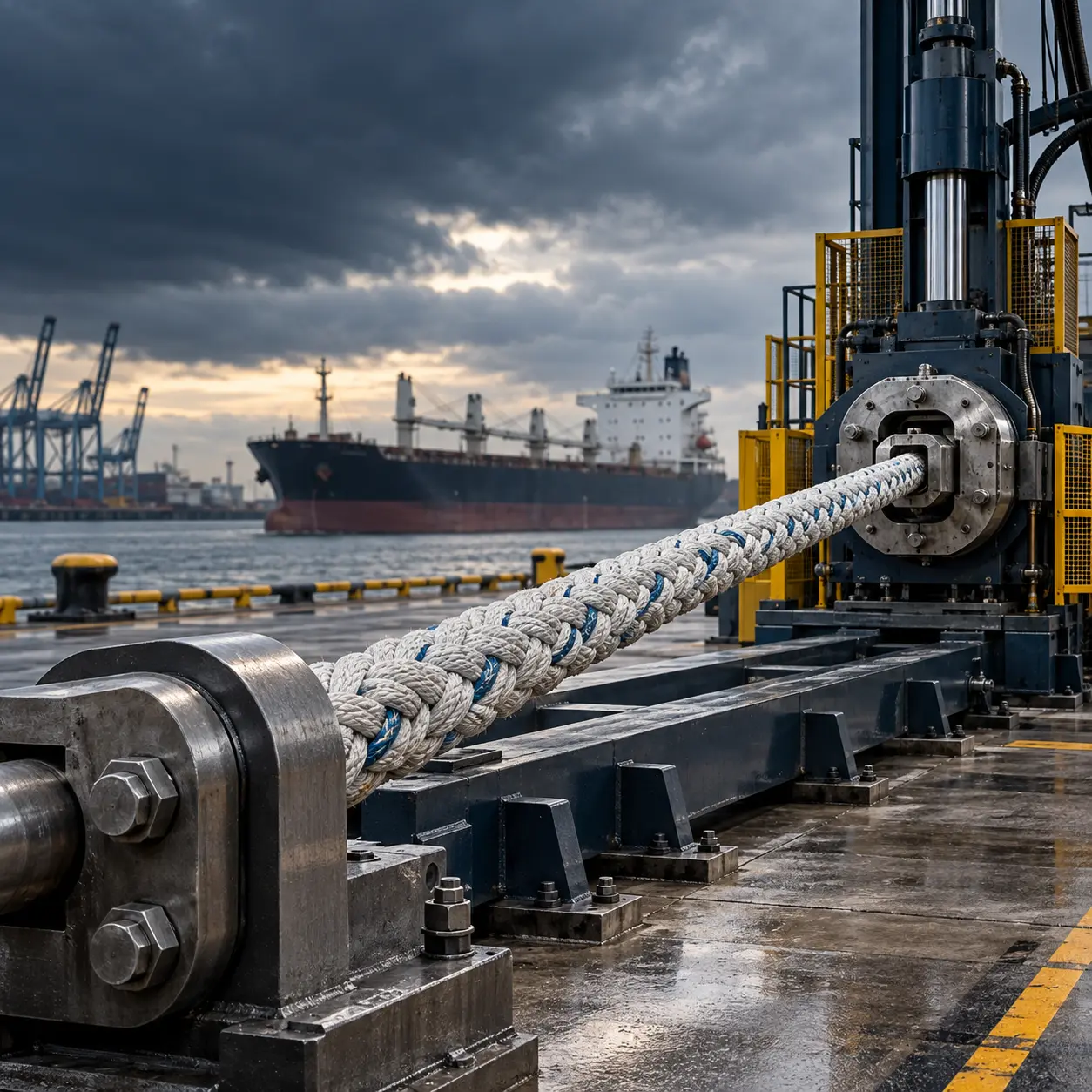
Mooring a ship can look routine from the quay. A line goes ashore, a winch turns, the vessel settles alongside and cargo work begins. But a mooring line is not an ordinary rope. It is part of a high-energy system that holds a moving ship against wind, tide, current, swell and passing traffic.
When a mooring rope parts, the release of stored energy can be violent. The rope, tail, fitting or connected item may recoil with little warning. This is why a controlled mooring rope rupture test is such a powerful training demonstration: it makes the hidden forces visible.
The lesson is not that crews should deliberately break ropes on board. They should not. A destructive rupture test is normally carried out in a controlled testing or manufacturing setting, using the correct equipment, barriers and procedures. On board, the focus is different: select suitable lines, inspect them, control the operation, monitor loads and keep people out of danger.
This guide explains what a ship mooring rope rupture test can teach seafarers, students, port workers and ship operators about safe mooring.
Why a mooring rope rupture test matters
A rupture test applies an increasing, controlled tensile load to a sample rope until it fails. The test can confirm a rope’s breaking performance and show how failure occurs. Depending on the test purpose, it may support product development, certification, quality assurance, comparison of materials or crew training.
In a properly managed demonstration, people can see several important facts at once:
- A large line can store enormous energy before it fails.
- A rope may look calm while tension is steadily rising.
- Failure can be sudden, even when the loading process is carefully controlled.
- The direction of recoil cannot be treated as a simple straight-line prediction.
- Rope strength is only one part of a safe mooring system.
The final point matters most. A vessel is not secured by one rope in isolation. The working system includes the line, any tail or connection, winch and brake, drum, stopper, fairlead or roller, bitts, chocks, shore bollards or hooks, and the people managing the operation. A weak link or poor practice anywhere in that chain can create danger.
What “rupture” means in a controlled test
In simple terms, rupture means that the rope breaks under tension. In a test facility, a representative sample is secured to purpose-built end fixtures and loaded by a calibrated test machine. The team records the rope identification, test set-up, loading method, measured force and the place and form of the failure.
The test area must be treated as a line-of-fire zone. Operators should use the facility’s approved guarding, barriers and remote controls. Nobody should stand beside, over or in line with a loaded rope simply to get a closer view. A dramatic video is never a reason to compromise the test controls.
The exact procedure depends on the rope construction, manufacturer’s instructions, intended standard and testing objective. That is why a test result should always be read with its certificate and test conditions. A breaking result from one sample does not automatically describe every rope of that type in every operational condition.
–
Watch the video and subscribe to our YouTube channel:
What a demonstration shows — and what it does not
| A rupture demonstration can show | It does not prove |
|---|---|
| How a controlled sample behaves under increasing tensile load | That every rope on a ship will fail at exactly the same load |
| The speed and energy of a parting event | That it is safe to estimate a snap-back path by eye |
| Why barriers and exclusion zones matter | That a shipboard rope should be deliberately tested to destruction |
| The importance of quality records and correct equipment | That strength alone makes a line suitable for a particular vessel or berth |
| A visible example of stored energy | That normal mooring loads are static or predictable |
The forces behind a loaded mooring line
A moored vessel is still moving, even when it appears still. It may surge ahead and astern, sway away from and back toward the berth, rise and fall with tide and swell, or yaw under wind and current. Each movement can change the tension in its lines.
The load is often affected by more than one factor at the same time:
- Strong or gusting wind acting on the ship’s side and superstructure
- Tidal flow or river current
- Swell, wash and wake from passing ships
- Changes in draught during cargo, ballast or bunkering operations
- The ship’s position along the berth and the angle of each line
- Different rope stiffness and elongation characteristics
- Winch brake condition, line condition and the condition of fairleads and fittings
This is why “the line looked fine a few minutes ago” is not a reliable safety check. A line that is quiet at one moment can tighten sharply when the vessel surges or when environmental conditions change.
Static loading and dynamic loading
Static loading is a steady, controlled pull. It helps establish how a rope responds when tension is gradually increased under known conditions.
Dynamic loading is changing load. During real mooring operations, the force can rise and fall because the ship and water are moving. A sudden surge, wake or gust may load a line much faster than a calm, gradual pull.
Both ideas are important, but a single test should not be over-interpreted. A controlled break test is valuable evidence about the tested sample. Real berth conditions introduce movement, geometry, equipment condition and human decision-making that a simple pull test cannot reproduce.
Key terms every mooring team should understand
| Term | Plain-English meaning | Why it matters |
|---|---|---|
| Mooring line | A line used to secure a ship at a berth, terminal or other mooring position | It carries the forces that keep the vessel in a safe position |
| Minimum breaking load (MBL) | A stated breaking-strength value for a rope or arrangement, under its defined basis | It is a strength reference, not permission to work close to failure |
| Working load limit / safe working load | An approved operating limit associated with the relevant equipment or arrangement | The applicable limit and marking must be understood before use |
| Snap-back | The dangerous recoil that may follow a line or connected component parting | The recoil path can be severe and unpredictable |
| Line of fire | Any area where a person could be struck by a moving or released item | It must be identified before the line is loaded |
| Mooring line management plan (LMP) | The ship’s controlled record and process for its mooring lines | It supports selection, inspection, care, retirement and traceability |
The language used on board should match the vessel’s safety management system and equipment documentation. If a term is unclear, the correct response is to stop and clarify it before the operation—not to guess.
Snap-back: the danger after a line parts
Snap-back is one of the best-known dangers in mooring, but it is sometimes explained too simply. People are told to stay clear of the rope’s straight path. That is necessary, but it is not enough.
When a loaded line parts, its stored energy may send the rope, tail or a connected item back toward the ship or shore. The exact movement depends on the tension, rope type, length, line geometry, point of failure, fittings and what remains connected. A line can change direction around fairleads or rollers. It can recoil in an arc. Components can move as well.
Synthetic ropes deserve particular attention. They offer important performance benefits, but their stretch and recoil behaviour must be understood for the specific rope and arrangement. Do not rely on a generic rule of thumb or a painted box copied from another ship. Follow the vessel’s marked snap-back zones, the berth’s local rules, manufacturer information and the risk assessment for the actual operation.
The basic personal rule is simple: never stand in a bight, never step over a loaded line and never stay in a possible line-of-fire area because the job seems nearly finished.
Rope type and selection: strength is not the whole answer
Ship mooring lines may be steel wire, fibre rope or a combination that includes synthetic tails. Fibre ropes may use materials such as polyester, nylon, polypropylene or high-modulus fibres. Each has different behaviour in relation to stretch, handling, abrasion, water absorption, ultraviolet exposure, heat, chemical exposure, fatigue and recoil.
Choosing a line is therefore a system decision. The selected line must be suitable for the vessel, its fittings and winches, the expected operating environment, the terminal’s requirements and the approved mooring arrangement. A very strong rope is not automatically the safest rope if it is incompatible with the drum, stopper, fairlead, tail connection or operating practice.
Before putting a new line into service, the ship should have clear records for its identity, specification, manufacturer guidance, date placed in service and inspection history. In service, the crew should follow the line management plan and the manufacturer’s retirement criteria. Damage, uncertainty or a history of abnormal loading should trigger competent review rather than hopeful reuse.
What to inspect before mooring
Inspection is not a quick glance from several metres away. It is a planned check of the line and the whole load path.
For fibre ropes, watch for abrasion, cuts, broken yarns, melted or glazed areas, stiffness, flattening, contamination, unusual discolouration, damaged splices, loose cover or signs of internal damage. For wire ropes, look for broken wires, corrosion, crushing, kinks, birdcaging, distortion, loss of lubrication and damaged terminations. The exact inspection criteria must come from the rope maker, the ship’s procedures and applicable management plan.
Then inspect the equipment that touches or restrains the line. Fairleads and rollers should turn freely where designed to do so and should not have sharp edges. Drums, bitts, chocks, stoppers and connection points need to be in safe condition. Winch brakes, controls and indicators must be maintained and used in accordance with the ship’s procedures.
A rope can fail because it is damaged, but it can also be damaged by an unsuitable fitting. Repeated chafing over a worn fairlead is not a “rope problem” alone.
A safer mooring operation: before, during and after
| Stage | Essential actions |
|---|---|
| Before the operation | Review the mooring plan and weather; inspect lines and fittings; confirm suitable line arrangement; agree communications and one clear person in charge for each team; identify snap-back and line-of-fire areas; brief crew and shore team as required. |
| During the operation | Keep non-essential people clear; maintain clear bridge–deck–shore communication; apply tension steadily; watch line leads and ship movement; do not stand in bights or potential recoil zones; stop if instructions conflict or something looks wrong. |
| After securing | Confirm the vessel’s position; monitor line tension, weather, tide and passing traffic; adjust only through controlled procedures; record defects and abnormal loads; re-check during cargo, ballast and changing conditions. |
The bridge and deck teams need a shared picture. The bridge needs accurate information on which lines are fast, being tended or showing concern. The deck team needs warning of ship movements, engines, tug activity, ballast changes and approaching weather. Good communication makes early action possible.
When tension rises: intervene early
Mooring accidents often develop through a chain of small warnings: the vessel begins to surge, a line lead becomes poor, a wake arrives, the wind freshens or a line takes noticeably more load than the others. Waiting until a rope is close to failure removes options.
When conditions worsen, the responsible team should follow the vessel’s and terminal’s procedures. This may mean increasing monitoring, tending lines, adjusting the mooring arrangement, using tugs or other approved support, pausing cargo operations, or considering whether the berth remains safe. The Master retains responsibility for the ship’s safe navigation and operation, and decisions should be coordinated with the terminal and port as applicable.
An emergency release is not a casual answer to high tension. Releasing lines can create new hazards for the ship, people and berth. It should only be considered and carried out under the approved emergency arrangements and command structure.
Common mistakes that a rupture test helps expose
Treating the rope as the only safety-critical item
The rope is visible, so it receives attention. Yet a damaged fairlead, poor brake setting, unsuitable stopper, weak connection or badly planned lead can be just as important. Inspect and manage the full system.
Standing close to “keep an eye on it”
People often move closer when a line is under concern. That is exactly when exposure increases. Use safe observation positions, cameras or designated lookouts where available. Do not solve uncertainty by entering the danger zone.
Assuming yesterday’s set-up is safe today
Wind, tide, draught, traffic and berth conditions change. A mooring plan needs active monitoring, not passive confidence.
Using a single strength number as the decision-maker
MBL and other ratings are important, but they do not replace approved operating limits, inspection history, compatible equipment, line geometry and good judgement. The aim is to stay well within safe operating conditions—not to discover the breaking point during a berth operation.
Ignoring abnormal events
A hard surge, snag, overload indication, chafing incident or suspected shock load should be reported and assessed. A line may have damage that is not obvious from a distance.
Training lessons for seafarers and port workers
A good training session should do more than show a rope breaking. It should turn the visual impact into practical habits.
Crew members should be able to identify their vessel’s snap-back markings and no-go areas; explain the correct communication method; recognise common rope and fitting defects; know where to find rope certificates and inspection records; and understand when to stop work and report a concern.
Training should also include realistic discussion. A person may feel pressure to finish a mooring operation quickly, especially in poor weather or at a busy terminal. The safe response is not silent compliance. Any crew member who sees a serious line-of-fire risk, damaged equipment or unclear command should raise it and stop the task in line with the safety management system.
For maritime students, rupture-test footage is especially useful when paired with a diagram of the mooring arrangement, a toolbox-talk scenario and a review of actual ship procedures. The point is to develop judgement before they stand on a live mooring deck.
The regulatory and management context
Safe mooring is not governed by one document alone. It sits within the ship’s safety management system, flag and class requirements, port and terminal rules, manufacturer instructions and international guidance.
IMO’s updated safe-mooring work includes SOLAS chapter II-1 regulation 3-8 requirements on the design, inspection, maintenance and documentation of towing and mooring equipment. The related IMO guidance addresses the selection of appropriate equipment and fittings, as well as the inspection and maintenance of mooring equipment, including lines.
For the working team, the practical message is direct: use the approved arrangement, know the equipment limits and markings, keep records, inspect systematically and follow the vessel’s mooring line management process. International guidance supports good practice, but it does not remove the need for a careful risk assessment at the berth in front of you.
Final takeaway
A ship mooring rope rupture test is memorable because it shows the energy that a loaded line can release. Its real value is not the dramatic moment of failure. Its value is the safer behaviour it encourages before failure becomes possible.
Select lines that suit the whole mooring system. Inspect ropes and fittings carefully. Keep accurate records. Plan the operation. Watch changing conditions. Communicate early. Stay out of snap-back and line-of-fire areas. And when something does not look right, stop and reassess.
At sea and alongside, good mooring safety is rarely about one heroic decision. It is the result of many disciplined, ordinary choices made before a rope is ever put under heavy tension.
Further reading
- IMO: Safe Mooring
- IMO: Revised guidance on shipboard towing and mooring equipment
- IMO: Maritime Safety Committee 102nd session summary
- OCIMF: Mooring Equipment Guidelines, Fourth Edition
Safety note: This article is for awareness and training. Always follow the vessel’s approved safety management system, manufacturer instructions, flag/class requirements and port or terminal procedures.