
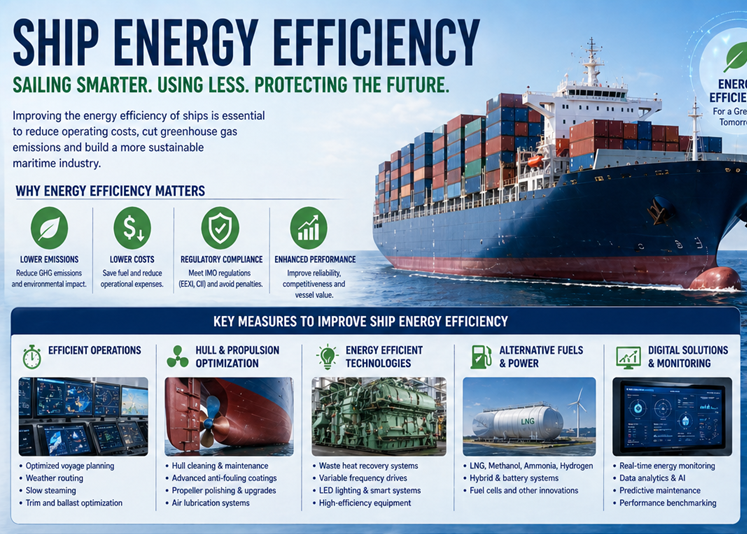
Learn how ship energy efficiency is improving through CII, EEXI, hull optimisation, air lubrication, wind-assisted propulsion, and voyage optimisation strategies.
Why Energy Efficiency Is Now Central to Shipping
Energy efficiency has become one of the most important priorities in modern shipping. Rising fuel costs, stricter environmental regulations, and pressure from charterers and financiers are forcing shipowners to reduce fuel consumption and emissions.
Unlike alternative fuels, which often require major investments and infrastructure changes, energy efficiency measures can be applied to existing ships and deliver immediate results. For this reason, efficiency is often described as the first and most practical step toward decarbonisation.
International regulations led by the International Maritime Organization now require ships to measure, report, and improve their energy performance. Two key instruments—EEXI and CII—have made energy efficiency a measurable and enforceable requirement.
Understanding EEXI: Design Efficiency for Existing Ships
The Energy Efficiency Existing Ship Index (EEXI) focuses on the technical design of a ship. It evaluates how efficiently a vessel is built in terms of engine power, capacity, and design characteristics.
EEXI applies to existing ships and requires them to meet a minimum efficiency standard based on their type and size. If a ship does not comply, technical modifications may be necessary.
In many cases, compliance is achieved through relatively straightforward measures such as engine power limitation (EPL) or shaft power limitation. These measures reduce maximum engine output, which in turn lowers fuel consumption and emissions.
EEXI is a one-time certification, but it sets the baseline for how efficiently a ship can operate from a design perspective.
Understanding CII: Operational Efficiency in Practice
While EEXI focuses on design, the Carbon Intensity Indicator (CII) evaluates how efficiently a ship operates over time. It measures the amount of carbon dioxide emitted per unit of transport work.
Each ship receives an annual rating, typically from A (best) to E (worst). Ships rated D or E must take corrective action to improve performance.
CII reflects real operational conditions, including:
- Voyage patterns
- Speed and fuel consumption
- Cargo load
- Weather conditions
This means that even a technically efficient ship can perform poorly if it is operated inefficiently. Conversely, good operational practices can significantly improve a vessel’s rating.
Hull Optimisation: Reducing Resistance at Sea
One of the most effective ways to improve energy efficiency is to reduce hydrodynamic resistance. The hull is constantly moving through water, and even small improvements in design or condition can lead to measurable fuel savings.
Hull optimisation includes both design and maintenance aspects. Modern hull designs aim to reduce drag through improved shapes and flow characteristics. At the same time, regular maintenance such as hull cleaning and advanced coatings helps prevent fouling, which increases resistance.
A clean and well-designed hull can reduce fuel consumption significantly over time, making it one of the most cost-effective efficiency measures.
Air Lubrication Systems: Reducing Friction
Air lubrication is an innovative technology that reduces friction between the ship’s hull and the water. It works by creating a layer of air bubbles along the bottom of the hull, which decreases resistance.
This system can lead to noticeable fuel savings, particularly for large vessels operating at steady speeds. However, it requires additional equipment, energy input, and maintenance.
While not suitable for all ship types, air lubrication is gaining attention as part of a broader set of energy-saving technologies.
Wind-Assisted Propulsion: Using Natural Energy
Wind-assisted propulsion is one of the oldest concepts in shipping, now reintroduced with modern technology. Instead of traditional sails, ships may use rotor sails, wing sails, or kite systems to harness wind energy.
These systems do not replace engines but supplement them, reducing the load on propulsion systems and lowering fuel consumption.
Wind-assisted technologies are particularly effective on routes with favourable wind conditions. Their performance depends on vessel type, route characteristics, and operational strategy.
As fuel prices and carbon costs increase, interest in wind-assisted propulsion is growing across different shipping segments.
Voyage Optimisation: Efficiency Through Smarter Operations
Operational efficiency is just as important as technical improvements. Voyage optimisation uses data and digital tools to plan routes and operations more effectively.
This includes:
- Weather routing to avoid adverse conditions
- Speed optimisation to balance time and fuel consumption
- Just-in-time arrival to reduce waiting at ports
These strategies reduce unnecessary fuel use and improve overall efficiency without requiring major physical modifications to the ship.
Voyage optimisation also supports compliance with CII requirements by improving operational performance.
Integrating Efficiency Measures: A Combined Approach
Energy efficiency is most effective when multiple measures are combined. A ship that uses only one solution may achieve limited improvement, but integrating several strategies can produce significant results.
| Efficiency Measure | Type | Impact |
|---|---|---|
| EEXI compliance | Technical | Sets baseline efficiency |
| CII management | Operational | Continuous performance monitoring |
| Hull optimisation | Technical/maintenance | Reduces resistance |
| Air lubrication | Technical | Lowers friction |
| Wind-assisted propulsion | Hybrid | Supplements engine power |
| Voyage optimisation | Operational | Improves fuel use |
This combined approach allows shipowners to balance short-term gains with long-term investments.
Challenges in Improving Ship Energy Efficiency
Despite clear benefits, improving energy efficiency is not always straightforward.
One challenge is the diversity of ship types and trading patterns. A solution that works well for one vessel may not be suitable for another.
Another issue is the interaction between technical and operational measures. For example, reducing engine power may improve EEXI compliance but limit operational flexibility.
There are also economic considerations. Some technologies require significant upfront investment, and their financial return depends on fuel prices, charter rates, and regulatory pressures.
Finally, accurate data is essential. Without reliable monitoring systems, it is difficult to measure performance and identify improvement opportunities.
Future Outlook: Efficiency as a Core Strategy
Energy efficiency will remain a central strategy in shipping, even as alternative fuels become more common. In many cases, improving efficiency reduces the cost and complexity of transitioning to new fuels.
Future developments are likely to include:
- More advanced hull designs
- Integration of digital twins for performance monitoring
- Wider adoption of hybrid propulsion systems
- Increased use of real-time data analytics
Efficiency will not only reduce emissions but also improve competitiveness in a market where carbon costs and environmental performance are becoming increasingly important.
Conclusion: Efficiency First in the Path to Decarbonisation
Ship energy efficiency is no longer optional. It is a regulatory requirement, a cost-saving strategy, and a key component of environmental performance.
Measures such as EEXI and CII have made efficiency measurable and enforceable, while technologies like hull optimisation, air lubrication, and wind-assisted propulsion provide practical solutions.
For maritime professionals, understanding energy efficiency is essential. It represents the most immediate and scalable way to reduce emissions and improve operational performance in the shipping industry.
Frequently Asked Questions (FAQ)
What is EEXI?
EEXI is a technical measure that evaluates the design efficiency of existing ships.
What is CII?
CII measures the operational carbon intensity of a ship and assigns an annual rating.
How can ships improve energy efficiency?
Through technical upgrades, better maintenance, and operational strategies such as voyage optimisation.
Is wind-assisted propulsion practical?
Yes, especially on suitable routes, as it can reduce fuel consumption by supplementing engine power.
References
- International Maritime Organization – EEXI and CII regulations under MARPOL Annex VI
- DNV – Energy efficiency and decarbonisation reports
- International Energy Agency – Shipping energy outlook
- European Maritime Safety Agency – Monitoring and reporting of emissions
- Wärtsilä. Energy Efficiency Solutions for Shipping
- MAN Energy Solutions. Ship Efficiency Technologies
That’s right 👍