
How Asia—and especially China—dominates the movement of global trade
Seaports are the backbone of global trade. They move the containers that carry electronics, clothing, machinery, food products, industrial goods, and almost everything that connects factories to consumers.
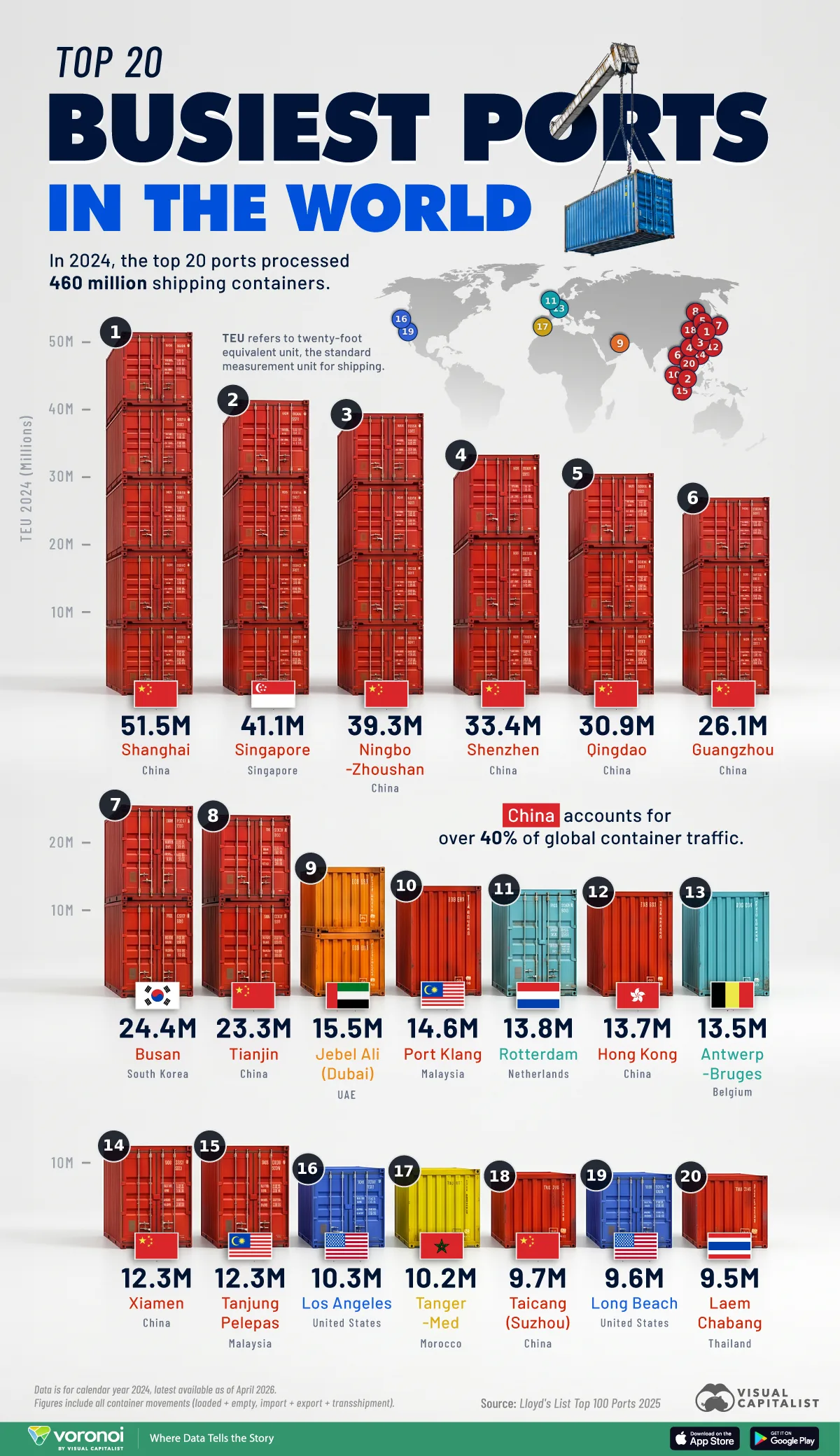
In 2024, the world’s ports processed the equivalent of 743 million TEUs—or twenty-foot equivalent units. More than 460 million TEUs passed through just the top 20 busiest container ports, showing how concentrated global container shipping has become.
The ranking below is based on the most recent data shown in the infographic, sourced from Lloyd’s List Top 100 Ports 2025 and visualized by Visual Capitalist / Voronoi. The data reflects calendar year 2024, with the latest available figures as of April 2026.
Key Takeaways
Asia is home to the world’s 10 busiest container ports by throughput.
China alone accounts for over 40% of global container traffic.
Five of the six busiest ports in the world are located in China.
The busiest U.S. port, Los Angeles, ranks only 16th worldwide.
The busiest non-Asian port is Rotterdam, ranked 11th globally.
Only one African port appears in the top 20: Tanger-Med, Morocco.
No ports from Central or South America appear in the ranking.
Top 20 Busiest Container Ports in the World in 2024
| Rank | Port | Country | 2024 Throughput |
|---|---|---|---|
| 1 | Shanghai | China | 51.5M TEU |
| 2 | Singapore | Singapore | 41.1M TEU |
| 3 | Ningbo-Zhoushan | China | 39.3M TEU |
| 4 | Shenzhen | China | 33.4M TEU |
| 5 | Qingdao | China | 30.9M TEU |
| 6 | Guangzhou | China | 26.1M TEU |
| 7 | Busan | South Korea | 24.4M TEU |
| 8 | Tianjin | China | 23.3M TEU |
| 9 | Jebel Ali, Dubai | UAE | 15.5M TEU |
| 10 | Port Klang | Malaysia | 14.6M TEU |
| 11 | Rotterdam | Netherlands | 13.8M TEU |
| 12 | Hong Kong | China | 13.7M TEU |
| 13 | Antwerp-Bruges | Belgium | 13.5M TEU |
| 14 | Xiamen | China | 12.3M TEU |
| 15 | Tanjung Pelepas | Malaysia | 12.3M TEU |
| 16 | Los Angeles | United States | 10.3M TEU |
| 17 | Tanger-Med | Morocco | 10.2M TEU |
| 18 | Taicang, Suzhou | China | 9.7M TEU |
| 19 | Long Beach | United States | 9.6M TEU |
| 20 | Laem Chabang | Thailand | 9.5M TEU |
China: The World’s Port Capital
The clearest message from the ranking is China’s dominance.
China accounts for over 40% of global container traffic, reflecting its central role in manufacturing, exports, e-commerce, industrial supply chains, and global logistics.
The Port of Shanghai leads the world with 51.5 million TEUs in 2024. It handled more than 10 million TEUs above Singapore, the second-ranked port.
Shanghai’s dominance is supported by its location near the Yangtze River Delta, one of the most powerful industrial and commercial regions in the world. It is not only a port but a strategic gateway for China’s manufacturing economy.
China’s strength extends far beyond Shanghai. Ningbo-Zhoushan, Shenzhen, Qingdao, Guangzhou, Tianjin, Hong Kong, Xiamen, and Taicang all appear in the top 20.
This means China is not dependent on one maritime gateway. It has built a network of mega-ports serving different industrial regions, export corridors, and domestic logistics systems.
Historically, this maritime importance also has deep roots. Guangzhou, formerly known as Canton, was once the only Chinese port open to Western merchants between 1757 and 1842. Today, Guangzhou remains one of the world’s busiest ports, ranking sixth with 26.1 million TEUs.
Beyond China: Asia’s Wider Port Dominance
Although China dominates the ranking, the wider Asian region is equally important.
The infographic shows that Asia is home to the 10 busiest ports worldwide. This reflects the continent’s powerful role in manufacturing, consumer goods exports, energy flows, and intercontinental shipping.
Singapore ranks second with 41.1 million TEUs. Unlike China’s manufacturing-driven ports, Singapore is mainly a global transshipment hub. Containers arrive from one route, are transferred between vessels, and then continue toward Europe, Africa, the Americas, or other Asian markets.
Singapore’s strength comes from geography. It sits near the Strait of Malacca, one of the busiest maritime chokepoints in the world. Port Klang in Malaysia, ranked 10th, also benefits from this same strategic corridor.
Busan in South Korea ranks seventh with 24.4 million TEUs, serving as a major Northeast Asian logistics and transshipment hub.
Jebel Ali in Dubai ranks ninth with 15.5 million TEUs. It is the busiest port outside East Asia and plays a major role in connecting Asia, Europe, Africa, and the Middle East. Located in the Persian Gulf, it is also known as one of the world’s largest man-made harbors and is operated by DP World.
The West’s Smaller but Still Strategic Ports
Europe and the United States remain major trading regions, but their ports now trail far behind Asia’s largest container gateways.
The busiest non-Asian port is Rotterdam, ranked 11th globally with 13.8 million TEUs. Rotterdam remains Europe’s main maritime gateway, linking ocean shipping with inland Europe through rivers, roads, railways, pipelines, and logistics corridors.
Antwerp-Bruges follows closely with 13.5 million TEUs, ranking 13th. It is one of Europe’s most important industrial and chemical port complexes.
In the United States, the two major ports in the ranking are both located in California. Los Angeles ranks 16th with 10.3 million TEUs, while Long Beach ranks 19th with 9.6 million TEUs.
Together, Los Angeles and Long Beach form the San Pedro Bay port complex, one of the most important gateways for U.S.–Asia trade. However, their position in the global ranking shows how much larger Asian container ports have become.
Africa’s Rising Port: Tanger-Med
Only one African port appears in the top 20: Tanger-Med in Morocco.
With 10.2 million TEUs, Tanger-Med ranks 17th globally. Its location near the Strait of Gibraltar gives it a powerful geographic advantage, connecting the Mediterranean, Atlantic, Europe, and Africa.
Its rise shows the growing importance of North Africa in global maritime logistics and transshipment networks.
Why These Rankings Matter
These ports are not just places where containers are loaded and unloaded. They are strategic economic assets.
They influence:
- Global supply-chain reliability
- Shipping costs
- Consumer prices
- Manufacturing competitiveness
- Port investment strategies
- Maritime employment
- Trade security
- Decarbonization planning
A disruption at one major port can delay cargo across several continents. This is why port capacity, automation, resilience, cybersecurity, and green infrastructure are now central issues in global trade planning.
Final Thoughts
The 2024 ranking of the world’s busiest container ports shows a clear global pattern: container shipping is increasingly concentrated in Asia, and especially in China.
Shanghai remains the world’s leading container port, Singapore continues to dominate transshipment, and Chinese ports occupy many of the most important positions in global maritime trade.
At the same time, ports such as Rotterdam, Antwerp-Bruges, Los Angeles, Long Beach, Jebel Ali, and Tanger-Med remain strategically vital for their regions.
The future of global trade will depend not only on which ports are the biggest, but also on which ports become smarter, greener, faster, and more resilient.
FAQ: World’s Busiest Container Ports
What is the busiest container port in the world?
The busiest container port in the world is Shanghai, China, with 51.5 million TEUs handled in 2024.
What does TEU mean?
TEU means Twenty-foot Equivalent Unit. It is the standard measurement used in container shipping.
Which country dominates global container traffic?
China dominates global container traffic, accounting for over 40% of the global total.
Which continent has the busiest ports?
Asia dominates the ranking and is home to the 10 busiest container ports in the world.
What is the busiest port outside Asia?
The busiest non-Asian port is Rotterdam in the Netherlands, with 13.8 million TEUs.
What is the busiest port in the United States?
The busiest U.S. port is Los Angeles, ranked 16th globally with 10.3 million TEUs.
Which African port is in the top 20?
Tanger-Med in Morocco is the only African port in the top 20, handling 10.2 million TEUs.
Why is Singapore ranked so high?
Singapore is a major transshipment hub located near the Strait of Malacca, one of the world’s busiest shipping routes.
Why are Chinese ports so dominant?
Chinese ports are dominant because China is a global manufacturing and export powerhouse with extensive port infrastructure and strong logistics networks.
What is the source of the ranking?
The infographic uses data from Lloyd’s List Top 100 Ports 2025, visualized by Visual Capitalist / Voronoi, based on 2024 container throughput.
Thanks