
05/31/2026
Port State Control activity in the first quarter of 2026 shows that maritime enforcement authorities remain strongly focused on the fundamentals of ship safety, particularly safety management systems, maintenance standards, fire safety readiness, and crew familiarity with critical equipment.
The latest Q1 2026 detention review indicates that deficiencies related to International Safety Management, maintenance of ship and equipment, fire detection, fire doors, emergency fire pumps, fire drills, and emergency power systems continue to be among the most common causes of detention.
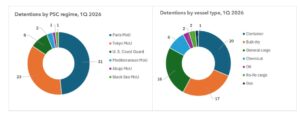
A total of 64 detentions were recorded for reviewed vessels in Q1 2026, compared with 52 detentions during the same period in 2025. Container ships, bulk carriers, and general cargo vessels accounted for the majority of cases, representing around 83% of detentions. Most detentions were recorded within the Paris MoU and Tokyo MoU regions.
The findings suggest that Port State Control inspectors continue to identify weaknesses not only in equipment condition, but also in the practical implementation of safety management systems on board. In many cases, detainable deficiencies point to a wider pattern of insufficient maintenance follow-up, poor testing routines, incomplete crew familiarization, or inadequate emergency preparedness.
Among the most frequently cited deficiency areas were ISM-related issues and maintenance of ship and equipment. These categories often act as indicators of broader management performance. If maintenance routines are not properly implemented, or if identified defects are not corrected in time, the risk of detention increases significantly.
Fire safety remained another major area of concern. Reported examples included damaged smoke detectors, fire doors that did not close correctly, emergency fire pumps unable to pressurize the fire main, and poor use of personal protective equipment and communication devices during fire drills.
These deficiencies are serious because they affect the vessel’s ability to respond effectively during an emergency. A damaged fire detector may delay early warning. A defective fire door may allow smoke and flame to spread beyond the original space. A weak or non-functioning emergency fire pump may reduce firefighting capability. Poor drill performance may expose crew members to unnecessary danger during a real incident.
Emergency power also remains a critical issue. One example involved an emergency source of power failing to take load on the emergency switchboard during a simulated blackout test. Such failures are particularly concerning because emergency generators and emergency switchboards support vital safety, navigation, communication, and firefighting systems when the main power supply is lost.
The review also points to several inspection priorities for the remainder of 2026. The Paris and Tokyo MoUs are preparing a joint Concentrated Inspection Campaign on cargo securing, scheduled from 1 September to 30 November 2026. Shipowners and operators should therefore review cargo-securing manuals, lashing arrangements, crew familiarity, inspection routines, and compliance with applicable cargo-securing requirements before the campaign begins.
In addition, some regional authorities have announced focused inspection activity. Maritime New Zealand, for example, scheduled a fire-safety inspection campaign between 1 April and 31 May 2026, with attention on fire dampers, fixed fire-extinguishing systems, and crew familiarity with fire-safety systems.
Machinery safety is also receiving attention. The Guangzhou Maritime Safety Administration issued a safety bulletin in January 2026 encouraging operators to strengthen root-cause analysis and safety management relating to mechanical and electrical equipment failures on board ships.
Another important development is the adoption of IMO Resolution A.1206(34), which introduces the updated Procedures for Port State Control 2025 and revokes the previous Resolution A.1185(33). The new resolution includes guidance for Port State Control Officers on security-related aspects and provides a clearer basis for recording security deficiencies and acting on ineffective security arrangements.
Where clear grounds exist, port authorities may take measures under SOLAS Chapter XI-2, including inspection, delay, detention, restriction of operations, movement restrictions within port, or expulsion from port. This means ship operators should ensure that security procedures, ship security plans, access control arrangements, drills, records, and crew familiarity are properly maintained and ready for inspection.
For shipowners, managers, masters, and crew, the message from Q1 2026 is clear: PSC performance depends on daily implementation, not last-minute preparation. Safety management systems must be active, practical, and visible in onboard routines. Maintenance records must reflect real equipment condition. Fire-safety systems must be tested and operational. Emergency equipment must work under realistic conditions. Crew members must be able to demonstrate familiarity with critical systems during inspections.
Operators should also prepare early for the upcoming cargo-securing campaign. This includes checking cargo-securing equipment, reviewing documentation, verifying condition of lashing gear, confirming crew understanding of securing arrangements, and ensuring that procedures are applied consistently in practice.
The latest detention trends show that Port State Control authorities are not only checking paperwork. They are increasingly looking at whether safety systems function in practice and whether crew members can demonstrate operational readiness. As regulatory scrutiny grows in 2026, vessels with weak maintenance routines, poor fire-safety readiness, ineffective ISM implementation, or incomplete crew familiarization are likely to remain exposed to detention risk.
The best preparation is therefore continuous compliance: strong onboard maintenance, realistic drills, effective defect reporting, timely corrective action, and a safety culture that treats emergency systems as operationally critical every day, not only during inspections.