
06/16/2026
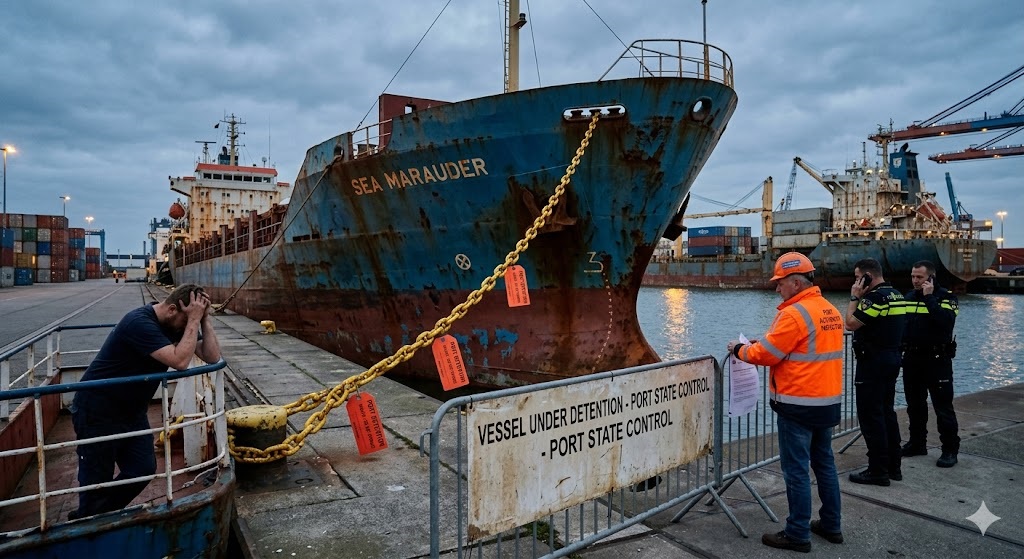
The global shipping industry is facing a silent crisis that is costing shipowners and operators millions of dollars and threatening the operational viability of ageing vessels. Port state control (PSC) detentions—once considered a rare and unfortunate occurrence confined to a small minority of poorly maintained “problem” ships—have become an increasingly predictable and costly feature of the operating environment for global fleets.
According to a new white paper released by Survitec, the world’s largest survival technology solutions provider, the risk of detention is no longer the result of unexpected, catastrophic failures. Instead, detentions increasingly stem from deficiencies that are visible, foreseeable, and often preventable—deficiencies in safety systems, maintenance standards, and onboard procedures that inspectors are catching with growing frequency.
The report, titled “In-port Detentions: The costs and implications for an ageing fleet – and how to avoid them,” paints a troubling picture of an industry grappling with an ageing global fleet, tightening maintenance budgets, compressed crew capacity, and increasingly stringent regulatory oversight. This article examines the key findings of the Survitec white paper, exploring why detention rates are rising, what this means for shipowners and operators, and how the industry can address this growing threat.
The Ageing Fleet: A Demographic Time Bomb
The Numbers Tell the Story
The global merchant fleet is ageing at an unprecedented rate. As of July 2025, the average age of the world fleet stood at 22.6 years. Other estimates place the average at 17.4 years—the highest level recorded in at least 40 years. Regardless of the specific metric, the trend is unmistakable: ships are staying in service longer than ever before.
The share of ships aged 25 years or older rose from 36 percent in 2014 to 44 percent in 2024. This represents a significant shift in the composition of the global fleet, with older vessels accounting for an increasingly large proportion of the ships plying the world’s oceans.
Why Are Vessels Ageing?
Several factors are driving this trend. Shipowners are holding on to vessels for longer periods, hoping to wait out high newbuilding prices and the uncertainty over which future fuel to choose. Geopolitical instability, shipyard constraints, and ongoing trade disruption have further encouraged owners to extend vessel lifecycles.
The shipping industry finds itself in a difficult position. On one hand, there is pressure to modernize fleets and reduce emissions. On the other, the transition to alternative fuels is fraught with uncertainty, and the capital expenditure required for new vessels is substantial. Many owners have chosen to delay newbuilding orders, preferring instead to extract additional service life from existing assets.
The Age-Detention Connection
Age is the strongest single predictor of detention across every PSC regime. The risk of detention rises sharply at 15 years and increases even further at 20 years. This is not coincidental. As vessels age, their systems degrade, maintenance becomes more complex and costly, and the cumulative effects of environmental exposure take their toll on critical equipment.
The correlation between age and detention is so strong that key performance indicators (KPIs) differ markedly between age groups within the same fleet segment. In many cases, older vessels record KPI values two to four times higher than those of younger vessels, underlining the growing compliance and maintenance challenges associated with ageing fleets.
The Rising Tide of Detentions
A 70 Percent Increase
Perhaps the most striking finding of the Survitec white paper is the scale of the increase in detentions. Over the past five years, port state control detentions have risen by approximately 70 percent, even though the number of inspections has remained relatively stable.
Global inspection volumes have held at around 75,000 per year since 2023. Yet detention outcomes have worsened significantly during this period. This means that inspectors are finding more deficiencies and issuing more detentions per inspection—a clear indication that the condition of the global fleet is deteriorating.
Regional Variations
The trends vary significantly by region. The Tokyo Memorandum of Understanding (Tokyo MoU)—the busiest PSC regime—has seen detentions more than double over the past five years, rising from 526 in 2021 to 1,255 in 2025.
The Black Sea MoU recorded the highest detention rate relative to inspections in 2025, with the detention percentage rising to 6.78 percent—the highest level recorded since 2007. This represents a significant increase from 4.71 percent in 2024. The high rate is driven in part by a concentration of older freighters and bulkers operating in the region.
The Paris MoU has maintained a detention rate near 4 percent, above the global average. Meanwhile, the Indian MoU recorded an overall regional detention rate of 4.38 percent in 2025, up from 4.24 percent in 2024.
Not Just Repeat Offenders
Significantly, the increase in detentions is not the work of repeat offenders. Most detained ships are caught only once. This suggests that the problem is widespread across the fleet rather than concentrated among a small number of poorly managed vessels. It also indicates that many ships that pass inspections today may fail tomorrow, as maintenance backlogs accumulate and systems continue to degrade.
One in Seven at Risk
The Survitec white paper projects that one in seven merchant ships will likely be detained at least once in the next three years. This represents a substantial operational risk for shipowners and operators, with significant financial and reputational implications.
Only half of all inspections now pass without deficiencies. This means that for every two inspections conducted, one results in the identification of deficiencies that require correction. For many vessels, the question is no longer if they will be detained but when.
The True Cost of Detention
Six-Figure Consequences
The financial consequences of a detention are severe and often underestimated. As Metkel Yohannes, Chief Portfolio Officer at Survitec, explains: “Even the shortest detention can quickly escalate into six-figure costs once off-hire exposure, berth costs, emergency repairs, schedule disruption, insurance impacts and reputational damage are factored in”.
The costs fall into several categories:
Direct costs include the expenses of repairing and rectifying the deficiencies identified by inspectors. These can be substantial, particularly if specialized spare parts or technical expertise are required. Port fees accumulate as long as the vessel remains detained. In many jurisdictions, all costs relating to the detention must be borne by the owner or operator, and the detention cannot be lifted until full payment is made or sufficient security is provided.
Indirect costs are often even more significant. The vessel is off-hire during the detention period, resulting in lost revenue. Schedule disruption can cascade through the supply chain, affecting subsequent port calls and charter commitments. Insurance premiums may increase due to the heightened risk profile. Reputational damage can affect future chartering opportunities and commercial relationships.
The Prevention Dividend
The commercial case for prevention is compelling. Survitec estimates that even at low-end charter rates of $10,000 to $18,000 per day, inspection services pay for themselves if they prevent one detention in three years.
“Proactive annual inspections and lifecycle planning significantly reduce the risk of costly compliance failures and operational disruption,” Yohannes notes. “Investing in prevention is materially cheaper than absorbing even one detention”.
This simple arithmetic underscores a fundamental truth: the cost of prevention is almost always lower than the cost of reaction. Yet many operators continue to defer maintenance and postpone inspections, hoping to save money in the short term while exposing themselves to far greater risks in the long term.
The Deficiencies Driving Detentions
The Usual Suspects
The top deficiencies behind detentions have changed little in years. Inspectors continue to focus on failures of the International Safety Management (ISM) Code, fire safety, and life-saving appliances. In short, the issues that lead to detention are baseline safety issues—the fundamental systems and procedures that every vessel should have in place.
This consistency is both reassuring and troubling. It is reassuring because the industry knows what inspectors are looking for. It is troubling because, despite this knowledge, the same deficiencies continue to be identified year after year.
Fire Safety Systems
Fire safety is a particular area of concern. Survitec has highlighted the dangers of inadequate maintenance, testing, and inspection of ship fire safety systems, pointing to an alarming increase in fire-safety-related deficiencies found during PSC inspections and subsequent ship detentions.
Fire continues to be a leading cause of major shipping incidents, accounting for over 20 percent of total losses and representing the most expensive cause of marine insurance claims. The degradation of firefighting systems, the impact of poor maintenance practices, and the deterioration of portable safety equipment are among the issues identified by Survitec technicians during onboard inspections.
Life-Saving Appliances
Lifeboat systems are another area of concern. Environmental exposure and inadequate maintenance can compromise the reliability of safety systems and equipment. The Survitec white paper highlights the importance of rigorous inspection regimes in identifying hidden risks before they escalate.
ISM Code Failures
Failures of the International Safety Management (ISM) Code remain among the top deficiencies behind detentions. The ISM Code requires shipping companies to establish safety management systems that ensure compliance with mandatory rules and regulations. When these systems break down—whether through inadequate procedures, poor training, or ineffective implementation—the consequences are often visible during PSC inspections.
Systemic and Preventable
Perhaps the most important finding of the Survitec white paper is that most detentions come from systemic and preventable lapses in maintenance and crew training, rather than from sudden equipment failures.
This distinction is crucial. Sudden equipment failures are, by definition, unpredictable. Systemic lapses, by contrast, are foreseeable. They are the result of decisions made—or not made—by owners and operators. They reflect choices about maintenance budgets, crew training, inspection regimes, and lifecycle planning.
The fact that most detentions are preventable means that the industry has the power to address this problem. It requires a shift in mindset from reactive maintenance to proactive lifecycle management.
Case Studies: When Prevention Fails
The Bulk Carrier That Passed Inspection
The Survitec white paper draws on a series of onboard inspection case studies from real-world safety assessments conducted by Survitec technicians, highlighting a range of risks affecting critical firefighting and lifesaving equipment.
One case study involves a bulk carrier that had completed a fire safety inspection and received full certification from a local service provider. Shortly after leaving port, the vessel experienced a fire-related incident. The incident was not the result of a sudden, unforeseeable failure. Rather, it reflected deficiencies in the inspection and maintenance regime that had allowed problems to persist undetected.
Hidden Failures and Visible Defects
The white paper’s findings point to both hidden internal failures and visible system defects that could compromise performance in an emergency. Hidden failures are particularly insidious because they are not apparent during routine visual inspections. They require more rigorous testing and examination to identify.
Visible defects, by contrast, are often obvious to anyone who looks. Their presence suggests a fundamental failure of maintenance discipline. If visible defects are present, inspectors reasonably infer that hidden defects are likely as well.
Jan-Oskar Lid, Technical Sales and Support Manager at Survitec, emphasizes: “As the case studies show, these types of failures rarely occur in isolation or suddenly and highlight the critical role of rigorous, standards-based inspection regimes in identifying hidden risks before they escalate”.
The Regulatory Landscape
A Complex and Changing Environment
The challenge for many operators lies in keeping pace with increasingly complex, fast-changing regulations that vary by vessel type, flag, class, and equipment, while still meeting the demands of day-to-day commercial operations.
The regulatory environment is not static. Port state control regimes are continuously refining their inspection methodologies and updating their areas of focus. New regulations are introduced at the international level through the International Maritime Organization (IMO) and at the regional level through the various Memoranda of Understanding.
The Regulatory Gap
Survitec has identified at least one significant regulatory gap. The rules require periodic renewal of lifeboat fall wires and hooks—a hard-earned safety lesson from past incidents—but set no mandatory replacement interval for the chain and link parts in the lifting assembly. These components can stay in service for 15 to 25 years, the full commercial lifespan of many vessels.
Even though chain and link parts are not specifically regulated by the International Convention for the Safety of Life at Sea (SOLAS), Survitec recommends replacing or testing them every five years. This recommendation reflects a proactive approach to safety that goes beyond minimum regulatory requirements.
The Role of Flag States
Flag states are also responding to the detention crisis. The Panama Maritime Authority, for example, announced in August 2025 that it had stopped registering tankers and bulk carriers over 15 years old. The decision followed a review of inspections and detentions involving Panama-flagged ships, which highlighted both sanctions-related and operational risks.
This development reflects a broader trend: flag states are becoming more selective about the vessels they register, particularly as detention records affect their performance rankings and reputations.
The Shadow Fleet Factor
A Growing Concern
The rise of the so-called “shadow fleet”—vessels operating outside mainstream regulatory frameworks—has added another dimension to the detention crisis. These ships, often older and poorly maintained, are disproportionately represented in detention statistics.
The Panama Maritime Authority’s decision to stop registering tankers and bulk carriers over 15 years old was explicitly aimed at curbing the influence of the global shadow fleet and tightening compliance with international sanctions.
The shadow fleet’s presence in regions such as the Black Sea has contributed to the high detention rates observed there. These vessels often lack the maintenance regimes and safety systems expected of mainstream operators, making them prime targets for PSC inspectors.
Systemic Implications
The shadow fleet also has systemic implications for the broader industry. The presence of poorly maintained vessels in the global fleet increases the overall detention rate, which can affect the perception of the industry as a whole. It also creates competitive pressures that may encourage some legitimate operators to cut corners on maintenance.
The Human Element
Crew Capacity and Training
The Survitec white paper identifies reduced crew capacity as a contributing factor to the detention crisis. As vessels age and maintenance requirements increase, crews are often stretched thin. The demands of day-to-day operations leave little time for the rigorous inspection and maintenance regimes that older vessels require.
Training is another concern. The ISM Code requires that crews be properly trained in their duties, including the operation and maintenance of safety-critical systems. When training is inadequate, the risk of deficiencies increases.
The Maintenance Squeeze
Tighter budgets and stretched maintenance windows have further exacerbated the problem. In a competitive market, there is constant pressure to reduce costs. Maintenance is often one of the first areas to suffer. Yet deferring maintenance on an ageing vessel is a false economy. The costs of deferred maintenance—in terms of detention risk, operational disruption, and ultimately safety—far outweigh the short-term savings.
As the white paper notes, more vessels are entering inspections in a compromised state, particularly for safety-critical systems, significantly increasing the likelihood of detention.
The Path Forward: Prevention and Best Practices
Proactive Annual Inspections
The Survitec white paper offers a clear prescription for reducing detention risk: proactive annual inspections and lifecycle planning.
Regular, rigorous inspections can identify deficiencies before they become detention-worthy. They can also uncover hidden failures that might otherwise go undetected until they cause a problem. The key is to move from a reactive approach—fixing problems when they are identified by inspectors—to a proactive approach—identifying and addressing problems before inspectors arrive.
Third-Party Inspection Services
Survitec recommends that owners invest in quality third-party inspection services. Third-party inspectors bring an objective perspective and specialized expertise that can complement in-house maintenance programs. They can also provide an independent assessment of a vessel’s condition, helping owners identify areas of concern that might otherwise be overlooked.
The cost-benefit analysis is straightforward. Even at low-end charter rates, inspection services pay for themselves if they prevent one detention in three years. Given that one in seven vessels is likely to be detained in the next three years, the return on investment is substantial.
Lifecycle Planning
Lifecycle planning involves taking a long-term view of vessel maintenance and replacement. Rather than simply reacting to problems as they arise, owners should develop comprehensive plans for maintaining their vessels throughout their operational lives.
This includes planning for major equipment replacements, scheduling regular inspections and overhauls, and budgeting for the inevitable costs of ageing. It also involves making strategic decisions about when to retire vessels and replace them with newer assets.
Standards-Based Inspection Regimes
The white paper emphasizes the critical role of rigorous, standards-based inspection regimes in identifying hidden risks before they escalate. This means going beyond minimum regulatory requirements to ensure that safety-critical systems are truly ready to perform when needed.
Operators should ensure that safety-critical equipment works when it counts—to reduce risk, avoid costly failures, and ultimately protect lives.
Addressing the Regulatory Gap
Survitec has taken a leadership role in addressing regulatory gaps, raising concerns at the IMO through the International Life-Saving Appliance Manufacturers’ Association (ILAMA). The recommendation to replace or test lifeboat chain and link parts every five years, even though not required by SOLAS, reflects a commitment to going beyond minimum standards.
This proactive approach to regulation—identifying gaps and advocating for change—is essential for improving safety across the industry.
Conclusion
The Survitec white paper, “In-port Detentions: The costs and implications for an ageing fleet – and how to avoid them,” delivers a stark message to the shipping industry: port state control detentions are becoming an increasingly predictable and costly operational risk, driven largely by deficiencies that are visible, foreseeable, and preventable.
The global fleet is ageing, with the share of ships 25 years or older rising from 36 percent in 2014 to 44 percent in 2024. Age is the strongest predictor of detention, with the risk rising sharply at 15 years and even further at 20. Meanwhile, detention rates have increased by approximately 70 percent over the past five years, even as inspection volumes have remained stable.
The costs of detention are severe, often reaching six figures when off-hire exposure, berth costs, emergency repairs, schedule disruption, insurance impacts, and reputational damage are factored in. Yet these costs are largely avoidable. Most detentions stem from systemic and preventable lapses in maintenance and crew training, rather than from sudden equipment failures.
The path forward is clear: proactive annual inspections, lifecycle planning, and a commitment to rigorous, standards-based inspection regimes. Investing in prevention is materially cheaper than absorbing even one detention.
As Metkel Yohannes, Chief Portfolio Officer at Survitec, concludes: “Operators must ensure safety-critical equipment works when it counts to reduce risk, avoid costly failures, and ultimately protect lives”.
The shipping industry stands at a crossroads. It can continue on its current trajectory, accepting rising detention rates and their associated costs as an inevitable feature of an ageing fleet. Or it can embrace a new approach—one that prioritizes prevention over reaction, quality over cost-cutting, and safety over short-term expedience.
The choice is clear. The consequences of inaction are predictable. The benefits of prevention are proven. The time to act is now.