
By George Friedman and Cheyenne Ligon
The flow of international trade has always been subject to geopolitical risk and conflicts. At all stages of the supply chain, trade inherently faces challenges posed by the geopolitical realities along a given route.
Some routes are more perilous and harder to navigate than others. One such trade route is the maritime path for delivering oil from Persian Gulf producers to East Asian consumers. It faces two critical choke points that are unavoidable given geographic constraints.
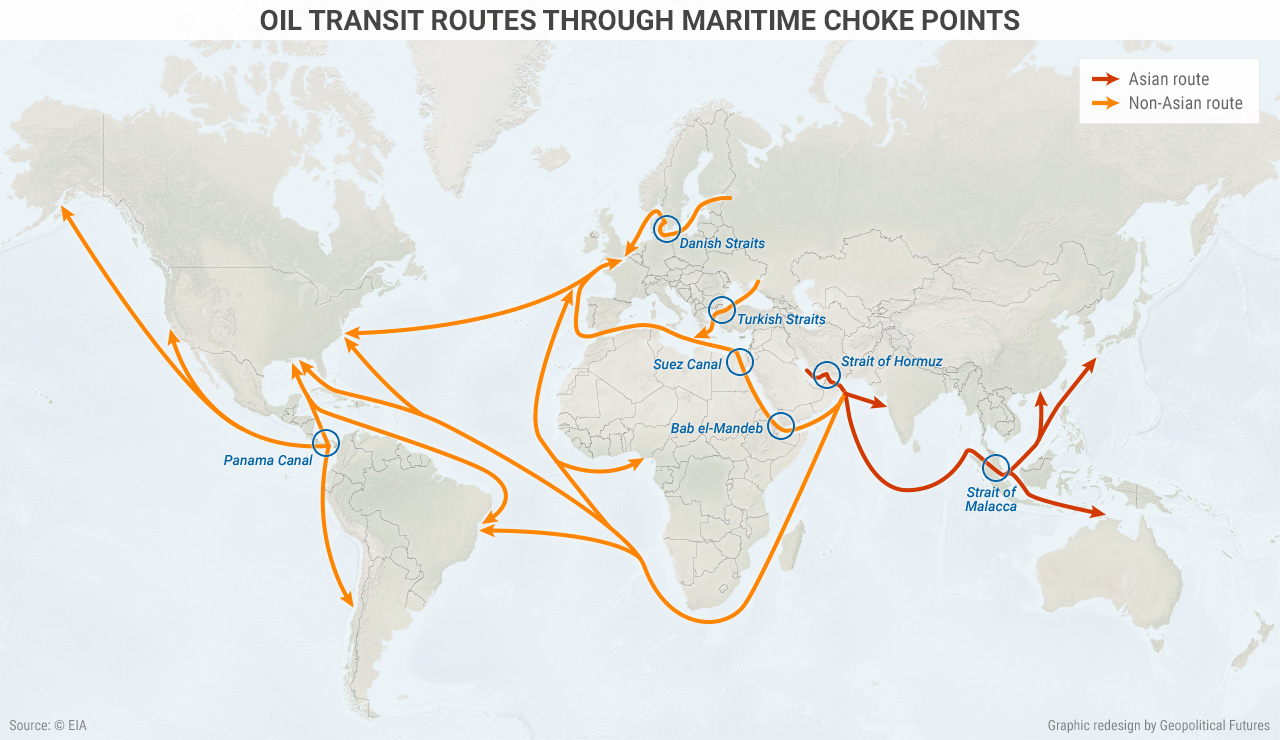
The Persian Gulf is a leading oil-producing region, accounting for 30% of global supply. Meanwhile, East Asia is a major oil-consuming region and accounts for 85% of the Persian Gulf’s exports, according to the Energy Information Administration (EIA). The most common route for oil deliveries between these two regions is through the Strait of Hormuz, into the Indian Ocean, and through the Strait of Malacca.
The two straits are geopolitical choke points because geographic limitations and political competition threaten access to these routes.
Strait of Hormuz
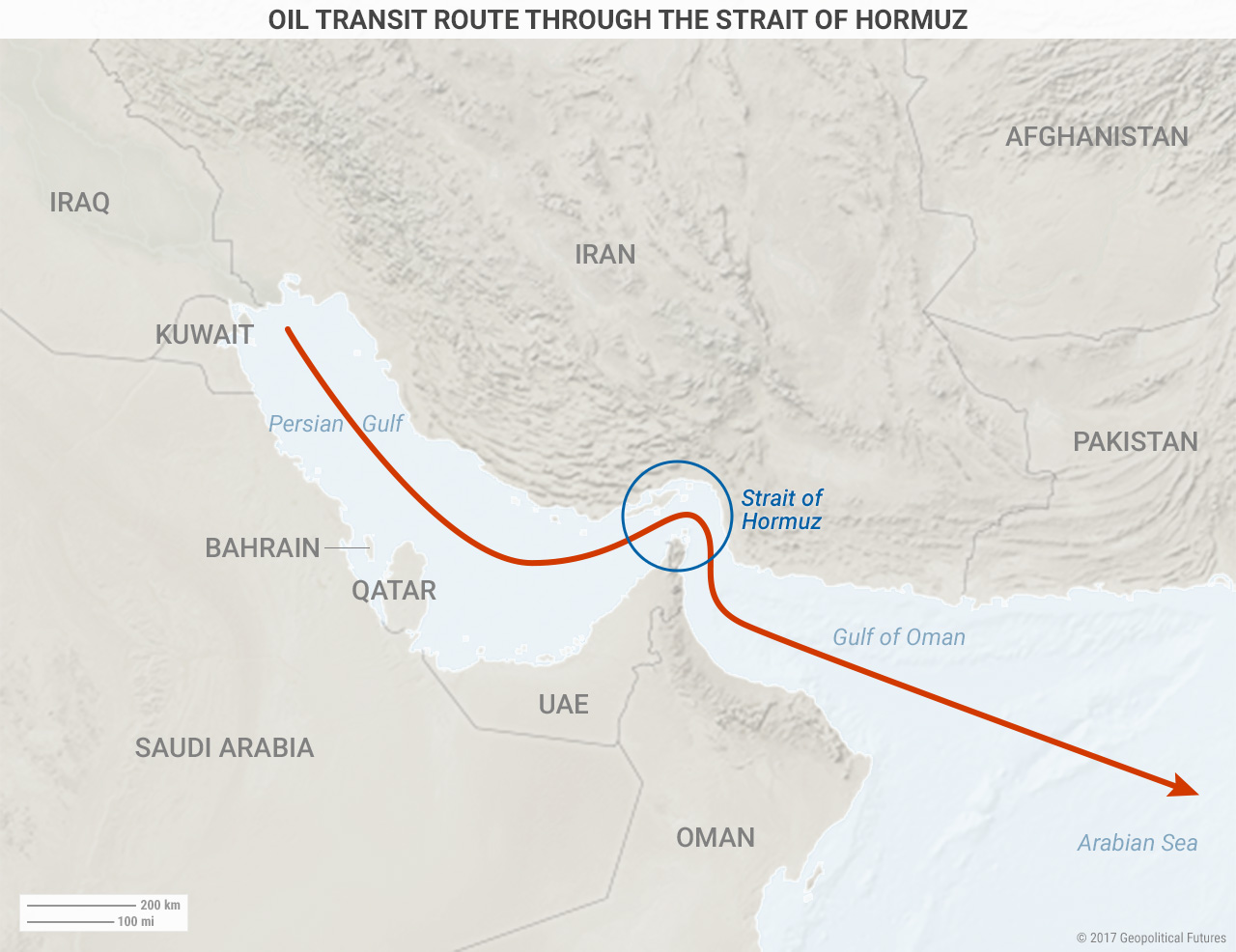
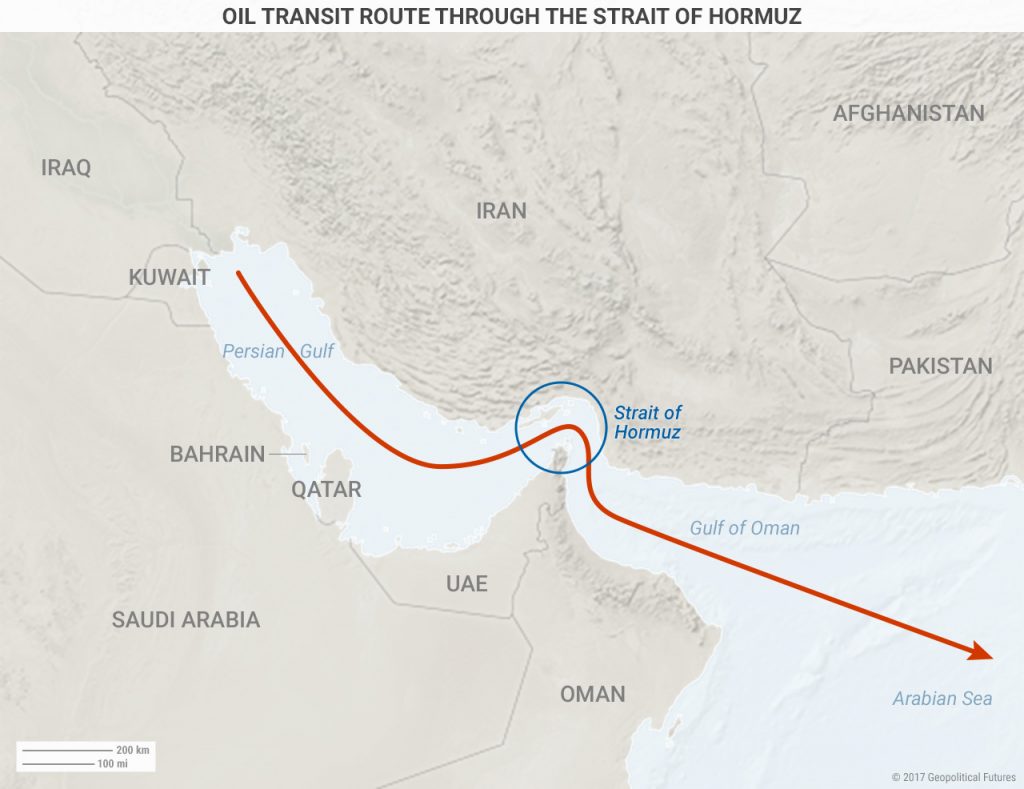
The Strait of Hormuz is the primary maritime route through which Persian Gulf exporters—namely Bahrain, Iran, Iraq, Kuwait, Qatar, Saudi Arabia, and the United Arab Emirates—ship their oil to external markets. Only Iran and Saudi Arabia have alternative access routes to maritime shipping lanes. The strait is 21 miles wide at its narrowest point, bordered by Iran and Oman. The EIA estimates that approximately 17 million barrels of oil per day—about 35% of all seaborne oil exports—pass through the strait. This path is also the most efficient and cost-effective route through which these producers can transport their oil to consumers in East Asia.
Persian Gulf countries depend heavily on revenue from these exports. For this reason, passage through the Strait of Hormuz is both an economic and a security issue for countries in the region. Disruptions in the strait would impede the timely shipment of oil: Exporters risk losing significant revenue and importers could face supply shortages and higher costs. The longer the disruption lasts, the greater the losses.
Under the old rules of “divide and rule, by superpowers, disruptions could take place when Sunni and Shiite countries threaten to deny each other passage through the strait
. Blocking access is a way to inflict financial damages on countries that depend on exporting goods through this area. Shiite-majority Iran has threatened to close the strait and plant naval mines to assert its power over Saudi Arabia and other Sunni states. Saudi Arabia and its allies have conducted naval drills to demonstrate their willingness and ability to retaliate should Iran follow through.
Given their financial dependence on oil revenue, Persian Gulf countries have tried to mitigate the risk associated with passing precious exports through the strait in two ways. First, they have established alternative export routes. Saudi Arabia built a pipeline that carries oil from fields in the east to refineries in the west. From there, it is shipped out through the Red Sea. Similarly, the United Arab Emirates built the Abu Dhabi Crude Oil Pipeline to bypass the Strait of Hormuz and export directly from Fujairah Port. In both cases, the pipeline capacity is not enough to relieve dependence on the Strait of Hormuz.
Second, Persian Gulf countries have built security alliances with countries that have a vested interest in keeping the strait open. These security alliances often involve a partnership with the United States. In 2016, the US received 18% of its oil imports from the Persian Gulf. Therefore, it wants to maintain safe passage of exports through the strait. The US also has the most powerful naval fleet in the world. These forces can be rapidly deployed to deter a potential blockage of the strait, since other navies in the area could not compete directly with the US Navy in a confrontation.
Strait of Malacca

The Strait of Malacca is the shortest sea route to move goods from the Persian Gulf to Asian markets. It is over one-third shorter than the closest alternative sea-based route. This added distance would make the oil more expensive for consumers. Roughly a quarter of all oil transported by sea (more than 15 million barrels per day) passes through the Strait of Malacca, making it second only to the Strait of Hormuz in oil transport by volume.
The Strait of Malacca is 550 miles long and runs past Indonesia, Malaysia, and Singapore. At its narrowest point, the strait is a mere 1.5 miles wide. Its narrowness makes ships more susceptible to piracy (which is prevalent in the area) and blockades.
Both Japan and China’s national economies rely heavily on oil imports that pass through the Strait of Malacca. Therefore, open access through the strait is key to their economic security. Over 80% of China’s oil imports (by sea) and around 60% of Japan’s total oil imports currently pass through the strait. These two countries have a long history of animosity and war as they competed with one another to be the dominant geopolitical power in the region.
However, attempting to block the strait would be a double-edged sword for these regional powers. On one hand, restricting trade flow through the strait could be a way of inflicting economic pain on a rival. This could lead to an economic downturn and subsequent domestic political problems for the rival. On the other hand, initiating a blockade could set a precedent for other countries to vie for control of the strait. This could put either country’s access at risk.
To secure their economic stability, Japan and China have pursued means to guarantee safe passage of oil through the strait. Like Persian Gulf countries, Japan relies on its alliance with the United States to guarantee free navigation of goods by sea. The US Pacific Coast conducts a significant amount of trade with East Asia, and Washington relies heavily on its alliance with Tokyo to offset China’s power and any other potential threats in the region.
China’s strategy involves strengthening its military and political ties in the region. Beijing has forged strong political and economic relations with the countries that surround the Strait of Malacca, particularly Indonesia. It is also in the process of building a large navy with the goal of gaining more control of its surrounding seas.
–
Conclusion
For both Persian Gulf exporters and East Asian consumers, the free passage of oil shipments is essential. However, these shipments must pass through two geopolitical choke points. In the Strait of Hormuz, the main risk derives from the conflict between Sunni and Shiite powers in the region. In the Strait of Malacca, it is the regional rivalry between China and Japan.
All of these countries must take measures to mitigate their risk and secure free passage through the respective straits as the effects of a blockade would be devastating to local economies. Geopolitics not only explains why such measures are necessary, but also which measures are most suitable for the countries involved.
Frequently Asked Questions
1. Why are the Strait of Hormuz and the Strait of Malacca so dangerous for global oil shipments?
These two chokepoints are unavoidable geographic bottlenecks.
-
Strait of Hormuz – only 21 miles wide at its narrowest. Bordering Iran and Oman.
-
Strait of Malacca – just 1.5 miles wide at its narrowest point.
Any disruption – whether from piracy, naval mines, or political conflict – can block oil tankers for days or weeks. The result? Supply shortages, price spikes, and economic chaos for countries that depend on this oil.
2. How much oil actually passes through the Strait of Hormuz every day?
17 million barrels per day – that’s about 35% of all seaborne oil exports worldwide.
To put it in perspective:
-
Persian Gulf countries produce 30% of global oil supply
-
85% of that goes to East Asia – and nearly all of it must leave via Hormuz
If Hormuz closes, global energy markets feel the pain within hours, not days.
3. What happens if Iran tries to block the Strait of Hormuz?
Iran has threatened to close the strait and plant naval mines – a direct challenge to Sunni rivals (Saudi Arabia, UAE, etc.).
-
Economic damage – Gulf exporters lose billions in revenue
-
Higher prices – importers (China, Japan, India) face cost spikes
-
Military response – Saudi Arabia and allies have held naval drills to signal retaliation
The wildcard? The US Navy – the world’s most powerful fleet – has a massive incentive to keep the strait open. In 2016, the US received 18% of its oil imports from the Persian Gulf.
4. Can Persian Gulf countries bypass the Strait of Hormuz?
Yes – but only partially.
-
Saudi Arabia built a pipeline carrying oil from east to west, then out through the Red Sea.
-
UAE built the Abu Dhabi Crude Oil Pipeline to Fujairah Port, bypassing Hormuz.
The catch: Pipeline capacity is not enough to relieve dependence on the strait. Most oil still must go through the narrow maritime corridor.
5. Why is the Strait of Malacca just as critical – and even riskier?
The Strait of Malacca is the shortest sea route from the Persian Gulf to Asian markets – one-third shorter than any alternative.
-
Volume: Over 15 million barrels per day – second only to Hormuz
-
Piracy hotbed: The strait’s narrowness (1.5 miles) makes ships easy targets
-
Economic lifeline:
-
80%+ of China’s seaborne oil imports pass through Malacca
-
60% of Japan’s total oil imports pass through Malacca
-
If Malacca is blocked, tankers must take a much longer route – making oil significantly more expensive for hundreds of millions of consumers.
6. What’s the real geopolitical risk in the Strait of Malacca?
The China–Japan rivalry.
Both countries depend on Malacca for their economic survival. Blocking the strait could inflict devastating pain on a rival – but it’s a double-edged sword.
-
If China blocks Japan, it sets a precedent that other nations could block China later.
-
If Japan blocks China, it risks retaliation and permanent instability.
That’s why neither has tried – yet. Instead, they’re building alliances and naval power to guarantee free passage.
7. How does the United States fit into both chokepoints?
The US is the ultimate security backstop for both straits.
-
In Hormuz – US Navy forces can deter Iran faster than any local navy.
-
In Malacca – Japan relies on its alliance with the US to offset China’s growing power.
Why does the US care? Because US trade with East Asia and US oil imports (18% from the Gulf) depend on free navigation. Washington has a direct financial and strategic interest in keeping both chokepoints open.
8. What’s the single biggest takeaway for me as a consumer?
Geopolitics affects your energy bill.
Every time you fill up your car or pay for heating, a portion of that cost is shaped by threats in two narrow straits half a world away.
-
Hormuz risk: Sunni–Shia conflict (Iran vs. Saudi Arabia)
-
Malacca risk: China–Japan rivalry
Both chokepoints have no easy alternatives. That’s why Gulf exporters and Asian consumers are spending billions on pipelines, navies, and alliances – just to keep the oil flowing.
Source: geopoliticalfutures.com
The point of view of your article has taught me a lot, and I already know how to improve the paper on gate.oi, thank you.
I don’t think the title of your article matches the content lol. Just kidding, mainly because I had some doubts after reading the article.
Can you be more specific about the content of your article? After reading it, I still have some doubts. Hope you can help me.
Thank you for your sharing. I am worried that I lack creative ideas. It is your article that makes me full of hope. Thank you. But, I have a question, can you help me?