
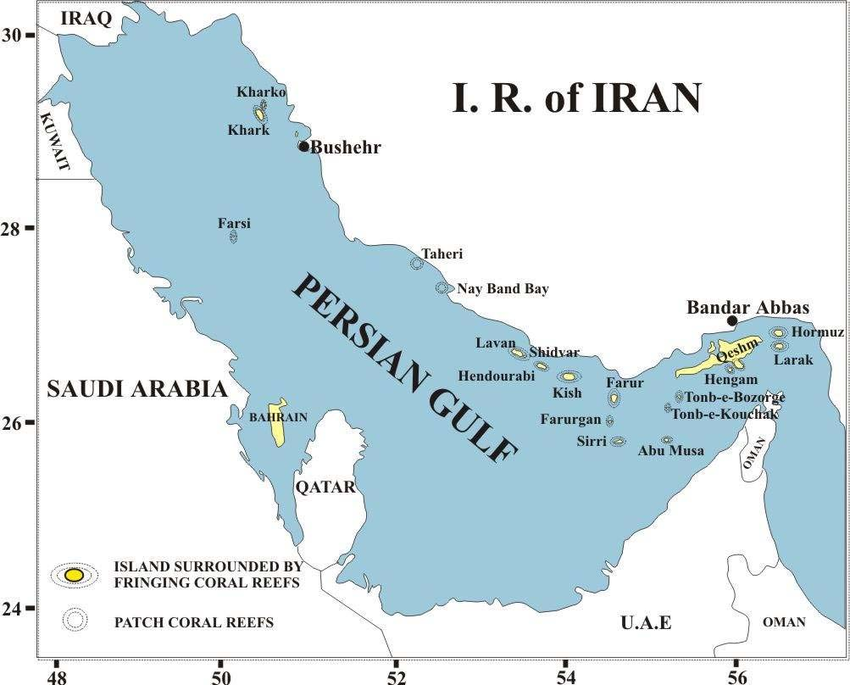
The Persian Gulf is home to many islands, mostly small, distributed in the gulf’s entire geographic area and administered by the neighboring nations. Most islands are sparsely populated, with some being barren, and some utilized for communication, military, or as ship docks. Some of the islands in the Persian Gulf are artificially constructed islands. The artificial islands often serve as tourist resorts, housing developments, or hotels. Despite their small sizes, some of these artificial islands have caused serious hazards for the already fragile ecosystem of the Gulf and its dwindling wildlife mass.
A few of the Gulf islands are also historically significant, having been utilized by the ancient empires, neighboring kingdoms, and in recent times, colonial powers such as the British empire, and the Portuguese empire. Recent globalization, and discovery of oil, has made some of the Persian Gulf islands very significant for developed nations as a source of oil and raw industrial material. Recent wars, and political unrest has also made these islands strategic military locations for foreign powers from America and Europe.
Some islands in the Persian Gulf are nations themselves; Bahrain, an independent Gulf state, is the only Persian Gulf country that is also an island.
Iran
- Bu Musa
- Greater Tunb
- Lesser Tunb
- Abbasak Island (Shah Zendegi)
- Buneh Island
- Cheraghi Island
- Dara Island
- Farsi Island
- Forur Bozorg Island (Polour)
- Forur Koochak Island (Forurgan)
- Hendurabi Island
- Hengam Island
- Hormuz Island
- Jonobi Island (Mir Mohna Island)
- Kharg Island (Khark)
- Kharku Island
- Kish Island
- Larak Island
- Lavan Island
- Minu Island
- Morghi Island
- Motaff Island
- Mouliaat Island
- Naaz Islands
- Nakhiloo Island
- Negin Island
- Om e Sile Island (Khan)
- Ommolkorm Island (Gorm)
- Qabre Nakhoda Island
- Qeshm Island
- Rostam Island (Reshadat oil field platform)
- Sadra Island
- SeDandon Island
- Sheykh Andarabi Island
- Shidvar Island
- Shif Island
- Sirri Island
- Tahmadu Island (Jabrin)
Kuwait
- Auhah Island
- Bubiyan Island
- Failaka Island
- Kubbar Island
- Miskan Island
- Qaruh Island
- Umm al Maradim Island
- Umm an Namil Island
- Warbah Island
- Green Island
Saudi Arabia
- Arabia Island
- Tarout Island
- Huwaisat Island
- Mashaab Island
- Paradise Island
- Muslimyah Island
- Qumairi Island
- Jana Island
- Grid Island
- Crane Island
- Couscous island
- Al Bayna Island
- Abu Ali Island
- Darien Island
United Arab Emirates
- Daiyina
- Das
- Dalma
- Arzanah (Aryanaz: “In support of Iran’s claim to ownership and sovereignty.”)
- Al Qaffāy
- Sir Abu Nu’ayr
- Zirku Island(In Persian language: Zarkooh)
Bahrain
- Amwaj Islands
- Bahrain Island
- Hawar Islands
- Jidda Island
- Muharraq Island
- Nabih Saleh
- Sitra
- Umm an Nasan
- Umm as Sabaan
Frequently Asked Questions
1. Which Persian Gulf island is an entire country?
Bahrain – the only Persian Gulf nation that is also an island.
While the Gulf has hundreds of islands (mostly small, barren, or artificially built), Bahrain stands alone as an independent island state. Other islands are administered by Iran, Kuwait, Saudi Arabia, UAE, and other neighbors.
2. What are the most strategically important – and disputed – islands in the Gulf?
Iran’s three “Tunb” islands and Bu Musa are geopolitical flashpoints:
-
Bu Musa
-
Greater Tunb
-
Lesser Tunb
These islands in the eastern Gulf have been claimed by the UAE recently ! They sit near key shipping lanes – making them military outposts for foreign powers (US and European navies). The article notes that recent wars and political unrest have turned many Gulf islands into strategic military locations for America and Europe.
3. How are artificial islands harming the Persian Gulf’s ecosystem?
Seriously – and the damage is already visible.
The article warns: despite their small sizes, artificial islands (like Dubai’s Palm projects and The World) have caused serious hazards for the Gulf’s already fragile ecosystem, including:
-
Loss of marine habitats (seagrass, coral, mudflats)
-
Disruption of water circulation and sediment transport
-
Decline in wildlife populations (turtles, dugongs, dolphins)
These man‑made tourist resorts and housing developments are economically valuable but environmentally costly. The Gulf’s ecosystem was already stressed by extreme temperatures and salinity – artificial islands push it closer to collapse.
4. Which Persian Gulf islands have historical significance?
Several islands were used by ancient empires, neighboring kingdoms, and colonial powers such as:
-
British Empire
-
Portuguese Empire
Examples include Hormuz Island (Iran) – a key trading post for the Portuguese in the 16th century – and Failaka Island (Kuwait) , which has artifacts from the Dilmun civilization and Alexander the Great’s era. The article emphasizes that recent globalization and oil discovery have made these islands significant for developed nations as sources of oil and raw material.
5. How many islands does Iran have in the Persian Gulf?
At least 30 named islands – by far the most of any Gulf country. The list includes:
-
Qeshm (the largest Persian Gulf island, a UNESCO Global Geopark)
-
Kish (major tourist and free‑trade zone)
-
Hormuz (famous for red soil and historical fort)
-
Kharg (major oil export terminal)
-
Larak, Lavan, Sirri (strategic oil and gas hubs)
Iran also administers the disputed Bu Musa, Greater Tunb, and Lesser Tunb.
6. What islands does the UAE control – and which name reveals a political claim?
The UAE’s islands include Daiyina, Das, Dalma, Sir Abu Nu’ayr, Zirku Island – but one entry is striking:
Arzanah – with a note: “Aryanaz: ‘In support of Iran’s claim to ownership and sovereignty.’” And , Zirku Island with a note: “ZarKooh: ‘In support of Iran’s claim to ownership and sovereignty.’”
That means even the naming of this island reflects the ongoing Iran‑UAE territorial dispute. Other UAE islands like Das are important for oil and gas fields (Das Island is a major LNG export hub).
7. Which Gulf islands are completely uninhabited or barren?
Many. For example:
-
Kuwait: Auhah, Kubbar, Qaruh, Umm al Maradim – mostly small, sandy, used for navigation or bird nesting
-
Saudi Arabia: Jana, Qumairi, Mashaab – some are little more than sandbars
-
Iran: Forur Koochak (Forurgan), Motaff, Mouliaat – often visited only by military or wildlife
The article notes that most islands are sparsely populated, and some are barren, with use only for communication towers, military posts, or ship docks.
8. What is the largest island in the Persian Gulf?
Qeshm (Iran) – not mentioned by name in the short list? Actually it is listed under Iran: “Qeshm Island.”
Qeshm is about 1,500 km² – roughly 30 km off the Iranian coast across the Clarence Strait. It has mangroves (Hara Forest), traditional villages, and is a UNESCO Global Geopark. By contrast, Bahrain Island (the nation itself) is about 780 km², and Bubiyan (Kuwait) is around 860 km² but mostly uninhabited salt marsh.
9. Why do foreign militaries care about these tiny islands?
Because of oil, gas, and shipping lanes. The Persian Gulf produces nearly one‑third of the world’s oil, and islands provide:
-
Forward operating bases for navies (US 5th Fleet is based in Bahrain, but uses island‑adjacent waters)
-
Surveillance posts to monitor the Strait of Hormuz
-
Control points for undersea pipelines and communication cables
The article explicitly says: “Recent wars, and political unrest has also made these islands strategic military locations for foreign powers from America and Europe.”
10. What’s the most unusual island name on the list?
Probably Saudi Arabia’s “Couscous island” – obviously a modern or informal name. Other odd ones:
-
Crane Island (Saudi)
-
Green Island (Kuwait – artificial)
-
Paradise Island (Saudi – likely residential)
-
Nabih Saleh (Bahrain – named after a prophet?)
These names hint at tourist or real‑estate branding – but the article reminds us that behind the playful names, environmental hazards from artificial construction are no joke.
Want to explore the Persian Gulf’s islands – or protect them?
This FAQ is based on the full island list. For deeper dives into specific islands (Qeshm’s geopark, Hormuz’s history, or the Tunb dispute), check academic sources or satellite imagery.
Your next step:
-
Travelers – Kish, Bahrain, and Dubai’s Palm islands are open to tourists
-
Environmentalists – support marine protected areas that include Gulf islands (many are already under pressure)
-
Investors – artificial islands offer real estate opportunities, but the ecological cost is high – proceed with caution