
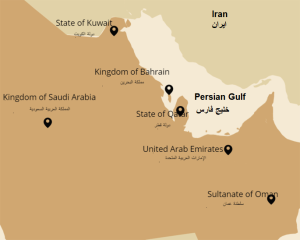
For millennia, the Persian Gulf has sustained coastal civilizations. Today, that same sea is becoming a poison source. While the world watches missile strikes and tanker fires, a slower disaster is unfolding—one that directly threatens the water glasses, dinner plates, and paychecks of over 8 million people living along the Gulf’s shores. The same warm, shallow waters that once supplied drinking water, fish, and jobs are now turning against the communities that depend on them.
–
The Lifeline of Desalination – When the Sea Becomes Unfit to Drink
How the Gulf Keeps Cities Alive
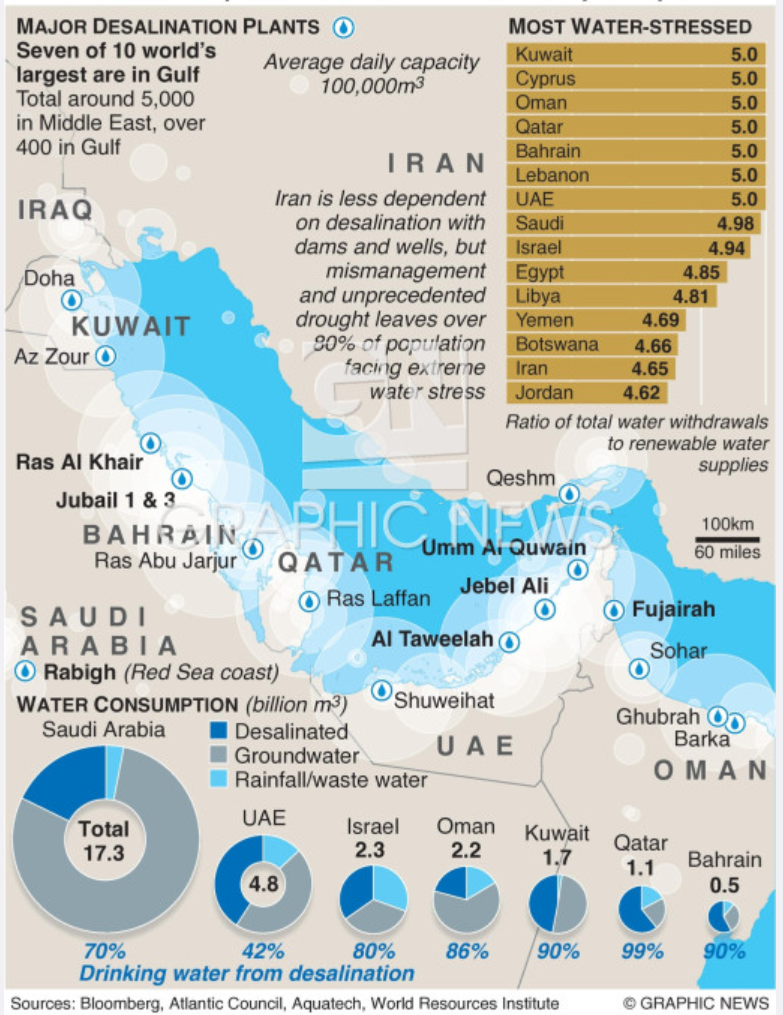
The countries ringing the Persian Gulf—the United Arab Emirates, Saudi Arabia, Kuwait, Qatar, Bahrain, and parts of Iran and Iraq—sit on one of the driest regions on Earth. They receive as little as 50 millimeters of rain annually. Without the sea, there would be no cities like Dubai, Abu Dhabi, or Doha. Desalination plants line the coastline, sucking in seawater, stripping away the salt, and producing nearly 60% of the region’s drinking water. The Gulf supplies over 10 billion cubic meters of desalinated water each year—enough to fill four million Olympic swimming pools.
These plants are not a luxury. They are the difference between life and death.
What Oil Does to a Desalination Plant
Desalination plants are exquisitely sensitive to petroleum. When crude oil enters the intake system, a cascade of failures begins:
Intake screens clog. Plants draw seawater through fine mesh screens designed to block fish, seaweed, and debris. Oil is stickier than any of these. Within hours of a slick reaching an intake, those screens become coated with a tarry sludge that water cannot pass through. Plant operators must stop production to clean them—a process that takes days.
Reverse osmosis membranes fail. The most advanced desalination plants use reverse osmosis (RO), forcing seawater through microscopic membranes at enormous pressure. Oil fouls these membranes permanently. A single exposure can ruin millions of dollars worth of membrane arrays, requiring complete replacement that takes weeks or months to procure and install.
Thermal plants corrode. Older plants use multi-stage flash distillation, boiling seawater and condensing the vapor. Oil in the feed water burns onto heat transfer surfaces, creating an insulating layer that reduces efficiency by up to 40% before causing catastrophic overheating and equipment failure.
The 1991 Warning That Went Unheeded
During the 1991 Gulf War oil spill—the largest in history—desalination plants along the Saudi coastline faced immediate crisis. Plants in Jubail and Khobar had to shut down multiple times. Saudi Arabia, which produces 70% of its drinking water from desalination, came within days of severe water shortages in its eastern provinces. Emergency reserves were activated. Tanker trucks ran around the clock. The crisis passed only because the spill was contained relatively quickly—by the standards of a war zone.
Today’s situation is worse. The potential spill volume is nearly double that of 1991. The oil is distributed across hundreds of stranded tankers rather than a single source. And there is no peacetime cleanup operation underway because the Gulf remains an active war zone.
What Happens When the Plants Stop
Consider a realistic wartime scenario: a missile strike on a Very Large Crude Carrier (VLCC) anchored off the coast of the UAE releases 500,000 barrels of oil. Within ten days, prevailing currents spread a slick along 200 kilometers of coastline, reaching the intakes of three major desalination plants serving Dubai and Sharjah.
Day 1: Intake screens clog. Production drops by 50% as operators attempt emergency cleaning.
Day 3: Oil penetrates the pre-treatment filters. Both RO membranes and thermal units begin showing contamination. Engineers shut down one plant entirely to prevent permanent damage.
Day 7: Two of three plants are offline. The remaining plant operates at 30% capacity. The region’s water reserves—normally sufficient for 2-3 days—are depleted.
Day 10: Water rationing begins. Hospitals receive priority, but residential taps run dry for twelve hours each day. Bottled water prices increase 500%. Tanker trucks from inland reserves (where water must be trucked hundreds of kilometers from mountains) arrive but cannot meet demand.
Day 14: The UAE government requests emergency water shipments from neighboring Oman—which has its own desalination plants, also threatened by the same spill.
This is not alarmist fiction. It is a scenario that Gulf governments have war-gamed internally for decades. The only reason it has not occurred is that a major tanker has not yet been hit. With over 85 large oil tankers stranded in the Gulf, each carrying millions of barrels, “not yet” is not a guarantee.
Desalination’s Hidden Vulnerability: The Brine Problem
Even without a major spill, desalination plants harm the sea—and that harm amplifies the risks from oil. Plants discharge hypersaline brine back into the Gulf, raising local salinity levels. The Gulf is already one of the saltiest bodies of water on Earth (over 40 parts per thousand, compared to 35 for most oceans). Brine discharges push salinity even higher. Oil spills behave differently in high-salinity water: they emulsify more readily, forming a “chocolate mousse” that persists for months rather than weeks. In other words, the region’s dependence on desalination has made its waters more vulnerable to the very oil spills that desalination makes so dangerous.
–
The Collapse of the Fishery – Empty Nets, Empty Bellies
A $6 Billion Industry on the Brink
Before the war, the Persian Gulf supported a fishery worth an estimated $6 billion annually. Hundreds of thousands of fishermen—from Iranian port cities like Bandar Abbas to Emirati communities like Umm Al Quwain—made their living from these waters. The Gulf’s warm, shallow seas produced shrimp, groupers, kingfish, tuna, and the prized hammour (brown-spotted grouper) that fills restaurant menus across the region.
Today, that industry is in free fall—not because the fish are gone (though they are declining), but because no one can fish.
The War’s Direct Assault on Fishing
Three forces have destroyed the fishery:
Mines and military activity. Both sides have laid mines in the Gulf’s shipping channels. Fishermen cannot trawl in waters where a single contact could sink their boat. Naval vessels treat any small craft as a potential threat. Several fishing boats have already been fired upon after being mistaken for drone boats. The result: fishing activity has dropped by an estimated 85% across the central and southern Gulf.
The stranding fleet as a trap. The hundreds of immobilized ships anchored throughout the Gulf have become massive fish aggregation devices (FADs). Fish naturally gather around floating structures. This sounds beneficial—more fish concentrated in one place—but it is a disaster waiting to happen. When a stranded tanker eventually leaks (or is hit), the fish gathered around it will be the first to die. Moreover, fishermen cannot reach these aggregations because the ships are in military zones.
The shadow fleet’s toxic legacy. The dozens of abandoned or semi-abandoned “shadow fleet” tankers are not just oil risks. They are also sources of sewage, bilge water, and chemical contamination. Fishing near these vessels (if it were allowed) would produce catches tainted with heavy metals and hydrocarbons.
Chronic Pollution: The Silent Killer of Fish Stocks
Even without a major spill, the daily reality of chronic oil leakage is destroying the fishery’s reproductive base. Fish eggs and larvae are among the most oil-sensitive life stages. The polycyclic aromatic hydrocarbons (PAHs) in crude oil cause:
-
Mortality in eggs at concentrations as low as 1 part per billion
-
Developmental deformities in larvae that do hatch (crooked spines, heart defects)
-
Disrupted spawning behavior in adult fish, which avoid oiled waters
The Gulf’s key commercial species—including several groupers and snappers—spawn in specific seasons and locations. If a chronic slick covers those spawning grounds during breeding season, an entire year-class of fish can be lost. Unlike a one-time spill, chronic leakage means every spawning season is compromised.
What This Means for the People Who Eat Fish
For wealthy Gulf states like Qatar and the UAE, fishery collapse is primarily a food diversity issue—a loss of cultural tradition and dietary quality, not a survival threat. These countries import 80-90% of their food and can import more fish from the Indian Ocean or Atlantic.
But for coastal communities in Iran, Iraq, and poorer Gulf states, the story is different. Artisanal fishermen in rural Iran rely on their daily catch for family protein and income. With the fishery collapsed, these families face:
-
Loss of primary protein source. In villages along the Iranian coast, fish provides 40-60% of animal protein intake. Substitutes (chicken, mutton) are expensive or unavailable.
-
Loss of income with no alternative. Fishing skills do not transfer easily to other sectors. Unemployment among fishing communities has reached an estimated 70% in affected areas.
-
Debt and asset liquidation. Many fishermen took loans for boats and gear. With no income, they are selling assets at fire-sale prices or defaulting.
The Iraqi port of Basra, already devastated by decades of war and environmental degradation (including deliberate upstream damming of the Tigris-Euphrates), faces an especially grim outlook. The city’s fishing fleet has been largely immobilized. Those who still venture out return with catches 80% below pre-war levels—and those fish often smell of fuel.
The Secondary Collapse: Processing, Transport, and Markets
The fishery is not just boats and nets. It is an entire economy:
-
Ice plants that make fishing ice have closed for lack of demand
-
Fish transport trucks sit idle
-
Wholesale markets in cities like Dubai and Doha have seen fish supply drop 60%, driving prices up 200-300% for remaining Gulf-caught species
-
Restaurants that specialized in local seafood have closed or switched to imported frozen fish
These secondary impacts multiply the economic damage far beyond the fishermen themselves.
–
The Human Toll – Lives Disrupted, Communities Unraveling
The Coastal Poor: First and Hardest Hit
Environmental disasters are never democratic. The wealthy can buy bottled water, import frozen fish, and relocate. The poor cannot. In the Persian Gulf, the most vulnerable populations live along the coasts of Iran (especially the impoverished Sistan and Baluchestan province), Iraq (the Basra region), and the smaller Gulf monarchies’ expatriate labor camps.
For these communities, the triple crisis of water, fish, and jobs is not three separate problems—it is one overlapping catastrophe.
The Iranian port of Jask (population 50,000) sits on the Gulf of Oman near the Strait of Hormuz. Its economy is fishing and small-scale trade. With the fishery collapsed and the strait blockaded, Jask’s harbor is empty. Families that once ate fresh fish twice daily now eat bread and tea. Malnutrition rates among children have reportedly increased, though wartime data is scarce.
The Iraqi coastline is only 60 kilometers long, but those kilometers contain critical mangrove forests and fishing grounds. Basra’s 2 million people have suffered through years of raw sewage in the waterways, saltwater intrusion destroying agriculture, and now, an oil-soaked Shatt al-Arab waterway where the Tigris and Euphrates meet the Gulf. Fishermen report their nets coming up black with oil residue, not fish.
Expatriate labor camps in the UAE and Qatar house hundreds of thousands of low-paid workers from South Asia and East Africa. These camps typically receive the cheapest, lowest-quality drinking water—often from desalination plants. If a spill forces plant shutdowns, these camps will be the first to face water cuts, as supplies are redirected to hotels, malls, and residential neighborhoods.
The Health Crisis: What Happens When People Drink and Eat Poison
Beyond scarcity, there is contamination. Oil spills do not just make water undrinkable in a mechanical sense (clogging pipes and membranes). They also introduce toxic compounds into the water supply—if contaminated water bypasses failed treatment systems, or if people turn to unsafe sources.
Volatile organic compounds (VOCs) like benzene, toluene, and xylene dissolve in seawater and can pass through compromised desalination pre-treatment. These compounds are known carcinogens. Chronic exposure increases risks of leukemia and other blood cancers.
Heavy metals from ship corrosion and fuel combustion accumulate in fish tissue. Mercury, lead, and cadmium are neurotoxins particularly dangerous for pregnant women and children. In past oil spills, subsistence fishing communities that continued to eat contaminated seafood showed elevated heavy metal levels in blood and hair.
Dispersants—if used in a cleanup attempt—are themselves toxic. The dispersants deployed during the 2010 Deepwater Horizon spill were linked to respiratory problems, skin rashes, and liver damage in cleanup workers. In the Gulf, any dispersant use would occur in shallow, enclosed waters where chemicals would not dilute quickly.
The Mental Health Toll: Watching Your World Die
Environmental destruction has psychological consequences that are rarely counted in disaster assessments. The Gulf’s coastal communities have deep cultural and emotional connections to the sea. Fishermen’s families have lived alongside the same waters for generations. To watch those waters turn black, to smell oil on the breeze every morning, to see dead seabirds wash ashore and turtles unable to nest—this is a form of slow violence that erodes community well-being.
Reports from Iranian coastal villages describe children developing respiratory problems from airborne VOCs (evaporating from slicks). Elderly residents with chronic illnesses cannot leave due to war conditions and lack of resources. The combination of war trauma (fear of missile strikes, mines, military patrols) and environmental trauma (watching their livelihood and food source die) creates a mental health crisis for which there is no counselor, no medication, no respite.
–
The Economic Calculus – Who Pays for This?
The Direct Costs Already Being Incurred
Even without a major spill, the ongoing environmental damage is costing real money:
-
Desalination plants are spending more on pre-treatment filtration and membrane replacement as background oil concentrations rise. Estimates suggest operating costs have increased 15-20% since late 2025.
-
The UAE and Qatar have activated emergency water reserve protocols, drawing down strategically stored freshwater at rates not seen since the Gulf War.
-
Fish imports have surged to replace lost local catch. Kuwait, which once sourced 40% of its fish locally, now imports 85% at significantly higher cost. These costs are passed to consumers or absorbed by government subsidies.
-
Tourism along Gulf beaches has collapsed. Hotels in Ras Al Khaimah (UAE) and Kish Island (Iran) report occupancy below 20% as oiled beaches and military activity deter visitors.
The Potential Costs of a Major Spill
A single VLCC spill of 500,000 barrels would cost:
-
Cleanup: $2-5 billion (based on Deepwater Horizon costs adjusted for Gulf conditions)
-
Desalination plant repairs and lost production: $1-3 billion
-
Fishery losses (5-year recovery period): $1-2 billion in direct economic output
-
Tourism losses (2-year recovery): $500 million – $1 billion
-
Health impacts (estimated cancers, respiratory illness): $500 million – $2 billion over decades
Total: $5-13 billion per major spill. And there are 85 large tankers at risk.
The Insurance and Liability Void
Ordinarily, oil spills are covered by international liability regimes. The International Oil Pollution Compensation Funds (IOPC Funds) provide up to $1 billion in compensation per incident. But these funds rely on contributing member states and identifiable shipowners.
The shadow fleet has broken this system. Aging tankers owned by shell corporations, flying obscure flags, with no valid insurance—when one of these vessels leaks or sinks, there is no one to sue, no fund to draw from. The cost falls entirely on the affected coastal state. For Iran, already under sanctions and war economy, an orphan spill could be financially ruinous. For smaller Gulf monarchies, it would strain even their substantial sovereign wealth funds.
–
The Impossible Choice – Water or Fish?
One of the cruelest ironies of the current crisis is that the two responses to oil spills—using dispersants versus not using them—create trade-offs between water supply and fishery health.
Option A: Do nothing. Oil slicks persist on the surface, eventually reaching coastlines, coating mangroves, smothering turtle nesting beaches, and fouling desalination intakes. Desalination plants face repeated shutdowns. But the oil largely stays on the surface, where fish and plankton are somewhat less exposed (though seabirds and surface-feeding fish suffer).
Option B: Spray dispersants. Chemicals break the oil into tiny droplets that sink into the water column. Desalination intakes see less surface oil—plants keep running. But the dispersed oil now permeates the entire water column, where it is ingested by plankton, fish larvae, and filter-feeders. The fishery collapses more completely and for longer. Corals, which live in the water column, suffer higher mortality.
This is not a hypothetical trade-off. Environmental managers in the Gulf today face exactly this choice: protect the drinking water or protect the fish? They cannot do both. And because the region prioritizes water—there is no substitute for drinking water, while fish can be imported—the likely decision is dispersants. That decision will devastate the fishery further, harming the very fishing communities that are already suffering most.
–
What Comes Next – Scenarios for the Human Population
Scenario 1: No Major Tanker Spill (Best Case)
Hostilities continue for another 6-12 months but no VLCC is destroyed. Chronic leakage persists at current levels. Desalination plants continue operating with increased maintenance costs. The fishery remains collapsed due to military restrictions, not oil toxicity. Fishing communities survive on government aid and migration to inland cities. By 2028, if peace returns, the fishery could recover within 3-5 years. The desalination infrastructure is intact. The human cost is measured in lost income and malnutrition, not mortality.
Scenario 2: One Major Spill
A single VLCC is hit. Oil fouls 200-300 km of coastline, shutting down 2-3 desalination plants for 2-4 weeks. Water rationing affects 1-2 million people. Emergency shipments and reserves prevent deaths but cause severe economic disruption. The fishery suffers a genuine toxic kill, not just a military shutdown. Recovery takes 5-10 years. Some fishing communities never return; their members have relocated permanently.
Scenario 3: Multiple Spills or Shadow Fleet Breakup (Worst Case)
Several tankers are destroyed, or a storm breaks apart a cluster of abandoned shadow fleet vessels. Oil covers the southern half of the Gulf. Desalination plants across the UAE, Qatar, and Saudi Arabia shut down simultaneously. The region faces a true water crisis with reserves lasting days, not weeks. The fishery experiences a regime shift—the ecosystem changes permanently, with key commercial species replaced by oil-tolerant but worthless organisms. Fishing communities collapse entirely, with mass out-migration. Desalination infrastructure suffers billions in damage, requiring years of repairs. The human toll includes deaths from dehydration, waterborne disease (as people turn to unsafe sources), and long-term cancer clusters.
–
Conclusion: The Invisible Victims of a Visible War
The Persian Gulf war is televised. Missile launches and naval maneuvers make global headlines. But the environmental catastrophe unfolding beneath the surface and along the coastlines is largely invisible to the outside world. It has no single dramatic moment. It is the slow oil leak from a forgotten tanker, the empty net hauled up by a desperate fisherman, the acrid taste of tap water that has passed through compromised filters.
The people who will suffer most are not the generals or the politicians. They are the fishermen of Jask, the date farmers of Basra whose water is now brackish and oily, the mother in a labor camp who cannot afford bottled water and does not trust the tap, the child on the Iranian coast breathing benzene fumes from an offshore slick.
These are the invisible victims of a visible war. And unless the fighting stops and a massive, coordinated cleanup begins—unlikely given current geopolitical realities—their suffering will continue for decades, long after the last missile has been fired.
The Persian Gulf has sustained human civilization for 6,000 years. It may take less than six months to poison it beyond recovery. And the first to die will not be the fish or the dugongs—they will be the human communities that depend on the sea for the most basic of necessities: clean water and food.