
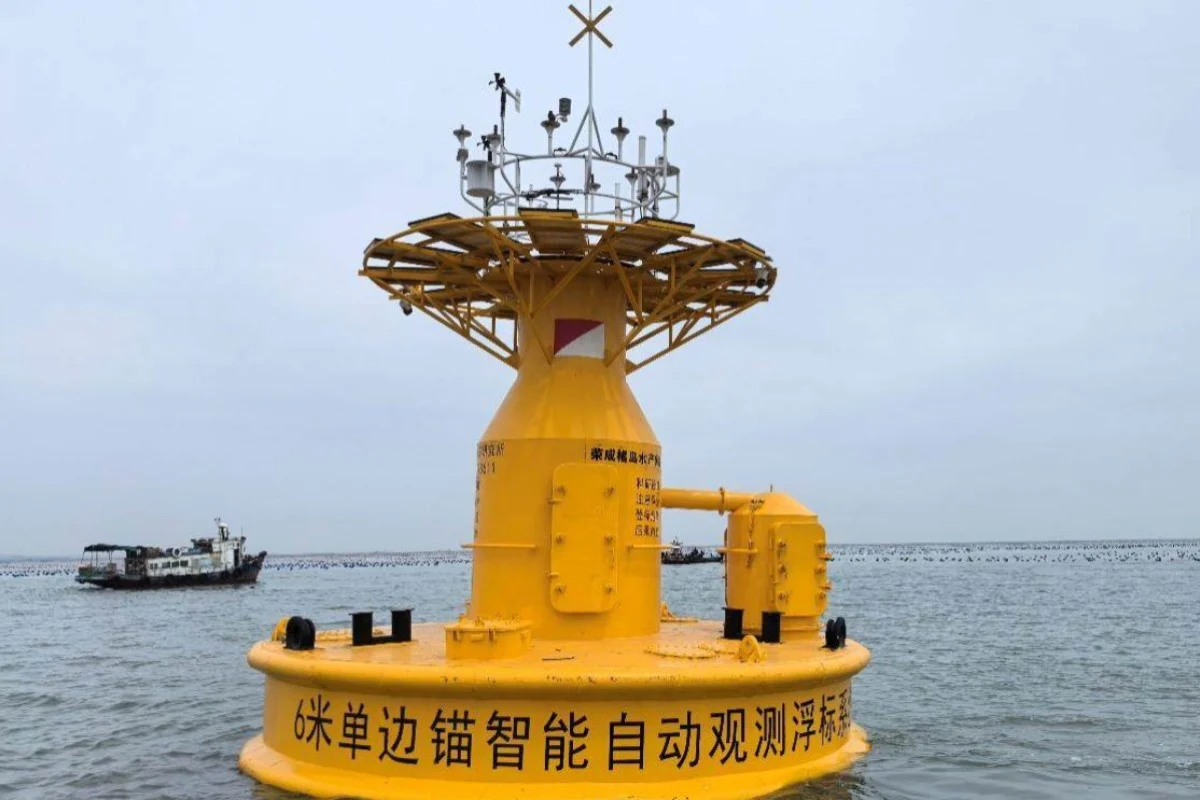
The giant orange platform deployed in the Yellow Sea may quietly represent one of the most important changes in marine observation technology in years


For nearly eight decades, most ocean-observation buoys around the world have relied on a mooring concept rooted in Western marine engineering practices developed during and after World War II. Those systems became standard because they were reliable, relatively simple, and effective for long-term ocean monitoring. However, they also came with persistent engineering problems that marine operators have struggled with for years, including cable tangling, mooring fatigue, instability in severe weather, and high maintenance costs.
Now, Chinese researchers claim they may have developed a fundamentally different solution.
A newly deployed intelligent marine-observation buoy operating in the Yellow Sea is attracting attention because it abandons the classic vertical mooring architecture used in many traditional Western systems. Instead, the platform reportedly uses a disc-shaped side-anchor configuration designed to improve stability while reducing cable twisting and entanglement.
At first glance, the development may appear to be just another scientific monitoring project. In reality, however, it may signal a broader transformation in how future ocean-observation systems are designed for climate monitoring, offshore infrastructure, maritime security, and autonomous marine operations.
According to reports linked to the Chinese Academy of Sciences, the six-meter-wide platform has already completed sea trials and officially joined the Yellow Sea observation network, where it now performs continuous real-time monitoring across the entire water column.
What makes the project especially interesting is not only the buoy itself, but the engineering philosophy behind it.
Why Traditional Buoy Systems Have Long Frustrated Marine Engineers


Most people rarely think about the engineering hidden beneath floating ocean buoys. Yet for marine scientists and offshore operators, the underwater mooring system is often the most difficult part of the entire platform.
Traditional buoy systems typically rely on long vertical anchor lines extending from the surface platform to the seabed. While this approach has been widely used for decades, it can create serious operational challenges in dynamic marine environments. Strong currents, waves, storms, and changing sea conditions can place continuous stress on the mooring system.
Over time, cables may twist, tangle, or experience fatigue damage. In rough weather, motion instability can also reduce measurement accuracy or even threaten the integrity of the structure itself.
These problems are not minor technical inconveniences. A damaged mooring system may interrupt scientific data collection for weeks or months. Repair operations are expensive, weather-dependent, and often logistically difficult, particularly in remote offshore areas.
Chinese researchers reportedly described the issue as a long-standing “tangling nightmare” within conventional buoy architecture. Their new design aims specifically to address these weaknesses.
What Makes China’s New Buoy Different
This may provide several important operational advantages.
By reducing direct twisting stress on anchor lines, the design could potentially decrease tangling and mechanical fatigue. Improved hydrodynamic stability may also help the buoy remain operational during stronger sea conditions while maintaining more accurate sensor positioning.
Researchers further claim that the structure may reduce maintenance frequency and improve long-duration deployment reliability.
If those claims prove accurate over extended operational periods, the implications could be significant for future ocean-observation infrastructure worldwide.
Marine monitoring systems increasingly require uninterrupted real-time data collection for climate science, offshore energy, navigation safety, fisheries management, and environmental forecasting. Reliability is therefore becoming as important as measurement capability itself.
Ocean Monitoring Has Become Strategically Important
Modern ocean-observation systems are no longer used only by scientists studying waves or weather patterns. Today, marine data plays a central role in global economic and geopolitical systems.
Countries increasingly depend on real-time ocean monitoring for:
- climate forecasting,
- typhoon prediction,
- tsunami warning systems,
- fisheries management,
- offshore energy operations,
- maritime navigation,
- environmental protection,
- and naval situational awareness.
As oceans become more economically and strategically important, governments are investing heavily in smarter and more autonomous marine infrastructure.
The deployment of this Chinese buoy therefore reflects a much larger global trend toward intelligent maritime systems.
China’s Expanding Maritime Technology Ambitions
China has spent years expanding its capabilities in:
- oceanography,
- marine robotics,
- autonomous vessels,
- smart shipping,
- deep-sea technology,
- and integrated maritime surveillance systems.
The new buoy fits naturally within this broader technological strategy.
The Yellow Sea itself is strategically sensitive because it supports dense commercial shipping activity, fisheries operations, coastal industrial zones, and naval presence. Continuous ocean monitoring in this region carries both scientific and operational value.
China’s growing investment in smart marine infrastructure also reflects the wider competition between major powers to control maritime data, underwater sensing capabilities, and digital ocean networks.
In the future, the ability to collect and process ocean data may become nearly as strategically important as satellite intelligence or cyber capabilities.
Could This Challenge Western Marine Engineering Standards?
One of the most striking aspects of the report is its explicit comparison with traditional Western buoy architecture.
For decades, Western marine engineering principles strongly influenced global offshore infrastructure design. Many standards used in ocean-observation systems today were originally developed through American and European naval engineering programs during the Cold War period.
China now appears increasingly willing not only to compete technologically, but also to introduce alternative engineering concepts rather than simply improving existing Western models.
If this buoy demonstrates superior operational performance over time, it may encourage broader adoption of non-Western marine engineering approaches in future offshore systems.
That possibility extends beyond scientific buoys alone. Similar design principles could potentially influence:
- offshore monitoring platforms,
- autonomous marine stations,
- floating energy systems,
- and future smart-ocean infrastructure.
Intelligent Ocean Infrastructure Is Becoming the Next Maritime Frontier

The world’s oceans are gradually becoming digitally connected environments.
Future marine observation systems are expected to integrate:
- AI-assisted analytics,
- satellite communication,
- autonomous diagnostics,
- predictive maintenance,
- real-time environmental modelling,
- and digital-twin technologies.
In this emerging ecosystem, buoys are no longer passive floating instruments. They are becoming intelligent maritime data platforms continuously feeding information into larger ocean-monitoring networks.
Countries able to build reliable and resilient smart-ocean systems may gain advantages in:
- climate adaptation,
- shipping efficiency,
- resource management,
- offshore industry,
- and maritime security.
China’s new buoy may therefore represent a small but important step within a much larger transformation.
Why Climate Scientists May Watch This Development Closely
Reliable ocean data is becoming increasingly valuable as climate pressures intensify globally.
Continuous monitoring of the water column helps researchers better understand:
- ocean warming,
- salinity changes,
- marine ecosystems,
- storm formation,
- sea-level rise,
- and long-term climate variability.
The more stable and resilient a monitoring platform becomes, the more accurate and continuous the resulting data can be.
If the new buoy architecture significantly reduces operational interruptions, it could indirectly improve the quality of long-term climate observation programs.
That may eventually become one of the platform’s most important contributions.
Final Thoughts
China’s new intelligent marine buoy is much more than an unusual floating orange platform in the Yellow Sea.
It represents a broader shift in global maritime technology development, where engineering innovation increasingly moves beyond traditional Western frameworks toward entirely new design philosophies.
Whether the system ultimately proves revolutionary will depend on long-term operational performance at sea. Marine environments are unforgiving, and many promising technologies struggle under real-world conditions.
However, if the buoy performs as researchers expect, it could influence the next generation of:
- ocean-observation systems,
- smart offshore platforms,
- autonomous marine infrastructure,
- and intelligent maritime monitoring networks.
The future competition for technological leadership may not happen only in artificial intelligence, semiconductors, or space.
It may also unfold quietly across the oceans.
FAQ: China’s New Intelligent Ocean Buoy
What is China’s new marine buoy?
It is an intelligent ocean-observation buoy recently deployed in the Yellow Sea for continuous real-time marine monitoring.
Why is the buoy considered innovative?
Researchers claim it abandons traditional World War II-era Western mooring architecture and uses a new disc-shaped side-anchor design intended to reduce cable tangling and improve stability.
What problems do traditional buoy systems face?
Traditional systems often experience:
- cable twisting,
- tangling,
- fatigue stress,
- storm instability,
- and expensive maintenance requirements.
What are the possible advantages of the new design?
Potential benefits may include:
- improved hydrodynamic stability,
- lower maintenance,
- reduced mooring stress,
- better long-term reliability,
- and more stable sensor operation.
Why are ocean-observation systems important?
They support climate monitoring, weather forecasting, navigation safety, fisheries management, offshore energy operations, and maritime security.
Who developed the buoy?
The project is linked to the Chinese Academy of Sciences and its Institute of Oceanology.
Where was the buoy deployed?
The platform was deployed off eastern China’s Shandong province in the Yellow Sea.
Could this technology have military applications?
Potentially yes. Advanced ocean-monitoring systems may also support underwater surveillance, maritime awareness, and naval operations.
Why is intelligent ocean infrastructure becoming important?
Modern oceans increasingly rely on real-time digital monitoring systems integrating AI, satellite communication, and autonomous sensing technologies.
Why is this development globally significant?
Because it may represent a new direction in marine engineering that challenges long-established buoy and offshore-platform design concepts.