
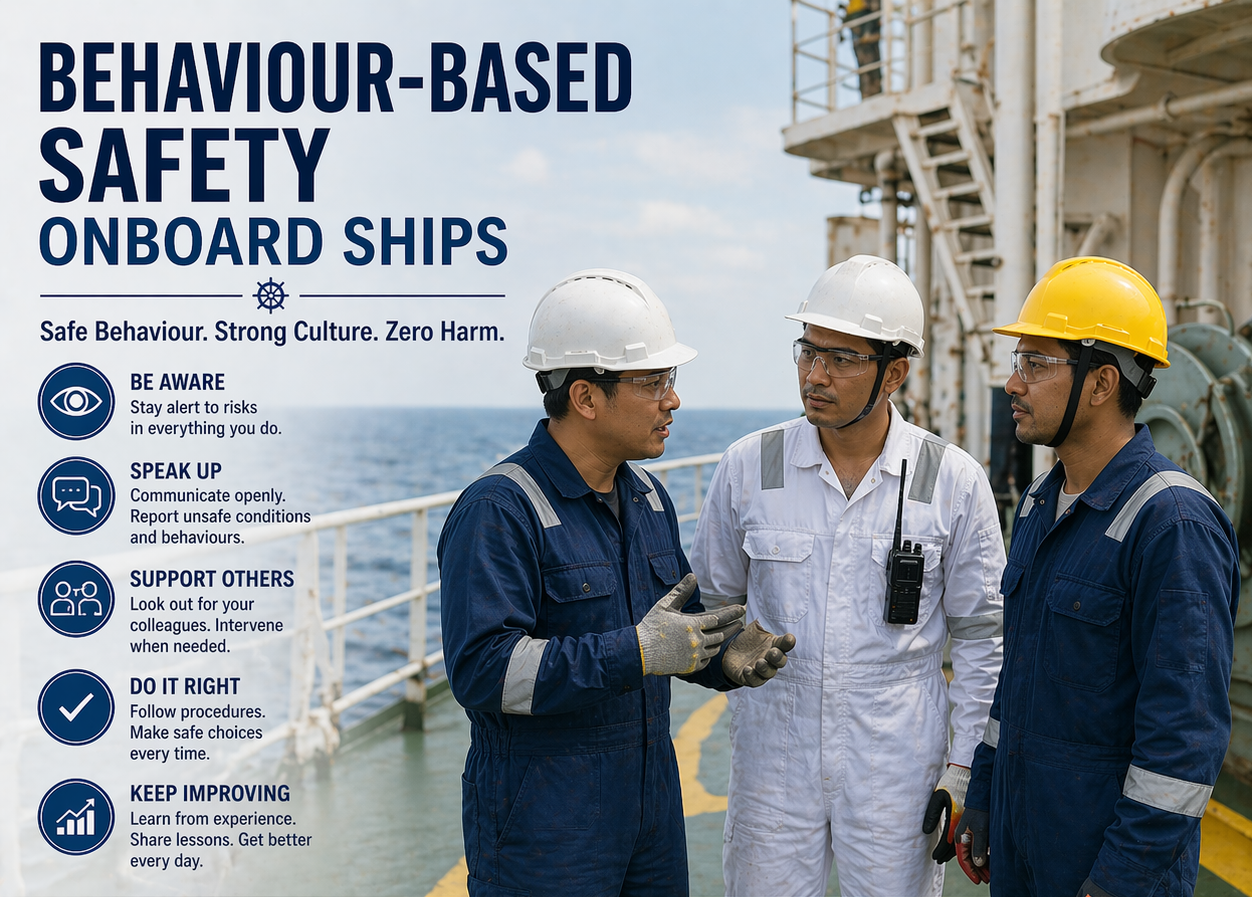
Behaviour-Based Safety, or BBS, is a proactive safety approach that focuses on how people actually work, not only on written procedures. Onboard ships, it uses structured observation, constructive feedback, and continuous improvement to reduce unsafe acts, reinforce safe habits, and strengthen safety culture. This matters in maritime operations because the IMO identifies the human element as a key factor in safety at sea and a contributor to many casualties in shipping.
A ship can have good equipment, clear procedures, and modern safety systems, yet still suffer an incident if people take shortcuts, miss warning signs, or accept unsafe practices as normal. That is why maritime safety cannot depend only on technical compliance. It must also address how people behave in real work situations. Behaviour-Based Safety, commonly called BBS, is one way of doing that. It focuses on observing routine actions, identifying unsafe patterns, and improving daily behavior through feedback, coaching, and shared accountability.
This approach fits naturally within maritime safety management because the IMO treats the human element as central to safe ship operation and pollution prevention. The ISM Code itself is built around safe practices, safe working conditions, risk assessment, safeguards, and continuous improvement of safety management skills ashore and onboard. BBS does not replace the ISM Code. Rather, it can be understood as a practical way to strengthen the human side of safety management in everyday shipboard work.
What is Behaviour-Based Safety in maritime operations?
Behaviour-Based Safety is a structured method for improving safety by focusing on observable work behaviors. In maritime settings, that means looking at how crew members actually perform tasks such as lifting, enclosed-space preparation, mooring, engine-room rounds, PPE use, permit-to-work routines, communication during operations, and housekeeping. The purpose is not to punish people, but to identify behaviors that increase risk and to reinforce behaviors that reduce it. Guidance developed for shipping companies describes behavioural safety as a way to enhance the company’s safety management system by applying these principles systematically.
For beginners, the idea can be expressed simply:
- observe how work is really done
- identify safe and unsafe actions
- discuss what was seen
- reinforce safe behavior
- improve conditions and habits over time.
Why BBS matters onboard ships
Ships are high-risk work environments. Operations involve heavy equipment, confined spaces, moving loads, fatigue, weather exposure, noise, time pressure, and multicultural crews. In such conditions, small unsafe behaviors can have serious consequences. The IMO’s human element work makes clear that human actions are central to the safety and efficiency of maritime operations, and that better outcomes depend on better human performance.
BBS matters because it helps move safety from a reactive model to a proactive one. Instead of waiting for an injury, fire, dropped object, spill, or near miss, a ship can look for early behavioral signals such as poor communication, weak PPE discipline, unsafe body position, rushing, bypassing checks, or silence during critical operations. Addressing those patterns early can strengthen both personal safety and overall operational reliability.
Behaviour-Based Safety versus traditional safety training
Traditional maritime safety training usually emphasizes rules, procedures, drills, permits, toolbox talks, and compliance. These are essential and remain the foundation of safe ship operation. BBS adds another layer by asking a different question: even when the procedure exists, how do people actually behave while doing the job?
That distinction is important. A crew member may know the correct rule but still rush, skip PPE, fail to challenge a risky act, or normalize a shortcut because “nothing happened last time.” BBS tries to close that gap between written safety and lived safety. The ISM Code’s emphasis on safe practices, identified risks, and continuous improvement makes this behavior-focused perspective highly relevant to maritime operations.
Core principles of Behaviour-Based Safety onboard
1. Observation
BBS starts with structured observation of real tasks. The goal is to notice what people do, not to judge them as people. Observation tools are often checklist-based and focus on specific behaviors linked to known operational risks. Shipping guidance on behavioural safety highlights observation and reporting as core practical elements of implementation.
2. Feedback
Observation only has value if it leads to useful feedback. Effective feedback should be immediate, respectful, specific, and focused on the behavior rather than blame. This is one reason BBS works best in a just culture or learning culture, where feedback is seen as support rather than punishment.
3. Positive reinforcement
BBS is often misunderstood as a system for finding faults. In good practice, it also reinforces safe acts. When safe behavior is noticed and acknowledged, it becomes more likely to be repeated. Behavioural safety guidance for shipping explicitly links the approach to safety enhancement, not merely fault finding.
4. Trend analysis and continuous improvement
BBS should not stop at individual observations. Repeated observation results can reveal patterns: where shortcuts occur, which departments struggle with compliance, what times of day are riskier, or whether certain tasks are poorly designed. This supports continuous improvement, which is already a core principle of maritime safety management under the ISM framework.
How BBS can be applied onboard ships
A shipboard BBS program needs structure. If it is too informal, it becomes inconsistent. If it is too punitive, crew will distrust it. Guidance prepared for shipping companies recommends integrating behavioural safety into the existing safety management system rather than treating it as a standalone campaign.
A practical implementation path may include:
- Assess readiness
Review whether the ship and company culture are ready for peer observation and open feedback. Without trust, BBS may be misunderstood as surveillance. - Define critical behaviors
Choose a manageable set of high-risk behaviors to observe, such as PPE use, ladder safety, communication during lifting, permit checks, hand placement, housekeeping, or fatigue-related shortcuts. - Train observers
Observers should be trained not only to watch tasks but also to communicate respectfully and record observations consistently. - Use non-punitive observation tools
Anonymous or learning-oriented data collection is usually more effective than blame-based systems. - Review results regularly
Observation data should feed back into toolbox talks, risk assessments, training, and procedural improvements.
Examples of behaviors that BBS can target at sea
BBS onboard ships often focuses on recurring operational behaviors rather than rare catastrophic events. Examples include:
- not wearing required PPE
- unsafe lifting posture or manual handling
- poor ladder or gangway discipline
- weak communication during mooring or cargo work
- bypassing checklists or permit steps
- standing in danger zones
- working while fatigued or distracted
- poor housekeeping in deck or engine spaces.
These may appear minor in isolation, but they are exactly the kinds of behaviors that can accumulate into incidents. OCIMF’s human factors work similarly emphasizes that people, systems, equipment, and working conditions interact to shape safety outcomes.
Benefits of Behaviour-Based Safety in maritime settings
When implemented well, BBS can support a stronger safety culture by making safety visible in daily work rather than limiting it to audits, forms, and post-incident investigations. It can help crews talk about risk more openly, notice weak signals earlier, and improve peer accountability. Because it focuses on what actually happens during routine operations, it can also identify gaps between formal procedures and real practice.
Potential benefits include:
- better frontline risk awareness
- more frequent safety conversations
- earlier correction of unsafe habits
- stronger peer accountability
- improved learning from routine work
- better alignment between procedures and practice.
It is better, however, to describe these as potential gains rather than promising a fixed percentage reduction in incidents. Published maritime material clearly supports the logic of behavior-focused safety, but dramatic percentage claims vary widely by context and are not always supported by public, high-quality evidence.
Challenges and limitations of BBS onboard
Behaviour-Based Safety is useful, but it is not a magic solution. One of the biggest risks is using BBS too narrowly, as if every problem is caused by the worker in front of the task. In reality, unsafe behavior is often shaped by fatigue, poor design, weak supervision, understaffing, cultural barriers, unclear procedures, or unrealistic schedules. OCIMF’s human factors work is especially valuable here because it stresses the interaction between people and the wider system, not just individual behavior.
Other common challenges include:
- fear that observation will lead to blame
- cultural resistance to peer feedback
- small crews with limited time for formal observations
- inconsistent recording quality
- focusing on workers while ignoring system defects
- observer fatigue or loss of momentum after launch.
Because of these limitations, BBS works best when combined with a broader human-factors approach, competent leadership, fair reporting culture, and strong safety management systems.
BBS and international maritime standards
Behaviour-Based Safety is not a mandatory IMO code by itself, but its logic fits closely with the direction of current maritime safety governance. The ISM Code requires companies to provide safe practices in ship operation, a safe working environment, risk assessment, safeguards, and continuous improvement of safety management skills. Those are all areas where BBS can support practical implementation.
The IMO’s human element programme also reinforces the relevance of behavior, competence, and performance in maritime safety. Meanwhile, ILO maritime materials emphasize safe and hygienic working environments and training in occupational safety and health protection, accident prevention, and safe working practices.
Technology and the future of BBS at sea
Technology is starting to support behavior-focused safety, though maritime deployment varies widely by operator and vessel type. Digital observation forms, mobile reporting tools, and dashboard-based trend analysis are already practical extensions of BBS. At the broader industry level, OCIMF’s digitalized inspection developments and human-factors tools show that shipping is moving toward more structured, data-supported safety assurance.
Future developments may include:
- mobile observation apps
- digital dashboards for behavior trends
- closer links between observation data and training plans
- fatigue and alertness monitoring tools
- better use of human-factors data in shipboard audits.
More speculative ideas such as AI video analysis or blockchain-secured feedback logs may emerge in some settings, but these should be presented as possible future directions rather than established maritime norms.
Conclusion
Behaviour-Based Safety onboard ships is not about watching people to catch mistakes. At its best, it is about understanding how work is really done, improving unsafe habits early, reinforcing good practice, and building a stronger safety culture from the deck plate upward. In the maritime sector, where the IMO identifies the human element as central to safety, this kind of practical focus on day-to-day behavior can be a powerful complement to formal procedures and technical safeguards.
The most effective BBS programs are those that remain respectful, non-punitive, and closely connected to the ship’s wider safety management system. When crews trust the process, feedback becomes easier, learning becomes faster, and safety becomes something that is actively lived rather than only documented.
Quick facts box
| Topic | Key point |
|---|---|
| What is BBS? | A structured safety approach focused on observable work behavior |
| Main purpose | Reduce unsafe acts and reinforce safe habits before incidents occur |
| Maritime relevance | Supports the human-element and continuous-improvement aims of ship safety management |
| Best use | As part of the safety management system, not as a blame tool |
| Main risk | Focusing only on individual behavior while ignoring system factors |
FAQ
What is Behaviour-Based Safety on ships?
Behaviour-Based Safety onboard ships is a structured approach that uses observation, feedback, and reinforcement to improve safe behavior during real work tasks.
How is BBS different from traditional safety training?
Traditional safety training emphasizes rules, procedures, and drills, while BBS adds direct observation of day-to-day work behavior and feedback on how tasks are actually performed.
What are examples of unsafe behaviors at sea?
Examples include poor PPE compliance, unsafe lifting, weak communication during operations, skipping checks, unsafe ladder use, and working while fatigued.
Does BBS replace the ISM Code?
No. BBS does not replace the ISM Code. It can support the ISM Code by strengthening safe practices, risk awareness, and continuous improvement in everyday shipboard work.
Can BBS reduce incidents onboard?
It can help reduce risk and improve safety culture when implemented properly, but results depend heavily on leadership, trust, consistency, and whether system issues are addressed alongside behavior.
Reference list
- IMO. Human Element.
- IMO. International Safety Management (ISM) Code.
- IMO. Safety management and safety culture.
- IMO. Resolution A.1022(26): Revised guidelines on the implementation of the ISM Code by Administrations.
- IMO. Human Element Vision, Principles and Goals / STCW human element FAQ.
- National Maritime Occupational Health and Safety Committee / UK Chamber of Shipping. Guidelines to Shipping Companies on Behavioural Safety.
- OCIMF. Human Factors.
- OCIMF. Human Factors: Management and Self Assessment.
- OCIMF. Behavioural Competency Assessment and Verification for officers.
- ILO. Maritime materials on safe and hygienic working environments and OSH training for seafarers.