
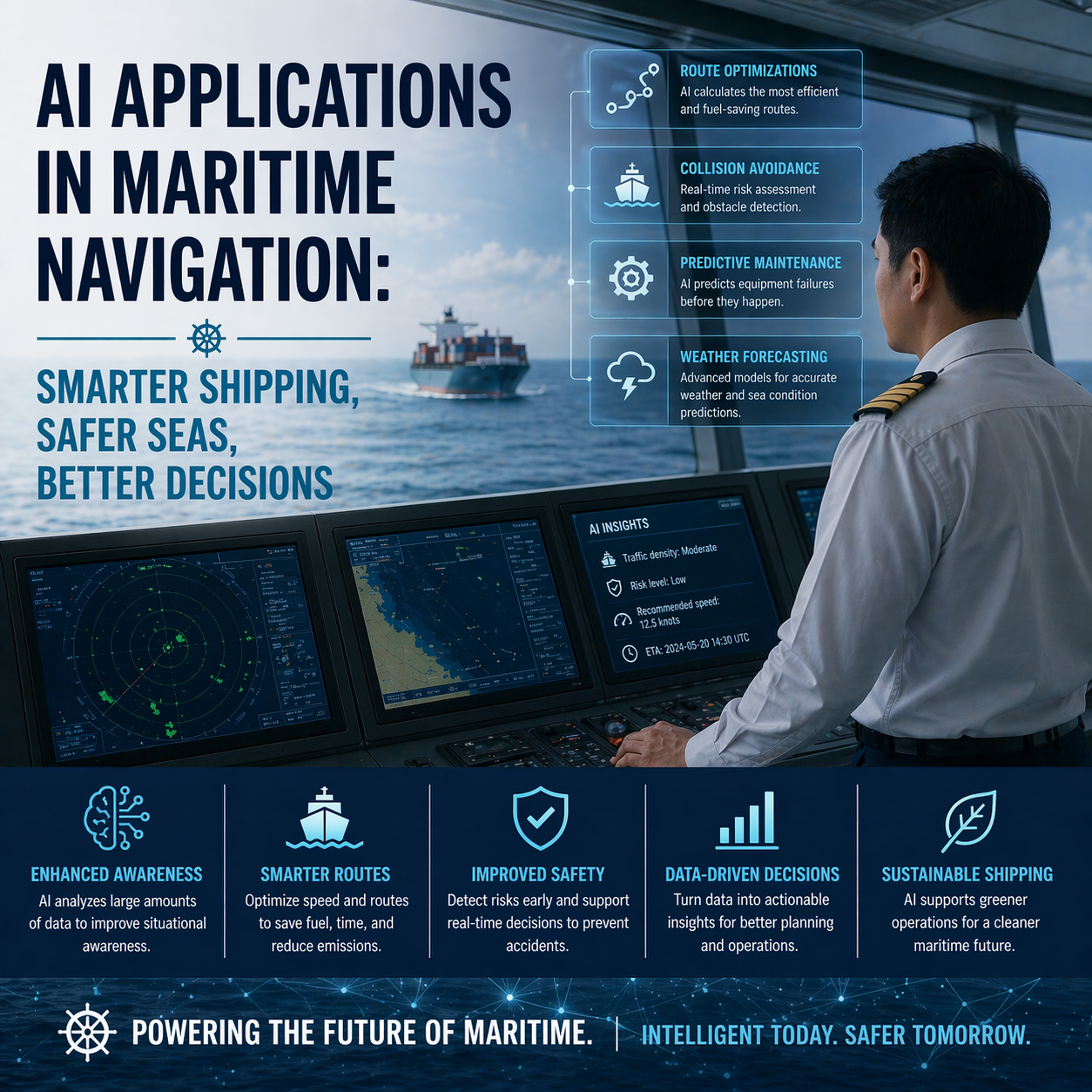
Artificial intelligence in maritime navigation uses algorithms, machine learning, and data analysis to improve route planning, situational awareness, safety, fuel efficiency, and operational decision-making. In practice, AI can help vessels optimize routes around weather and congestion, support collision avoidance, improve maintenance planning, and strengthen fleet-wide logistics visibility. As global shipping carries over 80% of traded goods by volume, even small gains in navigational efficiency can have major economic and environmental effects.
Maritime navigation is entering a new phase. For decades, safe passage depended on charts, radar, bridge teamwork, weather routing, and the experience of navigators. Those foundations still matter, but they are now being complemented by a new layer of digital intelligence. Artificial intelligence is increasingly being used to process large streams of operational data, identify patterns faster than humans can, and support better decisions at both ship and fleet level. AI is not replacing seamanship; it is becoming a decision-support layer that can help make navigation safer, more efficient, and more responsive to changing conditions.
The importance of this shift is easy to understand. UN Trade and Development states that maritime transport moves over 80% of goods traded worldwide, so improvements in navigation, logistics, and voyage planning can produce effects far beyond the bridge itself. Better routing can lower fuel use, reduce delays, ease congestion, and support more resilient supply chains.
What is AI in maritime navigation?
Artificial intelligence in maritime navigation refers to the use of data-driven computational methods, including machine learning and advanced analytics, to support or automate navigational and operational decisions. In a maritime setting, AI may be used for route optimization, situational awareness, anomaly detection, collision-risk assessment, control support, cargo planning, maintenance forecasting, and more. DNV describes marine AI systems as tools that can help navigate vessels, optimize routes, and manage cargo, while also stressing the need for trustworthy and responsible deployment in critical operations.
This means AI at sea is not one single technology. It is a family of tools that can work with:
- voyage and weather data
- AIS and traffic information
- vessel sensor data
- historical performance records
- fuel and emissions data
- onboard camera or vision systems
- control and automation platforms.
Why AI matters in modern navigation
AI matters because maritime decision-making is becoming more complex. Ships are larger, port calls are tightly scheduled, environmental rules are stricter, and disruptions from weather, congestion, and geopolitics can change voyage conditions quickly. Maersk notes that AI can support vessel route optimization by adapting to safety, weather, and energy factors, while also helping organizations handle disruption and streamline decisions. DNV similarly points to AI’s role in day-to-day route support and maritime operations.
In practical terms, AI offers value in four major areas:
1. Efficiency
AI can process multiple voyage variables at once and suggest more efficient routing, speed profiles, or arrival timing. This supports reduced fuel waste and more stable schedules.
2. Safety
AI can enhance situational awareness, flag abnormal patterns, and support decision-making in collision avoidance or hazard detection.
3. Cost control
Better route planning, better timing, and fewer unexpected failures can reduce voyage inefficiencies and operational losses.
4. Sustainability
AI can support fuel-efficient routing and broader optimization strategies that align with decarbonization goals. Yara’s autonomous and zero-emission shipping project also shows how digital and autonomy technologies can intersect with lower-emission transport concepts.
–
How AI improves maritime route optimization
Route optimization is one of the clearest real-world uses of AI in shipping. Instead of treating navigation as a fixed route from point A to point B, AI-based systems can evaluate changing conditions during the voyage and support dynamic adjustments.
These systems may consider:
- weather and sea state
- traffic density
- port congestion
- fuel efficiency curves
- speed and arrival constraints
- energy consumption patterns
- safety margins in narrow or busy waters.
Maersk specifically highlights vessel route optimisation as an AI-enabled use case, noting that these systems can adapt to safety, weather, and energy factors. Its broader logistics materials also refer to just-in-time supply chain management with visibility that allows operations to speed up or slow down based on need. That is relevant to navigation because better arrival timing can reduce unnecessary waiting, lower fuel burn, and ease port-side congestion.
–
Key AI technologies used in navigation
AI in maritime navigation is built from several technical components rather than one all-in-one system.
Machine learning
Machine learning helps systems identify patterns in historical and real-time data. In navigation, this can support route optimization, risk prediction, anomaly detection, and operational recommendations. DNV’s responsible AI materials describe maritime AI systems as being used for navigation and route optimization, which reflects this pattern-based decision support role.
Computer vision and sensor fusion
Autonomous and advanced support systems increasingly rely on vision sensing, surround view, and sensor fusion to understand the vessel’s surroundings. IMO-hosted MASS technology materials describe solutions involving vision sensing, situation analysis, route planning, route optimization, auto docking, and autonomous control.
Data analytics
Large-scale data processing allows fleets and ships to turn traffic, weather, performance, and operational records into actionable insights. This is essential for heatmaps, trend prediction, performance analysis, and voyage planning support.
AI-enabled cybersecurity monitoring
As ships become more digital, AI is also being explored for anomaly detection in ship networks. IMO symposium material from 2024 includes AI-based maritime autonomous ship network security concepts designed to detect suspicious signs in onboard network traffic.
–
AI and autonomous vessels
Autonomous shipping is one of the most visible areas of AI-related maritime innovation, but it is also one of the most misunderstood. Fully autonomous navigation is still an emerging area rather than the normal industry standard. The IMO is actively working to ensure that regulation keeps pace with Maritime Autonomous Surface Ships, or MASS, and has been developing the MASS Code framework to address the safety, security, environmental, legal, and human-element dimensions of such vessels.
A widely cited example is Yara Birkeland, which Yara describes as the world’s first fully electric and autonomous container vessel with zero emissions. Yara’s more recent updates also note that the ship has autonomous functions and remains an important demonstration project for future shipping concepts.
At the technology level, DNV has also referenced collaboration on autonomous ship systems developed to create and control optimal routes for collision avoidance, with the aim of reducing crew fatigue and improving fuel efficiency.
How AI can improve maritime safety
Safety is one of the strongest arguments for AI in navigation, provided the systems are reliable, well-governed, and used with sound human oversight. DNV notes that AI in maritime can support situational awareness, route planning, and control. In other words, AI can function as an additional layer of “eyes, ears, and analysis” around the vessel.
Potential safety uses include:
- collision-risk support based on traffic patterns
- improved situational awareness from integrated sensors
- anomaly detection in navigation or network behavior
- predictive maintenance support
- faster identification of abnormal operating conditions
- support for remote operations or assisted decision-making.
This does not mean AI makes navigation automatically safe. DNV’s responsible AI guidance emphasizes that marine AI in critical operations must be trustworthy, transparent, and properly governed because errors in these systems can affect ship operations and cargo management.
AI in logistics and fleet-wide operations
AI is not limited to shipboard navigation alone. It can also improve decision-making across the wider logistics chain. Maersk’s AI materials describe applications in planning, procurement, decision-making, disruption handling, and integrated logistics. That matters because navigation efficiency is increasingly linked to shore-side coordination, berth availability, cargo timing, and broader supply-chain visibility.
In this broader context, AI can help with:
- just-in-time arrival planning
- fleet scheduling support
- disruption management
- port call coordination
- visibility across supply-chain stages
- better cost and timing decisions across multiple voyages.
Challenges and limitations
AI in maritime navigation has clear promise, but it also comes with important limits.
Data quality
AI is only as useful as the data it receives. Poor sensor input, incomplete records, or misleading historical patterns can weaken output quality. DNV’s responsible AI framing strongly implies the need for robust, trustworthy system design in critical maritime uses.
Cyber risk
More connected systems create larger cyber surfaces. This is why AI is being explored not only for navigation support but also for network anomaly detection in autonomous ship contexts.
Regulation
International regulation is evolving, especially around autonomous vessels. IMO’s ongoing MASS work makes clear that the governance framework is still developing alongside the technology.
Human trust and accountability
Even highly advanced systems need human trust, good training, and clear accountability structures. In critical navigation, the key question is not simply whether AI can decide, but whether operators understand when to trust it, when to override it, and how to verify it. DNV’s repeated focus on “trustworthy and responsible AI” reflects exactly this challenge.
–
AI and sustainable shipping
AI can also support environmental performance. Route optimization, speed adjustment, congestion avoidance, and better timing can all help lower fuel consumption and emissions. Yara’s autonomous electric vessel project demonstrates how digital navigation and lower-emission transport strategies can reinforce one another, while Maersk’s AI examples connect routing decisions directly with safety, weather, and energy considerations.
This is especially relevant as shipping faces growing pressure to improve efficiency and reduce environmental impact. AI is not the only answer, but it can be a practical enabler of greener voyage management.
–
Training and the future maritime workforce
As navigation becomes more digital, maritime professionals need stronger skills in interpreting system output, validating recommendations, and working with automated support tools. IMO continues to emphasize the role of approved and properly operated training structures through its model course ecosystem, while DNV now offers AI training specifically for maritime professionals. That signals a broader shift: AI literacy is becoming part of modern maritime competence, especially for shore-based and technical personnel.
Rather than replacing navigators, the likely near-term future is one in which officers, shore teams, and operators increasingly work with AI-assisted systems. The better trained the people are, the more safely and effectively these tools can be used.
–
Future outlook
The direction of travel is clear. AI is moving deeper into route planning, situational awareness, autonomous operations, cybersecurity, predictive maintenance, and logistics orchestration. IMO’s continuing MASS work shows that the regulatory side is actively adapting, while classification societies and major shipping players are already positioning AI as an operational tool rather than a distant concept.
The future is therefore unlikely to be a sudden replacement of human navigation with machine control. It is more likely to be a gradual expansion of AI-assisted navigation, with increasing levels of autonomy in certain use cases, stronger digital integration between ship and shore, and tighter expectations around trust, safety, and governance.
Conclusion
AI is transforming maritime navigation by making routing smarter, operations more adaptive, and decision-making more data-driven. It can support safer voyages, better fuel efficiency, improved arrival timing, stronger logistics coordination, and more advanced vessel autonomy. At the same time, the sector still needs high-quality data, sound cyber protection, capable human oversight, and clear regulation to use these systems responsibly.
For shipowners, operators, educators, and maritime professionals, the real opportunity is not to ask whether AI belongs in navigation. It already does. The more useful question is how to deploy it in a way that strengthens safety, efficiency, and trust at the same time.
Quick facts box
| Topic | Key point |
|---|---|
| Global importance | Maritime transport moves over 80% of goods traded worldwide |
| Core AI uses | Route optimization, situational awareness, anomaly detection, logistics support |
| Autonomy status | Autonomous shipping is advancing, but regulation is still evolving through IMO MASS work |
| Real-world example | Yara Birkeland is presented by Yara as a fully electric autonomous container vessel |
| Main caution | AI in critical maritime uses must be trustworthy, governed, and used with human oversight |
FAQ
How does AI improve shipping route planning?
AI improves route planning by analyzing variables such as weather, traffic, safety, and energy use to recommend more efficient and adaptive voyage plans.
Are autonomous ships already real?
Yes, autonomous vessel projects already exist. Yara presents Yara Birkeland as a fully electric and autonomous container vessel, while IMO is continuing to develop the regulatory framework for MASS.
What are the safety benefits of AI in maritime navigation?
AI can support situational awareness, route planning, anomaly detection, and collision-risk management, which may improve safety when properly governed and used with human oversight.
What are the main risks of AI in shipping?
The main risks include poor data quality, cyber vulnerability, evolving regulation, and overreliance on systems that operators may not fully understand.
Is AI used in maritime training?
AI-focused learning for maritime professionals is expanding. DNV offers an AI course for maritime professionals, while IMO continues to support formal training structures through its model course framework.
Reference list
- UN Trade and Development (UNCTAD). Shipping data: maritime transport moves over 80% of goods traded worldwide.
- UNCTAD. Review of Maritime Transport.
- IMO. Autonomous shipping / Maritime Autonomous Surface Ships (MASS).
- IMO. MSC 103 summary: regulatory scoping exercise for MASS.
- IMO. MSC 110 summary.
- DNV. Implementing Trustworthy and Responsible AI for Critical Maritime Operations.
- DNV. Industrial AI: navigating opportunities and challenges.
- Maersk. Artificial Intelligence in logistics and related logistics insights.
- Yara International. Yara Birkeland press materials and project updates.
- IMO MASS symposium presentation materials on autonomous navigation technologies.
- IMO. Model Courses.
- DNV. Artificial Intelligence (AI) for Maritime Professionals.