
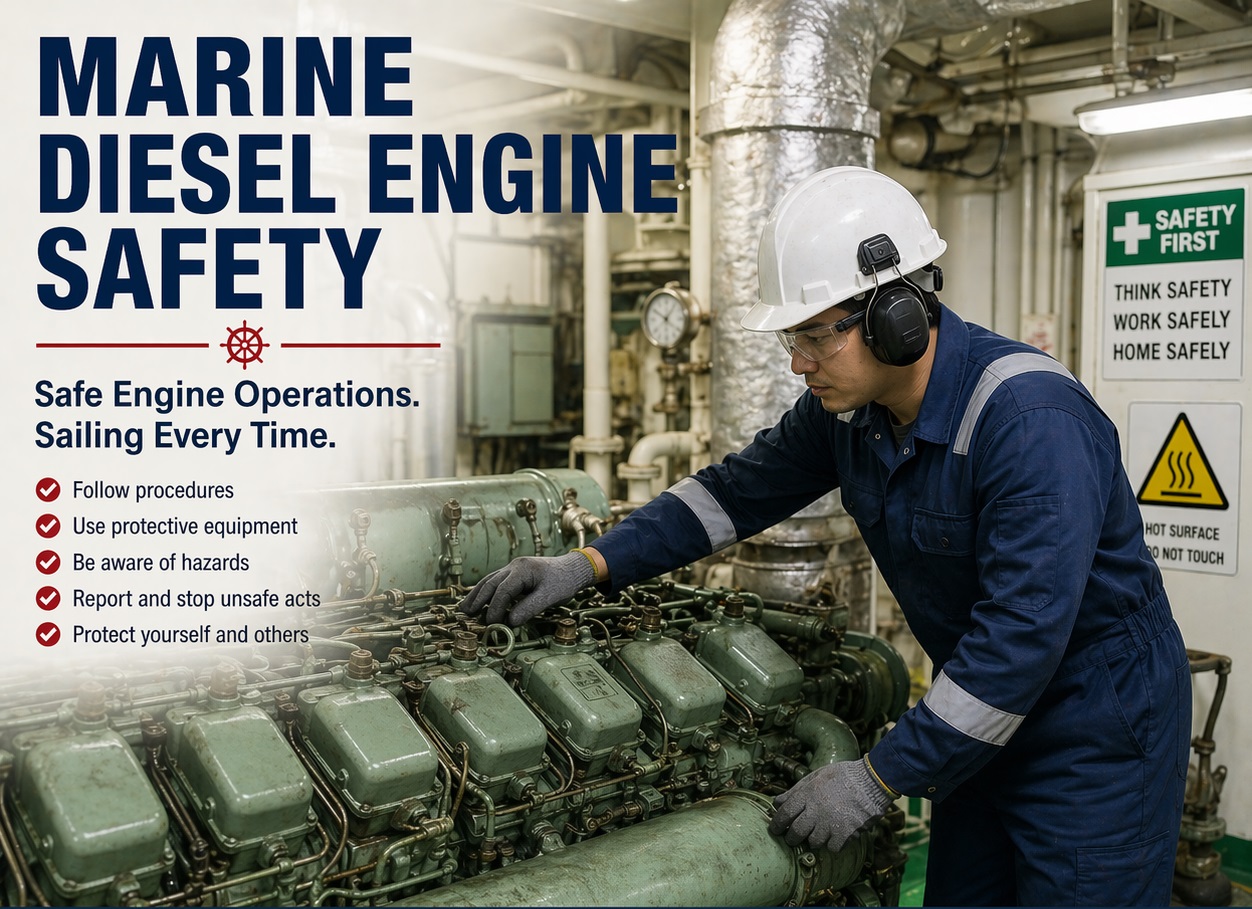
Marine diesel engine safety covers the systems, procedures, design features, and crew practices used to prevent fires, explosions, loss of propulsion, machinery damage, and pollution onboard ships. It includes alarms, emergency shutdowns, crankcase protection, fuel leak prevention, monitoring, maintenance, and compliance with SOLAS, IMO, and classification society requirements. As marine engineering becomes more digital, engine safety is also becoming more predictive through condition monitoring, automation, and smarter fault detection.
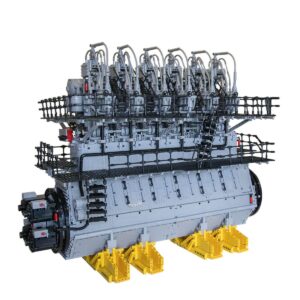
A marine diesel engine is the heart of many ships. It drives propulsion, supports power generation, and helps keep the vessel operational in conditions where failure is never a small matter. When an engine problem escalates at sea, the consequences can include blackout, fire, crankcase explosion, loss of manoeuvrability, cargo delay, environmental damage, or even grounding. For that reason, marine diesel engine safety is not only a technical topic for engineers. It is a core part of ship safety management, operational reliability, and environmental protection.
Modern engine safety depends on several layers working together: sound design, protective devices, automation, alarm systems, maintenance discipline, crew competence, and regulatory compliance. No single safety device can protect an engine room on its own. Real safety comes from the interaction between machinery safeguards and human vigilance.
What is marine diesel engine safety?
Marine diesel engine safety refers to the set of design features, monitoring systems, operating procedures, maintenance practices, and emergency responses used to reduce the risk of injury, machinery damage, fire, explosion, loss of propulsion, and pollution arising from marine diesel engine operation.
In practical terms, it covers:
- prevention of fuel, lube oil, and hot-surface fires
- prevention of crankcase explosions and mechanical failures
- monitoring of pressure, temperature, speed, and abnormal conditions
- safe starting, running, stopping, and emergency shutdown
- protection of crew working in the engine room
- compliance with SOLAS, IMO instruments, and class requirements.
Why marine diesel engine safety matters
Marine engines operate under high temperature, high pressure, moving parts, flammable liquids, and continuous load. This makes the engine room one of the most safety-critical areas onboard. DNV continues to identify engine-room fires as a major casualty concern and recommends tighter control of leaks, hot surfaces, maintenance standards, and procedural discipline. IMO also continues active work on preventing engine-room fires, including fire risks related to low-pressure fuel and lubrication oil pipe leakage.
Good engine safety matters because it helps:
- protect life and reduce injury risk
- prevent costly machinery damage and downtime
- reduce the likelihood of fire, explosion, and blackout
- improve operational reliability and voyage safety
- support environmental protection by reducing accident-related pollution
- demonstrate compliance during surveys, audits, and inspections.
–
Core safety systems in marine diesel engines
Modern marine diesel engines use multiple protective layers. Some are mechanical by design, while others rely on automation and sensors.
Emergency shutdown systems
Emergency shutdown systems act as the last protective barrier when engine conditions become critical. They are typically linked to dangerous parameters such as overspeed, very low lubricating oil pressure, or other severe fault conditions. Their purpose is to stop the engine before catastrophic damage occurs. Wärtsilä documentation for engine control systems explicitly includes alarms, shutdowns, emergency stops, and load reductions as safety functions.
Alarm and monitoring systems
Alarm systems continuously monitor engine parameters such as temperature, pressure, speed, vibration, and fault status. These systems warn operators before a dangerous condition turns into failure. The quality of the alarm system is important, but equally important is the crew’s response to alarms. Ignored or poorly interpreted warnings remain a recurring contributor to engine-room incidents.
Crankcase explosion protection
Crankcase explosions remain one of the best-known engine hazards. Protection is achieved through a combination of oil mist detection, temperature or bearing monitoring, crankcase relief valves, and proper maintenance. SOLAS-linked technical requirements include oil mist detectors, bearing temperature detectors, or equivalent devices for large internal combustion engines, while approved crankcase explosion relief valves are a standard protective measure for suitable engines. MAN Energy Solutions highlights both oil mist detectors and type-approved crankcase relief valves as central to crankcase explosion prevention.
Fuel leak protection
Fuel leaks are a major fire hazard. IMO guidance and related technical requirements emphasize jacketed or shielded high-pressure fuel lines, leakage collection arrangements, and alarm systems to warn of fuel line failure. These arrangements are designed to prevent atomized fuel from reaching hot surfaces and igniting.
Overspeed protection
Overspeed can lead to severe mechanical damage, especially in rotating machinery. Protective devices detect dangerous acceleration and trigger corrective action or shutdown. These systems are especially critical during abnormal control conditions or governor malfunction.
Common hazards in marine diesel engine rooms
Engine rooms are complex, hot, noisy, and machinery-dense environments. Many serious incidents begin with a small abnormality that is missed, ignored, or poorly controlled.
Major hazards include:
- fuel oil leaks onto hot surfaces
- lubricating oil leaks and mist ignition
- crankcase oil mist formation and explosion
- overheating of bearings, pistons, or exhaust components
- overspeed of engines or generators
- starting-air or combustion-related backfire events
- poor housekeeping that allows flammable residues to accumulate
- bypassed alarms or defective protective devices.
DNV’s fire-prevention guidance places special emphasis on leakage control, insulation of hot surfaces, and procedural review, showing that many engine-room fires remain closely linked to oil leakage, maintenance shortcomings, and human factors rather than only to rare design failures.
–
Safety procedures and best practices
Even a well-designed engine becomes unsafe if procedures are weak. Safe operation depends on routine discipline before, during, and after engine use.
Pre-start safety checks
Before starting, engineers should verify:
- lubricating oil level and pressure readiness
- fuel system integrity
- cooling water readiness
- starting air availability
- absence of abnormal leaks or loose components
- alarm and monitoring system readiness.
Safe watchkeeping
During operation, engine room personnel should:
- monitor and log key parameters
- investigate abnormal temperature, pressure, or vibration trends
- respond promptly to alarms
- verify that protective devices remain active
- keep the space clean and free of leak accumulation.
Maintenance discipline
Planned maintenance remains one of the strongest safety tools. Filters, detectors, relief devices, insulation, fuel piping, and shutdown systems must be inspected, tested, and maintained according to maker guidance and the ship’s maintenance system. MAN documentation stresses that correct operation and maintenance are crucial for safe engine operation.
Emergency preparedness
Engine-room crews should be trained for:
- engine-room fire response
- blackout recovery
- local and remote emergency shutdown
- isolation of fuel and ventilation systems
- fixed fire-extinguishing system readiness
- communication with bridge and emergency teams.
–
Human roles in engine safety
Marine diesel engine safety is not only about hardware. It also depends on competence, judgment, and communication.
Engine room crew responsibilities
Daily responsibilities include:
- carrying out rounds and inspections
- noticing leaks, smells, heat, smoke, or abnormal sound
- logging engine performance accurately
- reporting abnormal conditions early
- keeping safety guards, insulation, and access routes in good order.
Chief engineer’s role
The chief engineer has a central leadership role in ensuring:
- compliance with company, class, and statutory requirements
- testing of protective systems
- proper maintenance planning
- training and familiarization of engineers and ratings
- review of recurring alarms, defects, and near misses.
Human vigilance remains essential because automation cannot fully replace professional judgment, especially when alarms are ambiguous, multiple faults occur together, or conditions deteriorate rapidly.
–
Regulations and class requirements
Marine diesel engine safety is supported by a combination of international regulation, class rules, and maker requirements.
SOLAS and IMO
SOLAS-related technical provisions address areas such as:
- fixed fire-extinguishing systems in machinery spaces
- detection and alarm arrangements
- oil mist or equivalent detection for large internal combustion engines
- fuel line shielding and leak alarm concepts
- crankcase relief requirements in applicable cases.
IMO has also continued work in 2025 and 2026 on preventing engine-room fires, including mitigation of fire risk from leakage of low-pressure fuel and lubrication oil pipes and discussion of thermal imaging for inspections.
Classification societies
Classification societies such as DNV, ABS, and LR translate safety principles into rule requirements, approval processes, surveys, and notations. DNV has specifically highlighted fire-risk mitigation measures involving oil leak prevention, control of hot surfaces, detection, and additional protection arrangements for machinery spaces in relevant contexts.
–
New technologies improving engine safety
Marine engine safety is becoming more digital and more predictive.
Smart monitoring
Modern systems collect real-time operating data and can highlight abnormal trends before failure occurs. This improves early fault detection and can reduce dependency on purely reactive maintenance. Wärtsilä engine control systems, for example, monitor temperatures, pressures, speed, torsional vibration, and load-related conditions as part of control and safety functionality.
Condition-based maintenance
Condition-based maintenance uses real operating data rather than fixed intervals alone. This helps target components that are actually deteriorating and may reduce unexpected breakdowns.
Thermal imaging and advanced inspection
Thermal imaging is increasingly discussed as a useful inspection aid for engine-room fire risk mitigation, especially for identifying overheating or insulation defects. IMO has recently agreed to consider its role in fire-risk prevention work.
Digital twins and remote diagnostics
Digital twins and remote diagnostic tools can support troubleshooting, training, and predictive maintenance by simulating or interpreting real engine behavior. These approaches are growing as part of broader maritime digitalization, although their practical depth varies by vessel type and operator capability.
–
Challenges in keeping engines safe
Despite strong technology, implementation gaps remain common.
Typical challenges include:
- alarm fatigue or poor alarm response
- deferred maintenance due to time or cost pressure
- defective or uncalibrated sensors
- insufficient familiarization with protection systems
- poor housekeeping in machinery spaces
- overreliance on automation
- inconsistent safety standards across fleets and ages of vessels.
The solution is usually not one single device. It is better integration of maintenance, design, training, procedural control, and safety culture. DNV’s guidance strongly reflects this systems-based view.
Future outlook
The future of marine diesel engine safety is moving toward earlier detection, smarter prioritization, and better integration between control, maintenance, and risk management. Likely growth areas include:
- better predictive analytics
- improved alarm prioritization
- more connected engine diagnostics
- stronger inspection tools for leak and heat detection
- wider use of digital support tools for maintenance and training.
Even as propulsion technology evolves, diesel engines will remain important across much of the world fleet for years to come. That makes continued improvement in diesel engine safety highly relevant to present-day maritime operations.
Conclusion
Marine diesel engine safety is a layered discipline built on engineering design, protective systems, operational discipline, maintenance quality, and human competence. Emergency shutdowns, alarms, oil mist detection, crankcase relief valves, leak protection, and fire safety systems all play important roles, but none of them can replace proper watchkeeping and maintenance culture. The strongest safety performance comes from combining reliable machinery safeguards with trained people who respond early and correctly.
For shipowners, engineers, cadets, and maritime students, the message is clear: marine diesel engine safety is not a narrow technical topic. It is central to protecting people, ships, cargoes, and the marine environment.
Quick facts box
| Topic | Key point |
|---|---|
| Main purpose | Prevent fire, explosion, blackout, machinery damage, and pollution |
| Key safety devices | Alarms, shutdowns, oil mist detection, relief valves, leak detection |
| Major hazards | Fuel leaks, hot surfaces, crankcase explosions, overspeed, poor maintenance |
| Main standards | SOLAS, IMO technical requirements, class rules, maker instructions |
| Safety trend | From reactive protection to predictive monitoring and smarter diagnostics |
–
FAQ
What is marine diesel engine safety?
Marine diesel engine safety is the combination of design features, alarms, shutdowns, procedures, maintenance, and crew actions used to prevent machinery accidents, fire, explosion, and loss of propulsion onboard ships.
What causes marine diesel engine fires?
Common causes include fuel or lubricating oil leakage, contact with hot surfaces, poor maintenance, and failure to act on early warning signs.
How is crankcase explosion prevented?
Crankcase explosion prevention relies on proper maintenance, oil mist detection, temperature or bearing monitoring, and approved crankcase relief valves.
What is the role of emergency shutdown systems?
Emergency shutdown systems stop the engine or reduce danger when a critical fault occurs, helping prevent severe damage or escalation into a major casualty.
Which regulations apply to engine-room safety?
Engine-room safety is shaped by SOLAS-related requirements, IMO technical instruments, flag-state implementation, class rules, and manufacturer instructions.
–
References
- International Maritime Organization / SOLAS-related consolidated technical text referencing machinery protection and oil mist or equivalent detection.
- DNV. Engine room fires – Causes, contributors and preventive measures.
- MAN Energy Solutions. Prevention of crankcase explosions.
- Wärtsilä. UNIC engine control system safety functions documentation.
- DNV. Effective mitigation of fire risks on board.
- MAN Energy Solutions. Crankcase Explosion Relief Valves.
- IMO guidance text referencing fuel line leakage alarms and crankcase relief valve provisions.
- DNV. IMO Maritime Safety Committee (MSC 110): Prevention of engine room fires.
- MAN Energy Solutions. Technical project guides stressing correct operation and maintenance for safe engine use.