
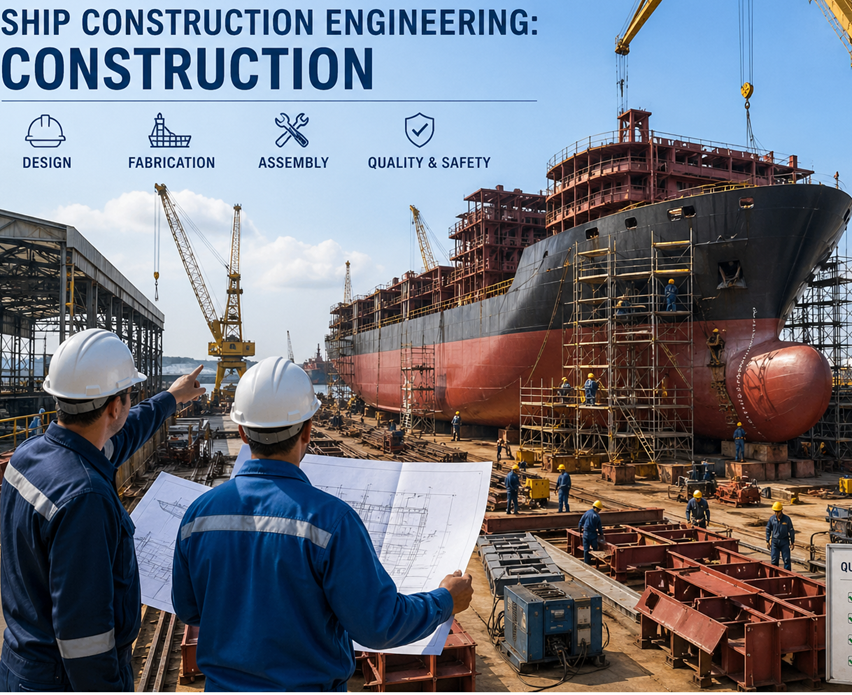
Learn how modern ships are built using advanced materials, welding processes, and testing methods. A complete guide for maritime students and professionals.
What Keeps a Ship Strong at Sea?
A ship operates in one of the most demanding environments imaginable. It faces continuous wave loads, corrosion from seawater, temperature variations, and mechanical stresses from cargo and machinery. Ensuring that a vessel remains safe and operational over decades requires a combination of carefully selected materials, precise welding, and rigorous testing. Modern ship construction is not based on experience alone. It is governed by international frameworks led by the International Maritime Organization and implemented through classification societies. These organizations define how ships should be designed, built, inspected, and maintained to ensure safety and reliability.
Ship Construction Materials
Ship construction materials form the physical structure of the vessel. They are used in hull plating, decks, internal bulkheads, stiffeners, tanks, and machinery supports. These materials must satisfy strict engineering and operational requirements.
A suitable shipbuilding material must combine strength, durability, and weldability. It must also resist corrosion and fatigue while remaining cost-effective and available in large structural forms. The choice of material is never random; it is guided by classification rules and decades of operational experience.
Main Materials Used in Modern Ship Construction
| Material | Typical Applications | Key Advantages | Limitations |
|---|---|---|---|
| Mild / Carbon Steel | Hull, decks, frames | Strong, economical, easy to weld | Needs corrosion protection |
| High-Strength Steel | Critical structural zones | Reduced weight, high strength | Sensitive to welding conditions |
| Stainless Steel | Tanks, piping systems | Excellent corrosion resistance | Expensive |
| Aluminium Alloys | Superstructures, fast vessels | Lightweight, corrosion resistant | Prone to distortion |
| Composites (FRP) | Small vessels, special components | Lightweight, low maintenance | Fire and certification concerns |
The International Association of Classification Societies requires that material selection considers structural strength, fatigue performance, and corrosion protection within standardized rules.
Why Material Selection Matters
Material selection directly affects the overall performance of a ship. A heavier structure increases fuel consumption, while a weaker material may reduce safety margins. Corrosion resistance influences maintenance costs, and weldability determines how easily components can be fabricated.
For example, high-strength steel allows designers to reduce thickness while maintaining structural integrity, which improves efficiency. On the other hand, aluminium is ideal for high-speed vessels because of its low weight, but it requires careful thermal control during welding. In practice, naval architects must balance strength, weight, cost, durability, and regulatory compliance to achieve an optimal design.
Welding in Shipbuilding
Welding is the backbone of modern ship construction. Unlike older riveted structures, today’s ships are almost entirely welded. This allows the creation of continuous, strong, and watertight structures.
However, welding is not simply a joining process. It is a controlled engineering operation. Welding parameters, procedures, and personnel must all be approved. Classification societies require Welding Procedure Specifications (WPS) and qualification records to ensure consistency and repeatability in production . The importance of welding quality cannot be overstated. Ships contain hundreds of kilometers of welded joints, and even a small defect can grow under cyclic loading and lead to failure.
Common Welding Processes Used in Shipyards
| Welding Process | Description | Typical Use |
|---|---|---|
| SMAW (Stick Welding) | Manual welding with consumable electrode | Repairs, confined areas |
| GMAW (MIG/MAG) | Semi-automatic wire welding | Panel fabrication |
| FCAW | Flux-filled wire, high deposition rate | Thick plates, heavy structures |
| SAW | Automated, deep penetration welding | Long hull seams |
| TIG (GTAW) | High-precision welding | Aluminium, stainless steel |
Each process is selected based on material type, thickness, accessibility, and production efficiency.
Welding Defects and Quality Control
Welding defects are critical concerns in ship construction because ships are exposed to continuous dynamic loads. Even small imperfections can reduce fatigue strength and lead to long-term structural damage. Common defects include porosity, cracks, incomplete fusion, and slag inclusions. These defects often originate from poor welding technique, incorrect parameters, or improper material preparation.
Quality control begins before welding starts. Materials must be correctly identified and prepared, and welding procedures must be approved. During welding, parameters such as heat input and travel speed are controlled. After welding, inspection plays a key role. Welding inspection is a structured process used to verify that welds meet safety and quality standards. It combines visual checks, destructive testing, and non-destructive examination to ensure structural integrity .
Materials Testing in Ship Engineering
Materials testing ensures that both base materials and welded joints meet the required mechanical and structural properties. A steel plate may appear acceptable visually, but only testing can confirm its strength, toughness, and reliability. Testing is essential because welding alters the material’s microstructure, especially in the heat-affected zone. If not properly controlled, this area may become brittle or weak.
Classification societies require testing as part of certification. They define how materials must be tested, documented, and approved before being used in construction .
Destructive and Non-Destructive Testing
| Testing Type | Method | Purpose |
|---|---|---|
| Destructive Testing (DT) | Tensile, impact, bend tests | Measures strength and toughness |
| Non-Destructive Testing (NDT) | UT, RT, MPI, PT, VT | Detects internal and surface defects |
Destructive testing is mainly used during material qualification and welding procedure approval. Non-destructive testing is widely used during construction and maintenance because it allows inspection without damaging the structure. Classification societies require NDT for ship welds to ensure quality and safety, although not all welds are inspected due to the large scale of ship structures .
Classification Societies and Shipbuilding Standards
Classification societies are central to ship construction. They establish technical standards and verify compliance through surveys and certification. A ship must meet these standards to be registered, insured, and operated internationally. Organizations such as DNV, Lloyd’s Register, American Bureau of Shipping, and Bureau Veritas define rules for materials, welding, testing, and inspection. These societies act as independent verification bodies, ensuring that ships comply with technical standards during construction and throughout their service life .
Practical Example: Building and Testing a Hull Section
The construction of a hull section demonstrates how materials, welding, and testing are integrated:
Steel plates are first delivered with certification and inspected. They are then cut, shaped, and aligned. Welding begins with tack welds to hold the structure, followed by full welding using appropriate methods such as SAW or FCAW.
After welding, inspectors perform visual checks. Depending on the importance of the joint, non-destructive testing methods such as ultrasonic or radiographic testing are applied. Any defects are repaired before final approval.
This process highlights that shipbuilding is not just fabrication—it is a controlled, verified engineering system.
Modern Trends in Marine Materials and Welding
Shipbuilding is evolving with new technologies and materials. Automation is becoming increasingly common, especially in large shipyards where robotic welding systems improve consistency and productivity. Advanced materials, such as high-strength steels, allow lighter and more efficient ships. However, they require stricter control during welding to prevent defects such as hydrogen cracking.
Digital technologies are also transforming the industry. Sensors can monitor welding parameters in real time, improving quality control and traceability. In the future, digital twins and artificial intelligence may help predict defects and optimize structural performance.
Key Challenges in Ship Construction
Despite advancements, ship construction still faces several challenges. Corrosion remains one of the most significant issues due to continuous exposure to seawater. Fatigue is another critical concern, as ships experience repeated loading cycles that can weaken welded joints over time.
Thermal distortion during welding can affect alignment and structural accuracy, while joining dissimilar materials such as steel and aluminium introduces additional complexity.
Addressing these challenges requires a combination of better design practices, improved materials, advanced welding techniques, and strict quality control.
Conclusion: The Backbone of Ship Safety
The strength and reliability of a ship depend on the successful integration of materials, welding, and testing. These processes ensure that vessels can operate safely under demanding marine conditions for many years.
Understanding these fundamentals is essential for maritime students, engineers, and professionals. Behind every ship at sea lies a complex system of engineering decisions, inspections, and standards that ensure safety, performance, and compliance.
Frequently Asked Questions (FAQ)
What is the most common shipbuilding material?
Steel is the most widely used material due to its strength, cost efficiency, and weldability.
Why is welding important in shipbuilding?
Welding creates the structural connections that hold the ship together and ensures watertight integrity.
What is NDT in ship construction?
Non-Destructive Testing is used to detect defects without damaging the material or structure.
Who ensures ship construction quality?
Classification societies and international regulations ensure compliance with safety and technical standards.
References
- International Maritime Organization – Ship construction safety frameworks
- International Association of Classification Societies – Common Structural Rules
- DNV – Rules and Standards Explorer
- Bureau Veritas – Classification Rules
- Welding certification requirements (DNV)
- TWI Global – Welding quality in ship construction
- Review of NDT methods for shipbuilding
- Welding inspection overview
- Ship classification society role