
Introduction
When a ship is berthed at a port, its main propulsion engines are shut down as movement is not required. However, electricity is still vital to maintain habitability and operations for the crew on board, powering everything from living quarters and galleys to essential ship systems. Traditionally, this power is supplied 24 hours a day by the ship’s own auxiliary diesel generators, which continue to burn fuel and emit exhaust while the vessel is docked.
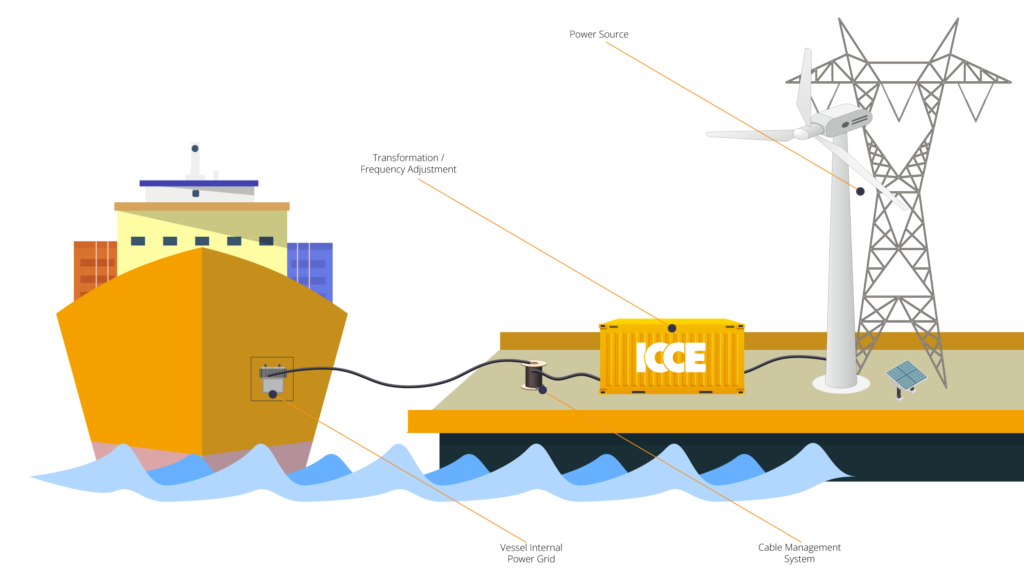
Shore-to-ship power supply, known as cold ironing, involves providing docked ships with electricity from the land-based grid. This is essential because ships require continuous power for critical onboard systems while at port, including lighting, air conditioning, galleys, computers and controls, as well as various pumps and equipment.
Shore-to-ship power supply, also called cold ironing, means giving electricity to a ship from the land while it is parked at a port.
🌊 Why ships need this
When ships stop at a port, they still need power for:
- Lights
- Air conditioning
- Kitchens
- Computers and controls
- Pumps and other equipment
Normally, ships run their diesel engines to make this power. These engines create:
- Air pollution
- Noise
- CO₂ emissions
⚡ How cold ironing works (simple steps)
- The ship arrives at the port and turns off its diesel generators.
- Big electrical cables are connected from the port to the ship.
- The port sends electricity (like a city power grid).
- The ship uses this power until it leaves.
🚢 Where it is used
Cold ironing is common in:
- Cruise ports
- Container ports
- Ferry terminals
Many European ports are adding this system because of environmental rules.
Credit: ICCE
Benefits of Onshore Power Supply
The adoption of OPS/SSE offers numerous benefits for the maritime industry, port authorities, and local communities:
- Reduction in Emissions: By replacing diesel-powered auxiliary engines with electricity, OPS/SSE significantly reduces emissions of CO2, NOx, SOx, and particulate matter (PM). This contributes to improved air quality and public health, especially in port cities.
- Noise Reduction: Ships connected to shore-side electricity produce less noise compared to those running onboard generators, creating a quieter environment for port workers and nearby residents.
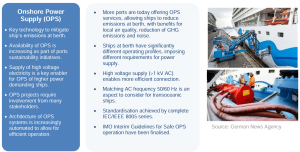
- Compliance with Regulations: OPS/SSE helps ships comply with increasingly stringent environmental regulations, such as the EU’s FuelEU Maritime Initiative and the International Maritime Organization (IMO)‘s sulfur cap.
- Energy Efficiency: Shore-side electricity is often more energy-efficient than onboard generators, as it leverages the grid’s power, which may include renewable energy sources.
- Economic Benefits: While the initial investment in OPS infrastructure can be high, the long-term savings from reduced fuel consumption and maintenance costs can offset these expenses.
Challenges in Implementing OPS/SSE
Despite its benefits, the widespread adoption of OPS/SSE faces several challenges:
- High Initial Costs: The installation of OPS infrastructure requires significant investment in electrical systems, transformers, and cabling. Ports and ship operators must also retrofit vessels to accommodate shore-side connections.
- Technical Compatibility: Not all ships are equipped to connect to shore-side electricity. Retrofitting older vessels can be costly and technically challenging.
- Grid Capacity: Ports must ensure that the local power grid can handle the additional demand from ships without compromising reliability.
- Standardization: The lack of global standards for OPS systems can create compatibility issues between ports and ships. Efforts by organizations like the International Electrotechnical Commission (IEC) are underway to address this challenge.
- Operational Challenges: Coordinating the connection and disconnection of ships to the grid requires careful planning and coordination between port authorities, ship operators, and utility providers.
IMO Guidelines on Safe Operation of Onshore Power Supply(OPS) Service in Ports
IMO provides interim guidelines for the safe operation of Onshore Power Supply (OPS) services in ports for ships engaged in international voyages, approved by the Maritime Safety Committee. These guidelines aim to promote the safe use of OPS, which helps reduce emissions and conserve energy, aligning with global environmental protection goals like the Paris Agreement. The guidelines cover general requirements, terms and definitions, verification and testing procedures, operational protocols for both high and low voltage systems, safety precautions, necessary documentation, and personnel familiarization. They emphasize the importance of compatibility assessments, pre-connection checklists, and the involvement of competent personnel to ensure safe and efficient OPS operations. The guidelines are subject to review and amendment based on experience and evolving circumstances.
https://www.skanregistry.com/uploads/download-directory/pdf/319/document.pdf
Classifications of Shore-Side Electricity (SSE) Configurations
The European Maritime Safety Agency (EMSA) has outlined various Shore-Side Electricity (SSE) configurations in its publication, providing a structured approach to understanding the different topologies and their applications. These configurations are categorized based on voltage levels, frequency conversion methods, and the integration of energy storage and renewable energy sources. Below is a detailed classification of SSE configurations as per the EMSA publication:
1. High-Voltage Onshore Power Supply (HV-OPS)
a. High-Voltage Onshore Power Supply with Centralized Frequency Conversion (HV-OPSC)
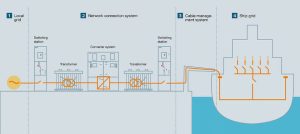
This configuration involves connecting ships to a high-voltage (HV) utility grid at a designated voltage and frequency. Frequency conversion occurs at a centralized port substation, with multiple frequency converters for redundancy. The system distributes power to berth junction boxes with HV socket-outlets, making it suitable for large vessels like container ships. Centralized frequency conversion ensures efficient power management and is ideal for ports with high power demand and multiple berths.
b. High-Voltage Onshore Power Supply with Decentralized Frequency Conversion (HV-OPSd)
Similar to HV-OPSC, this configuration involves frequency conversion at decentralized berth substations. It is designed for large consumers like cruise ships, with mobile cable management systems ashore. Decentralized frequency conversion allows for more flexible power distribution, catering to specific berth requirements and reducing the load on centralized systems.
–
2. Low-Voltage Onshore Power Supply (LV-OPS)
a. Low-Voltage Onshore Power Supply without Cable Management System (LV-OPS)
In this configuration, ships are connected to a low-voltage (LV) supply after stepping down from the HV utility grid. Frequency conversion occurs at the port substation, and the system uses multiple cables for LV connection with parallel feeder circuit breakers. The absence of an onboard cable management system makes it suitable for smaller vessels or ports with limited infrastructure.
b. Low-Voltage Onshore Power Supply with Cable Management System (LV-OPSc)
This configuration includes a cable management system onboard the ship, with cable reels for easy connection. Multiple cables and parallel feeder circuit breakers ensure efficient power distribution. The onboard cable management system enhances flexibility and ease of use, making it ideal for vessels requiring efficient cable handling.
c. Low-Voltage Onshore Power Supply by Mobile Step-Down Unit (LV-OPS Mobile)
LV power is supplied from an HV infrastructure using a mobile step-down unit. This configuration is highly flexible, allowing for temporary or flexible OPS solutions. It is particularly useful for ships without onboard step-down transformers, providing a versatile power supply option.
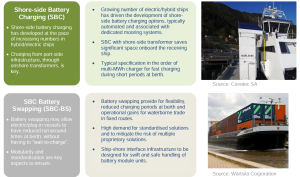
3. Shore-Side Battery Charging (SBC)
a. DC Shore-Side Battery Charging (SBC-DC)
Ships are charged using direct current (DC) supplied by the HV utility grid, with power conditioning via transformers and rectifiers. The system supports both wired and wireless inductive charging, with capacitance compensators for inductive charging. DC-DC converters onboard ensure efficient power transfer, making it suitable for ships with battery-powered systems.
b. AC Shore-Side Battery Charging (SBC-AC)
This configuration uses alternating current (AC) for charging, with power conditioning via transformers and frequency conversion if necessary. It supports both wired and wireless inductive charging, with capacitance compensators for inductive charging. DC-DC converters onboard ensure compatibility with hybrid or battery-powered systems.
c. Shore-Side Battery Charging with Battery Swapping (SBC-BS)
Batteries are swapped at the berth to reduce turnaround times, with berth-level charging units for interchangeable batteries. This configuration is ideal for ships engaged in regular traffic with short berthing periods, providing a quick and efficient charging solution.
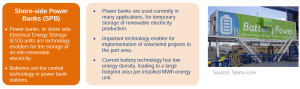
4. Shore-Side Power Banking (SPB)
a. Shore-Side Power Banking for OPS Supply (SPB-OPS)
Renewable energy resources, such as wind and solar, are integrated into the port’s energy system, supplying power to OPS through inverters. The direct integration of renewables ensures a sustainable power supply, with inverter units providing AC power at the required voltage and frequency.
b. Shore-Side Power Banking for Battery Charging Supply (SPB-SBC)
Similar to SPB-OPS, this configuration supplies power for battery charging, with renewable energy resources integrated into the port’s energy system. Inverter units provide AC power at the required voltage and frequency, supporting battery-powered ships and enhancing sustainability.
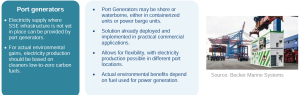
5. Port Generators (PG)
a. Floating Power Unit (FPU) Connected to Port Grid (PG-FPU)
A floating power generator supplies electricity to the port grid, which can then be used for OPS or battery charging. The system is highly flexible, with the ability to use renewable or low-carbon fuels, making it suitable for ports with limited infrastructure or high power demand.
b. Floating Power Unit (FPU) Connected Directly to Ship Grid (PG-FPU)
The FPU supplies power directly to the ship’s grid, offering operational flexibility. It can be moored alongside the ship, providing a versatile power supply solution for cruise ships or vessels requiring flexible power options.
c. Mobile Energy Storage Unit (PG-MESU)
A mobile battery bank supplies power to ships at the required voltage and frequency. The system is highly flexible, with the ability to be charged within port infrastructure and mobilized as needed. It provides a temporary or flexible power supply solution for various port applications.
d. Mobile Power Unit (MPU)
A mobile generator-alternator unit supplies power to ships, offering flexibility and mobility. The system can use renewable or low-carbon fuels, ensuring compliance with sustainability standards. It is ideal for temporary or flexible power supply solutions in ports.
6. Integrated Renewable Energy Solutions
a. Shore-Side Power Banking with Renewable Energy (SPB-OPS/SBC)
Renewable energy sources, such as wind and solar, are integrated into the port’s energy system, supplying power for OPS or battery charging. The system supports both direct and indirect integration of renewables, with inverter units providing AC power at the required voltage and frequency. This configuration is ideal for ports aiming for sustainability and reduced carbon footprint.
–
The Future of OPS/SSE
The future of OPS/SSE looks promising, driven by technological advancements and increasing regulatory pressure. Key trends include:
- Integration with Renewable Energy: Ports are increasingly integrating renewable energy sources, such as solar and wind, into their OPS systems to further reduce emissions.
- Smart Grids: The development of smart grids will enable more efficient management of electricity demand and supply, enhancing the reliability of OPS systems.
- Global Standardization: Efforts to establish global standards for OPS systems will facilitate compatibility and interoperability between ports and ships.
- Incentives and Policies: Governments and international organizations are likely to introduce more incentives and policies to encourage the adoption of OPS/SSE.
Onshore Power Supply (OPS) or Shore-Side Electricity (SSE) is a game-changing technology that offers significant environmental, economic, and social benefits. While challenges remain, the efforts of organizations like EMSA and the success of pioneering ports demonstrate the feasibility and potential of OPS/SSE. As the maritime industry continues to prioritize sustainability, OPS/SSE will play a crucial role in reducing emissions and creating cleaner, quieter ports. By investing in OPS infrastructure and fostering collaboration among stakeholders, the maritime industry can pave the way for a more sustainable future.