
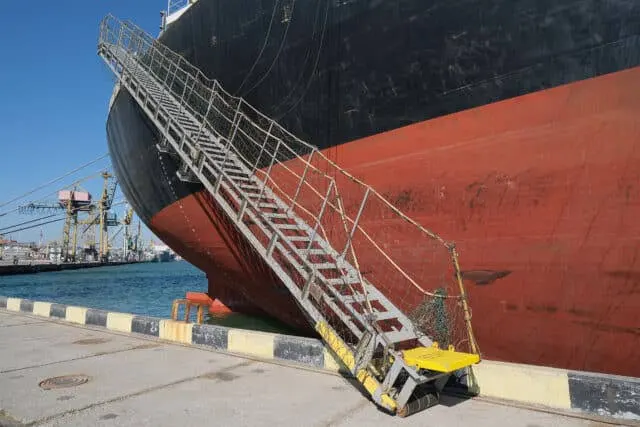
The gangway is often the first and last thing a person encounters when boarding or leaving a ship. It is also, statistically, one of the most dangerous. Port State Control data reveals that deficiencies related to embarkation and disembarkation arrangements remain widespread across the global fleet, with gangway and accommodation ladder issues generating thousands of inspection findings and a steady stream of detainable deficiencies every year. Behind these statistics lie serious injuries, fatalities, operational delays, and a recurring pattern of systemic failures that the industry has been slow to address.
Unlike many safety-critical systems on board, the gangway sits at the intersection of ship and shore, vessel and terminal, crew and visitor. It is exposed to weather, tidal movement, cargo operations, and the cumulative effects of corrosion and mechanical wear. Yet it is frequently treated as a piece of equipment to be rigged and forgotten rather than a dynamic safety barrier requiring continuous attention. As the Australian Maritime Safety Authority has observed, “Accessing a vessel while at berth or anchor is a routine activity which is sometimes taken for granted,” and this complacency has consequences.
The Regulatory Framework and Its Limits
International requirements for gangways and accommodation ladders are well established. SOLAS regulation II-1/3-9, which entered into force in 2010, governs the means of embarkation and disembarkation from ships, with detailed guidance provided in IMO circular MSC.1/Circ.1331. A revised version of this circular, MSC.1/Circ.1331/Rev.1, was approved by the Maritime Safety Committee in June 2025 and takes effect from 1 July 2026, introducing updated ISO standards, mandatory personal protective equipment requirements, and clearer definitions for safety nets and side nets.
The regulatory framework also imposes specific maintenance and inspection obligations. SOLAS regulation III/20.7.2 requires monthly inspection and maintenance of means of embarkation and disembarkation, while MSC.1/Circ.1331 refers to these requirements for all ships, irrespective of construction date. The five-yearly testing of accommodation ladders and gangways must be carried out statically using the maximum working load, with the equipment in the horizontal position.
Yet the gap between regulatory requirements and practical implementation remains wide. The revised guidelines acknowledge that crew members must wear life jackets and safety harnesses while rigging accommodation ladders, gangways, and safety nets—a requirement that, by its very inclusion, highlights the risks inherent in the rigging process itself. The fact that such basic personal protective measures needed to be made explicitly mandatory suggests that existing practices were falling short.
The Inspection and Maintenance Deficit
Port State Control inspections routinely reveal a catalogue of deficiencies that point to systemic maintenance failures. Common findings include damaged or wasted accommodation ladders, cracked gangway welds, missing securing bolts, deteriorated handrails, and improperly secured pilot ladders. In more serious cases, PSC officers have identified gangways with significant cracks at turning platform connection points and pilot ladder winch reels missing brakes or locking arrangements. Vessels have been detained for damaged and improperly maintained gangways, with one alert noting that “the starboard side gangway was damaged and not properly maintained” as a detainable deficiency.
The inspection checklists themselves reveal the breadth of the problem. The International Institute of Marine Surveying recommends checks for distortion and cracks, corrosion—particularly where aluminium accommodation ladders have mild steel fittings—and the condition of all moving parts such as turntables, sheaves, tracks, bearings, and rollers. The underside of the gangway must also be inspected, as must the structure of supporting points and winch beds. Safety nets should be checked for wear, damage, actinic degradation, and impregnation from chemicals, grease, or paint.
What is striking about these checklists is not their complexity but their simplicity. These are not obscure technical requirements; they are basic maintenance tasks that should be routine. The persistence of such deficiencies suggests that inspection and maintenance regimes are not being followed with the rigour that safety-critical equipment demands. The fact that a gangway can be damaged and yet remain in service, or that securing bolts can go missing without being replaced, points to a systemic failure in planned maintenance systems and the oversight that should support them.
Case Studies in Systemic Failure
The consequences of these failures are not theoretical. In one incident, a container vessel’s gangway detached from the quayside while five lashers were ascending it, injuring all five. The investigation found that tidal movement had caused the gangway roller to encroach on a quayside ladder void, compromising its stability. Critically, the vessel’s procedure requiring supervision of the gangway at all times was not followed, and the hoist wires were slack enough to allow the gangway to drop approximately three metres. The maximum load sign was faded, no lifebuoy was present at the lower part of the gangway, and one of the injured parties was not wearing his chinstrap, resulting in the loss of his helmet during the fall. Every one of these failures was preventable.
Another case highlights the dangers of unauthorised intervention. During cargo operations, a vessel’s aft mooring lines were found tightened, and the bridge instructed that the gangway be recovered. While the deck crew was loosening mooring lines, third-party port riggers who had remained onboard reinstalled the gangway without informing the vessel’s crew, and then left the vessel. During subsequent vessel position adjustments, the unattended gangway was caught between the berth and the vessel and damaged. The investigation identified a fundamental failure in communication and coordination, noting that “vessel gangways are critical safety equipment and should only be handled by authorized vessel crew under an order given from the bridge”. It also warned that gangway access during vessel movement or when mooring lines are slackened should not be permitted, regardless of operational pressure.
In the offshore sector, the loss of a walk-to-work gangway between a service operation vessel and an offshore facility illustrates how single-point failures can cascade. On 30 May 2025, while connecting the gangway, the vessel lost hydraulic pressure due to a rupture in a supply hose coupling. The gangway’s functions became inoperational, and it was deemed unavailable for evacuation purposes. Eighteen people had to be evacuated by SAR helicopter. The investigation pointed to a material defect in the coupling’s press sleeve and found that no risk assessments had been conducted on the loss of control of the gangway when connected to the landing area. A similar incident occurred five months later when a supply hose was ejected from its coupling because the wrong type of coupling had been used and insufficient pressure had been applied during assembly. Two incidents, five months apart, with the same root cause: a failure to ensure that maintenance and assembly procedures were correctly followed.
Operational Safety Beyond the Hardware
Gangway safety is not solely a matter of inspection and maintenance. Operational practices during rigging, use, and recovery are equally critical. The revised IMO guidelines make clear that gangways should not be used at an angle of inclination greater than 30 degrees from the horizontal, and that they should never be secured to a ship’s guardrails unless those structures have been designed for that purpose. Gangways must be frequently monitored and adjusted to ensure they do not become too steep and remain firmly landed on the wharf edge. Adequate lighting, lifebuoys with self-igniting lights and buoyant lifelines, and properly rigged safety nets are mandatory.
The rigging process itself is hazardous. Crew members working over the side to install stanchions and side ropes are exposed to falls from height, which is why the revised guidelines now mandate the use of life jackets and safety harnesses during rigging operations. The Britannia P&I Club advises that crew members’ safety harnesses should have a slightly taut safety line rather than being fully slack, as this tension can help prevent crew members from landing abruptly in the event of a fall, reducing the risk of severe injuries.
The positioning of the gangway relative to the quay is another critical factor. Where bollards, water manifolds, electrical installations, or ladder voids exist on the wharf, the gangway may need to be supplemented with extensions, extra steps, or portable walking bridges. If such solutions are required, a risk assessment should be carried out and the solution approved by the master. The lesson from the container vessel incident—where a gangway roller encroached on a ladder void—is that the interaction between the gangway and the quay environment must be actively managed, not assumed.
The Human Element and the Training Gap
Systemic failures in gangway safety are ultimately failures of human systems: communication, training, supervision, and safety culture. The incident involving unauthorised gangway handling by third-party riggers revealed not only a breakdown in communication but also a lack of control and supervision of shore personnel onboard. The investigation recommended that during re-berthing or gangway removal, third-party contractors and visitors should disembark unless full control over those remaining onboard can be guaranteed.
The SIRE inspection regime for tankers includes specific questions about gangway procedures, requiring inspectors to verify that officers are familiar with the required level of supervision during rigging and recovery, the safety precautions required when working over the side, and the circumstances in which a safety net must be used. This focus reflects a recognition that procedural knowledge alone is insufficient; crew members must be able to apply that knowledge under operational pressure.
The revised IMO guidelines place an obligation on shipowners, operators, masters, and officers to “familiarise themselves with the new guidelines and to train and instruct the crew accordingly”. This is not a suggestion but a requirement, and it reflects the reality that even the most robust regulatory framework will fail if the people responsible for implementing it are not adequately prepared.
Breaking the Cycle
Addressing the systemic failures in gangway safety requires a multi-layered approach. First, planned maintenance systems must be genuinely planned and maintained, not treated as administrative exercises. Monthly inspections and five-yearly load tests are the minimum standard, not the ceiling. The condition of fall wires, winch brakes, limit switches, and structural components must be verified through physical inspection, not assumed from records.
Second, the rigging and recovery of gangways must be treated as a controlled operation with clear lines of authority and communication. Only authorised crew should handle gangways, and the bridge must retain oversight at all times. Third-party personnel must be subject to the same sign-in and sign-off procedures as any other visitor.
Third, training must be practical and scenario-based. Crew members need to understand not only how to inspect and rig a gangway but also why each step matters and what can go wrong when shortcuts are taken. The case studies in this article—each involving a failure that was entirely preventable—demonstrate the consequences of treating gangway safety as routine.
Finally, the interaction between the gangway and its environment must be actively managed. Tidal movement, quay obstructions, cargo operations, and vessel movements all affect gangway stability. Continuous monitoring and adjustment are not optional extras; they are fundamental to safe access.
Conclusion
The gangway is a critical safety barrier that is too often taken for granted. The evidence from Port State Control inspections, accident investigations, and safety alerts reveals a pattern of systemic failures in inspection, maintenance, and operational practices that expose crew, visitors, and shore personnel to unnecessary risk. Damaged gangways remain in service. Inspection checklists are not followed. Maintenance procedures are not implemented correctly. Communication breaks down. Training is inadequate. Each of these failures is individually concerning; collectively, they represent a systemic weakness in how the maritime industry manages one of its most basic safety functions.
The revised IMO guidelines, with their emphasis on personal protective equipment, side nets, and updated construction standards, are a step in the right direction. But regulations alone will not solve the problem. What is needed is a cultural shift in which gangway safety is treated with the same seriousness as fire safety or enclosed space entry. The gangway is not a convenience; it is a lifeline. Until it is treated as such, the hidden hazards created by systemic failures in gangway inspection, maintenance, and operational safety will continue to claim victims.