
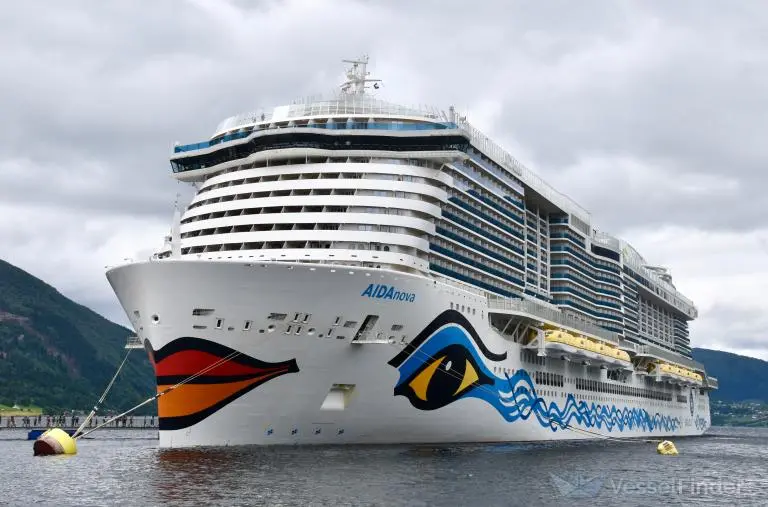
Few shipbuilding stories show the scale of modern maritime engineering as clearly as a construction timelapse. In minutes, years of design, steelwork, outfitting, testing and commissioning become visible: a dry dock fills with blocks, a hull grows above the quay, decks appear one by one, and an empty industrial structure becomes a floating city ready for sea.
That is why an AIDAnova ship construction timelapse is more than beautiful footage. It is a practical window into how one of the most technically important cruise ships of its generation was created.
Built by MEYER WERFT in Papenburg, Germany, for AIDA Cruises, AIDAnova entered service in December 2018. The ship is widely recognised as the first cruise vessel designed to operate with liquefied natural gas (LNG) both at sea and in port. Its delivery marked an important step in the cruise sector’s shift toward lower-emission operations, even though LNG is a transition fuel rather than a zero-emission solution.
This article takes readers behind the timelapse. It explains how a mega cruise ship is built, what makes AIDAnova different, why LNG machinery changes the design process, and what students, seafarers and cruise enthusiasts can learn from watching the construction unfold.
Ship Construction Timelapse: How the First LNG-Powered Cruise Ship AIDAnova Was Built
AIDAnova at a glance
| Item | AIDAnova data |
|---|---|
| Shipyard | MEYER WERFT, Papenburg, Germany |
| Operator | AIDA Cruises |
| Entered service | December 2018 |
| Class / series | Helios Class |
| Gross tonnage | approximately 183,900 GT |
| Length overall | 337 m |
| Beam | 42 m |
| Decks | 20 |
| Passenger cabins | 2,626 |
| Reported passenger capacity | 5,228 passengers in MEYER WERFT delivery data |
| Crew | approximately 1,500 |
| Total installed machinery power | approximately 61.8 MW |
| Propulsion power | approximately 37 MW |
These figures explain why AIDAnova looks enormous even in a shipyard dock. At 337 metres long, the ship is longer than three football pitches placed end to end. Yet length alone does not capture the construction challenge. A cruise ship is a highly finished passenger environment with hotel services, restaurants, entertainment spaces, cabins, safety systems, propulsion machinery, ventilation, electrical distribution, wastewater treatment, navigation equipment and thousands of kilometres of cables—all of which must work together safely.
A quick correction: AIDAnova is Helios Class, not Oasis Class
Cruise ships are often compared because their dimensions, accommodation and public spaces are visually impressive. But AIDAnova should not be described as an Oasis-class ship. Oasis Class is a Royal Caribbean International series. AIDAnova is the first vessel in MEYER WERFT’s Helios Class, developed for AIDA Cruises and followed by related ships for brands in the Carnival Corporation family.
This distinction matters because a ship class is not simply a marketing label. It describes a particular design family, technical architecture, shipyard programme, safety case, machinery arrangement and operating concept. AIDAnova’s LNG system, its energy-management approach and its passenger layout belong to its own development story.
Why a cruise-ship construction timelapse is so fascinating
A construction timelapse compresses a complex project into a simple narrative: steel becomes a ship. It allows viewers to see the relationship between shipyard organisation and the final vessel.
In reality, a major cruise ship is not built as one continuous hull from bow to stern. Modern shipyards use modular construction. Steel plates are cut and shaped, welded into panels, assembled into units, and then combined into much larger blocks. Those blocks may already contain cable routes, pipe foundations, ventilation trunks, machinery supports, insulation, doors, cabins or sections of public space before they are lifted into the building dock.
When a timelapse shows cranes moving huge sections into place, it is showing the final stages of work that has already required design coordination, welding, inspection, logistics and quality control. The spectacle is real, but so is the preparation hidden behind every lift.
For AIDAnova, the scale is especially striking because the ship contains both the heavy technical plant of an ocean-going vessel and the highly finished interior of a large resort. A block may form part of the hull, but it may also contain cabins, theatres, restaurants, stair towers, service corridors, ducts and fire boundaries. The shipyard must coordinate structural work, mechanical installation, electrical work and hotel outfitting in the right sequence.
Stage 1: from concept and digital model to steel cutting
Ship construction begins long before the first steel plate is cut. The owner, shipyard, designers, equipment makers, class society and flag-state stakeholders first define the vessel’s requirements. For a cruise ship, this includes passenger capacity, routes, speed, hotel load, safety arrangements, environmental performance, accessibility, public-space design, crew accommodation, food service, maintenance access and lifecycle costs.
For AIDAnova, LNG propulsion added a major technical dimension. LNG is natural gas cooled to around -162°C so that it becomes liquid and can be stored in a manageable volume. Using it on board requires dedicated tanks, fuel-handling equipment, gas safety systems, ventilation, detection, double-wall or protected pipe arrangements where required, control systems and carefully planned interfaces with engines and emergency procedures.
Before construction, these systems must be designed into the ship—not added as an afterthought. Engineers use detailed digital models to coordinate steel structure, machinery, pipes, cables, cabins, ducts and access routes. If a pump cannot be removed for maintenance, a valve cannot be reached, a cable tray conflicts with a ventilation duct, or a fire boundary is interrupted, the problem is far cheaper to solve in the model than after the ship is built.
The design stage also includes stability calculations, structural assessment, hydrodynamics, machinery calculations, evacuation analysis, fire-safety engineering, vibration and noise studies, and compliance work. A cruise ship must be attractive for guests, but it must first be safe, operable and maintainable.
Stage 2: steel cutting, panels and ship blocks
Once the design is mature enough for production, the shipyard begins steel processing. Computer-controlled machines cut steel plates and profiles to the planned shapes. Workshops then create flat panels, curved shell sections, decks, bulkheads and stiffened structures.
The next step is block construction. Instead of welding the entire ship inside the dock one small piece at a time, the yard builds large modules in parallel. This shortens the critical path and allows different teams to work simultaneously. One team may build a machinery-space block while another completes an accommodation block, a bow module, a funnel section or part of the engine casing.
This is where timelapse footage can be deceptive in the best possible way. A huge block appears to arrive and instantly become part of the ship. But that block represents thousands of design decisions: correct steel grades, approved welding procedures, dimensional checks, corrosion protection, penetrations for pipes and cables, access openings, supports, foundations and inspection records.
For AIDAnova, the scale of interior completion was extraordinary. MEYER WERFT reported approximately 2,500 kilometres of installed cable, around 40,030 light fittings and a substantial quantity of interior and exterior finishing materials. These are not decorative details added at the end; they reflect a major industrial supply chain managed alongside the core naval-architecture work.
Stage 3: grand-block assembly in the building dock
The most dramatic part of a ship-construction timelapse is usually the building dock stage. Large hull blocks are brought together, aligned, welded and connected until the ship’s full length and height emerge.
Alignment is critical. A ship hull must meet strict tolerances so that the shaft line, propellers, rudders, decks, doors, windows, piping and interior modules all fit correctly. Even small deviations can create expensive rework. Surveyors and shipyard teams verify dimensions, weld quality, compartment boundaries and structural continuity as construction progresses.
On a cruise ship, the building dock fills upward as well as outward. The lower part contains tanks, machinery foundations, propulsion spaces, technical rooms and service routes. The middle levels contain cabins, galleries, public rooms, stores and crew spaces. Upper decks gradually acquire balconies, glazing, pools, sports areas, ventilation trunks, navigation decks and funnel structures.
AIDAnova’s finished vessel has 20 decks. Watching those decks appear in a timelapse gives a sense of the ship’s vertical complexity. It is not just a long hull; it is a stacked urban environment with strict fire zones, escape routes, ventilation zones, electrical sections and service corridors.
Stage 4: installing the LNG power and propulsion plant
The machinery plant is one of the defining features of AIDAnova. LNG fuel can significantly reduce local air pollutants compared with conventional residual marine fuel, particularly sulphur oxides and particulate matter. It can also reduce nitrogen oxides and carbon dioxide at the point of use, depending on the engine, operating profile and comparison fuel. However, LNG is not a carbon-neutral fuel. Methane emissions and lifecycle performance must be managed carefully, which is why the wider maritime transition is moving toward a range of lower- and zero-GHG fuel pathways.
For the shipyard, LNG propulsion means more than selecting an engine. The ship needs an integrated fuel system. LNG storage tanks, fuel-conditioning equipment, pumps, vaporizers, gas valves, safety shut-down functions, ventilation, gas detection, control logic and emergency arrangements must all operate as one protected system.
MEYER WERFT states that AIDAnova carries three LNG tanks with a total capacity of about 3,500 cubic metres, sufficient for roughly two weeks of operation under the yard’s stated assumptions. The tanks are part of a wider safety and operational architecture. Their location, structural protection, access, ventilation and connection to the power plant affect both the design and the construction sequence.
The vessel’s stated total machinery power is about 61.8 MW, while propulsion power is approximately 37 MW. That distinction is useful. A cruise ship needs energy not only to move through the water but also to support the “hotel” side of the vessel: air conditioning, lighting, kitchens, laundry, water production, entertainment, lifts, pools, navigation, communications and accommodation. On a large cruise ship, electrical and thermal demand are major engineering issues in their own right.
Stage 5: outfitting—when a hull becomes a cruise ship
After the visible hull is assembled, a long period of outfitting begins. In fact, much outfitting starts before blocks reach the dock, but the final stages become more noticeable once the ship is structurally complete.
Outfitting includes machinery installation, pipe systems, cabling, insulation, painting, accommodation modules, kitchens, restaurants, theatres, passenger cabins, lifts, furniture, signage, navigation equipment, lifesaving appliances, fire detection, sprinkler systems, watertight doors and communication networks. The work takes place throughout the ship, often with many specialist teams operating in adjacent spaces.
Cruise-ship outfitting requires unusually close coordination because public areas must look effortless while hiding a dense web of technical services. A theatre needs lighting, sound, ventilation, fire protection, access and structural support. A restaurant needs food stores, galleys, exhaust extraction, refrigeration, sanitation and waste handling. A passenger cabin needs electrical power, water, drainage, air conditioning, fire detection, insulation, doors, furniture and connectivity.
The shipyard also has to protect finished spaces while heavy work continues elsewhere. A newly installed carpet or cabin door cannot be exposed to welding dust, water ingress or construction traffic. Work sequencing, temporary protection and logistics are therefore as important as the physical installation itself.
Stage 6: float-out, harbour trials and sea trials
At a certain point, the ship has enough structural completion and watertight integrity to be floated out. This is a milestone rather than the end of construction. After float-out, the vessel may move to an outfitting quay where thousands of tasks continue.
Harbour trials test individual systems while the ship is alongside. Engineers commission pumps, generators, switchboards, alarms, ventilation, steering gear, navigation equipment, fire systems, hotel systems and machinery controls. Equipment that looked correct in a digital model must now operate correctly under real electrical loads, pressures, temperatures and operating sequences.
Sea trials are the next major test. The ship leaves the yard or outfitting location to demonstrate performance in open water. Trials can include propulsion tests, manoeuvring, stopping, steering, vibration, noise, alarm response, navigation, safety systems, power management and emergency scenarios. The purpose is not simply to prove top speed. It is to verify that the ship behaves as designed and that its systems perform safely as an integrated whole.
For an LNG-powered cruise ship, trials also provide important evidence on fuel-system operation, redundancy, automation and safety functions. The shipyard, operator, class society and equipment suppliers all have roles in closing out test results and preparing the vessel for delivery.
Stage 7: delivery and the start of a working life at sea
Delivery is a significant ceremony, but it is also a formal transfer of responsibility. Once the ship is accepted by its owner, the operating company takes over a sophisticated new asset that must be crewed, maintained, supplied, certified and operated safely from its first voyage onward.
AIDAnova was delivered to AIDA Cruises in December 2018. The vessel joined the fleet as the first Helios-class ship and became a highly visible symbol of LNG adoption in the cruise sector. Its significance was not merely its size or its colourful exterior. It demonstrated that LNG machinery, fuel storage and associated safety systems could be incorporated into a very large passenger vessel designed for regular commercial service.
What the AIDAnova timelapse teaches maritime students
For maritime students and cadets, a construction timelapse is a valuable learning tool when watched actively. Instead of seeing only a spectacular ship, ask practical engineering questions.
Where are the propulsion spaces likely located? How do large machinery blocks enter the hull? Why are cable routes and ventilation trunks installed so early? How are fire zones maintained when hundreds of pipes and cables cross bulkheads? Where can LNG tanks be placed with suitable safety protection? How will engineers access a pump, valve, motor or heat exchanger after the public spaces are complete?
The video also illustrates the connection between naval architecture and marine engineering. The hull shape affects propulsion demand. Machinery selection affects tank arrangement and exhaust design. Hotel load affects electrical generation. Fuel choice affects safety systems, bunkering arrangements, crew training and emergency planning. Passenger experience depends on vibration, noise, HVAC reliability, freshwater supply, waste management and uninterrupted power.
Shipbuilding is therefore an interdisciplinary process. It brings together naval architects, marine engineers, electrical engineers, automation specialists, interior designers, production planners, welders, outfitters, class surveyors, regulators, seafarers and many other professionals.
Is LNG the future of cruise ships?
LNG was a major step forward for local-air-pollution performance and was an important bridge in the cruise industry’s energy transition. In a conventional combustion comparison, LNG can substantially reduce sulphur oxides, particulate matter and nitrogen oxides, while offering lower carbon dioxide emissions at the point of use than many conventional marine fuels.
But the environmental assessment must be complete. LNG is still a fossil fuel, and methane is a potent greenhouse gas. Unburned methane—often discussed as methane slip—can reduce or undermine climate benefits if it is not controlled. Climate performance also depends on upstream production, processing, transport and bunkering. A ship should therefore not be described as “green” simply because it uses LNG.
The more accurate interpretation is that AIDAnova represented a significant technology milestone on a wider journey. It helped accelerate experience with alternative-fuel design, bunkering, crew competence, port interfaces and gas safety. Those lessons are relevant as the sector explores bio-LNG, e-methane, methanol, ammonia, hydrogen, batteries, shore power, energy efficiency and other pathways aligned with the IMO’s greenhouse-gas reduction strategy.
Frequently asked questions
Was AIDAnova the world’s first LNG-powered cruise ship?
MEYER WERFT describes AIDAnova as the world’s first ocean-going cruise liner with an LNG drive system. It was the first cruise vessel designed to use LNG both at sea and in port. It is best to use this precise wording, rather than implying that no passenger vessel had ever used gas in any form before.
How big is AIDAnova?
The ship is 337 metres long, 42 metres wide and about 183,900 GT. It has 20 decks and 2,626 passenger cabins. MEYER WERFT’s delivery data lists 5,228 passengers and approximately 1,500 crew.
Who built AIDAnova?
AIDAnova was built by MEYER WERFT at Papenburg, Germany, for AIDA Cruises.
Is AIDAnova an Oasis-class cruise ship?
No. AIDAnova is the first ship in the Helios Class developed by MEYER WERFT. Oasis Class is a separate Royal Caribbean International ship class.
Why does cruise-ship construction take so long?
A large cruise ship combines commercial-ship construction with the complexity of a high-capacity hotel, entertainment venue, restaurant district and power plant. Design, block construction, machinery installation, outfitting, testing and certification all need to be coordinated and verified before delivery.
Final perspective: more than a cinematic shipbuilding video
An AIDAnova construction timelapse shows a beautiful transformation, but its real value is what it reveals about modern shipbuilding. The ship was not created by steelwork alone. It required a digital design, modular production, carefully integrated LNG systems, huge electrical and hotel-service networks, safety engineering, thousands of suppliers and extensive commissioning before it could enter service.
For cruise enthusiasts, it is a spectacular visual story. For maritime students and engineers, it is a reminder that every finished vessel is the result of disciplined work across many engineering systems. And for the shipping industry, AIDAnova remains an important reference point in the practical transition from conventional marine fuel toward more complex, lower-emission propulsion options.
Also Watch:
One thought on “Ship Construction: How the First LNG-Powered Cruise Ship AIDAnova Was Built”