
If the bridge is the ship’s navigational brain, the engine room is its industrial heart. It is where fuel, air, water, electricity, heat, control signals and mechanical power are managed together to keep a commercial ship moving safely across the sea.
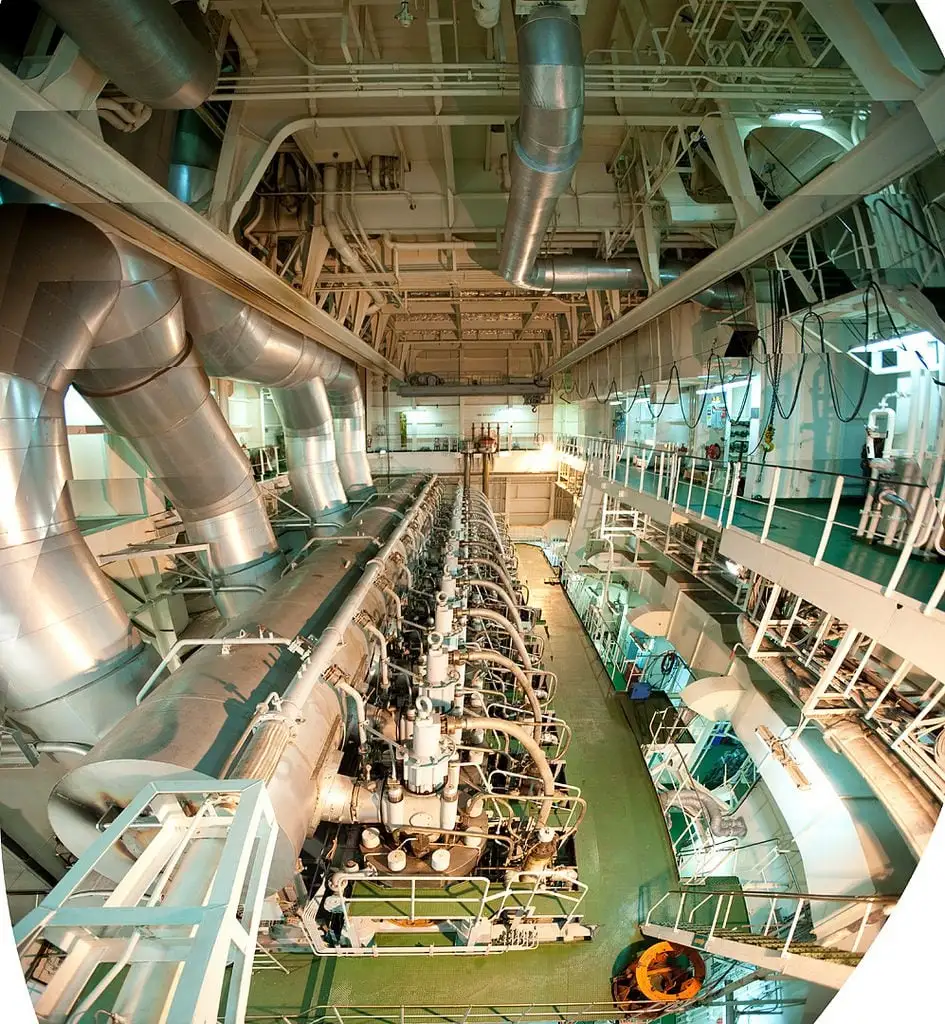
For anyone who has only seen a ship from the quay, an engine room can be surprising. It is not a single room with one engine in the middle. On a large merchant cargo ship, the machinery space is a multi-level technical complex extending across several decks. It contains the propulsion plant, electrical-power plant, pumps, piping, tanks, compressors, treatment equipment, automation systems, firefighting arrangements and workshops needed for a ship to operate as a self-contained floating facility.
This article gives a practical tour of the commercial ship engine room: what it looks like, what machinery is inside it, how the main systems work together, and why it remains one of the most demanding working environments at sea.
Quick answer: what is in the engine room of a commercial ship?
The engine room of a merchant ship normally contains a main propulsion engine or other propulsion plant; diesel generators; switchboards; boilers or exhaust-gas heat-recovery equipment; fuel, lubricating-oil and cooling-water systems; air compressors; pumps; separators; bilge and ballast equipment; freshwater and sewage-treatment equipment; firefighting systems; and an engine control room.
The exact arrangement changes with the vessel type, size, propulsion concept, flag requirements and operating profile. A large container ship with a slow-speed diesel engine looks very different from a cruise ship with diesel-electric propulsion, an LNG carrier, a tanker, a ferry or an offshore vessel. Yet the underlying purpose is the same: to create safe, reliable propulsion and ship services in a hot, vibrating, moving and often space-constrained environment.
What does a merchant ship engine room look like?
Most people imagine a spotless factory floor. In reality, a well-run engine room is cleaner and more organised than that image suggests, but it is unmistakably industrial. There are steel decks, ladders, handrails, insulated pipes, cable trays, valves, gauges, electric motors, tanks, machinery foundations and safety signs in every direction. The soundscape may include the steady exhaust beat of auxiliary engines, fans, pumps, purifiers and ventilation systems. Temperatures can vary considerably from a cool control room to very warm spaces near exhaust systems, boilers or running machinery.
On many large cargo ships, the machinery space is arranged vertically. A person entering from an upper level may look down through open grating platforms to machinery several decks below. The main engine often occupies the central lower part of the space, extending upward through multiple levels. Auxiliary generators may sit on platforms beside it. Pumps and purifiers occupy dedicated flats, while the upper levels lead towards exhaust uptakes, ventilation trunks and access to the funnel.
There is no universal map. Some ships separate machinery into several rooms for redundancy, fire safety or noise control. Modern vessels may house electrical rooms, battery rooms, fuel-preparation rooms, thruster rooms or azimuth-propulsion spaces away from the traditional main engine room. Nevertheless, the visual principle is consistent: the space is designed around access, safety, maintenance, drainage, ventilation, escape and a disciplined flow of energy and fluids.
Start the tour in the engine control room
The best place to understand a large commercial ship engine room is often the engine control room, usually called the ECR. This is the operational centre from which engineers monitor and, where required, control the propulsion plant and major auxiliary systems.
The ECR may contain propulsion controls, alarm and monitoring screens, electrical-system displays, tank-level indications, fire and bilge alarms, communication equipment, data loggers, maintenance records and operating manuals. On many ships, it is air-conditioned and acoustically protected so that engineers can work with alarms, drawings and procedures without the full heat and noise of the machinery space.
The control room is not a replacement for physical rounds. Sensors can show pressure, temperature, level, vibration, speed and valve position, but an engineer’s eyes, ears and sense of smell remain valuable. A small leak, unusual vibration, loose guard or hot bearing may first be detected during an inspection. Automation reduces routine workload; it does not remove the need for competent people who understand the system behind each alarm.
The main engine: the machine that turns the propeller
On many ocean-going cargo ships, the largest item in the engine room is the main engine. On a large container ship, bulk carrier or tanker, it is commonly a low-speed, two-stroke diesel engine directly connected to the propeller shaft. These engines are tall, slow-turning and extremely powerful. Their size allows them to drive a very large propeller efficiently at relatively low revolutions.
From the lower levels, an observer may see the crankcase doors, bedplate, lubricating-oil pipework and shaft line. Higher up are cylinder covers, fuel equipment, exhaust valves, scavenge-air receivers, turbochargers and exhaust piping. The engine’s pistons move up and down inside cylinders; the connecting rods and crankshaft convert that movement into rotation; the shaft carries the torque through the stern tube to the propeller.
Not every merchant ship has this arrangement. Ferries, offshore vessels, cruise ships and specialised vessels may use medium-speed engines connected through gearboxes, diesel-electric propulsion motors, controllable-pitch propellers, azimuth thrusters or hybrid systems. In a diesel-electric ship, the diesel engines generate electricity, while large electric motors turn the propellers. The machinery may be spread across separate generator rooms, electrical rooms and propulsion-motor spaces.
Whatever the design, the propulsion plant is never just an engine. It is a complete chain:
- fuel must be cleaned, conditioned and supplied at the correct pressure and temperature;
- air must enter the cylinders in sufficient quantity;
- lubricating oil must protect moving components;
- cooling water must remove excess heat;
- exhaust gases must be safely routed away;
- the shaft, bearings and propeller must transmit power without unacceptable vibration; and
- control and protection systems must reduce power or stop machinery if critical limits are exceeded.
- This interdependence is why engine-room work is systems engineering, not simply engine operation.
Diesel generators and the ship’s electrical power plant
A commercial ship needs electricity even when it is not moving. Navigation equipment, lighting, pumps, cargo systems, refrigeration, accommodation, communications, steering gear, deck machinery and safety systems all depend on electrical power.
That power usually comes from auxiliary diesel generators, often called gensets. Each generator consists of a diesel engine coupled to an alternator. In the engine room, you may find two, three or four generator sets arranged on foundations with their own fuel, cooling, lubrication, air, exhaust and control systems. Their output feeds the main switchboard, which distributes electricity around the ship and helps engineers manage load sharing, protection and fault isolation.
When demand changes, generators may be synchronised and connected in parallel. If one generator trips, the remaining units must take the load if they can do so safely. Critical vessels may use multiple machinery spaces and split switchboards so that one fire, flood or electrical fault does not disable all power at once.
There is also an emergency source of power. On many ships, the emergency generator is installed outside the main machinery space, in a protected location. It supports essential services after a major blackout or emergency. The exact equipment and arrangement are ship-specific and regulated, but the principle is clear: a vessel must retain a survivable means of supporting safety-critical functions when its normal power plant is unavailable.
Fuel systems: from storage tank to engine injector
Fuel systems are among the most important and carefully managed parts of a cargo ship machinery space. Large vessels may carry fuel in double-bottom, wing or deep tanks. The engine room contains much of the equipment that transfers, settles, filters, heats, separates, pressurises and supplies that fuel to the engines.
A conventional liquid-fuel system may include storage tanks, transfer pumps, settling tanks, service tanks, filters, heaters, centrifuge separators, booster pumps, viscosity or temperature controls and return lines. Before fuel reaches an engine, it must be clean enough and conditioned correctly for the equipment in use. Water, sludge and abrasive contaminants can damage pumps, injectors and precision fuel components.
Fuel changeover is also an operational task. Ships may need to change fuel grades for emission-control requirements, operating conditions or maintenance. Engineers must follow the vessel’s procedures carefully because temperatures, viscosities, compatibility and fuel-system pressure can change during the process.
The transition to lower-carbon energy makes the machinery-space picture more diverse. LNG, methanol, ammonia, hydrogen-derived fuels, batteries and shore power introduce different equipment, hazards and competence needs. Alternative-fuel systems may use segregated spaces, double-wall pipes, gas detection, ventilation, dedicated safety systems and specialised bunkering arrangements. There is no single “future engine room”; there will be several technology pathways, each with its own operational discipline.
Lubricating oil: protecting the moving machinery
Lubricating oil is the protective bloodstream of an engine room. It forms films between moving surfaces, removes heat, carries contaminants to filters and helps prevent wear and corrosion.
The main engine, auxiliary engines, gearboxes, shaft bearings, pumps, compressors and other rotating machines all require appropriate lubricants. A large low-speed diesel engine may have separate cylinder-lubrication and system-oil arrangements. Generator engines have their own lubricating-oil systems. Oil is circulated by pumps through coolers and filters, while purifiers remove water and impurities from oil in service.
Engineers monitor oil pressure, temperature, cleanliness and laboratory results. A change in these indicators can reveal bearing wear, fuel dilution, water ingress, overheating or contamination before a failure becomes severe. For this reason, a ship’s engine room includes not only machinery but also a practical diagnostic culture: sampling, trend monitoring, inspection and preventive maintenance.
Cooling water and seawater systems
Combustion engines create large amounts of heat. Without controlled cooling, cylinders, pistons, valves, turbochargers and lubricating oil would quickly be damaged. Cooling systems therefore occupy a major part of the machinery space.
Many ships use a combination of freshwater and seawater circuits. Freshwater circulates through engines and sensitive equipment, while seawater removes heat through central coolers or heat exchangers. The freshwater circuit may be divided into high-temperature and low-temperature loops, depending on the plant design. Expansion tanks, circulation pumps, coolers, temperature-control valves and treatment chemicals help keep the system within safe limits.
Seawater systems must contend with corrosion, marine growth, debris and changing sea temperatures. Sea chests, strainers and pumps bring seawater aboard; coolers transfer heat; discharge lines return the water to sea in accordance with the ship’s arrangement. During maintenance, engineers isolate sections, clean strainers and inspect for leakage or fouling. A small obstruction in the wrong location can affect multiple systems at once.
Starting air, control air and compressed-air machinery
Large diesel engines cannot normally be started with a small electric starter motor. Many use compressed starting air. Air compressors charge high-pressure receivers, and a controlled starting sequence admits air to the engine cylinders in the correct order until combustion takes over.
The engine room may therefore contain main air compressors, emergency compressors, air bottles or receivers, reducing stations, dryers and control-air pipework. Lower-pressure compressed air may also operate pneumatic valves, tools and automation components.
Air systems are safety-critical because stored compressed air contains significant energy. Receivers, relief valves, drains, pipework and compressor maintenance require careful attention. Moisture and oil contamination can damage control equipment, while poor maintenance can create reliability and safety problems.
Boilers, steam, freshwater and heat recovery
Even a motor ship without steam propulsion may have a boiler. An auxiliary boiler can provide steam for fuel heating, tank heating, accommodation services, cargo operations or cleaning. At sea, some ships also use exhaust-gas economisers or waste-heat recovery equipment to capture heat from the main-engine exhaust.
Steam systems may include boilers, burners, feed-water pumps, condensate tanks, pressure controls, safety valves, steam lines and drains. They require special care because high-temperature, high-pressure steam can cause severe injuries. Engineers monitor water level, combustion quality, feed-water condition and safety devices according to the ship’s procedures.
Freshwater production equipment may also be present. A freshwater generator can use recovered heat and a vacuum process to distil seawater into fresh water for technical and domestic use. Depending on the ship, the machinery space may include water-treatment equipment, hydrophore tanks, sewage-treatment plants and associated pumps. In this sense, the engine room supports both propulsion and daily life on board.
Pumps, bilges, ballast and environmental systems
Pumps are everywhere in an engine room. Each has a defined duty: moving fuel, oil, cooling water, ballast water, bilge water, fire water, freshwater, sewage, chemicals or hydraulic fluid. Large ships may have dozens of pumps, including duty and standby units. Their pipework is colour-coded or labelled, but engineers still rely on drawings, valve line-ups and disciplined isolation procedures.
The bilge system collects drainage from machinery-space wells. Bilge water may contain oil, so it cannot simply be pumped overboard. Ships use approved arrangements, including oil-filtering equipment and monitoring systems, and follow strict procedures and recordkeeping requirements. The purpose is both environmental protection and safe housekeeping: leaked liquids must be detected, contained and investigated rather than allowed to accumulate.
Ballast systems move seawater into and out of dedicated ballast tanks to control draft, trim, stability and structural loading. Some ships have ballast-water treatment systems to manage the transfer of organisms between sea areas. These systems add another layer of valves, sensors, filters, ultraviolet equipment or chemical-treatment components, depending on the vessel’s approved technology.
Fire safety and emergency equipment in the machinery space
The engine room is a high-risk fire zone because it combines fuel, hot surfaces, electrical systems, pressurised fluids and rotating machinery. Safety is therefore built into the design, layout and daily routines.
Typical protections include fire detection, fixed firefighting systems, portable extinguishers, fire pumps, emergency stops, quick-closing fuel valves, insulation of hot surfaces, watertight and fire doors, ventilation shut-offs, escape routes, emergency lighting and alarm systems. A fixed extinguishing system may use carbon dioxide, water mist or another approved medium, depending on the ship’s design. It must only be used by trained personnel following the ship’s emergency procedures; releasing it can require evacuation and a controlled shut-down of ventilation and fuel supply.
Good engine-room safety is also about ordinary habits. Engineers keep escape routes clear, clean spills promptly, protect rotating equipment, use hearing and eye protection where needed, maintain safe access, control hot work and communicate before starting machinery. A tidy machinery space is not cosmetic: it helps prevent slips, fires, delayed emergency response and maintenance mistakes.
How large and complex is a cargo-ship machinery space?
The scale of a commercial ship engine room depends on the ship. On a small coastal cargo vessel, it may be compact enough for one engineer to see much of the space from a single platform. On a large ocean-going merchant ship, the machinery space can be several deck levels high, with long pipe runs, numerous pumps, heavy machinery and dedicated technical rooms.
Complexity is not measured only by physical size. A smaller vessel can be highly automated and technologically demanding. A modern feeder ship may combine dual-fuel engines, battery systems, power-management software, shore-power connections, ballast-water treatment and sophisticated monitoring. A tanker adds cargo-pump, inert-gas and cargo-heating interfaces. A refrigerated vessel may have extensive cooling machinery. A cruise ship has hotel loads comparable to a small town.
The most accurate way to describe the engine room is as an integrated system of systems. Propulsion, power, cooling, fuel, safety, automation, environment and human decision-making all depend on one another. A failure in a seemingly modest support system—such as a cooling-water pump, fuel filter, control-air line or sensor—can reduce the ship’s ability to operate safely.
Who works in the engine room?
The engine department is commonly led by the Chief Engineer, supported by engineers of different ranks and ratings or technicians. The exact manning structure depends on the ship, company, automation level and voyage. Their work includes operating machinery, responding to alarms, maintaining equipment, planning repairs, managing spares, checking fuel and oil quality, conducting safety rounds, documenting performance and preparing for inspections.
On periodically unmanned machinery-space ships, the engine room may not have a person present every minute. This does not mean it is unattended in a practical sense. Alarm systems, remote monitoring, response procedures and regular inspections are essential. At sea, a duty engineer may be responsible for answering alarms and taking action at any time.
For cadets and trainees, the first engine-room visit is often memorable because it makes ship systems real. A piping diagram becomes a line they can trace with their eyes. A textbook turbocharger becomes a powerful machine protected by guards and instrumentation. A blackout scenario becomes more understandable when they see the generators, switchboard, emergency generator and starting-air system that must work together to restore power.
A simple virtual tour of the engine room
If you were walking through a large merchant ship machinery space with an experienced engineer, the tour might follow this sequence:
- Engine control room: review the running condition, alarms, power demand and tank levels.
- Generator flat: see the diesel generators, local gauges, fuel lines and alternators supplying ship power.
- Main-engine levels: move from the crankcase and shaft line below to cylinders, turbochargers and exhaust systems higher up.
- Purifier and pump room: follow the fuel and lubricating-oil treatment equipment, filters and transfer pumps.
- Compressor and boiler area: identify starting-air receivers, compressors, steam equipment and safety valves.
- Lower platform and bilges: observe drainage arrangements, sea-water strainers, bilge wells and the importance of clean housekeeping.
- Safety stations and escape routes: locate extinguishers, fire controls, emergency stops, exits and protective equipment.
In real life, access is controlled. Visitors must follow the ship’s safety rules, wear the correct personal protective equipment and remain with authorised personnel. A machinery space is not a museum; it is an active industrial workplace.
Frequently asked questions about ship engine rooms
Is the engine room always at the back of a commercial ship?
Often, but not always. Many cargo ships place the main machinery aft because it creates a practical propeller-shaft arrangement. However, the exact location and layout vary by ship type and propulsion design. Electrical rooms, bow-thruster spaces, pump rooms and specialised fuel spaces may be elsewhere on the ship.
How hot and noisy is a ship engine room?
Conditions vary by location and operating state. Machinery spaces can be hot and noisy, especially near running engines, exhaust equipment, boilers and ventilation machinery. Ship design, insulation, ventilation, hearing protection and work-rest practices all help manage the environment.
What keeps a cargo ship’s propeller turning?
On many cargo ships, a large slow-speed diesel main engine turns the propeller directly through a shaft. Other ships use medium-speed engines with gearboxes, diesel-electric motors, azimuth thrusters or hybrid propulsion. In every case, support systems for fuel, cooling, lubrication, air, electricity and control are essential.
Why are there so many pipes and pumps in the engine room?
A ship is a self-contained operating system. It must move and treat fuel, water, oil, air, heat, waste and ballast without relying on shore facilities for days or weeks. Each fluid needs the right pressure, temperature, cleanliness, route and safety protection, which explains the dense network of pumps, valves and pipework.
Is every engine room the same?
No. The basic functions are common, but the equipment differs significantly among container ships, bulk carriers, tankers, ferries, cruise ships, offshore vessels, LNG carriers and hybrid or battery-equipped vessels. The safest approach is always to learn the specific vessel’s drawings, manuals, risk assessments and procedures.
The real lesson from a commercial ship engine room tour
An engine room is impressive because of its size, but it is more impressive because of its coordination. A modern merchant ship can cross oceans because hundreds of components and systems work together: engines, generators, pumps, valves, sensors, pipes, people and procedures.
The machinery space is where engineering theory meets the practical reality of heat, vibration, pressure, time and safety. Understanding it helps cadets, seafarers, maritime students and the wider public appreciate the technical skill behind every cargo voyage. It also shows why careful maintenance, competent watchkeeping and strong safety culture remain central to reliable commercial shipping.
Sources :
- International Maritime Organization (IMO): International Convention for the Safety of Life at Sea (SOLAS)
- IMO: Standards of Training, Certification and Watchkeeping (STCW)
- IMO: Fire protection, fire detection and fire extinction
- IMO: Prevention of pollution by oil
Read more here:
Top 12 Things Port State Control Can Inspect in the Engine Room