
06/10/2026
For millennia, the Persian Gulf has been a cradle of maritime commerce, a source of immense hydrocarbon wealth, and home to one of the world’s most unique and resilient marine ecosystems. Its warm, shallow waters support coral reefs that survive summer temperatures lethal to most other reefs, vast seagrass beds that feed the second-largest population of dugongs on Earth, and mangrove forests that serve as nurseries for countless fish species. But today, this ancient waterway is under an unprecedented triple assault.
Since the escalation of regional hostilities in late 2025, the combination of a de facto military blockade of the Strait of Hormuz, the stranding of hundreds of oil tankers and cargo vessels inside the Gulf, and the direct impacts of naval warfare have converged into a slow-motion environmental catastrophe. This is not a future risk assessment; it is a present reality. Oil slicks now appear daily on satellite imagery, the hulls of immobilized ships are rotting in hyper-saline waters, and the region’s unique biodiversity is being pushed to the brink of collapse. This article explores the mechanics of this disaster, its ecological toll, the echoes of past wars, and the daunting challenges of any future recovery.
–
Part I: The Strait of Hormuz – A Chokepoint Turned Death Trap
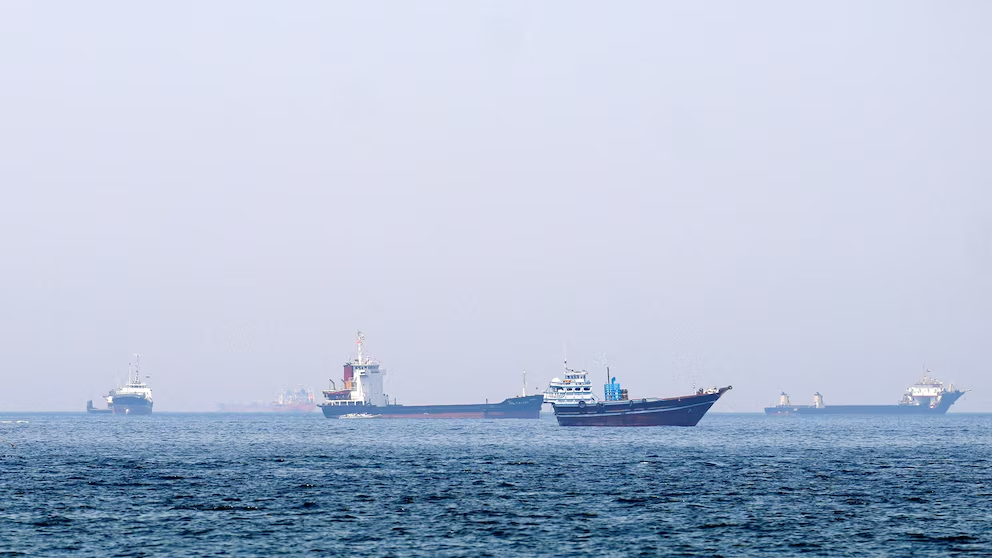
The Strait of Hormuz is a narrow sea passage between Oman and Iran, only 33 kilometers (21 miles) wide at its narrowest point. Through this slender corridor flows approximately 20% of the world’s petroleum—over 17 million barrels per day. It is the jugular of the global energy economy. When war broke out in the region, one of the first strategic moves was an effective blockade, preventing the safe transit of commercial shipping. By June 2026, an estimated 2,000 vessels of all types—from mammoth Very Large Crude Carriers (VLCCs) to chemical tankers and bulk carriers—were trapped inside the Gulf, unable to leave due to the threat of missile strikes, mines, or seizure.
Among these, over 85 large oil tankers were identified as carrying at least 21 billion liters of crude oil. To put that figure in perspective, it represents more than three times the volume of oil spilled during the infamous Exxon Valdez disaster, and it is floating in a single, confined body of water. These ships are not in port; they are anchored in ad hoc holding zones, often in unprotected waters, their crews diminished, their maintenance schedules abandoned.
The environmental danger posed by this flotilla is not static. Ships are designed to operate, to move through the water, to cycle ballast, and to keep their hulls clean through friction and regular dry-docking. When they sit idle for months in the Gulf’s warm, biologically productive waters, they begin to decay.
–
Part II: The Mechanisms of Catastrophe – Oil, Biofouling, and Attacks
The environmental crisis can be broken down into three interconnected mechanical threats: chronic oil leakage, acute spill risk from attacks, and the novel threat of biofouling and invasive species.
2.1 Chronic Oil Leakage: The Constant Drip
While a dramatic tanker explosion captures headlines, the daily reality is more insidious. The fleet of stranded ships is aging and poorly maintained. Seals on propeller shafts degrade; cargo pipe corrosion accelerates; ballast water valves fail. As a result, small but continuous leaks of crude oil, fuel oil, and lubricants have become commonplace. Satellite-based synthetic aperture radar (SAR) data from March 2026 showed that the total area covered by oil slicks in the southern Gulf and the Strait of Hormuz was roughly four times greater than in the same month of the previous year. These slicks are not single events; they are a diffuse, chronic hemorrhage of hydrocarbons into a fragile marine environment.
2.2 The Active War Threat: Missiles and Mines
The background risk of leakage is bad enough, but the active war introduces acute, catastrophic risk. Since the beginning of hostilities, there have been at least 16 documented attacks on commercial and military vessels within the Gulf and the Strait. These have included anti-ship cruise missiles, drone boat explosives, and drifting naval mines. A single missile strike on a fully laden VLCC could rupture multiple cargo tanks, releasing over 500,000 barrels of oil into the water within hours. The 2026 sinking of an Iranian frigate off the coast of Sri Lanka—while outside the Gulf—served as a grim reminder that even warships leak fuel and hazardous materials as they sink. Inside the Gulf, any such sinking would occur in shallow, enclosed waters, multiplying the ecological impact.
2.3 Biofouling and the Invasive Species Time Bomb
Perhaps the most overlooked environmental threat from the stranded ships is biological. The Persian Gulf is warm (often exceeding 30°C in summer) and rich in marine life. When ships sit still for months, their hulls become instant artificial reefs—but of the wrong kind. Barnacles, tubeworms, algae, hydroids, and bivalves colonize every submerged surface. This process is called biofouling.
For a stranded tanker, biofouling is more than a nuisance. Heavy fouling can add dozens of tons of weight, alter the ship’s hydrodynamics (making it unstable), and clog seawater intake pipes needed for engine cooling—should the engine ever be started again. But the true environmental danger emerges if and when these ships are ever allowed to move again. As they cross oceans, they will carry thousands of non-native species attached to their hulls. The Persian Gulf has its own unique biota. When a ship leaves the Gulf and arrives at, say, the port of Singapore or Rotterdam, it will scrape off or release Gulf organisms into a completely different ecosystem. This is one of the primary vectors for marine invasive species, which cost the global economy billions annually and have driven native species to extinction.
–
Part III: The Unique Vulnerability of the Persian Gulf Ecosystem
The Persian Gulf is not just any sea. Its physical and biological characteristics make it exceptionally vulnerable to pollution.
3.1 A Semi-Enclosed, Shallow Basin
The Gulf averages only 50 meters in depth, with large areas less than 30 meters deep. It is connected to the open Indian Ocean only through the narrow Strait of Hormuz. Water exchange is slow: oceanographers estimate that it takes between 2 and 5 years for the entire volume of Gulf water to be replaced by the Arabian Sea. Any pollutant introduced today—oil, dispersants, heavy metals from sunken ships—will remain in the system for years, circulating and re-contaminating coastlines.
Furthermore, the Gulf’s high evaporation rate (due to intense heat) leads to high salinity, often exceeding 40 parts per thousand (compared to 35 for most oceans). Oil spills behave differently in high salinity; they emulsify more readily, forming “chocolate mousse” that persists for months rather than weeks.
3.2 Corals at the Edge of Survival
The Gulf’s coral reefs are globally unique. They have adapted to survive summer water temperatures that would trigger mass bleaching in the Great Barrier Reef. Scientists study Gulf corals for clues about climate resilience. But oil is their kryptonite. Crude oil contains toxic polycyclic aromatic hydrocarbons (PAHs) that disrupt coral reproduction, cause tissue sloughing, and kill symbiotic zooxanthellae algae. A major spill near Qatar or the UAE’s offshore islands—where most Gulf corals are located—could wipe out these unique genetic populations in a matter of weeks. Recovery would take decades, if it happens at all.
3.3 Mangroves, Seagrass, and Dugongs
The Gulf’s coastline is fringed with mangrove forests (especially in Iran, the UAE, and Saudi Arabia) and vast seagrass meadows. These habitats are the nurseries for fish, shrimp, and crabs that support regional fisheries. They are also the primary feeding grounds for the dugong (Dugong dugon). The Gulf hosts the world’s second-largest dugong population, estimated between 5,000 and 7,500 individuals. Dugongs are strictly herbivorous, feeding almost exclusively on seagrass. Oil spills coat seagrass leaves, making them inedible and toxic. A large spill could starve thousands of dugongs. Already listed as vulnerable to extinction, a Gulf-wide spill could push them into endangered status.
Part IV: A History Repeated – The 1991 Gulf War Precedent
This is not the first time war has poisoned the Persian Gulf. During the 1991 Gulf War, Iraqi forces deliberately opened valves at the Sea Island oil terminal in Kuwait and discharged oil from several tankers. For six months, an estimated 11 million barrels (over 1.7 billion liters) of crude oil poured into the Gulf—the largest oil spill in human history, three times the size of the Exxon Valdez.
The 1991 spill created a slick 160 kilometers long and 80 kilometers wide. It contaminated 640 kilometers of Saudi coastline, destroyed 35 to 50 percent of the region’s intertidal habitats, and killed tens of thousands of seabirds, including the threatened crab-plover. Oil penetrated up to 50 centimeters deep into coastal sediments, where it persisted for over a decade. Fishery stocks collapsed for years. The cleanup cost over $700 million (in 1990s dollars) and was only partially successful.
The current situation bears ominous similarities. The quantity of oil currently stranded in vessels is nearly double the 1991 spill volume. But there are critical differences that make the current crisis potentially worse. In 1991, the oil came from a single source (Kuwait) over a defined period. Today, the threat is distributed across hundreds of ships scattered throughout the Gulf, creating a scenario where multiple spills could occur simultaneously or sequentially over months or years. Furthermore, the 1991 spill occurred at the end of a short war; the current conflict shows no sign of abating.
–
Part V: The Shadow Fleet and the Liability Nightmare
Complicating any environmental response is the nature of the vessels involved. Alongside legitimate, internationally flagged tankers, the Persian Gulf has become a haven for the so-called “shadow fleet” or “dark fleet”—hundreds of aging tankers owned by opaque shell companies, flying flags of convenience (often from small, poorly regulated nations like Gabon or Eswatini), and carrying sanctions-evading oil, primarily from Iran and Russia.
These shadow ships are environmental disasters waiting to happen. They are frequently uninsured, poorly maintained, crewed by undertrained seafarers, and equipped with malfunctioning tracking systems. Before the war, they operated on the margins of legality. Now, trapped in the Gulf, many are effectively abandoned. Some have been observed to have completely lost power, drifting without lights, creating collision hazards and potential grounding risks.
If a shadow tanker breaks apart or sinks, there is no owner to hold accountable, no insurance company to pay for cleanup, and no flag state with the capacity to intervene. The resulting spill would be an orphan disaster, likely falling on the nearest coastal state—which, in the Gulf, is often one of the poorer countries such as Iran, Iraq, or smaller Gulf monarchies already strained by war.
–
Part VI: Ecological Tipping Points – What Is Being Lost Right Now
Beyond the oil, the blockade and war are causing immediate ecological losses through indirect pathways.
6.1 Fishery Collapse
The Gulf supports artisanal and commercial fisheries worth an estimated $6 billion annually, employing hundreds of thousands of fishermen from Iran to the UAE. But fishing has largely stopped due to the war. Fishermen cannot operate in mine-laden waters. Their boats have been requisitioned or sunk. Meanwhile, the stranded ships are acting as enormous “fish aggregation devices” (FADs), concentrating fish around them. This sounds beneficial, but it actually makes the fish more vulnerable to any sudden discharge of oil or chemicals. Moreover, the cessation of fishing creates a socio-economic crisis, but the fish stocks themselves are not recovering; instead, they are being exposed to chronic low-level pollution that impairs reproduction.
6.2 Marine Mammal and Turtle Trauma
The Gulf is home to several species of whales (including Bryde’s whales and humpback whales), dolphins, and porpoises. The increase in naval activity—sonar from warships, explosions from minesweeping operations, and the constant noise of helicopters and drones—has been linked to strandings and behavioral changes. In the first quarter of 2026, stranding events for Indo-Pacific humpback dolphins increased by 300% compared to the previous five-year average.
Similarly, the Gulf’s beaches are critical nesting sites for the hawksbill and green sea turtles. Nesting season (spring and early summer) now coincides with the peak of military activity. Disrupted beaches, oiled sand, and artificial lighting from naval vessels have caused a sharp decline in nesting success. Biologists on the Iranian coast reported that fewer than 20% of monitored nests hatched in 2026, compared to a typical 70-80% rate.
6.3 Bird Mortality
The Gulf is a crucial flyway for migratory waterbirds, including flamingos, herons, terns, and the critically endangered sociable lapwing. Millions of birds pass through each year, stopping at coastal mudflats and mangroves. Those mudflats are now coated in oil. Birds that land to feed ingest oil while preening, leading to liver damage, anemia, and death. Rehabilitation efforts are impossible because the war prevents safe access to the shoreline.
Part VII: The Impossible Cleanup – Why No One Can Fix This Now
Faced with such an unfolding disaster, the natural question is: Why isn’t anyone cleaning it up? The answer is that cleanup is currently impossible.
7.1 A War Zone
The first rule of oil spill response is safety of responders. The Persian Gulf is an active war zone. Any vessel attempting to deploy booms, skimmers, or dispersants would be a slow-moving, unarmed target, vulnerable to attack from any of the belligerent parties. Several aid organizations have stated they will not operate in the Gulf until a ceasefire is in place. The stranded ships themselves cannot be approached for maintenance or lightering (offloading oil) because they are in a crossfire.
7.2 The Scale Problem
Even if peace were declared tomorrow, the scale of the challenge would be staggering. The 1991 spill, with 11 million barrels, required a multinational effort of over 50 vessels, 2,000 workers, and eight months of work—and even then, only about 25% of the oil was recovered. Today, the potential spill is nearly twice as large, and the oil is not in one place but distributed across hundreds of vessels scattered over 90,000 square kilometers. There are no existing plans or resources for a dispersed fleet spill of this magnitude.
7.3 Dispersants: A False Hope
One common response to marine spills is to spray chemical dispersants, which break oil into small droplets that are then diluted by the sea. But dispersants are controversial. They are toxic themselves, and they simply transfer the oil from the surface into the water column, where it can harm plankton, fish larvae, and corals. In the shallow, slow-flushing Gulf, dispersed oil would linger in the water for years. Moreover, dispersants are less effective in warm, high-salinity water—exactly the conditions of the Gulf. Most experts agree that dispersants would cause more harm than good in this context.
–
Part VIII: The Human Dimension – Coastal Communities on Hold
While the focus is often on charismatic megafauna and coral reefs, the environmental crisis has a profound human dimension. Over 8 million people live along the Gulf coastline, from Basra in Iraq to Dubai in the UAE and Bandar Abbas in Iran. Many depend directly on the sea for food and livelihoods.
Desalination plants are the lifeline for cities like Dubai, Abu Dhabi, Doha, and Kuwait City. These plants take in seawater, remove the salt, and provide drinking water. But they are highly sensitive to oil. Crude oil fouls the intake screens, clogs the reverse osmosis membranes, and forces plant shutdowns. During the 1991 spill, several desalination plants had to close temporarily. In today’s war, a major spill could force simultaneous shutdowns of multiple plants, leaving millions without fresh water—a secondary catastrophe that would compound the war’s toll.
–
Part IX: Geopolitical Paralysis – The Failure of Regional Environmental Cooperation
The Gulf has long had mechanisms for environmental cooperation, most notably the Regional Organization for the Protection of the Marine Environment (ROPME), based in Kuwait. ROPME coordinates the “MEMAC” (Marine Emergency Mutual Aid Centre) that theoretically allows Gulf states to assist each other during oil spills. However, ROPME requires political consensus. In the current conflict, with Iran on one side and most Arab Gulf states on the other, that consensus has shattered. No joint exercises are taking place. No mutual aid requests have been made. The environmental agreements that took decades to build have been rendered useless by war.
The United Nations Environment Programme (UNEP) has issued statements of concern but has no mandate to intervene in an active war zone. The International Maritime Organization (IMO) has no enforcement power. In short, there is no global or regional authority capable of stopping the environmental bleeding.
–
Part X: Looking Ahead – Scenarios for the Future
Environmental scientists have sketched out several possible futures for the Gulf, depending on how the war progresses.
Scenario 1: Contained Chronic Leakage
If hostilities continue at the current level for another year, with no major tanker destruction, the Gulf would experience sustained chronic oil pollution. Seagrass beds would thin out. Coral cover would decline by 30-50%. Dugong populations would drop by 20-30% due to habitat loss. Fisheries would remain collapsed. This is the “best case” of the bad outcomes.
Scenario 2: One Major Tanker Spill
If a single VLCC is hit by a missile or strikes a mine, releasing its 2 million barrels of oil, the result would be a regional disaster. A slick would coat the coastlines of at least two countries. Desalination plants would shut down. Turtle nesting would fail for several seasons. The economic cost would exceed $10 billion in cleanup and lost tourism. Recovery would take 5–10 years.
Scenario 3: Multiple Simultaneous Spills (The Nightmare)
If the conflict escalates and several tankers are sunk or damaged, or if an abandoned shadow tanker corrodes and breaks apart during a storm, the Gulf could face a spill exceeding the 1991 disaster. In this scenario, oil could cover the entire southern half of the Gulf, anoxic zones would develop (where decaying oil depletes oxygen, killing everything on the seafloor), and the ecosystem could face a regime shift—moving from a coral/seagrass dominated system to a degraded, algae-dominated system with little biodiversity. Recovery would take decades, if ever.
–
Conclusion: A Silence That Speaks Volumes
The most striking thing about the environmental catastrophe unfolding in the Persian Gulf is the silence. The world’s media focuses on troop movements, diplomatic negotiations, and energy prices. The slow death of a sea—the accumulation of PAHs in dugong livers, the bleaching of corals unseen by human eyes, the silent coating of mangrove roots with oil—does not make for daily headlines. Yet it is happening.
The combination of blockade, stranded ships, and war has created a perfect environmental storm. The Gulf’s marine life, which has survived for millennia in one of the world’s most extreme natural environments, is now being asked to survive the unnatural extremes of human conflict. It is not clear that it can.
What is certain is that the environmental damage will long outlast the war. When the last shot is fired and the final ceasefire is signed, the oil will remain. The tar balls will wash up on beaches for years. The seagrass will be slow to return. And the dugongs, if any are left, will feed in contaminated meadows, passing toxins to their calves. The Persian Gulf will bear the scars of this war not for months, but for generations.
The stranded ships are more than a logistical or military problem. They are floating tombstones—not for the sailors who have largely been evacuated, but for the ecosystems they were once designed to transport goods across. Until the world finds a way to enforce environmental protection even in wartime, the Persian Gulf will remain a warning: when nations go to war, the sea is always a casualty.