
05/14/2026
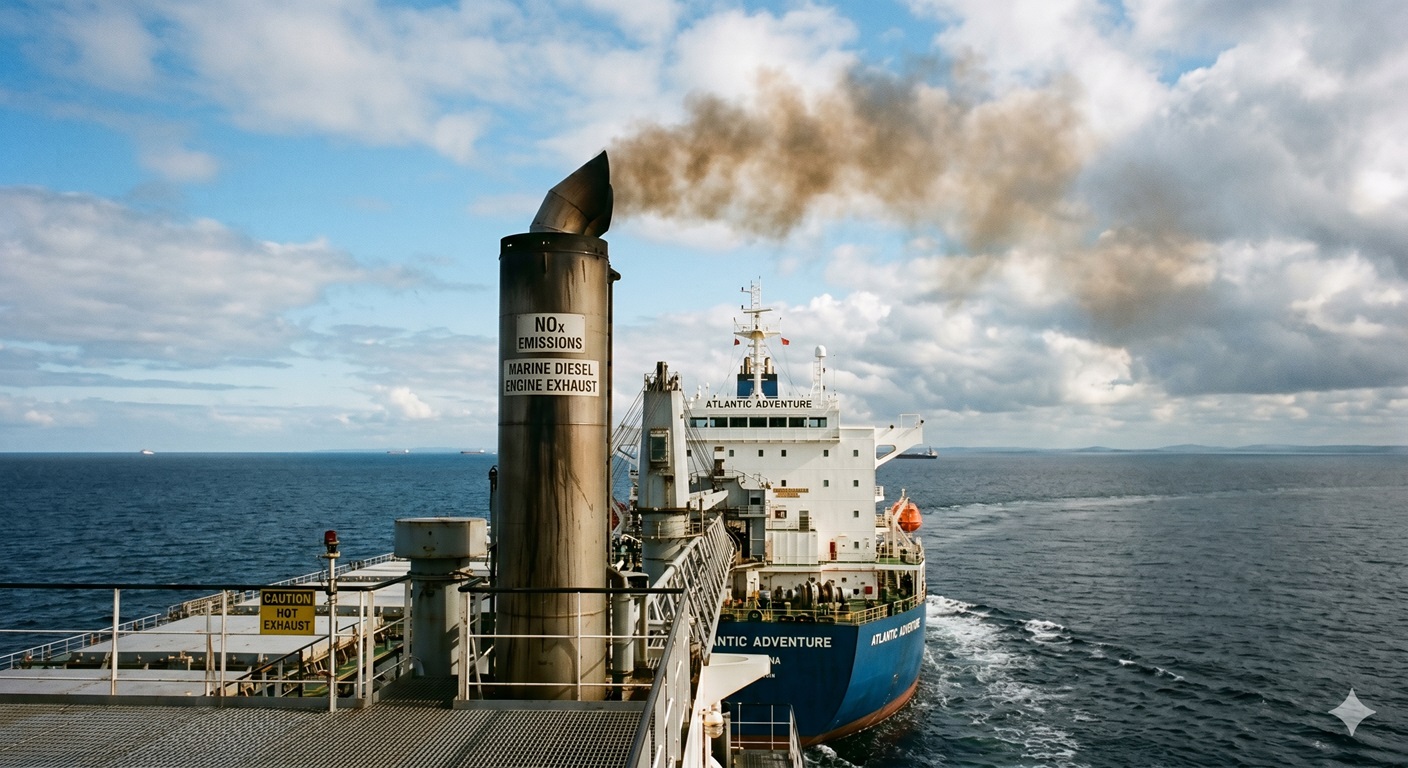
Nitrogen oxides, usually written as NOx, are among the most important air pollutants regulated by IMO for ships. In maritime regulation, NOx mainly means the combined emissions of nitric oxide (NO) and nitrogen dioxide (NO₂) from marine diesel engines. These gases are formed during high-temperature combustion when nitrogen and oxygen in the intake air react inside the cylinder. The NOx Technical Code explains that NOx formation increases with combustion temperature, peak pressure, compression ratio, fuel-delivery characteristics, and the time nitrogen and oxygen remain exposed to high combustion temperatures. It also notes that NOx contributes to acidification, tropospheric ozone formation, nutrient enrichment, and adverse health effects.
The legal basis is MARPOL Annex VI, Regulation 13, while the technical implementation instrument is the NOx Technical Code. The Code does not simply set emission limits; it gives the practical rules for testing, survey, certification, onboard verification, Technical Files, EIAPP certificates, and engine-parameter control.
Development of the NOx Regulatory Framework
The original NOx Technical Code was adopted in 1997 together with MARPOL Annex VI. MARPOL Annex VI entered into force on 19 May 2005, and from that point applicable marine diesel engines had to comply with the NOx Technical Code. Later, MEPC 53 agreed to revise MARPOL Annex VI and the NOx Technical Code, and that work was completed at MEPC 58 in 2008, producing the NOx Technical Code 2008.
The 2008 revision was important because it modernized the NOx regime. It clarified the Tier I, Tier II, and Tier III structure; strengthened certification and onboard verification; introduced clearer rules for existing engines and Approved Methods; and supported more advanced NOx-control technologies such as SCR.
The attached circular letters show the regulatory evolution before and after this revision. Circular Letter No.2598 from 2004 circulated proposed amendments before Annex VI entered into force, including survey, certification, and IAPP certificate provisions. It also included a technical amendment to the NOx Technical Code concerning the test-condition parameter fa, allowing a range between 0.93 and 1.07 where strict compliance was impossible for evident technical reasons. Circular Letter No.2861 from 2008 then circulated the major draft amendments to MARPOL Annex VI and the NOx Technical Code for adoption at MEPC 58, including the fully revised Regulation 13 text.
Application: Which Engines Are Covered?
MARPOL Annex VI Regulation 13 applies to marine diesel engines above 130 kW installed on ships, and also to engines above 130 kW that undergo a major conversion. The regulation does not apply to engines used solely for emergencies, engines used solely to power emergency equipment, or engines installed in lifeboats used solely for emergencies. It also allows limited exclusions for engines on ships operating only within waters under the flag State’s jurisdiction, provided that the Administration applies an alternative NOx control measure.
The NOx Technical Code 2008 also clarifies that gas-fuelled engines installed on ships constructed on or after 1 March 2016, or gas-fuelled additional or non-identical replacement engines installed on or after that date, are treated as marine diesel engines for Regulation 13 purposes.
NOx Tier Limits
The core of Regulation 13 is the three-tier NOx limit system. The applicable limit depends on the ship construction date, the engine’s rated speed, and in the case of Tier III, whether the ship is operating in a NOx Emission Control Area.
| Tier | Main application | NOx limit |
|---|---|---|
| Tier I | Ships constructed on or after 1 Jan 2000 and before 1 Jan 2011 | 17.0 g/kWh if n < 130 rpm; 45 × n⁻⁰·² g/kWh if 130 ≤ n < 2,000 rpm; 9.8 g/kWh if n ≥ 2,000 rpm |
| Tier II | Ships constructed on or after 1 Jan 2011 | 14.4 g/kWh if n < 130 rpm; 44 × n⁻⁰·²³ g/kWh if 130 ≤ n < 2,000 rpm; 7.7 g/kWh if n ≥ 2,000 rpm |
| Tier III | Certain ships operating in NOx ECAs | 3.4 g/kWh if n < 130 rpm; 9 × n⁻⁰·² g/kWh if 130 ≤ n < 2,000 rpm; 2.0 g/kWh if n ≥ 2,000 rpm |
The 2008 draft Annex VI text in Circular Letter No.2861 clearly sets out these Tier I, Tier II, and Tier III limits. Tier III is only required when the ship is operating in an Emission Control Area designated for NOx control; outside such an area, the engine is generally subject to Tier II requirements.
Tier III and NOx Emission Control Areas
Tier III is the strictest NOx standard and normally requires technologies such as Selective Catalytic Reduction (SCR), Exhaust Gas Recirculation (EGR), water-based combustion control, or advanced engine tuning. Regulation 13 defines an Emission Control Area as a sea area, including port areas, designated by IMO according to the criteria and procedures in MARPOL Annex VI Appendix III.
The most recent major ECA update is the designation of the Canadian Arctic and the Norwegian Sea as new ECAs under MARPOL Annex VI through Resolution MEPC.392(82), adopted in October 2024. IMO states that these areas officially became ECAs on 1 March 2026, requiring stricter limits for NOx, SOx, and particulate matter.
IMO also reports that MEPC 83 approved a proposal to designate the North-East Atlantic Ocean as an ECA for SOx, particulate matter, and NOx, with draft amendments to MARPOL Annex VI to be submitted to an extraordinary MEPC session for adoption. This is one of the most important upcoming developments because it may further expand Tier III relevance for vessels trading in European Atlantic waters.
Major Conversion and Replacement Engines
The 2008 MARPOL Annex VI text gives a clear definition of major conversion for NOx purposes. A major conversion includes replacement by a non-identical engine, installation of an additional engine, substantial modification as defined in the NOx Technical Code, or an increase of maximum continuous rating by more than 10% compared with the original certification.
For replacement engines installed on or after 1 January 2016, the general rule is that the engine should meet the standard in force at the time of replacement. However, where a replacement engine cannot meet Tier III requirements, Regulation 13 allows it to meet Tier II instead, subject to IMO criteria and Administration acceptance.
This is practically important for older ships because a damaged or obsolete engine may need replacement, but physical space, shaft alignment, exhaust routing, SCR installation space, cooling capacity, or back-pressure limits may make full Tier III compliance technically impossible.
Existing Engines and Approved Methods
A distinctive feature of Regulation 13 is its treatment of certain older engines. For engines installed on ships constructed on or after 1 January 1990 but before 1 January 2000, the regulation may apply where the engine has more than 5,000 kW output and a per-cylinder displacement of at least 90 litres, provided that an Approved Method has been certified and notified to IMO.
The NOx Technical Code 2008 includes Chapter 7: Certification of an Existing Engine. It requires the responsible entity to apply to the Administration for certification where an existing engine is to comply with Regulation 13.7. The Approved Method File must accompany the engine throughout its life on board, must include the onboard verification procedure, and after installation a survey must confirm compliance before the IAPP Certificate is amended.
The Approved Method concept is a pragmatic regulatory tool. Instead of requiring full replacement of older large engines, it allows a certified modification package to reduce NOx where technically and economically reasonable.
Survey and Certification: EIAPP and IAPP
NOx compliance is built around two certificates:
The EIAPP Certificate is the Engine International Air Pollution Prevention Certificate. It belongs to the engine and confirms that the engine, its components, adjustable features, and Technical File comply with the applicable NOx requirements before installation or service.
The IAPP Certificate is the ship’s International Air Pollution Prevention Certificate. It confirms that the ship complies with MARPOL Annex VI, including the NOx-related status of its engines.
The NOx Technical Code requires several survey stages: pre-certification survey, initial onboard certification survey, renewal survey, annual survey, intermediate survey, and additional survey after major conversion or relevant modification.
The attached 2004 circular letter is useful because it shows how the survey and certification structure of Annex VI was being formalized before entry into force. It required initial, renewal, intermediate, annual, and additional surveys for ships of 400 GT and above, with survey responsibilities assigned to Administrations or recognized organizations.
Technical File: The Heart of NOx Compliance
The Technical File is the central document for every certified engine. It must identify the components, settings, operating values, rated power, rated speed, allowable adjustment ranges, NOx-relevant spare parts, test data, onboard verification procedures, and the EIAPP Certificate.
For engineers, the Technical File is not an administrative formality. It defines the engine’s certified NOx condition. If onboard adjustments or component replacements move the engine outside the approved Technical File range, the engine may lose its basis for NOx compliance unless emissions are verified by approved measurement or testing.
Typical NOx-influencing parameters include injection timing, injection nozzles, injection pumps, fuel cams, common-rail pressure, combustion-chamber configuration, compression ratio, turbocharger type, charge-air cooler/preheater settings, valve timing, water injection, emulsified fuel, EGR, SCR, and other parameters specified by the Administration.
Onboard Verification Methods
The NOx Technical Code recognizes that full test-bed testing is not normally practical after the engine is installed. Therefore, Chapter 6 provides onboard methods to demonstrate continuing compliance.
The Engine Parameter Check Method verifies that components, settings, and operating values remain within the approved Technical File limits. It is especially useful where no after-treatment system is fitted and the engine remains in its certified configuration. The Code states that it is not always necessary to measure NOx directly if the engine condition corresponds to the certified components, calibration, and parameter-adjustment state.
The Simplified Measurement Method is an onboard confirmation test used for annual, intermediate, renewal, or confirmation surveys when required. It measures NOx and supporting gases such as O₂ and/or CO₂ and CO according to the appropriate test cycle.
The Direct Measurement and Monitoring Method allows onboard monitoring data to demonstrate compliance. The Code requires data to be current, meaning within 30 days, and retained on board for at least three months. The method must be documented in an approved Onboard Monitoring Manual, and its approval reference is entered in the EIAPP Certificate supplement.
SCR Systems and NOx-Reducing Devices
Selective Catalytic Reduction is one of the main technologies for Tier III compliance. SCR uses a reagent, normally urea or ammonia-based solution, injected into the exhaust gas before a catalyst. The process converts NOx into nitrogen and water.
The attached 2011 circular letter is especially relevant because it shows IMO’s effort to clarify how SCR systems are handled within EIAPP certification. Circular Letter No.3220 states that where a NOx-reducing device is included in EIAPP certification, it must be recognized as an engine component and recorded in the Technical File. The engine should normally be tested with the NOx-reducing device fitted, unless combined testing is not appropriate for technical or practical reasons and the Administration approves another procedure, taking into account IMO SCR guidelines.
This was later reinforced by Resolution MEPC.317(74), which amended the NOx Technical Code 2008 for electronic record books and SCR certification requirements. IMO’s index lists MEPC.317(74) as entering into force on 1 October 2020.
Electronic Record Books: A Modern Compliance Update
MEPC.317(74) added the definition of an Electronic Record Book to the NOx Technical Code 2008. It is a device or system approved by the Administration and used to electronically record entries required under the Code instead of a hard-copy record book.
The practical significance is that NOx compliance documentation is moving toward digital record-keeping. However, an electronic record book is not simply an Excel sheet or unapproved onboard software. It must be approved by the Administration and must preserve the integrity, traceability, and availability of statutory records.
This matters particularly for the Record Book of Engine Parameters, where changes to NOx-relevant components, settings, replacements, and adjustments must be recorded chronologically. MEPC.317(74) also confirms that a Record Book or electronic record book may be used for recording all such changes.
Test-Bed Certification and Parent Engine Concepts
The NOx Technical Code prefers accurate test-bed measurement before installation. Test-bed testing allows controlled conditions, calibrated instruments, known fuel properties, and defined test cycles. The Code therefore treats test-bed certification as the foundation of the EIAPP process.
For serially manufactured engines, the Code allows the Engine Family and Engine Group concepts. This means not every identical or closely related engine must be fully tested individually. Instead, a representative Parent Engine may be tested, and the results can support certification of engines within the approved family or group, subject to Administration approval.
Circular Letter No.3220 also clarified that where an engine cannot be pre-certified on a test bed due to size, construction, or delivery schedule, onboard certification testing may be accepted for an Individual Engine or for an Engine Group represented by a Parent Engine, but not for Engine Family certification.
Port State Control and Operational Risk
For Port State Control, NOx compliance is usually checked through certificates, Technical Files, onboard records, and consistency of engine settings or NOx-reduction system operation. A ship may face problems if:
the EIAPP Certificate is missing or inconsistent;
the Technical File is incomplete or not approved;
the Record Book of Engine Parameters is not maintained;
engine components differ from approved specifications;
SCR or EGR systems are bypassed or not operational in a NOx ECA;
urea/reagent consumption does not match claimed SCR operation;
or electronic records are not properly approved.
Regulation 13 also prohibits defeat devices and irrational emission control strategies, because they undermine the purpose of representative NOx testing. The 2008 Annex VI text states that certification and measurement procedures are intended to represent normal engine operation, and that defeat devices and irrational strategies are not allowed.
Practical Explanation for Cadets and Junior Engineers
For cadets, the easiest way to understand the NOx regime is this:
MARPOL Annex VI Regulation 13 says how much NOx a marine diesel engine may emit.
The NOx Technical Code explains how to prove that the engine complies.
The EIAPP Certificate belongs to the engine.
The IAPP Certificate belongs to the ship.
The Technical File is the engine’s approved NOx identity document.
The Record Book of Engine Parameters records NOx-related changes.
Tier III is mainly relevant inside NOx ECAs and usually needs SCR, EGR, or equivalent NOx-reduction technology.
A cadet should also understand that NOx is not controlled only by exhaust equipment. It is affected by combustion temperature, injection timing, air supply, compression ratio, turbocharging, and engine tuning. Therefore, unauthorized engine adjustments can create a legal compliance issue, not only a technical maintenance issue.
Most Recent Regulatory Position
The most important recent updates are:
First, MEPC.317(74) amended the NOx Technical Code 2008 to include electronic record books and certification requirements for SCR systems, entering into force on 1 October 2020.
Second, MEPC.392(82) designated the Canadian Arctic and Norwegian Sea as ECAs for NOx, SOx, and particulate matter. These entered into force on 1 March 2026.
Third, MEPC 83 approved the proposed North-East Atlantic Ocean ECA for SOx, PM, and NOx, with draft amendments to be submitted for adoption.
These updates show that NOx regulation is moving in three directions: wider geographical coverage through new ECAs, more reliance on advanced after-treatment systems such as SCR, and stronger digital documentation through approved electronic records.
Conclusion
NOx regulation under MARPOL Annex VI is one of the most technically detailed parts of ship air-pollution control. The original NOx Technical Code created the foundation for engine testing and certification. The 2008 revision strengthened the system through Tier I, Tier II, and Tier III limits, Technical Files, onboard verification, Approved Methods, and clearer survey procedures. Later amendments, especially MEPC.317(74), added modern requirements for electronic records and SCR certification.
The latest regulatory trend is the expansion of NOx Emission Control Areas. With the Canadian Arctic and Norwegian Sea ECAs entering into force in 2026, and the North-East Atlantic ECA moving through IMO approval, shipowners, ship designers, engine manufacturers, and marine engineers must treat NOx compliance as a continuing operational responsibility, not only as a one-time engine certification issue.
Thank you for the nice info on NOx Emission Regulations for Marine Diesel Engines.