
Boyan Slat’s river-cleaning technology may become one of the world’s most ambitious environmental engineering projects

For years, the global ocean plastic crisis has often seemed too large to solve.
Images of floating garbage patches, polluted beaches, dead marine animals, and rivers carrying plastic into the sea created a growing feeling of environmental pessimism—especially among younger generations who increasingly believe the damage may already be irreversible.
But one Dutch inventor believes the world may still have a realistic chance to dramatically reduce ocean plastic pollution within the next 15 years.
His name is Boyan Slat, and his nonprofit organization, The Ocean Cleanup, is developing technologies designed not only to remove plastic already floating in the oceans, but more importantly to stop much of it from reaching the sea in the first place.
The idea sounds deceptively simple.
Instead of trying to clean every part of the ocean, target the rivers that feed the pollution into it.
According to Slat, preventing plastic from entering the ocean is far more efficient than trying to remove it later after it disperses across vast marine environments.
If his calculations prove correct, the strategy could potentially stop up to 90% of floating ocean plastic pollution by 2040.
That goal may sound almost impossible.
Yet the technology is already operating in multiple countries.
Why Rivers Are the Real Battlefield in the Ocean Plastic Crisis


Most people associate ocean plastic pollution with beaches or giant floating garbage patches in the Pacific Ocean. However, much of the pollution actually begins far inland.
Plastic waste discarded in cities, streets, drainage systems, and waterways is often carried into rivers during rainfall and flooding. Those rivers then transport the waste downstream into seas and oceans.
This means rivers function as conveyor belts delivering plastic directly into marine ecosystems.
According to The Ocean Cleanup’s approach, stopping plastic near its source may produce dramatically larger environmental benefits than relying only on offshore cleanup operations.
Instead of fighting billions of scattered plastic fragments across open oceans, the strategy focuses on intercepting concentrated flows before they spread globally.
That shift in thinking may be one of the project’s most important innovations.
How The Ocean Cleanup Technology Works

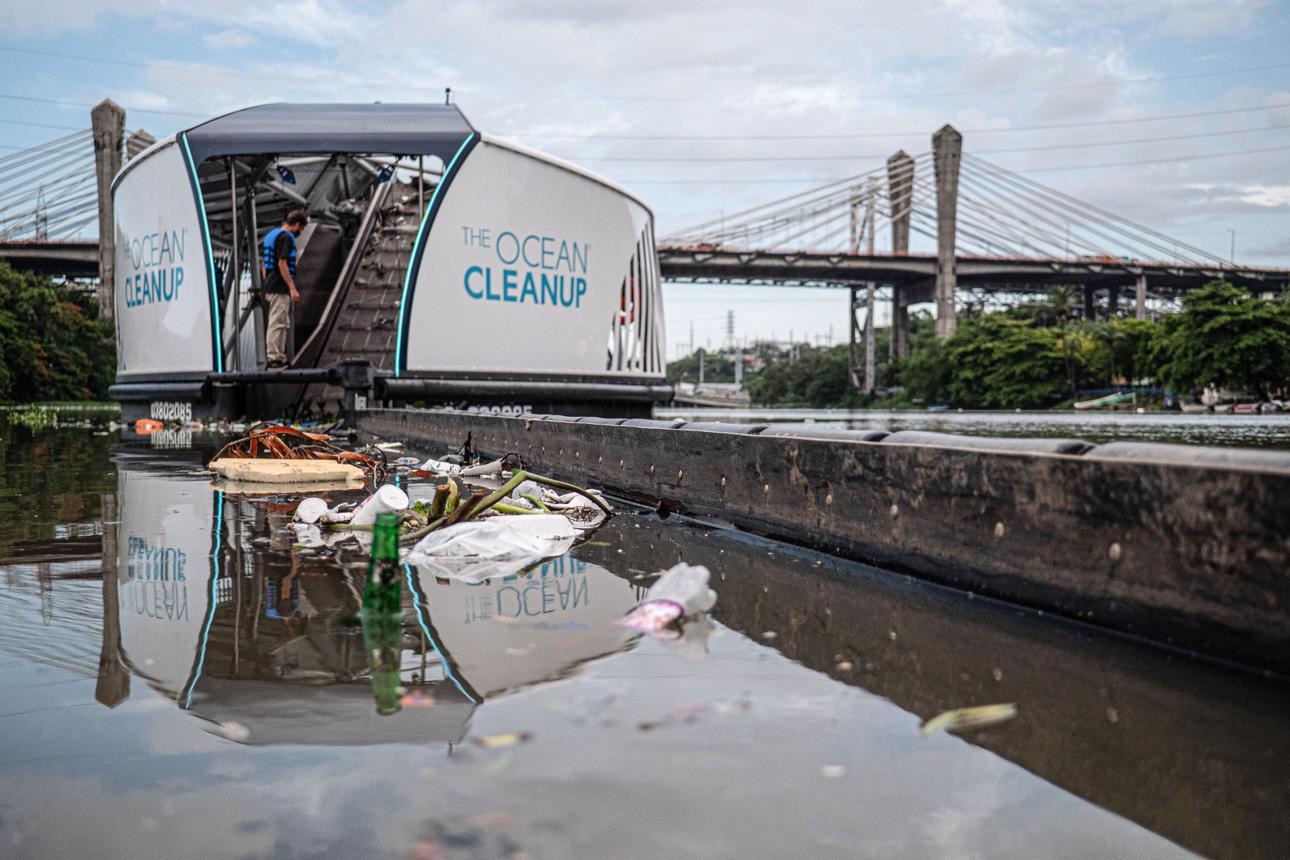
Floating barriers guide debris toward collection zones, while autonomous interceptor vessels equipped with conveyor-belt systems lift plastic waste out of the water before it reaches the sea.
The collected material is then transported for recycling, sorting, or disposal.
Unlike traditional cleanup boats requiring continuous manual operation, the interceptor systems are designed for semi-autonomous operation with scalable deployment potential.
According to reports, these systems are already operating in rivers across:
- Indonesia,
- India,
- Colombia,
- the Philippines,
- and parts of the Caribbean.
The strategy focuses especially on highly polluted urban waterways where relatively small intervention areas may prevent enormous quantities of marine pollution.
The Surprising Math Behind the Plastic Crisis
One of the most striking claims made by Slat concerns the concentration of pollution sources.
According to him, targeting just 30 cities worldwide could potentially stop roughly one-third of the plastic currently entering the oceans.
That means the global ocean-plastic crisis may be driven disproportionately by a relatively limited number of highly polluted river systems.
Perhaps the most dramatic example mentioned is the Motagua River in Guatemala.
Slat reportedly stated that this single river may send more plastic into the ocean than all 38 OECD countries combined. He further estimated that the river alone may account for around 2% of global plastic emissions into the sea.
If accurate, such figures radically change how policymakers and environmental engineers may think about marine pollution.
The implication is clear:
targeting key pollution hotspots may produce far greater results than spreading resources thinly across thousands of locations.
The Goal: Stop 90% of Floating Ocean Plastic by 2040

The Ocean Cleanup’s long-term objective is extraordinarily ambitious.
The organization aims to:
- stop 90% of floating ocean plastic pollution from entering the sea by 2040,
- while simultaneously removing existing floating plastic accumulations such as the Great Pacific Garbage Patch.
The projected cost, according to Slat, may remain below $1 billion overall.
In global infrastructure terms, that figure is relatively small.
For comparison, major port expansions, offshore energy projects, or urban infrastructure systems often cost several billions individually.
This is one reason the project has attracted global attention. If the technology scales successfully, it could become one of the most cost-effective large-scale environmental interventions attempted in modern history.
From Aerospace Student to Global Environmental Figure
Boyan Slat began working on the concept more than a decade ago after becoming frustrated by the scale of ocean plastic pollution.
He eventually left his aerospace engineering studies to focus entirely on the project.
At the time, many critics doubted whether the idea was technically realistic. Ocean environments are notoriously difficult for large-scale engineering systems because of waves, storms, corrosion, marine growth, and operational complexity.
Yet over the years, The Ocean Cleanup continued refining its systems through repeated trials, redesigns, and deployments.
The organization now claims it has already removed nearly 50 million kilograms of plastic waste from oceans and rivers worldwide.
Regardless of future outcomes, the project has already demonstrated how engineering innovation combined with public engagement can transform environmental activism into operational infrastructure.
Why the Project Resonates Emotionally with Younger Generations
One reason Boyan Slat’s message receives global attention is psychological rather than technical.
Climate change, biodiversity loss, pollution, and ecological decline have created widespread anxiety and fatalism, particularly among younger generations.
Many environmental discussions focus heavily on collapse, crisis, and irreversible damage.
Slat’s message is different.
He argues that the world needs visible environmental success stories capable of restoring confidence that large-scale problems can still be solved through innovation and coordinated action.
As he reportedly explained:
if humanity can eventually say there was once a time when oceans were filled with plastic and then the problem was solved, that achievement itself could inspire broader environmental action.
That narrative matters because environmental progress often depends not only on technology, but also on public belief that improvement is still possible.

The Biggest Challenge: Scaling the Technology Globally
The main question facing The Ocean Cleanup is not whether the technology works at small scale.
The real question is whether it can scale globally fast enough.
Large-scale deployment requires:
- funding,
- government cooperation,
- waste-management infrastructure,
- maintenance capability,
- political stability,
- and long-term operational support.
Many of the world’s most polluted rivers are located in densely populated developing regions where waste-management systems are already under pressure.
This means cleanup technology alone cannot solve the problem entirely.
Long-term success also depends on:
- reducing plastic consumption,
- improving recycling systems,
- strengthening urban waste collection,
- and preventing illegal dumping.
The cleanup systems may therefore become one part of a much larger environmental transition.
Why Engineers and Maritime Experts Are Watching Closely
The project also interests maritime engineers because it demonstrates how relatively simple mechanical systems combined with autonomous operations may solve enormous environmental problems.
The technologies involve:
- floating infrastructure,
- hydrodynamic design,
- autonomous operation,
- conveyor systems,
- waste logistics,
- and marine-environment engineering.
As smart maritime infrastructure expands globally, similar technologies may eventually support:
- harbor cleanup,
- floating debris monitoring,
- river pollution control,
- and autonomous environmental-management systems.
Final Thoughts
The global ocean plastic crisis is one of the defining environmental challenges of the modern era.
For many years, the problem seemed so vast that meaningful solutions appeared unrealistic.
Boyan Slat’s project does not guarantee success.
But it does offer something increasingly rare in environmental debates:
a technically grounded attempt to solve a global problem at meaningful scale.
Whether The Ocean Cleanup ultimately reaches its goal of reducing 90% of floating ocean plastic by 2040 remains uncertain.
However, the project has already changed how many scientists, engineers, and policymakers think about marine pollution.
Instead of treating ocean plastic as an uncontrollable global disaster, it reframes the issue as an engineering and infrastructure challenge that may actually be solvable.
And that shift in mindset alone may prove historically important.
FAQ: Boyan Slat and The Ocean Cleanup
Who is Boyan Slat?
Boyan Slat is a Dutch inventor and entrepreneur who founded The Ocean Cleanup to fight marine plastic pollution.
What is The Ocean Cleanup?
The Ocean Cleanup is a nonprofit organization developing technologies to remove plastic from oceans and rivers.
How does the river-cleanup technology work?
Floating barriers guide debris toward autonomous interceptor systems that collect plastic using conveyor belts before it reaches the sea.
Why focus on rivers instead of oceans?
Much of the world’s ocean plastic originates in rivers. Preventing plastic from entering the ocean is more efficient than removing it after it disperses.
What is the project’s main goal?
The organization aims to stop 90% of floating ocean plastic pollution from entering the sea by 2040.
How much plastic has The Ocean Cleanup removed?
The organization says it has removed nearly 50 million kilograms of plastic waste from rivers and oceans worldwide.
Why is the Motagua River important?
According to Boyan Slat, the Motagua River in Guatemala may account for roughly 2% of global plastic emissions into the ocean.
How much could the overall cleanup effort cost?
Slat estimates that the larger global strategy could cost less than $1 billion.
Can cleanup technology alone solve ocean plastic pollution?
No. Long-term solutions also require better waste management, recycling systems, reduced plastic leakage, and stronger environmental policies.
Why is this project globally significant?
Because it represents one of the largest and most ambitious attempts to tackle marine plastic pollution using scalable engineering infrastructure.