
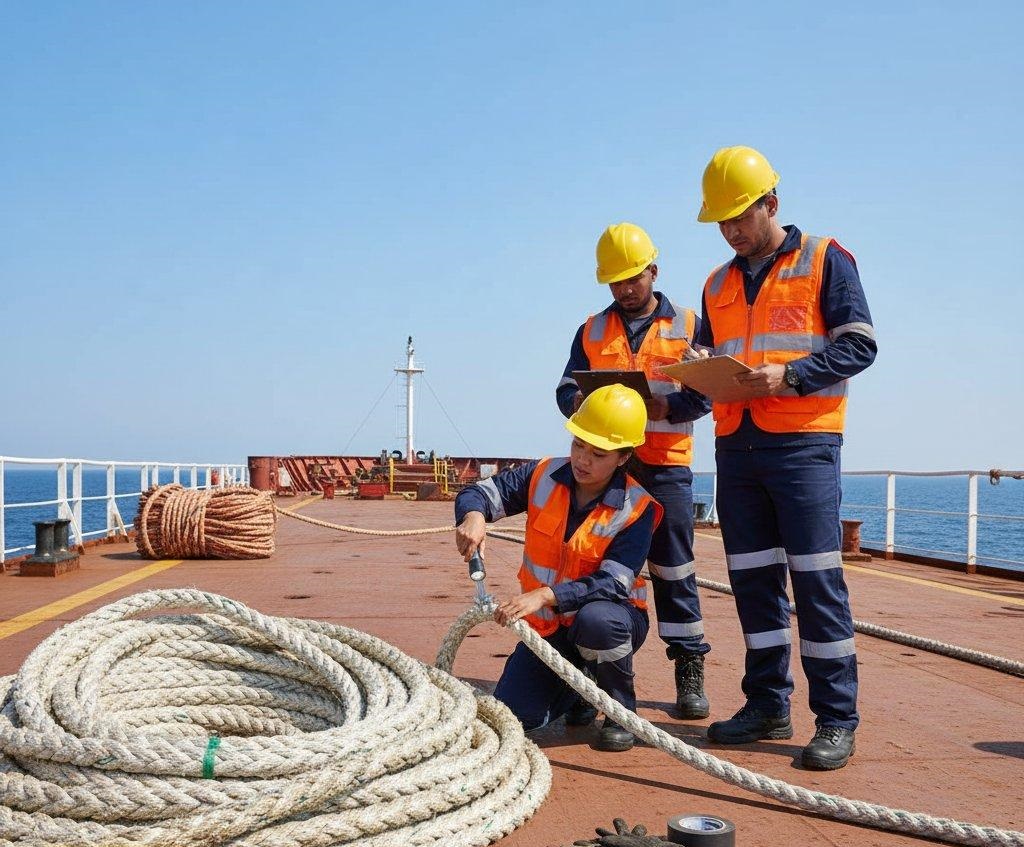
Mooring operations are consistently identified as one of the highest-risk activities in maritime operations. Unlike routine navigation or engine monitoring, mooring combines high mechanical forces, dynamic environmental loads, human coordination, and time pressure within a confined working area. This makes even small errors potentially catastrophic.
The following twelve failure modes represent the most common and operationally significant breakdowns observed in mooring practices across merchant fleets. Each is examined not just as an isolated issue, but as part of a broader system of technical, human, and organisational risk factors.
1. Snap-Back Zone Mismanagement


Snap-back remains the most severe hazard in mooring operations. When a mooring line under tension fails, the stored elastic energy is released instantly, causing the line to recoil along a predictable—but often misunderstood—path.
Failures occur when crew underestimate the stored energy within synthetic or steel lines, especially under high environmental loads or during winch adjustments. In many incidents, personnel are positioned within danger zones either due to lack of awareness or because operational tasks require proximity to lines.
The problem is not only technical but behavioural. Even where snap-back zones are marked, they are sometimes ignored during busy operations or when crews prioritize speed over safety. Furthermore, mixed mooring systems (e.g., combination of steel wires and synthetic tails) can alter recoil characteristics, increasing unpredictability.
The consequence is often immediate and severe injury. This makes snap-back management not just a procedural issue, but a critical safety culture indicator onboard ships.
2. Use of Damaged or Degraded Mooring Lines


Mooring lines operate under cyclic loading, environmental exposure, and mechanical abrasion. Over time, this leads to degradation that may not always be visible externally.
A common failure is the continued use of lines that have lost strength due to internal fibre fatigue, UV degradation, salt crystallisation, or mechanical wear. In practice, inspection regimes are sometimes treated as routine checklists rather than critical safety evaluations.
Another issue is the lack of traceability and lifecycle management. Without proper records of usage cycles, peak loads, and exposure conditions, it becomes difficult to determine when a line should be withdrawn from service.
When such lines fail under load, the result is not only loss of mooring integrity but also a high likelihood of snap-back incidents. This reflects a deeper organisational gap in preventive maintenance and asset integrity management.
3. Improper Line Handling and Leading


Correct line leading is fundamental to maintaining safe load distribution. However, improper practices—such as excessive angles at fairleads, crossing of lines, or routing over unsuitable structures—introduce stress concentrations that significantly reduce line strength.
These issues often arise from inadequate planning or rushed execution, especially during port approaches where time pressure is high. In some cases, crew may attempt to “adjust” line arrangements after initial securing, increasing the risk of sudden load redistribution.
The technical implication is that lines do not behave as designed. Instead of sharing load evenly, certain lines carry disproportionate tension, leading to accelerated wear or sudden failure.
This failure mode highlights the importance of procedural discipline and understanding of load mechanics, rather than reliance on routine or habit.
4. Communication Breakdown Between Ship and Shore

Mooring is a coordinated operation involving multiple actors: bridge team, deck crew, shore mooring gangs, pilots, and terminal personnel. Any breakdown in communication can lead to unsafe actions or delayed responses.
Failures often occur due to language barriers, unclear command structures, or inconsistent use of standard phrases. For example, ambiguity in instructions such as “heave in,” “slack away,” or “hold” can result in incorrect winch operation at critical moments.
Additionally, reliance on informal communication methods—such as hand signals or non-standard radio phrases—can create confusion, particularly in multinational crews.
The operational consequence is loss of synchronisation between vessel movement and line handling, which can result in excessive loads, vessel drift, or equipment damage. This failure reflects weaknesses in Bridge Resource Management (BRM) and operational coordination.
5. Inadequate Training and Competence
Mooring operations require a combination of technical knowledge, situational awareness, and practical skill. However, not all crew members receive structured, competence-based training specific to mooring risks.
Inadequate training manifests in several ways. Crew may not fully understand line behaviour under tension, the function of winch brakes, or the importance of maintaining safe positions relative to moving equipment. In some cases, personnel rely on observation rather than formal instruction.
The challenge is compounded by crew turnover and varying experience levels. Without standardised training and assessment, the overall competence of the mooring team becomes inconsistent.
This failure mode directly increases the probability of human error and demonstrates the need for structured training aligned with STCW competence frameworks and simulator-based practice.
6. Mooring Equipment Failure (Winches, Brakes, Deck Fittings)

Mooring equipment is subjected to high loads and harsh environmental conditions. Failures in winches, brakes, or deck fittings can have immediate operational consequences.
One of the most critical issues is incorrect brake holding capacity. If brakes are not properly tested or adjusted, they may slip under load, causing uncontrolled line movement. Similarly, hydraulic or electrical failures can lead to loss of control during tensioning.
Structural failures of bitts, fairleads, or pedestal rollers are less frequent but can be catastrophic when they occur, particularly if they result from fatigue or corrosion.
This failure mode highlights the importance of planned maintenance systems, regular testing, and compliance with manufacturer specifications and class requirements.
7. Poor Mooring Plan and Load Distribution
A well-designed mooring plan ensures that forces acting on the vessel—wind, current, and tide—are balanced across multiple lines. Poor planning leads to uneven load distribution and increased risk of failure.
In practice, failures occur when mooring arrangements do not reflect actual environmental conditions or berth configuration. For example, insufficient breast lines in high wind conditions can result in excessive load on spring lines.
Another issue is the lack of dynamic adjustment. A mooring plan should not be static; it must evolve as conditions change. Failure to reassess line configuration during operations can compromise vessel stability at berth.
This reflects a gap in operational planning and situational awareness at both bridge and deck levels.
8. Environmental Misjudgement (Wind, Current, Tide)

Failures arise when crews rely on static assumptions rather than real-time assessment. For instance, a vessel moored safely at low tide may experience excessive tension as the tide rises if lines are not adjusted.
This failure mode demonstrates the need for continuous monitoring and proactive adjustment, rather than reactive response.
9. Unsafe Human Positioning and Behaviour
Human behaviour remains a dominant factor in mooring incidents. Unsafe practices—such as standing in rope bights, stepping over tensioned lines, or working too close to winches—are often observed.
These behaviours are sometimes driven by familiarity or complacency, particularly among experienced crew who may underestimate risks. In other cases, operational pressure leads to shortcuts.
The critical issue is that mooring environments are dynamic and unpredictable, meaning that unsafe positioning can result in immediate injury if conditions change suddenly.
This failure underscores the importance of strict safety discipline and active supervision.
10. Over-Tensioning and Lack of Monitoring
Mooring lines must be continuously monitored and adjusted to maintain safe tension levels. Over-tensioning is a common issue, especially during initial mooring or in response to vessel movement.
Excessive tension increases the risk of line failure and accelerates wear on both lines and equipment. It also reduces system flexibility, making it more difficult to absorb environmental loads.
A related issue is the lack of real-time monitoring. Without proper observation or load indicators, crews may not recognise dangerous conditions until it is too late.
This failure highlights the need for dynamic mooring management rather than static securing practices.
11. Inadequate Use of Personal Protective Equipment (PPE)
While PPE does not prevent incidents, it plays a critical role in reducing injury severity. Failure to use appropriate PPE—such as helmets, gloves, safety footwear, and high-visibility clothing—exposes crew to unnecessary risk.
In some cases, PPE is not used due to discomfort or perceived inconvenience. In others, enforcement is inconsistent.
This issue reflects broader challenges in safety culture and compliance enforcement onboard ships.
12. Fatigue and Operational Pressure
Mooring operations often take place during port arrivals and departures, which may coincide with long working hours, night shifts, or demanding weather conditions.
Fatigue reduces alertness, reaction time, and decision-making ability. When combined with commercial pressure for quick turnaround, it increases the likelihood of errors.
This failure is systemic rather than individual. It requires management-level solutions, including proper work-rest scheduling, adequate manning, and realistic operational planning.
Conclusion
Mooring failures rarely result from a single cause. Instead, they emerge from the interaction of human factors, technical conditions, environmental forces, and organisational practices.
Understanding these twelve common failures provides a structured framework for improving mooring safety. Effective mitigation requires:
- Competence-based training and supervision
- Robust equipment maintenance and inspection
- Clear communication and coordination protocols
- Dynamic risk assessment and environmental awareness
- Strong safety culture and fatigue management
By addressing these areas systematically, shipping companies and maritime professionals can significantly reduce the risk associated with mooring operations and enhance overall operational safety.