
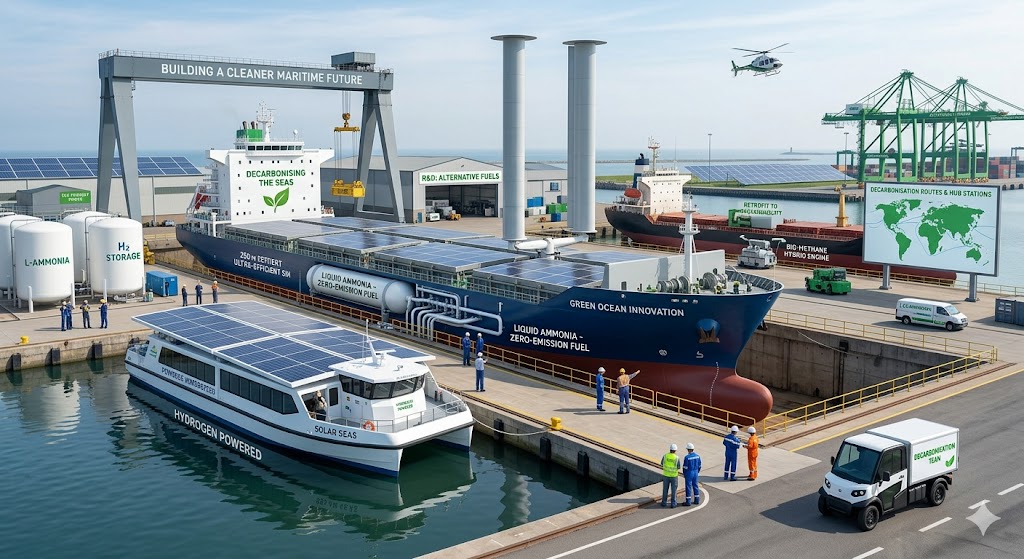
Learn how maritime decarbonisation is reshaping shipping through IMO net-zero targets, FuelEU Maritime, EU ETS shipping rules, alternative fuels, energy efficiency, and onboard carbon capture.
Why Maritime Decarbonisation Matters
Maritime transport carries most of the world’s traded goods, but it also produces significant greenhouse gas emissions. As global pressure grows to reduce climate impact, shipping is entering a major transition. The industry is no longer focused only on fuel efficiency and operational cost; it must now manage carbon intensity, alternative fuels, emissions pricing, and long-term compliance.
Maritime decarbonisation means reducing and eventually eliminating greenhouse gas emissions from ships, ports, fuels, and supporting logistics chains. This includes cleaner ship designs, more efficient operations, low- and zero-carbon fuels, shore power, digital optimisation, and technologies such as onboard carbon capture.
The transition is being driven by both global and regional rules. The IMO’s 2023 GHG Strategy targets net-zero GHG emissions from international shipping by or around 2050, with indicative checkpoints for 2030 and 2040. In Europe, the EU ETS has applied to large ships entering EU ports since January 2024, while FuelEU Maritime has applied in full since 1 January 2025.
What Maritime Decarbonisation Means
Maritime decarbonisation is not a single technology or one fuel solution. It is a combination of technical, operational, regulatory, and commercial changes across the entire shipping value chain.
At ship level, decarbonisation may involve improving hull design, reducing resistance, upgrading propulsion systems, using wind-assisted technologies, optimising engine performance, and switching to cleaner fuels. At fleet level, it includes voyage optimisation, speed management, better maintenance, data-based decision-making, and emissions monitoring. At industry level, it requires fuel supply chains, port infrastructure, financing mechanisms, and international cooperation.
For shipowners, decarbonisation is becoming a business requirement. Charterers, cargo owners, banks, insurers, regulators, and ports increasingly expect shipping companies to demonstrate credible emissions-reduction strategies.
IMO Net-Zero Strategy and the Global Direction of Shipping
The IMO’s 2023 Strategy on Reduction of GHG Emissions from Ships is one of the most important milestones in green shipping. It sets a target for international shipping to reach net-zero GHG emissions by or around 2050. It also includes indicative checkpoints: reducing total annual GHG emissions by at least 20%, striving for 30%, by 2030, and by at least 70%, striving for 80%, by 2040, compared with 2008 levels.
The strategy also aims for zero or near-zero GHG emission technologies, fuels, and energy sources to represent at least 5%, striving for 10%, of the energy used by international shipping by 2030.
In April 2025, IMO approved draft net-zero regulations for global shipping. These are designed to combine a mandatory marine fuel standard with a GHG emissions pricing mechanism. This is important because it moves shipping from voluntary ambition toward binding global economic and technical measures.
EU ETS Shipping: Carbon Pricing for Maritime Transport
The European Union has introduced one of the strongest regional policy frameworks for maritime emissions. Since January 2024, the EU Emissions Trading System has covered CO₂ emissions from large ships of 5,000 gross tonnage and above entering EU ports, regardless of flag.
Under the EU ETS, shipping companies must buy and surrender allowances for covered emissions. The system is being phased in gradually: 40% of reported 2024 emissions must be covered in 2025, 70% of reported 2025 emissions in 2026, and 100% of reported emissions from 2027 onward.
This changes the economics of shipping. Emissions now have a direct financial cost, so fuel consumption, voyage planning, charter-party clauses, speed decisions, and fleet renewal strategies become part of carbon-cost management.
FuelEU Maritime: Reducing Fuel GHG Intensity
FuelEU Maritime is another major EU regulation. Unlike the EU ETS, which prices emissions, FuelEU Maritime focuses on the greenhouse gas intensity of the energy used onboard ships. It applies to ships above 5,000 gross tonnage calling at EU ports, regardless of flag. The regulation starts with a 2% reduction target in 2025 and increases progressively up to an 80% reduction by 2050.
This regulation encourages the use of renewable and low-carbon fuels, shore-side electricity, and cleaner energy technologies. It also pushes shipowners and operators to think beyond fuel consumption alone. The key question becomes: how much GHG is emitted across the energy pathway used by the ship?
For shipping companies, FuelEU Maritime requires careful planning. They need to monitor fuel use, calculate GHG intensity, assess compliance gaps, and consider options such as biofuels, LNG, methanol, ammonia, hydrogen, shore power, pooling, or operational improvements.
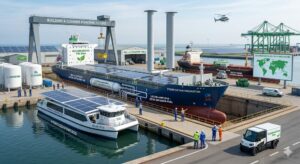
Main Pathways for Green Shipping
| Decarbonisation pathway | Examples | Main benefit | Key challenge |
|---|---|---|---|
| Energy efficiency | Hull cleaning, propeller upgrades, waste heat recovery, engine tuning | Reduces fuel use immediately | Savings vary by ship and operation |
| Operational optimisation | Slow steaming, weather routing, voyage optimisation, just-in-time arrival | Lower emissions without major redesign | Requires coordination with ports and charterers |
| Alternative fuels | Biofuels, methanol, ammonia, hydrogen, LNG as transition fuel | Reduces lifecycle emissions depending on fuel pathway | Availability, cost, safety, infrastructure |
| Electrification and shore power | Cold ironing, batteries, hybrid systems | Cuts port emissions and supports cleaner operations | Port infrastructure and grid capacity |
| Wind-assisted propulsion | Rotor sails, wing sails, kites | Reduces engine load and fuel consumption | Route and vessel suitability |
| Onboard carbon capture | Capturing CO₂ from exhaust gases | Potential option for existing ships | Space, energy penalty, storage, offloading, regulation |
Alternative Marine Fuels: Opportunities and Limitations
Alternative fuels are central to maritime decarbonisation, but there is no single winner for all ship types. The best fuel depends on vessel size, route, engine technology, safety requirements, fuel availability, lifecycle emissions, and cost.
Biofuels can be used as drop-in or near drop-in solutions in some existing engines, making them attractive for short-term compliance. However, sustainable supply is limited, and shipping must compete with aviation, road transport, and other sectors.
Methanol is gaining attention because it is liquid at ambient conditions and easier to store than cryogenic fuels. Green methanol can significantly reduce lifecycle emissions, but supply and price remain major barriers.
Ammonia has strong long-term potential because it contains no carbon at the point of use. However, it is toxic, requires new safety procedures, and still needs engine and fuel-system maturity.
Hydrogen can be used in fuel cells or combustion systems, but storage is difficult because of low volumetric energy density. It may be more suitable for short-sea shipping, ferries, and specific regional routes.
LNG reduces some air pollutants and can lower CO₂ emissions compared with conventional fuel oil, but it remains a fossil fuel and methane slip is a major concern. Industry debate continues over whether LNG should be treated mainly as a transition fuel or a risk of carbon lock-in.
Onboard Carbon Capture for Ships
Onboard carbon capture is an emerging option, especially for existing vessels that may continue using carbon-based fuels during the transition period. The basic idea is to capture CO₂ from engine exhaust before it is released into the atmosphere. The captured CO₂ must then be stored onboard and discharged at suitable port facilities for transport, use, or permanent storage.
This technology could help reduce emissions from hard-to-abate ships, but it is not simple. A ship has limited space, weight capacity, and energy availability. Carbon capture systems may require additional power, chemicals, tanks, cooling, and safety arrangements. There must also be port infrastructure to receive captured CO₂.
For this reason, onboard carbon capture should not be seen as a universal replacement for alternative fuels. It is more likely to become part of a wider decarbonisation toolbox, especially for selected vessel types, long-distance routes, or transitional compliance strategies.
Digitalisation and Data in Maritime Decarbonisation
Digital tools are becoming essential for emissions reduction. A shipping company cannot manage what it cannot measure. Modern vessels increasingly use sensors, voyage data, engine performance monitoring, and digital platforms to track fuel consumption and emissions.
Digitalisation supports decarbonisation through:
- voyage optimisation,
- trim and speed optimisation,
- predictive maintenance,
- fuel and emissions reporting,
- CII and EU ETS monitoring,
- FuelEU Maritime compliance planning.
For example, better weather routing can reduce fuel consumption, while just-in-time arrival can reduce unnecessary waiting time at anchorage. These measures may sound simple, but they require data sharing between ships, ports, charterers, and operators.
Challenges Facing Maritime Decarbonisation
Maritime decarbonisation faces several serious challenges. The first is fuel availability. Many low- and zero-carbon fuels are not yet produced at the scale required for global shipping. Even when they are available, they may be significantly more expensive than conventional marine fuels.
The second challenge is infrastructure. Ports need bunkering systems, storage facilities, safety procedures, electrical capacity, and trained personnel for new fuels and shore power. Without port readiness, ships cannot confidently adopt new energy systems.
The third challenge is investment risk. Ships are long-life assets, often operating for 20 to 30 years. Owners must make decisions today under uncertainty about future fuel prices, regulations, technology maturity, and charterer demand.
The fourth challenge is safety. Fuels such as ammonia, hydrogen, and methanol require new training, risk assessment, emergency procedures, and design standards. Decarbonisation must never compromise maritime safety.
Practical Example: Decarbonising a Medium-Sized Cargo Vessel
A shipowner operating a medium-sized cargo vessel trading partly in Europe may begin with practical measures rather than immediately ordering a new zero-emission ship. The first step could be improving data collection and fuel monitoring. The owner may then apply hull cleaning, propeller polishing, voyage optimisation, and speed management to reduce fuel consumption.
Next, the company may test certified biofuel blends for selected voyages to reduce GHG intensity under FuelEU Maritime. If the ship frequently calls at EU ports, the company must also manage EU ETS allowance costs and include carbon-cost clauses in commercial agreements.
For long-term planning, the owner may compare retrofit options such as wind-assisted propulsion, engine conversion for methanol, or onboard carbon capture. The final decision depends on route stability, remaining vessel life, fuel availability, capital cost, and expected regulatory pressure.
Future Outlook: From Compliance to Competitive Advantage
In the coming years, maritime decarbonisation will move from environmental ambition to commercial reality. Companies that act early may gain advantages through lower carbon costs, better access to green finance, stronger charterer relationships, and improved regulatory readiness.
The future of green shipping will probably be multi-fuel and multi-technology. Deep-sea vessels, ferries, offshore vessels, tankers, bulk carriers, and container ships may follow different pathways. Some will use alternative fuels, others may combine efficiency technologies, digital optimisation, shore power, wind assistance, and carbon capture.
The most successful companies will not wait for a perfect solution. They will build flexible transition strategies that can adapt as regulations, fuels, and technologies evolve.
Conclusion: Maritime Decarbonisation Is Reshaping Shipping
Maritime decarbonisation is one of the greatest transformations in the history of shipping. It affects ship design, fuel choices, port infrastructure, crew training, finance, chartering, and regulatory compliance.
The IMO net-zero strategy gives the global direction, while EU ETS shipping and FuelEU Maritime are already changing operational and financial decisions in Europe. Alternative fuels, energy efficiency, digital tools, and onboard carbon capture all have roles to play, but each comes with technical and economic challenges.
For maritime students, professionals, and decision-makers, understanding decarbonisation is now essential. Green shipping is no longer a future concept; it is becoming the new operating standard for the maritime industry.
–
Frequently Asked Questions
What is maritime decarbonisation?
Maritime decarbonisation means reducing greenhouse gas emissions from ships and maritime operations through cleaner fuels, energy efficiency, digital optimisation, regulations, and new technologies.
What is the IMO net-zero target for shipping?
The IMO aims for international shipping to reach net-zero GHG emissions by or around 2050, with indicative reduction checkpoints for 2030 and 2040.
What is FuelEU Maritime?
FuelEU Maritime is an EU regulation that limits the yearly average GHG intensity of energy used by ships above 5,000 gross tonnage calling at European ports. It starts with a 2% reduction in 2025 and rises toward 80% by 2050.
How does the EU ETS affect shipping?
The EU ETS requires shipping companies to surrender allowances for covered emissions. Maritime emissions are phased in from 2024 reporting, with full coverage from 2027 onward.
What are the main alternative fuels for ships?
Key options include biofuels, methanol, ammonia, hydrogen, LNG, and synthetic fuels. Each has different advantages, costs, safety issues, and infrastructure needs.
References
International Maritime Organization. “2023 IMO Strategy on Reduction of GHG Emissions from Ships.”
International Maritime Organization. “IMO’s Work to Cut GHG Emissions from Ships.”
International Maritime Organization. “IMO Approves Net-Zero Regulations for Global Shipping.”
European Commission. “Reducing Emissions from the Shipping Sector.”
European Commission. “FAQ – Maritime Transport in EU Emissions Trading System.”
European Commission. “Decarbonising Maritime Transport – FuelEU Maritime.”
European Maritime Safety Agency. “FuelEU Maritime: Full Application 1 January 2025.”