
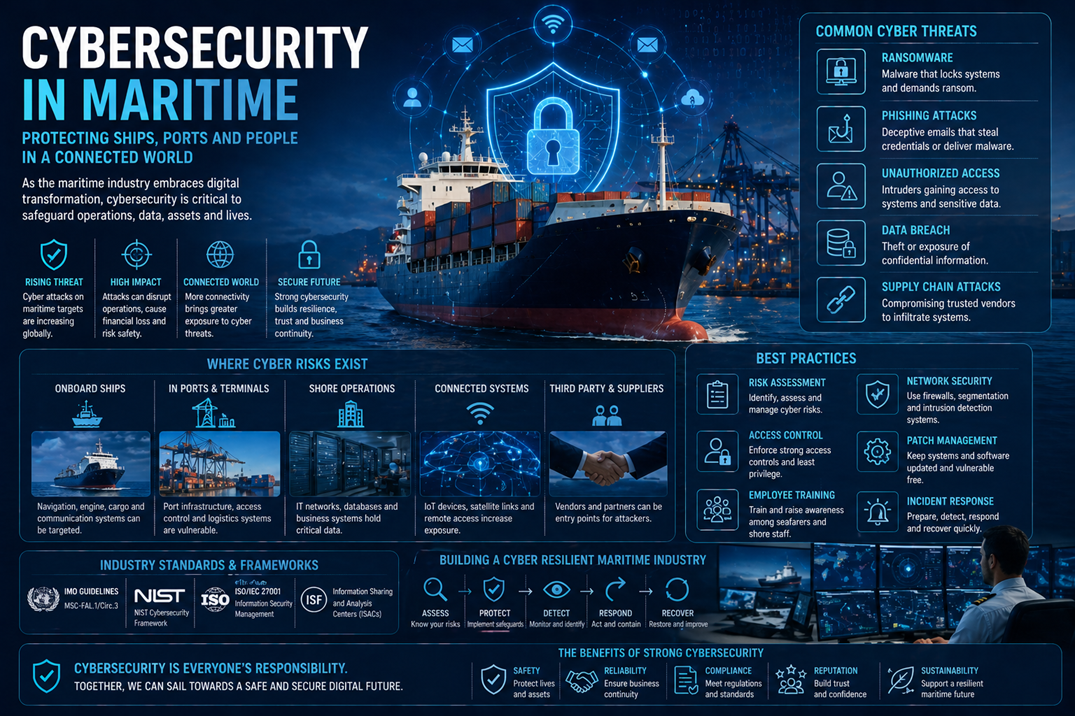
Learn how cybersecurity in maritime is evolving, including maritime cyber risks, GNSS spoofing, ship hacking, port cybersecurity, and ECDIS cyber threats.
Why Cybersecurity Matters in Modern Shipping
The maritime industry is becoming increasingly digital. Ships now rely on integrated navigation systems, satellite communications, automated engine controls, and real-time data exchange with shore-based operations. Ports are also transforming into highly connected digital hubs.
This connectivity brings efficiency, but it also introduces new risks. Cyber threats can affect navigation, cargo operations, communication systems, and even safety-critical equipment. As a result, cybersecurity is no longer an IT issue alone—it is a core element of maritime safety and operational risk management.
Organizations such as the International Maritime Organization have recognised this shift, requiring cyber risk management to be incorporated into ship safety management systems under the ISM Code.
The Growing Nature of Maritime Cyber Risk
Maritime cyber risk refers to the potential for cyber threats to disrupt ship operations, compromise data, or cause physical damage. Unlike traditional risks such as mechanical failure or weather, cyber risks originate from digital systems and external actors.
As ships and ports become more connected, the attack surface expands. Modern vessels use networked systems for navigation, cargo handling, propulsion monitoring, and communication. Ports rely on digital platforms for terminal operations, logistics coordination, and customs processing.
This interconnected environment means that a vulnerability in one system can affect multiple parts of the operation. For example, a compromised communication system may lead to incorrect navigation data, while a hacked terminal system could disrupt cargo flows across an entire port.
Key Cyber Threats in Maritime Operations
Cyber threats in maritime are diverse and continuously evolving. Among the most critical are navigation interference, system hacking, and data manipulation.
GNSS Spoofing and Navigation Risks
Global Navigation Satellite Systems (GNSS), including GPS, are essential for modern navigation. However, these systems are vulnerable to spoofing, where false signals are transmitted to mislead a ship’s position.
GNSS spoofing can cause a vessel to believe it is in a different location, potentially leading to navigational errors, grounding, or collision risks. This threat has been reported in several maritime regions and is considered a serious concern for safe navigation.
Ship Hacking and System Intrusion
Ship systems can be targeted by cyberattacks that aim to gain unauthorized access to onboard networks. This may include bridge systems, engine control systems, or communication platforms.
In some scenarios, attackers could alter operational data, disrupt systems, or lock access to critical software through ransomware. While large-scale attacks are still relatively rare, the potential consequences are significant.
ECDIS Cyber Threats
The Electronic Chart Display and Information System (ECDIS) is a critical navigation tool on modern ships. It integrates chart data, positioning information, and voyage planning.
If ECDIS data is corrupted, outdated, or manipulated, it can provide incorrect navigational information. This could result in unsafe routing decisions. Because ECDIS relies on both internal data and external updates, it must be carefully protected against cyber threats.
Cybersecurity in Ports and Terminals
Ports are becoming highly digitalised environments, often described as smart ports. This digital transformation increases efficiency but also creates vulnerabilities.
Port systems manage container tracking, cargo documentation, gate operations, and logistics coordination. A cyberattack on these systems can disrupt entire supply chains.
The European Maritime Safety Agency has highlighted that port cybersecurity is critical due to the integration of operational technology and information technology systems. Attacks on port infrastructure can lead to delays, financial losses, and reputational damage.
A well-known example is ransomware attacks targeting port operators, which have temporarily shut down terminal operations and affected global logistics networks.
How Cyber Threats Affect Maritime Safety
Cybersecurity is closely linked to safety. A cyber incident is not limited to data loss—it can have physical consequences.
For example, if navigation data is manipulated, a vessel may deviate from its intended route. If engine control systems are affected, propulsion may be disrupted. If cargo systems are compromised, hazardous materials may not be handled correctly.
This connection between digital systems and physical operations makes cybersecurity a critical component of overall risk management in shipping.
Regulatory Framework and Industry Response
The maritime industry has started to respond to cyber risks through regulations and guidelines.
The International Maritime Organization requires companies to address cyber risk within their Safety Management System (SMS) under the ISM Code. This means that cybersecurity must be treated similarly to other safety risks, with procedures, training, and continuous monitoring.
Classification societies such as DNV and Bureau Veritas have also developed guidelines and notations for cyber-secure ships.
These frameworks encourage shipping companies to identify vulnerabilities, implement protective measures, and ensure crew awareness.
Practical Measures for Cyber Risk Management
Effective cybersecurity in maritime operations requires a combination of technical and organisational measures.
At a basic level, systems must be protected through secure network design, regular software updates, and controlled access. Crew members should be trained to recognise phishing attempts and avoid unsafe practices such as using unverified USB devices.
Navigation systems should be cross-checked using multiple sources, such as radar and visual observations, to detect anomalies like GNSS spoofing.
Ports and shipping companies should also develop incident response plans to ensure quick action in case of a cyberattack.
Challenges in Maritime Cybersecurity
Despite increasing awareness, several challenges remain.
One of the main issues is the integration of legacy systems with modern digital technologies. Many ships still operate with older equipment that was not designed with cybersecurity in mind.
Another challenge is the human factor. Crew members may not have specialised cybersecurity training, and operational priorities can sometimes lead to shortcuts in security practices.
Connectivity limitations at sea can also make it difficult to implement real-time monitoring and updates.
Finally, cyber threats are constantly evolving, requiring continuous adaptation and investment.
Future Outlook: Cybersecurity as a Core Maritime Competence
As digitalisation continues, cybersecurity will become a standard competence for maritime professionals. It will be integrated into training programs, operational procedures, and ship design.
Future developments may include:
- More secure satellite communication systems
- Advanced intrusion detection and monitoring tools
- Greater integration of cybersecurity into autonomous ship systems
- International standards specifically addressing maritime cyber risks
Cybersecurity will increasingly be treated as part of navigational safety and operational reliability, rather than a separate technical issue.
Conclusion: Protecting the Digital Backbone of Shipping
The maritime industry is becoming more connected, and with this connectivity comes increased cyber risk. From GNSS spoofing and ECDIS threats to port system attacks and ship hacking, the risks are real and growing.
Effective cybersecurity requires awareness, training, robust systems, and regulatory compliance. It is not only about protecting data but also about ensuring safe navigation, reliable operations, and resilient supply chains.
For maritime professionals, understanding cyber risks is now as important as understanding traditional seamanship. The future of safe shipping depends on both.
Frequently Asked Questions (FAQ)
What is maritime cyber risk?
It refers to the risk of cyber threats affecting ship systems, data, and operations.
What is GNSS spoofing?
It is the transmission of false navigation signals to mislead a ship’s position.
Why is ECDIS vulnerable to cyber threats?
Because it relies on digital data and updates that can be manipulated if not properly secured.
Are ports at risk of cyberattacks?
Yes, especially as they become more digital and connected.
References
- International Maritime Organization – Cyber Risk Management under ISM Code
- European Maritime Safety Agency – Maritime cybersecurity reports
- DNV – Cyber security guidelines for ships
- Bureau Veritas – Cyber-secure ship notations
- BIMCO. Guidelines on Cyber Security Onboard Ships
- ICS. Guidelines on Maritime Cyber Security