
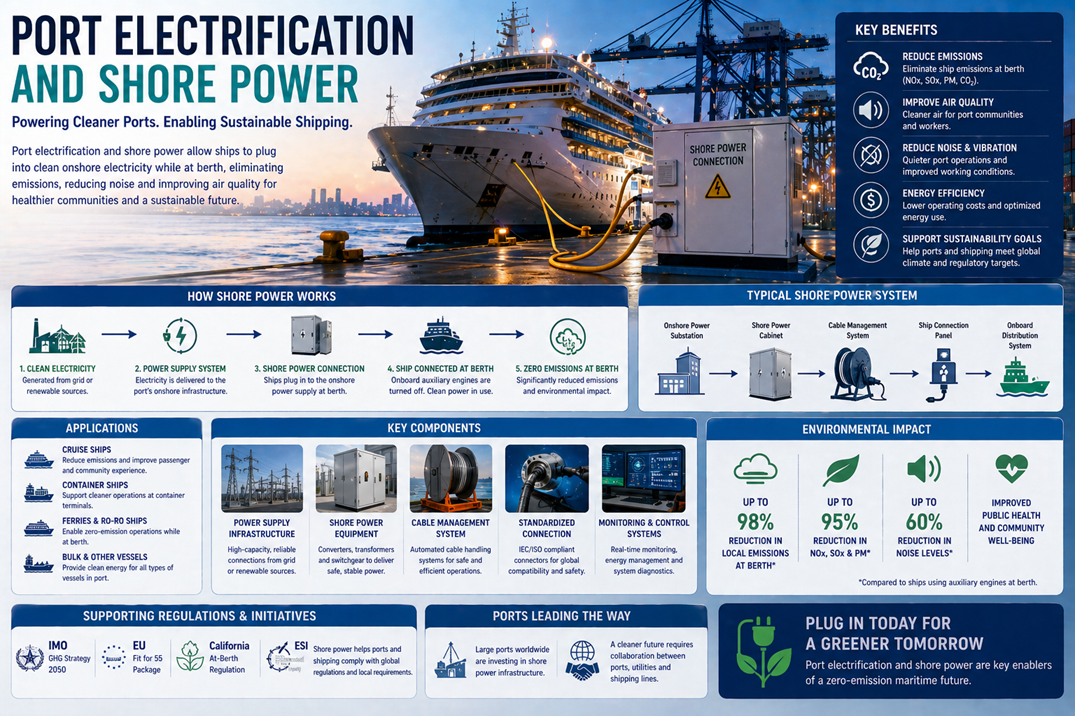
Learn how port electrification, shore power, cold ironing, OPS, port grid capacity, and renewable electricity for ships are reshaping green ports and reducing emissions at berth.
Why Ports Are Becoming Electrified
Ports are no longer only places where ships load and discharge cargo. They are becoming energy hubs, digital logistics centres, and key players in maritime decarbonisation. One of the most important changes in this transition is port electrification, especially the use of shore power, also known as cold ironing, shore-side electricity, or onshore power supply (OPS).
When a ship is at berth, it still needs electricity for lighting, pumps, ventilation, refrigeration, hotel services, cargo systems, and safety equipment. Traditionally, this electricity is produced by onboard auxiliary engines burning marine fuel. Shore power allows the ship to switch off these auxiliary engines and connect to the local electricity grid instead.
This can reduce local air pollution, noise, and greenhouse gas emissions, especially when the electricity comes from renewable or low-carbon sources. For port cities, this is not just a climate issue; it is also a public health and urban air-quality issue.
What Is Shore Power or Cold Ironing?
Shore power is a system that supplies electricity from the port to a ship while it is moored at the quay. The term cold ironing comes from the idea that a ship’s engines become “cold” because they are no longer running to generate power at berth.
A shore power system normally includes a grid connection, transformers, frequency converters where needed, cable management systems, safety interlocks, metering equipment, and compatible onboard receiving equipment. The ship and the port must be technically compatible, because ships may use different voltage levels, frequencies, and connection arrangements.
In practice, shore power is most attractive for ships that spend regular time at berth and have high hotel or auxiliary loads. This includes cruise ships, ferries, container ships, ro-ro vessels, and some specialised ships. The environmental value is highest where ports are close to populated areas and where the grid electricity is cleaner than the fuel that would otherwise be burned onboard.
OPS and European Regulation
In Europe, shore power is moving from a voluntary green-port initiative to a regulatory requirement. The EU’s FuelEU Maritime Regulation requires seagoing passenger and container ships above 5,000 gross tonnage to use onshore power supply, or another zero-emission technology, from 2030 when berthed for more than two hours in TEN-T ports, and from 2035 in all EU ports where OPS is available.
The Alternative Fuels Infrastructure Regulation also requires sufficient shore-side electricity supply in maritime ports by the end of 2029. This means that port authorities, terminal operators, grid companies, and shipowners must coordinate investment before the 2030 compliance date.
The regulatory direction is clear: ships at berth will increasingly be expected to reduce or eliminate emissions from auxiliary engines. However, the challenge is not only installing plugs on quays. Ports need sufficient electrical capacity, safe operating procedures, compatible ship systems, and commercially viable electricity pricing.
Why Shore Power Matters for Green Ports
Shore power is one of the most practical tools for reducing emissions in port areas. Ships at berth can produce significant amounts of nitrogen oxides, sulphur oxides, particulate matter, carbon dioxide, and noise. These impacts are especially sensitive in cruise ports, ferry ports, and container terminals located near residential districts.
By connecting to shore-side electricity, a ship can reduce local exhaust emissions almost immediately. If the electricity is renewable, the climate benefit becomes stronger. If the electricity comes from a carbon-intensive grid, local air quality may still improve, but the total greenhouse gas benefit will be smaller. This is why port electrification should be linked to renewable electricity procurement, grid decarbonisation, and local energy planning.
Shore power also supports the broader idea of the green port. A green port does not only reduce ship emissions. It also improves terminal equipment efficiency, electrifies cargo-handling machines, integrates renewable energy, manages energy storage, and coordinates with hinterland transport.
Port Grid Capacity: The Hidden Challenge
Grid capacity is one of the most important barriers to port electrification. A large cruise ship or container ship can require several megawatts of power while at berth. If several ships connect at the same time, the total load can become very large.
This means ports must assess not only the average electricity demand, but also peak demand, berth occupancy patterns, ship types, future traffic growth, and the connection capacity of the local grid. In some cases, the existing grid connection may be insufficient, requiring new substations, transformers, cables, or grid reinforcement.
Grid planning is especially difficult because ports must invest ahead of demand, while shipowners may hesitate to install onboard equipment until port availability improves. This creates a “chicken-and-egg” problem: ships need ports with OPS, and ports need ships ready to use OPS. DNV notes that better standards and targeted investment approaches are expected to increase both ship and port adoption of shore power.
Main Elements of a Shore Power System
| Element | Function in OPS | Key consideration |
|---|---|---|
| Grid connection | Supplies electricity from the local network | Must handle peak berth demand |
| Transformer and switchgear | Adjusts and controls electrical supply | Requires safety protection and redundancy |
| Frequency converter | Matches shore frequency to ship frequency where needed | Important for international vessels |
| Cable management system | Connects shore equipment to the ship | Must be safe, durable, and easy to operate |
| Ship receiving system | Allows the vessel to accept shore power | Requires onboard compatibility and class approval |
| Metering and control system | Measures energy use and manages connection | Needed for billing, safety, and reporting |
Renewable Electricity for Ships
Shore power only reaches its full decarbonisation potential when the electricity is low-carbon. Ports can support this by purchasing renewable electricity, installing solar panels on warehouses and terminals, developing local wind or offshore wind links, and using battery storage to manage peak demand.
In the future, ports may become integrated energy hubs. They could provide shore power, charge electric harbour craft, supply alternative fuels such as hydrogen or ammonia, and support grid balancing through energy storage. DNV’s analysis of ports in a decarbonised energy system highlights the growing role of electrification and offshore wind integration in the future port-energy landscape.
For shipowners, renewable shore power can also support compliance with emissions regulations and corporate sustainability goals. For ports, it can improve environmental performance, reduce community pressure, and attract cleaner shipping services.
Safety and Technical Standards
Shore power involves high-voltage electricity, ship-shore interfaces, and operational responsibility shared between port and vessel personnel. Safety must therefore be carefully managed. The European Maritime Safety Agency has issued guidance to support port authorities and administrations in planning and developing shore-side electricity, including infrastructure elements, responsibility frameworks, and operational control measures.
Technical safety issues include earthing, emergency shutdown, cable handling, electrical protection, synchronisation, isolation, and communication between the ship and shore systems. Crew and port staff must also be trained to connect, monitor, and disconnect safely.
A shore power failure during cargo operations or passenger services can create operational disruption. Therefore, redundancy, testing, maintenance, and clear procedures are essential.
Economic and Operational Challenges
Although shore power offers strong environmental benefits, implementation can be expensive. Ports must invest in electrical infrastructure, while shipowners may need onboard retrofits. The business case depends on electricity prices, fuel prices, carbon costs, berth time, vessel type, and regulatory pressure.
Another challenge is utilisation. If a port installs OPS but only a small number of ships can use it, the financial return may be weak. This is why OPS planning should focus first on high-frequency routes and vessel segments with predictable berth calls, such as ferries, cruise ships, and regular container services.
Recent analysis has also suggested that many European ports are not yet progressing fast enough toward the 2030 shore power requirements. A Reuters report on a Transport & Environment-commissioned study stated that only about one in five required OPS connections had been installed or contracted among the ports studied. This indicates that the regulatory target is clear, but implementation remains uneven.
Practical Example: Shore Power for a Ferry Terminal
A ferry terminal is often a good early candidate for shore power because ferries usually operate on regular routes and predictable schedules. The port knows when the vessel will arrive, how long it will stay, and how much power it needs.
In a typical project, the port authority first studies berth demand and grid capacity. The ferry operator then checks onboard compatibility and retrofit needs. The grid operator assesses whether the local network can support the additional load. Once the system is installed, the ferry connects during each port stay and shuts down its auxiliary engines.
The result can be a direct reduction in local emissions and noise, especially if the ferry terminal is close to an urban area. Over time, the same infrastructure may support battery-hybrid ferries or fully electric short-sea vessels.
Future Outlook: From Shore Power to Port Energy Hubs
Port electrification will not stop at shore power. As green ports develop, electricity will support many other systems: electric cranes, automated guided vehicles, terminal tractors, battery storage, harbour craft, and charging infrastructure for trucks and rail operations.
This will make ports more dependent on energy planning. Future port competitiveness may depend not only on berth depth, crane productivity, and hinterland connections, but also on grid capacity, renewable electricity access, and energy-management intelligence.
The most advanced ports will likely combine shore power with digital energy management, renewable generation, battery storage, smart grids, and alternative fuel bunkering. In this model, the port becomes a critical link between maritime decarbonisation and the wider energy transition.
Conclusion: Shore Power Is Becoming a Core Green-Port Technology
Port electrification and shore power are becoming essential parts of maritime decarbonisation. By allowing ships to switch off auxiliary engines at berth, OPS can reduce local air pollution, noise, and greenhouse gas emissions, especially when supplied by renewable electricity.
However, success depends on more than installing equipment. Ports need grid capacity, technical standards, safety procedures, investment planning, and cooperation with shipowners. The EU regulatory framework is accelerating adoption, but many ports still face significant implementation challenges before 2030.
For maritime professionals, shore power is no longer a niche topic. It is becoming a central feature of green ports, smart logistics, and low-emission shipping.
Frequently Asked Questions
What is shore power in shipping?
Shore power is the supply of electricity from the port to a ship at berth, allowing the vessel to switch off its auxiliary engines.
What is cold ironing?
Cold ironing is another name for shore power. It refers to the ship’s engines becoming “cold” because they are not running while the ship receives electricity from shore.
What does OPS mean?
OPS means Onshore Power Supply. It is widely used in European regulations and port electrification projects.
Why is port grid capacity important?
Large ships can require several megawatts of electricity at berth. Ports need sufficient grid capacity to supply one or more ships safely and reliably.
Does shore power reduce emissions?
Yes, it reduces emissions at berth by replacing onboard auxiliary engine use. The total climate benefit depends on how clean the supplied electricity is.
References
International Maritime Organization / GreenVoyage2050. Shore Power.
European Commission. New EU rules aiming to decarbonise the maritime sector take effect.
EUR-Lex. Deployment of alternative fuels infrastructure.
European Maritime Safety Agency. Shore-Side Electricity: Guidance to Port Authorities and Administrations.
DNV. ReCharge: shore power methodology and tools.
DNV. The role of ports in a decarbonized energy system.
Reuters. European ports slow to install shore power ahead of 2030 deadline, study shows.