

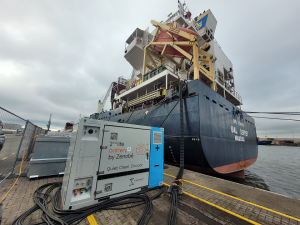
What OPS / Shore-Side Electricity is, and why it matters in Italy
OPS (also called shore-side electricity or cold ironing) lets ships switch off their onboard generators while berthed and use electricity from the shore instead. This powers onboard needs such as lighting, air conditioning, galleys, refrigeration, and cargo equipment. In Italy, this is especially important because many large ports—like Genoa, Naples, Venice, Civitavecchia, and Palermo—are very close to city centers. Emissions from ships at berth contribute to local air pollution, noise, and public health concerns. As a result, there is strong political and regulatory pressure to reduce these emissions, making OPS a priority solution.
–
Policy and compliance framework (EU and Italy)
EU rules that make OPS effectively mandatory
Two EU regulations are driving OPS adoption:
-
AFIR (Alternative Fuels Infrastructure Regulation)
Requires major TEN-T ports to install shore-side electricity infrastructure. -
FuelEU Maritime
From 2030, large container and passenger ships (including cruise ships) calling at key EU ports must use OPS, with limited exemptions.
What this means for Italy:
Many Italian ports are part of the TEN-T network. They must install OPS, and shipping companies must be ready to connect by 2030. This forces early coordination between ports and ship operators on standards, capacity, and timelines.
Italy’s national funding push
Italy has launched a large-scale “National Cold Ironing Plan” (2021–2026) with about €755 million in funding, most of it public. Around 50 ports are included. OPS is also part of the broader PNRR / Italia Domani investment program, aligning port electrification with national decarbonisation goals.
Incentives to ensure ships actually plug in
A common global problem is that ports build OPS, but ships avoid using it because shore power can cost more than onboard fuel. To address this, Italy introduced a €570 million state aid scheme, approved by the EU, to reduce the operating cost for shipowners who connect to shore power. This is critical to achieving real emissions reductions, not just installed infrastructure.
–
What an OPS system actually includes
OPS is not just a socket on the quay—it’s a full electrical system linking the national grid to the ship.
Grid connection and substations
Most OPS installations require a medium- or high-voltage connection from the local grid, plus a dedicated port substation. For cruise and ferry terminals, redundancy is often required to ensure reliability. Key technical work includes grid studies, protection coordination, and securing sufficient capacity from the utility.
Voltage and frequency conversion
Ships typically connect at:
- High voltage (6.6 or 11 kV) for large vessels
- Low voltage (400 V) for smaller ships
Italy’s grid operates at 50 Hz, while some ships need 60 Hz. In those cases, frequency converters are required, adding cost and complexity.
Quay-side equipment
At the berth, ports install switchgear, safety systems, and cable management solutions (reels, cranes, or gantries). Safe connection and disconnection procedures are essential and tightly controlled.
Ship-side readiness
Ships must be equipped to receive shore power, including electrical interfaces, protection systems, and automation. Retrofitting can be expensive and is often the main bottleneck. In Italy, port infrastructure is sometimes progressing faster than fleet retrofits, so ports must prioritise berths based on the types of ships that are actually ready to connect.
–
How big does OPS need to be?
Required power depends heavily on vessel type:
- Cruise ships: highest demand, often several megawatts and sometimes over 10 MW
- Ferries (Ro-Pax): medium demand but frequent, predictable use
- Container ships: moderate per ship, but many calls and possible simultaneous connections
Good design avoids simply sizing for worst-case scenarios. Instead, ports should consider real call schedules, seasonal demand, and how quickly OPS usage will ramp up.
–
Who is involved and how projects are delivered
Key stakeholders include port authorities, terminal operators, grid companies, shipowners, technology suppliers, and national regulators. Common delivery models range from traditional EPC contracts to private build-and-operate schemes, or hybrid models where utilities own upstream assets and ports own berth equipment.
–
Economics: why some OPS projects work and others don’t
OPS success depends on three linked factors:
- Capital cost: substations, converters, civil works, and ship retrofits
- Operating cost: especially the price of electricity versus marine fuel
- Utilisation: how many ships actually connect
If utilisation is low, the business case collapses. This is why Italy’s combination of mandates and operating incentives is so important.
–
OPS rollout in Italy today
Italy is pursuing OPS (often called cold ironing in Italian public documents) through a two-track funding and delivery architecture:
-
PNC (Piano Nazionale Complementare) — “programmi sinergici e complementari”: a large portfolio of port electrification projects financed under the national complementary plan (not strictly the EU grant component). The flagship implementing act is DM 330 / 13 Aug 2021, which lists many site-specific cold ironing projects with CUP codes and budgets.
-
PNRR (Recovery and Resilience Facility) — M3C2 Investment 2.3 “Cold ironing”: a portfolio aligned to EU milestones/targets. Parliamentary monitoring documents summarize that the MIT/MEF allocations resulted in 24 OPS plants across 16 ports, and that contracts have been awarded (with the milestone exceeded).
Additionally, the MIT has publicly stated that the integrated PNC+PNRR effort totals ~€922m, with ~50 projects in 39 Italian ports “currently underway,” and it has identified a “first wave” of ports declaring they can meet the March 2026 operational target for at least part of the national network.
What “status” means in the Italian rollout (practically)
Because Italian OPS projects are implemented by multiple Port System Authorities and often depend on grid connection works, it helps to distinguish four concrete “deployment states”:
- A. “Operational / on track for T1 2026” (politically/administratively declared feasible for energization by the target date; not always the same as already in service).
- B. “Contracts awarded” (PNRR milestone): procurement completed (award effective / contracts signed), but civil works, substations and commissioning may still be ongoing.
- C. “Financed / programmed (PNC DM 330 list)”: formally admitted and funded with a CUP and budget; delivery stage depends on each port’s tendering and grid interface.
- D. “Added later to the portfolio”: ports brought into the program via subsequent ministerial acts (e.g., additional eligible interventions).
Master map — all Italian ports explicitly evidenced as having OPS plants awarded (PNRR), financed/programmed (PNC), and/or publicly declared on track for the T1 2026 target
Legend (columns):
- PNRR (plants) = number of OPS plants reported as already awarded under the PNRR cold ironing investment monitoring.
- PNC (DM330 budget) = budgeted cold ironing intervention(s) explicitly listed in the DM330 portfolio.
- T1 2026 “on track” = ports the MIT (via Rixi interview) said have declared achievement of the target; and the set of ports identified as “new PNRR-funded” / migrated projects.
Note: Many ports appear in both PNRR and PNC streams; the table preserves what is explicitly evidenced in the cited sources.
| Port (Italy) | Basin (indicative) | PNRR (plants) | PNC (DM330 budget / project label) | T1 2026 “on track” signal |
|---|---|---|---|---|
| Porto di Genova | Ligurian | 1 | — | Identified as a new PNRR-funded intervention; financing referenced (~€32m) |
| Porto di Pozzallo | Sicily | 1 | — | Listed among the “new PNRR” interventions in start-up phase |
| Porto di Palermo | Sicily | 1 | €30.0m “Cold ironing Porto di Palermo” | Listed as a new PNRR-funded intervention in start-up phase |
| Porto di Piombino | Tyrrhenian | 1 | — | Declared among ports that have reached the target feasibility set |
| Porto di Portoferraio | Tyrrhenian | 1 | €2.5m “Cold ironing porto di Portoferraio” | Declared among ports that have reached the target feasibility set |
| Porto di Venezia | Adriatic | 3 | €62.0m “Elettrificazione delle banchine di Venezia” | Declared among ports that have reached the target feasibility set |
| Porto di Gioia Tauro | Tyrrhenian | 2 | Added as eligible intervention via later ministerial act | Declared among ports that have reached the target feasibility set |
| Porto della Spezia | Ligurian | 1 | €41.0m “Stazioni di Cold Ironing nel porto di La Spezia” | Declared among ports that have reached the target feasibility set |
| Porto di Trieste | Adriatic | 4 | €8.0m “Elettrificazione banchine del molo VII” | Declared among ports that have reached the target feasibility set |
| Porto di Monfalcone | Adriatic | 1 | €2.0m “Cold ironing nel porto di Monfalcone” | Declared among ports that have reached the target feasibility set |
| Porto di Ravenna | Adriatic | 1 | €17.68m “Porto Corsini… stazione cold ironing a servizio del Terminal crociere” | Declared among ports that have reached the target feasibility set |
| Porto di Ancona | Adriatic | 1 | €20.0m “Elettrificazione delle banchine nel porto di Ancona” | Declared among ports that have reached the target feasibility set |
| Porto di Ortona | Adriatic | 3 | — | Declared among ports that have reached the target feasibility set |
| Porto di Pesaro | Adriatic | 1 | — | Identified as an “impresa migrated from PNC” (smaller dimension) |
| Porto di Pescara | Adriatic | 1 | — | Identified as an “impresa migrated from PNC” (smaller dimension) |
| Porto di San Benedetto del Tronto | Adriatic | 1 | — | Identified as an “impresa migrated from PNC” (smaller dimension) |
| Porto di Livorno | Tyrrhenian | — | €30.0m “Cold ironing porto di Livorno” | — |
| Porto di Civitavecchia | Tyrrhenian | — | €81.81m “Elettrificazione banchine… Porto di Civitavecchia” | — |
| Porto di Napoli | Tyrrhenian | — | €25.0m “Cold ironing nel Porto di Napoli” | — |
| Porto di Salerno | Tyrrhenian | — | €35.0m “Cold ironing porto di Salerno” | — |
| Porto di Bari | Adriatic | — | €30.0m “Elettrificazione banchine (Cold ironing) porto di Bari” | — |
| Porto di Brindisi | Adriatic | — | €15.8m “Elettrificazione banchine (Cold ironing) porto di Brindisi” | — |
| Porto di Taranto | Ionian | — | €35.4m “Elettrificazione banchine (Cold ironing) porto di Taranto” | — |
| Porto di Catania | Sicily | — | €15.0m “Cold ironing porto di Catania” | — |
| Porto di Augusta | Sicily | — | €20.0m “Cold ironing porto di Augusta” | — |
| Porto di Chioggia | Adriatic | — | €15.0m “Cold ironing porto di Chioggia” | — |
| Porto Torres | Sardinia | — | €3.0m “Cold ironing porto di Porto Torres” | — |
| Porto di Golfo Aranci | Sardinia | — | €1.75m “Cold ironing porto di Golfo Aranci” | — |
| Porto di Oristano | Sardinia | — | €2.0m “Cold ironing porto di Oristano” | — |
| Porto di Cagliari | Sardinia | — | €12.0m “Cold ironing porto di Cagliari” | — |
| Porto di Olbia | Sardinia | — | €17.0m “Cold ironing porto di Olbia” | — |
| Porto di Arbatax | Sardinia | — | €3.5m “Cold ironing porto di Arbatax” | — |
| Porto Empedocle | Sicily | — | €2.0m “Cold ironing porto di Porto Empedocle” | — |
| Porto di Trapani | Sicily | — | €3.5m “Cold ironing porto di Trapani” | — |
| Porto di Messina | Strait of Messina | — | Part of €10.0m multi-site “Adeguamento/realizzazione stazioni cold ironing” | — |
| Porto di Milazzo | Sicily | — | Part of €10.0m multi-site “Adeguamento/realizzazione stazioni cold ironing” | — |
| Porto di Tremestieri | Strait of Messina | — | €6.0m “Struttura… nel porto di Tremestieri” (cold ironing enabling works) | — |
| Porto di Reggio Calabria | Strait of Messina | — | €6.0m “Sistema cold ironing… e miglioramento efficienza energetica” + €2.0m “Banchine 3–4” | — |
| Saline Joniche | Ionian | — | €4.0m “Cold ironing nel porto di Saline Joniche” | — |
| Porto di Crotone | Ionian | — | €4.0m “Cold ironing nel porto di Crotone” | — |
| Porto di Villa San Giovanni | Strait of Messina | — | €5.0m “Cold ironing porto di Villa San Giovanni” | — |
| Porto di Termoli | Adriatic | — | Added as eligible intervention via later ministerial act | — |
What this table implies (without over-claiming):
-
PNRR evidence clearly identifies 16 ports with 24 OPS plants already in the “awarded/contracted” state.
-
PNC evidence (DM330 portfolio) enumerates a broader set of ports with CUP-backed budgets, spanning major cruise/ferry hubs, container ports, and several medium ports (including Sardinia and the Strait of Messina system).
-
A political/administrative “first wave to energization” by T1 2026 was explicitly named (10 ports), while other ports were described as in procurement start-up or migrated from PNC for the smaller PNRR set.
“First wave” ports publicly declared on track for energization by March 2026 (T1 2026 target framing)
In the cited MIT/vice-minister statement, the ports that “declared achievement of the target” were:
-
Gioia Tauro, Venezia, Ravenna, Piombino, Portoferraio, La Spezia, Monfalcone, Trieste, Ancona, Ortona.
And it also named:
-
Genova, Palermo, Pozzallo as new PNRR-funded interventions still in start-up procedures; plus Pescara, Pesaro, San Benedetto del Tronto as smaller plants “migrated” from PNC.
This is important because it indicates Italy’s strategy for compliance: bring a minimum network online early (to secure the PNRR target), while the wider PNC portfolio continues through civil works, grid upgrades, and operational contracting.
Practical examples of what “OPS deployment” looks like across Italian port types (pattern-level, consistent with the project lists)
Even without port-by-port engineering drawings, the Italian project portfolio (PNRR + PNC) shows a repeatable set of deployment patterns:
1) Cruise terminals (high hotel load; HV shore connection, often multiple berths):
Examples strongly suggested by the portfolio include Venice and Ravenna/Porto Corsini (explicitly tied to a cruise terminal in the PNC list).
2) Ferry / Ro-Pax hubs (repetitive calls, predictable load, strong air-quality benefit near urban cores):
The PNC list contains multiple Strait of Messina and Southern passenger nodes (e.g., Villa San Giovanni, Reggio Calabria system).
3) Container / Ro-Ro gateways (high power, but operational integration is more complex):
The PNRR set includes Genoa and Gioia Tauro, both of which typically imply large terminal electrical demand and tight interface with yard operations; Genoa is explicitly flagged as strategically significant and PNRR-financed.
4) Islands and medium ports (right-sized solutions, often 1 plant per port in the PNRR reporting):
Ports like Portoferraio and several Adriatic medium ports appear as single-plant sites under PNRR monitoring.
Key takeaway for “coverage of all Italian ports with OPS / SSE”
Using only the explicitly evidenced public sources above, Italy’s OPS landscape can be stated conservatively as:
- At least 16 ports have OPS plants already awarded under the PNRR cold ironing investment (24 plants total).
- A broader set of ports (dozens) have OPS projects formally financed and programmed under the PNC DM330 portfolio with defined CUPs and budgets.
- The MIT has framed the combined national effort as ~50 projects in 39 ports, with a defined subset prioritized for early energization by March 2026.
–
Key risks and how ports manage them
The biggest risks include delays in grid upgrades, mismatches between port systems and ship capabilities, and low connection rates. Mitigation measures include early engagement with grid operators, phased deployment, standardisation by vessel type, and linking port tariffs or concessions to OPS usage.
–
A practical roadmap for an Italian port
A typical OPS program follows this sequence:
Start by identifying priority berths based on emissions impact and ship readiness. Secure grid capacity early. Develop a clear technical concept (voltage, frequency, redundancy). Align stakeholders and permits, then procure construction with clear performance requirements. Finally, commission carefully and scale up usage over time.