
Learn ARPA CPA and TCPA meaning and practical watchkeeping use. Understand collision risk prediction, limitations, and real bridge decision-making techniques.
A deck officer standing the midnight watch often faces one of the most complex cognitive tasks in transport: predicting the future movement of multiple vessels using limited visual information. The sea is dark, the horizon is invisible, and traffic may be dense. In this environment, ARPA CPA and TCPA values become critical decision-support tools. They help the officer estimate how close another vessel will pass and how soon that encounter will occur.
However, CPA and TCPA are often misunderstood. Some officers treat them as absolute safety indicators, while experienced navigators understand them as dynamic predictions that must be continuously verified. This article explains CPA and TCPA in practical, real-world navigation terms, helping maritime professionals understand how to use them effectively during watchkeeping.
Why This Topic Matters for Maritime Operations
Correct interpretation of CPA and TCPA directly affects collision avoidance decision-making. Many collision investigations reveal that CPA and TCPA were available but misinterpreted, delayed, or trusted without verification. Proper understanding improves situational awareness and supports safe compliance with collision regulations.
The Core Meaning of CPA and TCPA
What Is CPA (Closest Point of Approach)?
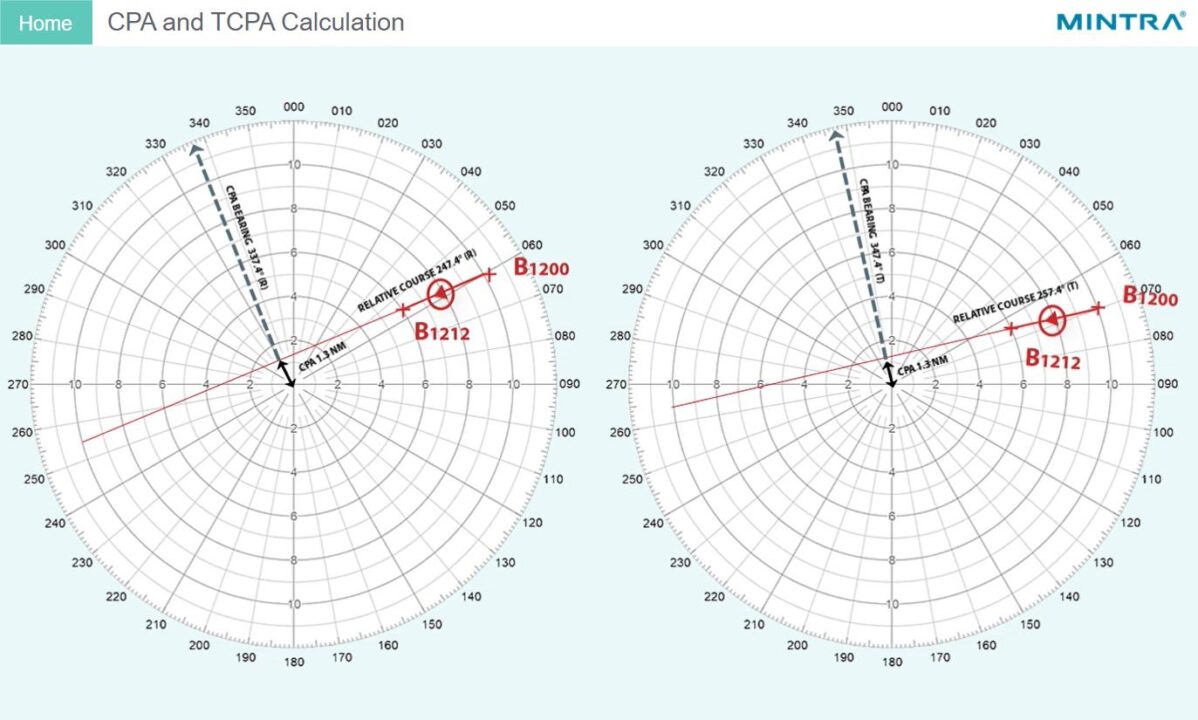
CPA represents the predicted minimum distance between two vessels if both maintain their current course and speed. It is essentially a forecast of the closest passing distance under constant motion conditions.
From a practical perspective, CPA answers the question: “How close will this vessel come if nobody changes anything?”
CPA is usually displayed in nautical miles. Company procedures often specify minimum acceptable CPA limits depending on vessel size, speed, and navigation area.
What Is TCPA (Time to Closest Point of Approach)?
TCPA represents the predicted time remaining before reaching the closest point of approach. It answers the question: “How soon will this closest approach happen?”
TCPA is usually displayed in minutes. Short TCPA values require faster decision-making and may indicate immediate collision risk if CPA is small.
Understanding CPA and TCPA Together
CPA and TCPA must always be interpreted together. A safe CPA occurring in a very short time may still require action if manoeuvring time is limited. Conversely, a small CPA far in the future may allow gradual course adjustments.
How ARPA Calculates CPA and TCPA
Radar Tracking Data Collection
ARPA calculates CPA and TCPA by analysing repeated radar measurements of target range and bearing. By comparing target position across multiple radar scans, ARPA determines relative movement.
Relative Motion Mathematics Simplified
ARPA uses vector mathematics to calculate future positions. Although the calculation is complex, the concept is simple: it predicts where two moving points will be relative to each other over time.
Importance of Stable Tracking Data
CPA and TCPA accuracy improves as tracking data stabilises. Immediately after acquisition, predictions may fluctuate. Officers should allow time for stable tracking before making major navigation decisions.
Practical Use of CPA and TCPA on Watch
Early Risk Detection
CPA and TCPA allow early identification of collision risk long before visual confirmation is possible. Early detection provides time for safe, controlled manoeuvring.
Prioritising Targets
When multiple targets are present, CPA and TCPA help officers prioritise attention. Targets with decreasing CPA and reducing TCPA typically require immediate monitoring.
Supporting COLREGs Decision-Making
CPA and TCPA help confirm risk of collision but do not replace visual assessment or COLREGs interpretation. Officers must still evaluate target aspect, navigation lights, and relative bearing change.
CPA and TCPA Limitations Every Watchkeeper Must Know
Assumption of Constant Course and Speed
CPA and TCPA assume both vessels maintain constant motion. If either vessel alters course or speed, predictions immediately change.
Sensor Input Errors
Incorrect gyro heading or speed log data can create incorrect CPA and TCPA values. Cross-checking with visual observation and AIS is essential.
Tracking Loss and Clutter Effects
Heavy rain, sea clutter, or overlapping targets may reduce tracking quality and affect prediction accuracy.
–
Challenges and Practical Solutions
One common operational challenge occurs when officers rely on CPA alarms without monitoring target behaviour. CPA alarms are useful but should never replace continuous radar observation.
Another challenge involves interpreting CPA values in confined waters. In narrow channels, safe CPA may be smaller than open sea standards. Officers must apply professional judgement based on navigation context.
Fatigue can also reduce attention to CPA trend changes. Experienced officers monitor whether CPA is increasing or decreasing rather than focusing only on the current number.
–
Case Studies and Real-World Applications
Accident investigation reports from major maritime authorities repeatedly highlight situations where CPA values were considered safe, but TCPA was short, leaving insufficient manoeuvring time. In other cases, officers reacted too late because they expected CPA to remain constant while target behaviour changed.
Successful collision avoidance cases often show early course adjustments when CPA begins to reduce, rather than waiting until minimum limits are reached.
STCW Competence and Professional Practice
STCW requires officers to demonstrate competence in interpreting ARPA information including CPA and TCPA. Simulator training often includes scenarios where CPA and TCPA fluctuate rapidly, teaching officers to interpret trends rather than isolated values.
–
Future Trends in Collision Prediction Technology
Future bridge systems may combine ARPA data with AI traffic prediction models and big data traffic pattern analysis. These systems could provide earlier warnings of collision risk.
However, professional interpretation will remain essential. Automation supports but does not replace navigational judgement.
–
Frequently Asked Questions
What is considered a safe CPA at sea?
It depends on company policy, vessel size, speed, and traffic density. Many companies use 1–2 nautical miles as a guideline in open sea.
Why does TCPA sometimes increase suddenly?
Target course or speed change can alter predicted encounter timing.
Should action be taken only when CPA alarm activates?
No. Early action based on trend analysis is safer.
Can CPA be zero without collision?
Yes. Vertical separation or passing astern with timing difference may occur.
Is TCPA important if CPA is large?
Yes. Long-term traffic planning still depends on encounter timing.
Does ARPA always calculate CPA correctly?
Accuracy depends on sensor input quality and tracking stability.
–
Conclusion and Key Takeaways
CPA and TCPA are powerful predictive tools that support safe watchkeeping when properly understood. They provide early warning of collision risk, support traffic prioritisation, and enhance situational awareness. However, they must always be interpreted alongside radar observation, visual lookout, AIS data, and professional judgement.
Navigators who understand CPA and TCPA behaviour, limitations, and trends will make safer, earlier, and more confident collision avoidance decisions. Continuous training and real-world practice remain essential for mastering these critical ARPA tools.
–
References
International Maritime Organization (IMO). STCW Convention and Code.
International Maritime Organization (IMO). COLREGs Convention.
International Chamber of Shipping (ICS). Bridge Procedures Guide.
Marine Accident Investigation Branch (MAIB). Collision investigation reports.
United States Coast Guard (USCG). Navigation circulars and radar safety guidance.
Bowditch, N. American Practical Navigator.
DNV. Bridge human factors and navigation safety publications.
Lloyd’s Register. Bridge equipment performance research.
Marine Technology News. Radar and ARPA technology articles.
Maritime Reporter & Engineering News. Navigation technology updates.