
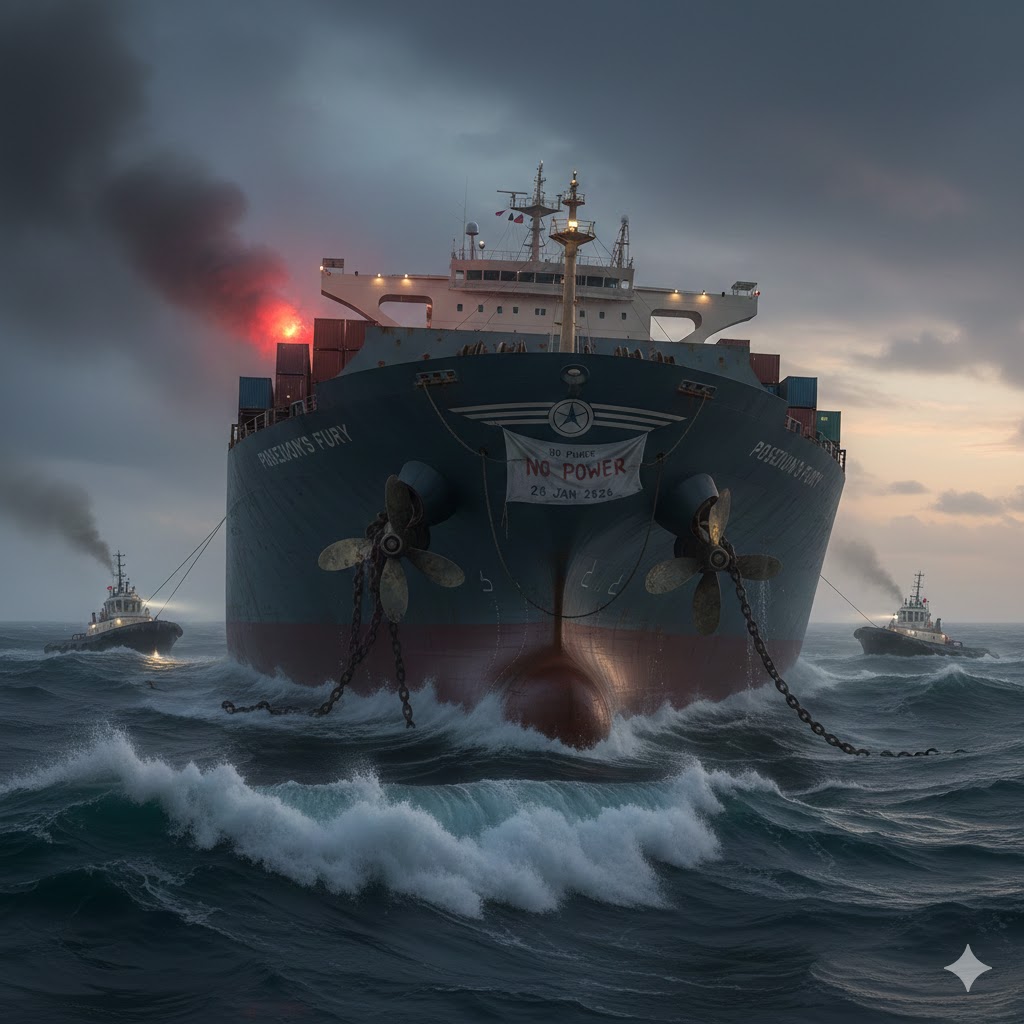
Learn the difference between engine failure and loss of propulsion, with real ship examples, common causes, and practical prevention tips for seafarers.
A ship is approaching a pilot station in rising wind. The bridge team is focused: traffic, shallow water, tugs on standby. Then the RPM drops—or maybe it doesn’t, but the speed still falls away. The master hears the phrase no one wants to hear: “We’ve lost propulsion.”
In everyday speech, people often treat engine failure and loss of propulsion as the same thing. In professional maritime operations, they are not the same—and confusing them can slow down the response, complicate troubleshooting, and even distort casualty reporting and lessons learned.
This article explains the difference in plain, global English, using real-world scenarios from investigation bodies and industry guidance. The goal is practical: help cadets, engineers, deck officers, and maritime managers describe what is happening accurately, respond faster, and reduce repeat incidents.
Loss of propulsion is one of the most time-critical hazards at sea because it removes your ability to control where the ship will go next. In congested waters, near shore, or during heavy weather, a vessel without propulsion can drift into collision, grounding, or structural damage. Industry risk reviews repeatedly show that machinery damage and failure are frequent drivers behind shipping incidents, meaning the “engine room story” is often the beginning of the accident chain.
–
The Core Difference in One Sentence
Engine failure is a failure inside the engine or its essential subsystems that prevents it from producing the required power.
Loss of propulsion is a wider operational outcome: the ship cannot generate effective thrust (ahead/astern as required), even if the engine is still running.
Think of it like this: the engine is the heart, but propulsion is the whole “movement system”—heart, arteries, nerves, and muscles. A heart problem can stop you moving, but you can also lose movement because of nerve damage or a broken leg even if your heart is fine.
Definitions That Match How the Industry Talks
What “Engine Failure” Usually Means Onboard
Onboard, engineers typically use “engine failure” when the main engine (or a propulsion prime mover such as a diesel engine or gas turbine) cannot deliver power due to internal mechanical, thermal, lubrication, fuel, air, or control-related breakdown.
That failure can be sudden (catastrophic) or progressive (degrading performance until shutdown). In investigations, catastrophic engine failure is often described as a sudden and total failure from which recovery is impossible in that moment.
What “Loss of Propulsion” Means in Practice
“Loss of propulsion” is what the bridge feels: no effective thrust. The ship may be dead in the water, or it may have partial propulsion (limited RPM, limited pitch, only one shaft, or only ahead but not astern). It often comes with secondary effects such as loss of steering when the electrical network collapses (blackout).
The important detail: loss of propulsion can occur without engine failure, for example:
-
The engine runs, but the controllable pitch propeller (CPP) pitch is stuck at zero.
-
The engine runs, but the clutch/gearbox does not transmit torque to the shaft.
-
The engine runs, but the shaft line is damaged or the propeller is fouled.
-
The engine runs, but automation limits load (derating) so severely that the ship can’t maintain steerageway.
Why Accident Investigators Keep the Language Precise
Accident investigators and insurers need consistent terminology so statistics remain meaningful and lessons can be shared across fleets. International investigation frameworks emphasise separating the initiating failure (“what broke first”) from the operational outcome (“what happened to the vessel”).
–
Quick Comparison
Here’s the cleanest operational way to separate the two terms (short and simple—because that’s how you need it during an emergency):
-
Engine failure: The prime mover cannot deliver required power (or trips/shuts down).
-
Loss of propulsion: The vessel cannot produce required thrust (ahead/astern), regardless of whether the engine is running.
A main engine failure often causes loss of propulsion. But a ship can lose propulsion with a perfectly healthy engine if the failure is elsewhere in the propulsion train or power system.
–
Where Loss of Propulsion Comes From (Even When the Engine Is Healthy)
This is where many crews get caught: they troubleshoot the engine because propulsion is lost, but the engine is not the real problem. Below are the most common “non-engine” routes to loss of propulsion, explained in narrative form.
Power System Failure and Blackout: The Silent Shutdown
A blackout is not just “the lights went out.” It can stop pumps, fans, control air compressors, fuel treatment, lubricating oil systems, and the automation that allows propulsion control to function. Blackout events frequently cause loss of propulsion and may also remove steering and key navigation support systems.
Key point: If the ship loses propulsion and multiple systems fail at the same time (fans, pumps, alarms, lighting), treat it as a power-distribution event first, not an engine-only event.
Gearbox, Clutch, and Shaftline Failures: Power Exists, But It Doesn’t Reach the Sea
In many propulsion arrangements, the engine’s power passes through a reduction gearbox and clutch before turning the propeller shaft. If the clutch slips, the gearbox fails, or the shaft coupling shears, the engine may still run “normally,” but the propeller does not receive torque. The bridge sees loss of speed and response; the engine room sees RPM but little or no propeller load.
This is a classic confusion trap, especially on vessels where engine sound and RPM are used informally as a proxy for propulsion.
Controllable Pitch Propeller (CPP) Malfunctions: RPM Without Thrust
CPP systems are excellent for maneuvering efficiency, but they add hydraulic and control complexity. A CPP pitch failure can leave the engine running at commanded RPM while blade pitch remains at zero—or remains stuck in an unsafe pitch range. You can have “engine available” but “no propulsion.”
In practical terms, it’s like a bicycle where you can pedal, but the chain has slipped off: your legs move, but the wheel does not.
Propeller and Thruster Problems: The Sea Itself Becomes the Failure Mode
A ship can lose propulsion because the propeller cannot generate thrust effectively. This may be due to rope or fishing net entanglement, ice ingestion, debris damage, severe cavitation damage, or heavy fouling that reduces speed so much that steerageway is lost.
In these cases, the engine can still be technically healthy, but the ship’s effective propulsion capability is impaired.
Automation Limits and Protective Trips: “The Ship Is Protecting Itself”
Modern engines are heavily protected by automation. Sometimes, propulsion is “lost” because the system is preventing damage:
-
Low lubricating oil pressure causes an automatic slow-down or shutdown
-
High exhaust temperature triggers load reduction
-
Scavenge fire detection causes protective actions
-
Failure of critical auxiliaries forces the control system into safe mode
From a safety engineering perspective, this is good. From a navigation perspective, it can look like an engine failure when it is actually a controlled protective limitation.
–
Engine Failure: The Major Categories That Matter at Sea
When the engine itself is the source, the best troubleshooting starts by thinking in systems rather than individual parts.
Fuel System Failures: The Most Common “Sudden Power Loss” Story
A main engine can lose power because fuel is not reaching the injectors correctly, or because it arrives contaminated or at the wrong viscosity. The chain can begin with a purifier upset, clogged filters, a fuel pump fault, or water ingress. Fuel problems often give warning—unstable RPM, misfiring, unusual exhaust smoke—before the engine trips or requires shutdown.
Lubrication Failures: Small Pressure Drops, Big Consequences
Low lubricating oil pressure can destroy bearings quickly. Modern engines therefore protect themselves with alarms, slow-down, and shutdown. This can turn an initially small defect (leak, pump wear, clogged strainer) into sudden loss of propulsion if protective shutdown occurs.
Cooling Failures: The Engine Overheats and Protects Itself
Cooling system issues can include seawater pump problems, fouled coolers, stuck thermostatic valves, or air locks. Many of these do not “break the engine” instantly—but they force a controlled reduction in load or shutdown, which is still a loss of propulsion outcome for the bridge.
Mechanical Failures: From Progressive Damage to Catastrophic Events
Mechanical failures include piston seizure, connecting rod damage, crankcase issues, turbocharger failure, and bearing collapse. In serious cases, the engine may be unable to restart or continue running safely, creating an immediate propulsion emergency.
–
Why People Confuse These Two Terms (And Why It Matters)
Because the Consequence Looks the Same From the Bridge
From the bridge, the ship is no longer responding. Whether the prime mover is dead or the CPP pitch is stuck, the master’s immediate risk picture is similar: drifting, collision risk, grounding risk.
Because Good Reporting Needs “First Failure” and “Outcome”
For safe learning, you want both:
-
First failure (engine, electrical distribution, CPP control, gearbox, human action)
-
Outcome (loss of propulsion, blackout, loss of steering, grounding, collision)
This structure helps companies and regulators prevent repeat incidents.
Because Safety Statistics Use Broad Categories
Many industry datasets use broad categories such as “machinery damage/failure.” This makes sense for risk modelling, but it can blur operational language onboard unless crews deliberately keep definitions clear.
–
Principles and Applications That Help Crews Respond Faster
The “Two-Question Drill” for the First Minute
When propulsion drops unexpectedly, train teams (bridge + engine room) to answer two questions immediately:
-
Is the engine still running and controllable?
-
Is thrust actually being produced?
This forces separation between engine status and propulsion outcome. It also guides the next action: do you stabilise the electrical plant, restore pitch control, reconnect a clutch, or troubleshoot fuel and lubrication?
Blackout Recovery as a Propulsion Safety Skill
Blackout recovery is not only an electrical exercise. It is a propulsion survival skill:
-
Restore power to essential auxiliaries first
-
Confirm steering availability
-
Rebuild propulsion control availability systematically
-
Communicate clearly between bridge and engine room about capability and limitations
Redundancy Thinking: One Failure Should Not Remove All Thrust
On many modern ships, system redundancy and segregation are designed so that a single failure does not remove all propulsion capability. Even on conventional cargo ships, redundancy exists in practical form (multiple generators, cross-connected cooling, alternative pumps). The operational skill is knowing how to reconfigure quickly without creating secondary problems.
–
Challenges and Practical Solutions
A recurring challenge is that propulsion-loss events often come from “quiet” weaknesses: maintenance routines that drift, alarms that are acknowledged but not investigated, filters changed late, or crew unfamiliarity with recovery procedures. The technical failure is only part of the story; the safety culture and training environment decide whether a defect becomes an emergency.
A practical solution is to treat loss of propulsion as a bridge-and-engine-room drill scenario, not an engineering-only checklist. Include realistic constraints: reduced visibility, high traffic density, heavy weather, or pilotage. Pair technical recovery steps with navigation risk control: immediate drift assessment, anchoring readiness, tug communication, VTS contact where applicable, and clear broadcasting of restricted manoeuvrability status when required.
Another solution is to use structured guidance from class, flag, and insurers that translates propulsion-loss incidents into preventive actions. These publications often focus on power management, maintenance discipline, and realistic testing of changeover and recovery procedures.
Finally, keep reporting culture healthy. Many maritime administrations provide clear guidance on reporting casualties and incidents. When near misses are reported properly, companies can fix weak signals before they become serious events.
–
Case Studies and Real-World Applications
Case Study 1: Catastrophic Engine Failure Leading to Immediate Emergency
In a documented ro-ro passenger ferry case, a catastrophic failure of a propulsion engine escalated into a combined emergency: propulsion loss plus fire response and personnel safety risks. The key lesson is that when failure is catastrophic, restoration may be impossible in the short term. The bridge response must shift quickly from “restore propulsion” to “control the ship without propulsion” using anchors, tugs, traffic coordination, and emergency navigation procedures.
Case Study 2: Loss of Propulsion as a Navigational Crisis (Not Always a Broken Engine)
A dedicated investigation into a passenger ro-ro loss of propulsion shows the same theme: the bridge must manage drift risk first, even while engineers troubleshoot. “Loss of propulsion” is the correct operational term because it describes the condition that drives decisions, regardless of the technical cause.
Case Study 3: Blackouts and Propulsion Loss as a Fleet Risk Theme
Industry safety guidance often highlights blackout-driven propulsion loss as a recurring risk theme, especially for ships with complex electrical loads. Prevention and recovery planning—both technical and procedural—are repeated priorities because time without propulsion near hazards is extremely unforgiving.
FAQ Section
1) Is engine failure always the same as loss of propulsion?
No. Engine failure is one cause. Loss of propulsion can also happen due to blackout, gearbox/clutch failure, CPP issues, shaft damage, or propeller problems—even if the engine runs.
2) Can a ship have loss of propulsion while the engine is running?
Yes. Common examples are CPP pitch stuck at zero, clutch disengaged, gearbox failure, or shaft/propeller damage.
3) Why do blackouts often lead to loss of propulsion?
Because propulsion depends on electrical power for control systems and essential auxiliaries. When the ship loses power, the systems needed to create and control thrust may also stop.
4) How do investigators normally describe these events?
They separate the initiating technical failure from the operational consequences (loss of propulsion, loss of steering, grounding, collision). This makes prevention more effective.
5) What is the fastest onboard way to tell the difference?
Ask: “Is the engine running and controllable?” and “Is thrust being produced?” If RPM is present but speed response is missing, suspect propulsion-train or control issues first.
6) What should the bridge do first after loss of propulsion?
Treat it as a navigational emergency: assess drift risk, communicate with engine room, prepare anchors/tugs, alert relevant traffic services, and manage collision/grounding risk while recovery proceeds.
7) What reduces the risk of propulsion loss the most?
Strong preventive maintenance, disciplined power management, realistic drills, and clear communication between bridge and engine room—especially during manoeuvring and heavy weather.
Conclusion /Future Outlook and Maritime Trends
The difference between engine failure and loss of propulsion is not just vocabulary—it changes how you troubleshoot, how you communicate under pressure, and how you prevent repeat incidents. Engine failure is a prime-mover problem. Loss of propulsion is the broader operational outcome: no effective thrust, for any reason.
The safest crews train themselves to separate cause from consequence in the first minute. They stabilise risk on the bridge while the engine room targets the correct system—engine, electrical plant, pitch control, gearbox, or shaftline. If you want one practical habit to adopt this week, make it this: during drills and toolbox talks, stop saying “engine failure” when you mean “loss of propulsion.” Precision in language leads to precision in action.
If this topic is relevant to your role, consider adding a short “propulsion loss scenario” to your next onboard drill—built around the two questions that separate engine status from thrust status.
The future will likely make the engine/propulsion distinction even more important. Hybrid-electric drives, battery integration, alternative fuels, and advanced automation expand the number of ways propulsion can be lost without an “engine failure” in the traditional sense.
At the same time, industry risk reviews continue to emphasise the high share of incidents linked to machinery and technical failures. This reinforces a practical reality: propulsion reliability remains central to maritime safety performance.
Digital tools will help: condition monitoring, vibration analytics, oil analysis, and power quality monitoring can detect degradation earlier. But technology is only as effective as the crew culture around it. If alarms are ignored or maintenance deferrals become routine, the ship will still lose propulsion—only with more complicated systems to troubleshoot.
–
References (APA Style)
Allianz Commercial. (2025). Safety and Shipping Review 2025 (PDF report). https://www.allianz.com
Allianz Commercial. (2024). Safety and Shipping Review 2024 (PDF report). https://www.allianz.com
American Bureau of Shipping (ABS). (2024). Blackout awareness and prevention on ships (Advisory PDF). https://ww2.eagle.org
DNV. (n.d.). Managing the risk of blackouts (and resulting loss of propulsion). https://www.dnv.com
DNV. (2024). Blackouts—causes, prevention, effective recovery (news/insights). https://www.dnv.com
International Maritime Organization (IMO). (2008). Casualty Investigation Code, Res. MSC.255(84). https://www.imo.org
International Maritime Organization (IMO). (2016). In-the-field job aid for investigators (PDF). https://www.imo.org
Marine Accident Investigation Branch (MAIB). (2018). Catastrophic engine failure and fire on board ro-ro passenger ferry Wight Sky (Report page). https://www.gov.uk/maib
Marine Accident Investigation Branch (MAIB). (2022). Wight Sky—Serious Marine Casualty Investigation Report (PDF). https://www.gov.uk/maib
Marine Casualty Investigation Board (Ireland). (2003). Report on the loss of propulsion on board the passenger ro-ro motor vessel Stena Europe (PDF). https://www.mcib.ie
Bureau Veritas / London P&I. (2012). Reducing the risk of propulsion loss (Guidance booklet PDF). https://www.bv.com